When you click on links to various merchants on this site and make a purchase, this can result in this site earning a commission. Affiliate programs and affiliations include, but are not limited to, the eBay Partner Network.
With most of the tough and dirty work behind me, I thought it would be great to start a thread on my car to summarize everything that has been done and what’s still in progress. After all, these cars are never truly finished, right? I also want to thank everyone for the support you’ve given me on various issues in other threads. I’m grateful to be part of such a friendly, supportive, and respectful community and definitely don’t take it for granted.
Since I was a kid, I’ve always dreamed of owning a red Corvette C3—the model with the plastic bumpers. That, to me, was the Corvette. I don’t have anything against the chrome bumper variant, of course! I’d been searching for the right car for several years—not every day, but I kept an eye out. Getting a classic American car in Europe is challenging: selection is limited, and finding a C3 in decent condition at a reasonable price is tough. Most available cars are fresh imports from the U.S. and are in terrible condition. For plastic-bumper variants, they’re typically $6-7k in the U.S. but go for around €20k here. Generally, the equation is something like U.S. market price × 2.5-3 = European market price. I was nearly ready to import a car from the U.S. myself after seeing lot of overpriced crap over here. Then, I stumbled upon the one I currently own, and the price-to-condition ratio made sense—about 13-14k, if I remember correctly.
About the car... It’s a 1975 Coupé with an automatic transmission. I preferred an automatic since I wasn’t a fan of how the manual gearbox operated. Plus, I believe that manual transmissions often lead to rougher handling, and that adds up over all those years... Interestingly, my C3 is an export version and has never been driven in the U.S. Originally exported to Germany in 1976, it had a single owner there and then another in the Czech Republic from 2006. This makes me the third owner in 50 years. In last 20 years, car was mostly sitting in the garage being driven for routine maintenance every other year.
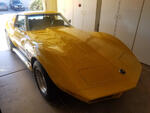
The original color of the car was yellow, but it was repainted red about 30 years ago. I don’t mind at all—I’m not strict about keeping everything factory original, and I prefer red anyway, so it works out perfectly!
I actually see it as an advantage that the car has no U.S. history. In Europe, Corvettes tend to be more valuable, and maintenance costs are higher. This usually means people who can't afford the upkeep stay away, resulting in cars that are generally in good shape and, most importantly, haven’t been overly modified or “molested”—well, not too much at least!
The car was mostly original when I acquired it. Many parts, including consumables, were still factory original—like the front brake rotors, which required drilling out the rivets to replace. All the suspension components were 50 years old and, unsurprisingly, completely worn out. The car also leaked from almost every part except the differential, leaving the garage floor a mess. Power steering components, radiator, the front right caliper, ATF from the cooling circuit at the front, oil from the pan—all of these had leaks. Both factory-original urethane bumpers were also disintegrating; I literally had to sweep them off the garage floor once I removed them. The vacuum mechanism for the front lights was also non-functional. And many other things.
Unfortunately, the exhaust isn’t factory original—headers were replaced with long-tube ones (which I don’t mind), but the midsection and rear mufflers were changed as well. The original mufflers were swapped for glasspacks, resulting in the rear midpipe section not angling slightly upwards, so the mufflers are exposed, which bugs me. I don’t like how it looks, but I've decided to work with it and try to fix it as best as I could, more on that later. Additionally, the carburetor was replaced with one from a truck, and someone has tampered with it, so that had to be adressed too. Otherwise, nothing else has been molested in the past.
On the positive side, it had been garage-kept and driven sparingly, so the frame is solid with only some surface rust. The interior was restored in the past, and the paint is nice—not show-quality, but definitely good, nice to look at. Compared to other C3s and classic cars I’ve seen, I’m satisfied with it. The engine runs smoothly and is in overall good condition, with no carbon buildup that I could see after removing the oil pan and valve covers. Both the transmission and differential are also functioning well.
After a year of working on the car, I can say I’m really enjoying it—well, most of the time! This isn’t my first project car, and compared to other European cars I’ve worked on, the C3 is relatively straightforward. The extensive knowledge base out there is a big plus, too.
The main challenge is the parts availability. While sourcing parts isn’t difficult, nearly everything has to be imported from the U.S., which often slows down progress. And those imperial-sized bolts, my ***... I live near a city with a population of around 500,000, and I know of only one shop that stocks a decent range of imperial fasteners. I can go in, show them what I need, and they’ll bring it out—but sometimes, they don’t have what I’m after. Then I either have to improvise or add it to my shopping list, waiting until I have enough items to justify an order.
The other challenge is that sometimes, no single U.S. store carries everything I need. If it were a BMW, I could order most parts online with next-day delivery, and for a standard bolt, I’d just stop by an ordinary hardware store.
I don’t plan to do a complete, frame-off, nut-and-bolt restoration. While it would be great to take it that far, since I do most of the work myself and have limited time, my goal is to make the car safe to drive, reliable, and nice to look at. That alone is still a LOT to tackle with a car this old. Originally, I aimed to finish the first phase (enough to pass the MOT) by spring 2024. Well, now it’s autumn… I ended up doing a lot of “while you’re at it…” kind of work!
Actual picture of the car - how does it look today:
How it looked when arrived:
You get the idea...
Car about being towed to my garage & pic of the interior. Will post more pictures of the inside once i'm done with at least rough cleaning
More details will follow
I began by removing all the power steering components, as each one was leaking. However, it's hard to say for certain because nearly everything was coated in a decades-old sludge, a mix of various oils and dust. The red ATF oil had also spilled all over the floor. All components appeared to be factory originals. I decided to rebuild them using kits from RockAuto, given that the quality of replicas nowadays is rather inconsistent. I dismantled the pump, valve, and cylinder for rebuilding and purchased a new set of hoses. All parts were thoroughly cleaned and oiled before reassembly. I even painted the pump and cylinder to some extent. As for the valve, I preferred to leave it as it was - did not want to risk that some paint ends up in those inlets... I've already driven the car several times, and the original PS system is functioning flawlessly, with no leaks whatsoever. Just yesterday, I finished balancing the valve. Here are some pictures of the pump rebuild process:
For the first time, I saw a complete assembly of a C3 Power Steering system that was not coated in oil.
As you can see, the right front caliper was leaking fluid between the halves, and the rotors were the original factory ones, 50 years old! Therefore, cobalt drills and a steady hand it was! Consequently, the front brakes are entirely new, including calipers, rotors, pads, and hoses. I purchased a complete set of four calipers, both front and rear, as a precaution. The rear ones are currently stored in the box, but I'm ready in case they begin to leak as well. I've opted to paint them red, the same RAL color as the springs. I regard the paint as a form of protection, as opposed to leaving them with their natural finish.
By the way, the yellow object on top of the caliper is the front bearing cotter pin wrapped in a Sticky Note, so I don't forget to install it.
Thank you for the welcome! Indeed, the Arizona plate was a keen observation. However, it was merely a prop I placed there since the Czech license plate wouldn't fit between the bumperettes. :-)
Never say never, but according to the almost 50 years old original paperwork from Germany, it was not used in the US :-)
Awesom job getting things worked out. It will be great fun for you. And, sometimes, the build is the most fun. Thats one reason I daily build classic cars for others, as well as wrench on my '75 C3 and '02 C5.
.
Nice work.....
Thanks 60 SHARK !Yes, the C3 is just another fun project of mine! Although I must admit, it's my most challenging one yet—this is the oldest car I’ve worked on so far, and there’s a lot that’s new to me. But I always like learning something new. Currently, I’m researching how to set the toe and perform at least a rough alignment so my front tires don’t squeak, as they’re misaligned after a complete front suspension overhaul. Finding a competent shop - both capable and willing to do alignment on a C3, that'll be another story...
I’ll share a few more pictures—here, I’ve been working on the oil pan, along with installing a new Fel-Pro gasket, fresh oil, and a new filter. Conveniently, suitable oil and a filter were readily available at a local auto parts store. It was nice to be able to order parts for the C3 like this, with next-day delivery! I used a Mann W 936/5 oil filter and Shell Rimula R4 15W40 oil, which has a high zinc content.
As I mentioned, the oil pan was leaking (from the front I think), so I decided to take it down. This was also a good opportunity to thoroughly clean it with a strong engine degreaser and give it a fresh coat of paint. There were a few bumps on the bottom, but since the mating surface was flat, I decided not to hammer them out, keeping it simple & don't risk any damage. The result turned out great.
I also polished the original load spreaders - looking great installed and should help secure the seal. I was glad these weren’t missing, as I’d seen in many other C3s while searching for my car.
I inspected the bottom of the oil pan for any metal particles, using a magnet too, and found none, which was a relief. The bottom of the engine looked good as well—no carbon buildup or scoring.
Contrary to the Fel-Pro instructions, I applied a thin layer of black high-temp silicone to the corners and front and back of the pan to avoid having to redo it. After several test drives, the oil pan is totally dry, with no drips on the garage floor anymore.
Loosening the bolts on the control arm joints was no easy task; they were completely seized! I resorted to using a ratchet with a long lever and nearly stripped the bolt on the ball joint puller. Surprisingly, the ball joints were still in relatively good shape—the rubber boots remained soft and intact. They functioned quite well, which was impressive given their age. However, I had new ball joints and bushings from Moog on hand, so out with the old ones.
As for the springs, they're probably the only aspect of working on cars that intimidates me, especially the larger ones that can't be easily lowered with just a floor jack. I have little faith in spring compressors. But I remembered a trick someone once shared with me: wrapping a paracord around the spring about ten times to secure it. Then, I gradually loosened each loop to slowly release the tension. It worked well, especially since most of the force had already been alleviated with the floor jack, and I only needed the springs to be slightly compressed so I could comfortably remove the from pockets. At first glance, the springs looked rough, but the restoration turned out wonderfully. I had them professionally blasted with pellets suitable for spring steel to preserve the material's structural integrity. Afterwards, they were powder coated in RAL 3020 to match the color of my favorite shoes (joke)
By the way, feel free to correct me regarding the technical terms, as my English is somewhat weaker in this regard...
Nice! I was always surprised at the number of classic American cars that I saw in Europe. Both times I was there I brought an American family car with me and bought European classics as my daily. The first time it was a Porsche 914, the second time a classic Mini….parts were bought and shipped from the states with the exception of hardware and consumables.
Oddly enough, my American cars were serviced at dealers there
Yes, it’s true that American vintage cars are quite popular here, although European makes and relatively common models also have a solid fan bases too.
American vintage cars have the advantage of being interesting and exotic here, even if they’re relatively common models. Finding European models with similar appeal is quite different in terms of both acquisition costs and maintenance.
Porsche 1914 & Austin Mini was indeed a cool choice! By the way, why you've been ordering parts from US for these cars?
I’ll also add some pics...
This time, it was a fairly simple task—removing the rear leaf spring.
It wasn't looking very nice, so I disassembled the individual leaves, which took a bit of effort, as you can see in the photo. Fifty years is a long time! I then cleaned the leaves of rust, applied a corrosion inhibitor, and gave them a light coat of paint. I installed new liners and thoroughly lubricated the whole assembly with graphite petroleum jelly. I wasn’t entirely sure powder coating was the best idea i this case, so I left it as-is for now. I’ll probably have to disassemble the rear suspension again, so there’ll be time to think about it. More on that below.
I also installed new rubber bushings for the rear leaf spring. The ride height was just right, so I reused the original bolts, which were in good condition. I cleaned them incl. threads, painted them lightly, and reused them.
However, I couldn’t say the same for the bolt that held the rear leaf spring together—it was completely done for, absolutely not worth saving. Of course, it was a special round-headed bolt, and I couldn’t find one locally. So what next? My shipment of spare parts arrived a few days ago, so I had three options:
Order a new bolt from the U.S. for $5 and pay $70 for shipping and fees.
Wait until I had enough parts for another order, which meant - wait two months to reassemble the leaf spring.
Improvise.
The choice was clear—I’d improvise. Fortunately, I was able to find a metric bolt and nut of a similar length and diameter, though with a hexagonal head. So, what to do? Angle grinder in one hand, drill in the other, and in a few minutes, the hexagonal head was rounded to the required diameter! I then assembled the leaves using a threaded rod, secured them with clamps, pulled out the rod, and fastened it all with the modified bolt.
While at it, I cleaned off rust and grime from the surrounding area. As I mentioned at the start, this isn’t a full frame-off restoration, but I’m gradually cleaning every part I can access. I remove surface rust, degrease everything, and apply a tannin-based corrosion inhibitor. This bonds to the clean metal and any remaining rust, creating a preserved epoxy layer that can be repainted. I use two-component paints with corrosion inhibitors, though regular paint would likely be sufficient as the car isn’t likely to see rain or any harsh environments, but, whatever...
I also changed the fluid in the differential, but that seems like a minor detail compared to all the other work done.
But I'll be disassembling the rear suspension again since it's not entirely finished. I still need to think through the procedure, though.
The main issue is that the bushings on the strut rods aren't in great shape. I already have new ones, so that's not a problem. What is a problem is that the lower shock bolts are completely frozen. I've tried everything—hammering with a big hammer over a reversed nut, using an adapter made from a metal pipe with a puller… but nothing works. It looks like I'll have to order some carbide blades for the sawzall and cut the bolts into several pieces. Then remove what's left from it from the trailing arms and for that, I might have to remove the trailing arms too.
Of course, this will probably lead to a “while you're at it” kind of situation. If I take out the trailing arms, I could tackle the half shafts too. And if I remove the half shafts, I might as well take the differential and drive shaft off. And, naturally, I could replace the rear bearings too, couldn’t I? So, here we are…None of it is exactly needed...
After a close inspection, I found that only strut rods bushnigs needs sort of an immediate attention (I've seen much worse though...). Also, I need to get them aligned because, looking at the photo below, it seems the rear wheels have a bit too much camber. Surprisingly, though, the trailing arms show no major play and move smoothly in the bushings. Altough, I got new set bushings for the trailing arms already.
To test the rear bearings, I attached an extra brake rotor onto the one already mounted (inverted) and tried to rock it—no play there, either. It would feel satisfying to complete all this work. But, then again, my experience with the C3 has taught me one thing: don’t mess with things that work!
2025 c3 ('74-'82) of the Year Finalist - Unmodified
2024 C3 of the Year Finalist - Unmodified
2023 C3 of the Year Finalist - Unmodified
Hi, and welcome aboard! You have certainly had a project there! But you clearly know what you are doing as far as the mechanical work goes. How much of the body work did you do? The car looks good now!
We've had our '78 for almost 35 years now, so I've tackled almost all of the projects that you have completed - I suspect you enjoy it more than me!😄 But, needs must! I'm contemplating ball joints soon.....
I can sympathise with you regarding availability of parts. When we lived in UK it was pretty simple to obtain parts form a number of excellent suppliers there, one only 5 miles from home! Since moving to France it's been a bit more difficult and the UK's stupid Brexit decision made things worse, with most UK companies now not shipping into Europe! I have found a good place in the Alsace region that gives almost next day service. They don't carry everything, but I think can probably obtain most things, given more time. Thankfully, Corvettes are amazingly popular here in France, so a surprising amount of help and support is available.
As an aside, you could do the alignment yourself - I used what is loosely termed as the "string method", a little more sophisticated than that in reality, but relatively simple to set up and achieve excellent results with. I have a set of guidelines somewhere......
Good luck with the shock mounts - I was lucky with ours, they just popped out with one hard hit with a mallet! But we spent hours on a friends and he resorted to the saw!😱
35 years – that’s amazing! I wonder how long I’ll keep mine. Cars are a hobby of mine, so I’d say I’m enjoying it, but you must be enjoying yours even more to have kept it for 35 years already! However, since we’re not on Instagram here I’ll be honest – the initial phase of my project was pretty rough. I went over the car thoroughly, and when I saw the true state it was in, realizing everything that needed to be done… It was overwhelming. Parts were a challenge, too, as I’ve mentioned earlier. After that, it was just a lot of dirty work – oil, dirt, dust everywhere. Almost every bolt was a struggle to loosen! Boxes of parts – new, used – just kept pilling up against the garage wall. But nothing was getting finished; I just kept dismantling more and more, uncovering additional issues. I’ll admit, I sometimes felt like selling it.
Eventually, though, I got over that. Once I started installing new or refurbished parts back into the car, the boxes with parts gradually disappeared, and the car started looking better and better – it boosted my morale a lot.
Yes, when I was looking for parts, I noticed quite a few distributors in the UK. But, as you mentioned, Brexit made things much harder. The biggest problem are customs. When a shipment arrives from the US by air, it takes maybe two days to arrive – but then it’s stuck in customs for another four. So the UK, being out of the EU, doesn’t really make a difference in this regard.
Here in the Czech Republic, there are also companies that specialize in supplying parts for American cars. The issue, though, is that they don’t have much stock of C3 parts and usually order them, so there’s not much added value. Still, for heavier or bulkier parts, ordering through a local distributor makes sense because shipping works out cheaper that way. Or, more precisely, the total cost is lower, even with their markup included.
Regarding bodywork, it wasn’t necessary overall; I only modified the bumpers. I’ll go into more detail on that later, but it was quite a challenge to find bumpers for the C3 that I didn’t have to cut into multiple pieces and re-glass before I could really work with them.
As for alignment, I have already come across the string method. It looks interesting. I found a few articles and discussions on the topic, and I’d definitely like to give it a try.
Currently, my main goal is to "somehow" set the toe on the front. After the complete front suspension overhaul, the setup got completely thrown off, and now the front wheels squeal at higher speeds. It’s quite annoying, so I'd like to get it sorted out as soon as possible. At the very least, I want to address this issue before doing a full alignment, which I’ll consider once I decide on what repair / replacements I'll be doing on the rear suspension.
I’ve already come to terms with the fact that I’ll need to cut the shock mounts with a saw. After all, it wouldn’t be the first time I’ve had to deal with a bolt that way. Where there’s a will, there’s a way!
Also, I finally had time to clean the interior a bit—just a rough wipe-down with a microfiber cloth and some general cleaner to get rid of the worst dirt buildup.
The interior was redone about 25 years ago. However, as I mentioned, car hasn’t been driven much, so it's in very good condition. It’s not entirely factory original, but it looks nice to me.
There are a few imperfections, of course: the passenger-side T-Top has some sagging fabric, the middle fan grilles are broken, and the side ones are worn out. Also, the turn signal lever and light control handle have fallen off. But I’ve already bought replacements, so it's just a matter of installing them. A few of the lower panels also need a bit of adjustment.
What bothers me most, though, is the middle panel. The missing radio wouldn’t really be an issue—I’d just get a non-functioning one to fill the space. It wouldn’t work here anyway, and I’m not planning on listening to music in that car. The bigger problem is that someone previously installed a modern radio and cut a rough hole for it.
I’m thinking what to do about it. I see three options:
Ignore it and leave it as-is.
Buy a new center panel and install an original radio.
Buy a “retro” radio for a few bucks, somehow fix the hole someone chopped in the panel, and use it as a placeholder / plug—basically what I’d do with the original radio as well.
I see it as option number 3 for now, I will see how I will or will not be satisfied with it and if needed, I may then proceed to explore option number 2.
The steering wheel is not factory original; I believe it is this model:More Information for GRANT K4193834 I must admit, I don’t like the look of it and would prefer the original. However, I do prefer the smaller diameter, as I’m constantly hitting the A-pillar with my left hand. Need to think in through....
I have another interesting tidbit to share. While cleaning my car's interior, I stumbled upon a file containing invoices from Germany. Such finds are always thrilling! I've only glanced over them since I don't understand German, which makes it a bit challenging.
One invoice in particular caught my attention though. Contrary to my previous statement that all power steering components were factory original, it turns out the Control Valve had been replaced back in 1998, wow! That was the year I was just learning to read... And Monica Lewinsky was blowing the whistle in the Oval Office, wasn't it?
The price listed on the invoice, including shipping and VAT, was 415.76 DEM (Deutsche Mark). For context, with the exchange rate at that time, this amounted to roughly 7500 CZK. To put it into perspective, the average monthly gross wage was about 11500 CZK. That's how fu*ked up it was back then...
2025 c3 ('74-'82) of the Year Finalist - Unmodified
2024 C3 of the Year Finalist - Unmodified
2023 C3 of the Year Finalist - Unmodified
A file containing invoices and a bit of history is a terrific find! (your smartphone translator will get a workout on all those pieces of paper!)
I did a quick search and it seems that back in 1999 (when the DEM was replaced by the Euro) that would have come to about 214 Euros or $233. The current price for a new valve from Corvette Central is only $194.... Ouch!
Certainly, when I have time, I'll go through it with a Google translator; I can't wait. In the meantime, we've had some decent weather lately, so I took the opportunity to spray the valance panel and air dam. I had some leftover Epoxy Primer and paint from when I painted the bumpers. I had to use it because it probably wouldn't last until spring in opened containers. It turned out nicely.
As evident from the picture below, the shocks needed... Some attention... They were completely non-functional; when compressed by hand, they remained in that position. I've purchased a new set of shocks from Kayaba. Since I intend to use the Corvette solely for cruising, I believe they will be more than adequate for that purpose.
I assumed that removing the shocks would be straightforward due to their design. The front ones posed no issue, but the rear ones, especially the right one, presented a challenge though. The bolt securing the top of the shock had rusted into the metal housing. Attempting to loosen it resulted in the bolt in the housing detaching from the rubber bushing and spinning within it, making it clear that it wouldn't come out by conventional means. After several futile efforts to dislodge the bolt, I decided that cutting it out was the only solution. However, the bolt's location was problematic — inaccessible to any tool due to the extremely limited space, not in the "comfortable" manner, so to speak.
I attempted to cut the top using various methods, as obvious from the picture Ultimately, a Dremel with a cutting wheel proved most effective. I cut through one side and extracted the rubber bushing with small pliers piece by piece. I thought that the shock could be detached at this point, but the limited space prevented sufficient tilting. Thus, I had to make a cut on the opposite side. After bending the top section by pulling it down, I managed to fit a small angle grinder, making short work of it & then finally remove the shock. The photo shows a grinding wheel attached, but that was merely for trial purposes to ensure it would fit and enable cutting only the shock without damaging the storage compartment behind it. I've changed that to cutting wheel, of course
Finally, I succeeded in removing the shock absorber, leaving only the bolt frozen in the housing. With the bolt now accessible, I used a multitool with carbide blades, as the standard metal blades were ineffective.
In the end, it was success. Though it turned out to be quite an ordeal. For the time being, I've used a metric bolt and nut of a similar diameter and length, but I plan to replace it with the correct fasteners, which I'll order along with a few other miscellaneous items.












 Euro 1975 Coupé Project
 I also want to thank everyone for the support you’ve given me on various issues in other threads. I’m grateful to be part of such a friendly, supportive, and respectful community and definitely don’t take it for granted.

 This isn’t my first project car, and compared to other European cars I’ve worked on, the C3 is relatively straightforward. The extensive knowledge base out there is a big plus, too.
















 In the meantime, we've had some decent weather lately, so I took the opportunity to spray the valance panel and air dam. I had some leftover Epoxy Primer and paint from when I painted the bumpers. I had to use it because it probably wouldn't last until spring in opened containers. It turned out nicely.


 For the time being, I've used a metric bolt and nut of a similar diameter and length, but I plan to replace it with the correct fasteners, which I'll order along with a few other miscellaneous items.