









PCV Valve

Thread Starter
Intermediate


Joined: May 2005
Posts: 34
Likes: 0
From: Bay Point, CA
 PCV Valve
I've been resurrecting my 1972 for many years and now I'm reinstalling my PVC valve. There are many varieties, are they interchangeable?
Would a PCV valve from a 350 work in a 454?
What would happen if a different one is used?
Would a PCV valve from a 350 work in a 454?
What would happen if a different one is used?

Safety Car


Joined: Oct 2007
Posts: 4,198
Likes: 1,072
From: South Florida
PCV valve flow depends on the specific engine make up
For example when the piston rings are worn and blowby has increased, a larger pcv valve orifice is needed to flow more crankcase byproduct volume
A PCV valve is not one-size-fits-all and needs to be modified or adjusted (sometimes by running two pcv valves in parallel for example)
The correct way to determine how much pcv flow (crankcase flow) is needed at idle, cruise and wide open throttle, is to measure the crankcase pressure
Crankcase pressure needs to be set to approx 0.8" to 2.5"Hg at all times to maintain a vacuum in the crankcase at all times
Anytime crankcase pressure rises above roughly 0.25"Hg to +0.01psi (above atmospheric) crankcase gas will contain large oil droplets and push oil through seals causing oil leaking, engine smoking, oil pushed into the intake manifold, oil spray, etc...
This is target Crankcase pressure as shown on a pressure gauge
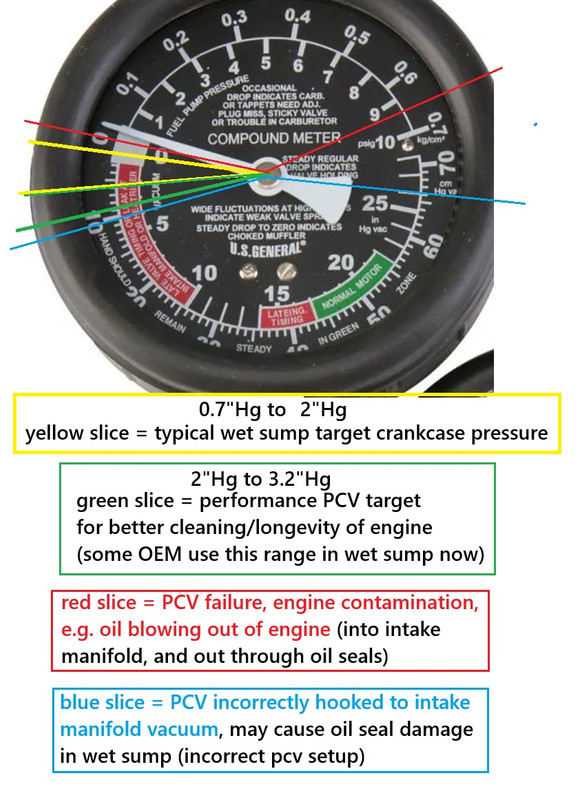
you can use a 1-bar map sensor to get an idea of the crankcase pressure
for example
https://forums.holley.com/forum/holl...nhg#post417512
Or use a pressure gauge of appropriate resolution
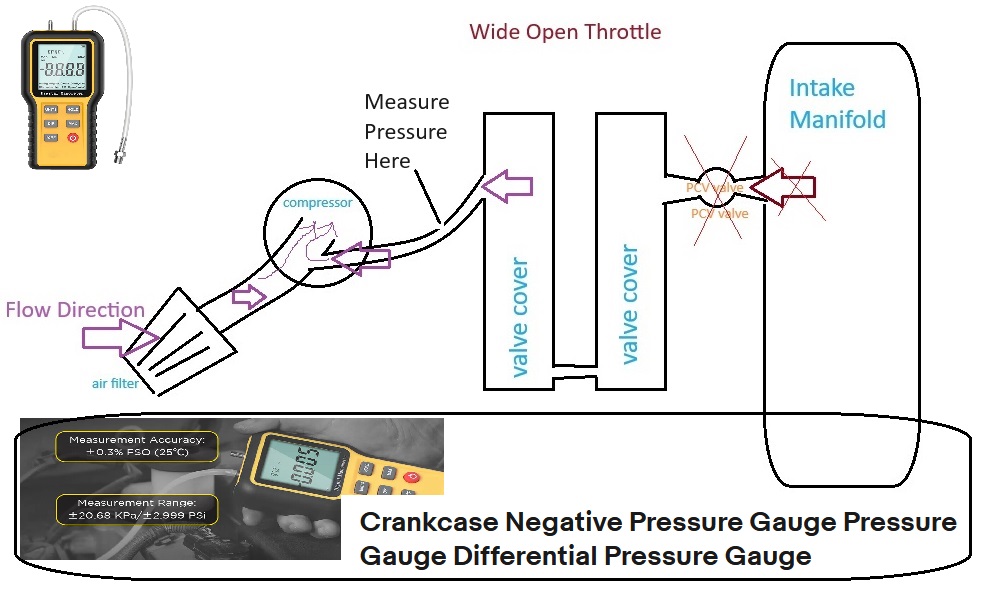
wide open throttle crankcase pressure is measured after the air filter where the air filter tube attaches to the crankcase on all OEM engines and this should be set and maintained more precisely as the engine becomes more performance oriented.
For example when the piston rings are worn and blowby has increased, a larger pcv valve orifice is needed to flow more crankcase byproduct volume
A PCV valve is not one-size-fits-all and needs to be modified or adjusted (sometimes by running two pcv valves in parallel for example)
The correct way to determine how much pcv flow (crankcase flow) is needed at idle, cruise and wide open throttle, is to measure the crankcase pressure
Crankcase pressure needs to be set to approx 0.8" to 2.5"Hg at all times to maintain a vacuum in the crankcase at all times
Anytime crankcase pressure rises above roughly 0.25"Hg to +0.01psi (above atmospheric) crankcase gas will contain large oil droplets and push oil through seals causing oil leaking, engine smoking, oil pushed into the intake manifold, oil spray, etc...
This is target Crankcase pressure as shown on a pressure gauge
you can use a 1-bar map sensor to get an idea of the crankcase pressure
for example
https://forums.holley.com/forum/holl...nhg#post417512
Or use a pressure gauge of appropriate resolution
wide open throttle crankcase pressure is measured after the air filter where the air filter tube attaches to the crankcase on all OEM engines and this should be set and maintained more precisely as the engine becomes more performance oriented.
Thread Starter
Intermediate
Joined: May 2005
Posts: 34
Likes: 0
From: Bay Point, CA
Thanks King for the in depth response to my question.
I guess the bottom line for me is to use the stock PCV valve for my unmodified 454 as GM intended.
However I see many engines with breathers in each valve cover and no PCV valve.
Is the PCV valve necessary?
I guess the bottom line for me is to use the stock PCV valve for my unmodified 454 as GM intended.
However I see many engines with breathers in each valve cover and no PCV valve.
Is the PCV valve necessary?

Melting Slicks


Joined: Sep 2016
Posts: 2,192
Likes: 956
From: Wauconda IL
Thread Starter
Intermediate
Joined: May 2005
Posts: 34
Likes: 0
From: Bay Point, CA
Sunflower: That's what I heard. I've been running with two breathers for a while but no oil mist film, I guess eventually I would see it.
No matter, I just finished reinstalling the PCV valve.
Thanks for your input.
No matter, I just finished reinstalling the PCV valve.
Thanks for your input.
Safety Car
Joined: Oct 2007
Posts: 4,198
Likes: 1,072
From: South Florida
PCV is an oil cleaning and piston ring draining cleaning mechanism
PCV is a oil leak prevention mechanism
PCV enables high mileage by preventing deposits in the oil system and keeps oil out of engine seals which prevents leaking
Blow-by is mostly water, for every gallon of fuel burnt will produce around 1 gallon of water
PCV keeps water out of engine oil
Blow-by contains mostly water and CO2. CO2 interact with water to form carbonic acid which attacks everything inside the engine and the oil. CO2 and water component of exhaust gas is one reason why exhausts rust easily when the engine is shut off water condenses from exhaust in the presence of CO2 causing rapid oxidation.
PCV keeps CO2 and water out of engine oil which protects the oil and engine quality.
PCV is the most important system on any combustion engine and the least understood
If anyone would like more detailed explanations i will be happy to go over each concept individually
PCV is a oil leak prevention mechanism
PCV enables high mileage by preventing deposits in the oil system and keeps oil out of engine seals which prevents leaking
Blow-by is mostly water, for every gallon of fuel burnt will produce around 1 gallon of water
PCV keeps water out of engine oil
Blow-by contains mostly water and CO2. CO2 interact with water to form carbonic acid which attacks everything inside the engine and the oil. CO2 and water component of exhaust gas is one reason why exhausts rust easily when the engine is shut off water condenses from exhaust in the presence of CO2 causing rapid oxidation.
PCV keeps CO2 and water out of engine oil which protects the oil and engine quality.
PCV is the most important system on any combustion engine and the least understood
If anyone would like more detailed explanations i will be happy to go over each concept individually
Corvette Stories
The Best of Corvette for Corvette Enthusiasts

8 Coolest Corvette Pace Cars (and Replicas) of All Time
Verdad Gallardo
Top 10 Corvette Engines RANKED by Peak Torque (70+ Years of Muscle!)
Joe Kucinski
Corvette ZR1X Will Be Pacing the Indy 500, And Could Probably Race, Too!
Verdad Gallardo
Top 10 Corvettes Coming to Mecum Indy 2026!
Brett Foote
Top 10 C9 Corvette MUST-HAVES to Fix These C8 Generation Flaws!
Michael S. Palmer
10 Revolutionary 'Corvette Firsts' Most People Don't Know
Joe Kucinski
5 Reasons to Upgrade to an LS6-Powered Corvette; 5 Reasons to Stay LT2
Michael S. Palmer
2027 Corvette vs The World: Every C8 vs Its Closest Competitor
Joe Kucinski
10 Most Common Corvette Problems of the Last 20 Years!
Joe Kucinski
Thread Starter
Intermediate
Joined: May 2005
Posts: 34
Likes: 0
From: Bay Point, CA
Hi Alan 71.
I agree about controlling emissions.
I always thought the PCV valve was an emissions control device.
The idea in sucking valve cover fumes back into the engine does not sound good.
But I'm no expert, that's why I ask questions.
But what I do know is I've been a Forum member for 21 years and during that time I've seen engines with solid valve covers on each side, or with a solid cover on one side and a breather in the other, or a breather on both sides, or a PCV valve on one side and a breather on the other, and finally (my new stock set up after running 2 breathers) a PCV valve on one side and a hook up to the air cleaner on the other.
I agree about controlling emissions.
I always thought the PCV valve was an emissions control device.
The idea in sucking valve cover fumes back into the engine does not sound good.
But I'm no expert, that's why I ask questions.
But what I do know is I've been a Forum member for 21 years and during that time I've seen engines with solid valve covers on each side, or with a solid cover on one side and a breather in the other, or a breather on both sides, or a PCV valve on one side and a breather on the other, and finally (my new stock set up after running 2 breathers) a PCV valve on one side and a hook up to the air cleaner on the other.
Old Pro Solo Guy


Joined: Dec 2017
Posts: 8,014
Likes: 4,369
From: Marlton NJ
KingTalon is exactly correct.
Keep the PCV.
It keeps carbonic and sulfuric acid out of the oil and helps your engine live longer.
Your engine bearings will appreciate clean oil
It only works at part throttle by design.
So drag racers never bother with PCV.
And many people copy everything racers do.
That must make it better, right?
(wrong for a street car)
Street cars spend 99% of their lives at part throttle.
Racers do run exhaust powered crankcase evacuation systems, or crankcase vacuum pumps, for the same reason of improved ring and gasket sealing, but they work at W.O.T.
But few street cars ever copy that.
Some current factory cars include both a PCV system, and a crankcase vacuum pump, that only works on demand at W.O.T. Some factory turbo cars both monitor and control crankcase vacuum levels, by computer.
So is it important?
Should you run it?
Is it misunderstood?
All "yes"
All PCV valves vary by their flow, and no one publishes flow ratings.
So just buy the suggested one.
If it does not give a vacuum reading as KingTalon suggested, (as measured at the dipstick tube hole at idle with a normal vacuum gauge), get another one , or the adjustable Wagner one that is available. Measuring it at cruise or WOT is much more difficult. And likely not too necessary on a good running N.A. street car.
Adjust the idle mixture and speed with it in place, it will cause a very slight change leaner or faster.
Keep the PCV.
It keeps carbonic and sulfuric acid out of the oil and helps your engine live longer.
Your engine bearings will appreciate clean oil
It only works at part throttle by design.
So drag racers never bother with PCV.
And many people copy everything racers do.
That must make it better, right?
(wrong for a street car)
Street cars spend 99% of their lives at part throttle.
Racers do run exhaust powered crankcase evacuation systems, or crankcase vacuum pumps, for the same reason of improved ring and gasket sealing, but they work at W.O.T.
But few street cars ever copy that.
Some current factory cars include both a PCV system, and a crankcase vacuum pump, that only works on demand at W.O.T. Some factory turbo cars both monitor and control crankcase vacuum levels, by computer.
So is it important?
Should you run it?
Is it misunderstood?
All "yes"
All PCV valves vary by their flow, and no one publishes flow ratings.
So just buy the suggested one.
If it does not give a vacuum reading as KingTalon suggested, (as measured at the dipstick tube hole at idle with a normal vacuum gauge), get another one , or the adjustable Wagner one that is available. Measuring it at cruise or WOT is much more difficult. And likely not too necessary on a good running N.A. street car.
Adjust the idle mixture and speed with it in place, it will cause a very slight change leaner or faster.
Last edited by leigh1322; Yesterday at 08:33 AM.
1967 Pedal Car Champion

Joined: Mar 2020
Posts: 9,004
Likes: 4,159
From: US-PNW
PCV valves: According to the '70-'72 judging guide, all Rochester carb'd engines got CV736C and Holley carb'd engines got CV746C, though some original Holley engines have been seen with CV736C valves as well. In general, the Holley engines were the higher performance LT-1 and LS-6 while the rest of the lineup had the Rochester carbs.
The CV736C had the GM part number 6423695.
The CV746C had part number 6484525.
The CV736C had the GM part number 6423695.
The CV746C had part number 6484525.
Safety Car
Joined: Oct 2007
Posts: 4,198
Likes: 1,072
From: South Florida
It only works at part throttle by design.
The way it works is the crankcase is tied to the air filter tract which all OEM air filtering by design pulls 0.8" to 1.5"Hg at wide open throttle on the crankcase which is about the same or more than it does evacuate at part throttle via the PCV valve.
This is why people complain about oil inside their intakes after going 20 or 40k miles with an aftermarket over-sized air filter - the lack of an inch or two of mercury pulling on the crankcase at WOT causes all kinds of mayhem in the crankcase - oil stays in piston rings and is pulled up to the chamber on the intake stroke. Light hydrocarbons leave behind sticky hard carbon on rings which seize and ruin cyl walls causing smoking and ruined engines. Crankcase pressure pushes oil into every seal and causes leaking and oil floods baffles which is then picked up by the pcv valve route after WOT ends. And so on.
PCV is full time, not just part throttle, but people ruin it with ignorance.
So drag racers never bother with PCV.
And many people copy everything racers do.
And many people copy everything racers do.
However I would point out that the power loss is a few percent and most 'drag racers' own their own engines so in my eyes doesn't make much sense to ruin an engine you own just for a few percent of power.
Racers do run exhaust powered crankcase evacuation systems, or crankcase vacuum pumps, for the same reason of improved ring and gasket sealing, but they work at W.O.T.
But few street cars ever copy that.
But few street cars ever copy that.
Some current factory cars include both a PCV system, and a crankcase vacuum pump, that only works on demand at W.O.T. Some factory turbo cars both monitor and control crankcase vacuum levels, by computer.
Thanks for promoting pcv information if you'd like examples (videos diagrams) I have for measuring PCV at part throttle and wide open throttle systems