


 anymore. it's not worth the aggrevation

Pointless distributor conversion

Race Director


Joined: Mar 2001
Posts: 14,619
Likes: 4,668
From: Mustang OK
2026 Corvette of the Year Finalist - Modified
2025 c1 of the Year - Modified Winner
2024 C1 of the Year Finalist - Modified
2023 C1 of the Year Finalist - Modified
2015 C1 of the Year Finalist

DANG!!!!!!!!!!!!!!!!!!!
I ain't belivin this topic has lasted this long!!!!!!!!!!!
Obviously, there are arguments for/against any type of ignition triggering. Most seem quite valid.
In the last 16yrs, I've installed about 50 of the PerTronix conversions. Four of my point type distributors have PerTronix, with the oldest existing one on the 56 Vette (16yrs), NEVER a problem. PerTronix has 2 types, and I prefer the original type with the magnet wheel below the rotor.
In 50yrs of driving automobiles (got my license in 58), I have had two points fail suddenly. Both failures were because the point spring broke-------------suddenly! That was toooooooooooooooo easy to fix with a replacement point set.
With all of my PerTronix conversions, I also use their Flamethrower coil.
I ain't belivin this topic has lasted this long!!!!!!!!!!!
Obviously, there are arguments for/against any type of ignition triggering. Most seem quite valid.
In the last 16yrs, I've installed about 50 of the PerTronix conversions. Four of my point type distributors have PerTronix, with the oldest existing one on the 56 Vette (16yrs), NEVER a problem. PerTronix has 2 types, and I prefer the original type with the magnet wheel below the rotor.
In 50yrs of driving automobiles (got my license in 58), I have had two points fail suddenly. Both failures were because the point spring broke-------------suddenly!
That was toooooooooooooooo easy to fix with a replacement point set.With all of my PerTronix conversions, I also use their Flamethrower coil.

Team Owner

Joined: Aug 2007
Posts: 58,061
Likes: 7,145
Army
DANG!!!!!!!!!!!!!!!!!!!
I ain't belivin this topic has lasted this long!!!!!!!!!!!
Obviously, there are arguments for/against any type of ignition triggering. Most seem quite valid.
In the last 16yrs, I've installed about 50 of the PerTronix conversions. Four of my point type distributors have PerTronix, with the oldest existing one on the 56 Vette (16yrs), NEVER a problem. PerTronix has 2 types, and I prefer the original type with the magnet wheel below the rotor.
In 50yrs of driving automobiles (got my license in 58), I have had two points fail suddenly. Both failures were because the point spring broke-------------suddenly! That was toooooooooooooooo easy to fix with a replacement point set.
With all of my PerTronix conversions, I also use their Flamethrower coil.
I ain't belivin this topic has lasted this long!!!!!!!!!!!
Obviously, there are arguments for/against any type of ignition triggering. Most seem quite valid.
In the last 16yrs, I've installed about 50 of the PerTronix conversions. Four of my point type distributors have PerTronix, with the oldest existing one on the 56 Vette (16yrs), NEVER a problem. PerTronix has 2 types, and I prefer the original type with the magnet wheel below the rotor.
In 50yrs of driving automobiles (got my license in 58), I have had two points fail suddenly. Both failures were because the point spring broke-------------suddenly!
That was toooooooooooooooo easy to fix with a replacement point set.With all of my PerTronix conversions, I also use their Flamethrower coil.
Nobody on here is going to change their mind about the topic based on this thread so I'm hoping the flames ratchet down and folks can 'agree to disagree'...

Burning Brakes


Joined: Jul 2004
Posts: 825
Likes: 17
From: Rowlett, TX
Function: adjective
Date: 1569
1 : suitable or fit to be relied on : dependable
2 : giving the same result on successive trials
Ahhh, you seem to be confusing reliability with predictability. I will readily agree that, because there is much more data available on points, the failure point of points is more predictable than electronic ignitions, but that does not mean points are more reliable.
And now, thanks to your condescending remarks and poor understanding of reliability I will now give you a lesson on reliability and how it applies in this instance:
Properly set up and installed points are known to be reliable (or in other words, giving the same result on successive trials) to 12,000 miles as listed in the owner's manual of our Corvettes. Therefore, we can presume that, to 12,000 miles, properly installed points are probably about 99% reliable. So, if we use that as a standard, a set of properly installed points passes a 99% reliability standard of 12,000 miles.
Well, at 12,000 miles, properly set up and installed electronic ignition conversions are at least 99% reliable. So a properly installed electronic ignition conversion also passes the 99% reliability standard of 12,000 miles.
If we want to stop at this point, we can conclude that, at 12,000 miles, both systems are equally reliable.
However, since you are claiming that points are more reliable, we must now extend the mileage test to determine a winner.
If we extend the test to 18,000 miles a small number of points sets will fail, dropping their reliability percentage to somewhere in the range of 98%. Of the properly installed electronic ignition conversions a few may also fail, not as many failures as observed in points sets, but probably within 1% so we will still call it a tie between the two at about a 98% reliability rate.
This is still inconclusive so let’s once again extend the test, this time to say, 24,000 miles. We will now start to see a dramatic increase in the failure rate of points while the failure rate of electronic ignition conversions will remain near constant. At this point the failure rate of points will probably rise to about 15%, leaving a reliability rate of approximately 85% while the electronic ignitions will still have a reliability rate of about 97%. So, at this point we now have a clear winner with the electronic ignition conversion proving much more reliable than a set of points.
The further we extend that reliability test, the more more favorably electronic ignitions will compare. At 50,000 miles the reliability percentage of points will drop well below 50% while the electronic ignition conversions will still have a reliability percentage well above 90%.
The conclusions that can be drawn from these tests are as follows:
*If you limit your expectations for reliability to 12,000 miles, the best that can be said for points ignitions are that they are equal to, but not more reliable than, electronic ignition conversions.
*If the reliability expectation is extended beyond 12,000 miles, electronic ignitions will prove to be more reliable than points.
*The further beyond 12,000 miles we extend our reliability test, the less reliable points will prove to be.
In my opinion, the reasons people blame electronic ignitions for not being reliable are three fold:
1. Because properly installed electronic ignition systems are so reliable, people expect those systems to last forever and are then disappointed when they don’t. At 12,000 miles an electronic ignition can most certainly be relied upon. At 50,000 miles it can still certainly be relied upon. At 80,000 miles its reliability becomes questionable. At 100,000 miles it’s probably not wise to continue relying on that original electronic conversion kit.
2. Improper installation due to ignorance or carelessness and then blaming the problem on the ignition system instead of the installer. As many people have stated when discussing points, the distributor has to be properly set up. The same holds true for electronic ignitions but proper set up has to be extended to include a properly installed system, a properly wired system, a properly matched coil, and a properly functioning electrical system.
The perfect analogy would be giving a third grader a set of points, having him install the points, and then blaming the points when they either don’t work immediately or don’t work forever after.
3. People try to compare multiple sets of points (and all of the related maintenance needed on multiple sets of points) to one electronic ignition conversion, and then conclude that a set of points is more reliable than an electronic ignition. This is foolish, the first time a wrench is turned to adjust a set of points, the reliability contest is lost. While if a person does their own work (and considers their own time to be worth very little money), maintaining and replacing points may be less expensive than electronic ignition, points will never be more reliable.

Le Mans Master


Joined: Oct 2000
Posts: 8,897
Likes: 1,356
From: Santa Ana CA

You can RELY on the points to fail at a certain point in time and are forewarned by the manufacturer (after the manufacture's suggested 12,000 miles). Thus, you can take steps to avoid a failure (change the points).
When can you rely on the electronic system to fail?

Last edited by toddalin; Oct 30, 2008 at 09:48 PM.

Race Director

Joined: Jul 2001
Posts: 15,892
Likes: 42
You must have been working on that all day. Cut and paste is indeed exhausting. I myself became exhausted just reading it and fell asleep twice.
Again you are confusing reliability with durability.
If a device is designed and manufactured to work in a consistent, acceptable manner for 12,000 miles (let's use your number) and in real life trials it consistently does that, it is in simple terms 100% reliable.
If the device does not reach it's designed service life and must be removed from service (at let's say 8000 miles) it could then be said that it has 'failed'.
Points (or tires or spark plugs or oil as I tried to illustrate above) that have achieved their design service life and are removed at that interval have not 'failed'. They have achieved the stated goal.
On the other hand, points that are kept in service longer than manufacturers specs (or are not maintained likewise) and subsequently contribute to service difficulties are not events that are attributable to manufacturing failures.
You might not like the fact that the points lasted only went 12,000 miles and wish they had gone 24,000 miles. In this circumstance you would be disappointed with their durability- but that's your problem. They have not failed and they are not unreliable.
If an improved design comes out that consistently lasts 24,000 miles instead of 12,000, durability has been increased by a factor of 2. Reliability remains constant at 100%.
If another manufacturer produced a unit that lasted only 6000 miles, but did it consistently, his durability is half or one quarter of the units above but the reliability rate is still 100%.
If you don't like the above methodology, please contact your local FAA representative. That's how they want the aviation industry to measure and certify reliability.
Since you like internet references, maybe you should have chosen this one:
http://en.wikipedia.org/wiki/Reliable_system_design
There's three problems with the electronic conversion units:
1) They suffer from random failures anywhere from day of installation onwards.
2) They have no apparent service life restriction that could effectively reduce the amount of high time in service failures- if such a limit were applied
3) Failures of the units usually come without any warning that would otherwise allow preventative measures to be taken.
The three factors above pretty well self-condemn the units to having a miserable reputation.
If you'd like to get some formal schooling on this science here's a link:
http://www.airlines.org/products/pub...htm?Product=48
If you're nice I can get you the 'members' rates.
BarryK, I'm on day shift. You can take over now. Best of luck.
Again you are confusing reliability with durability.
If a device is designed and manufactured to work in a consistent, acceptable manner for 12,000 miles (let's use your number) and in real life trials it consistently does that, it is in simple terms 100% reliable.
If the device does not reach it's designed service life and must be removed from service (at let's say 8000 miles) it could then be said that it has 'failed'.
Points (or tires or spark plugs or oil as I tried to illustrate above) that have achieved their design service life and are removed at that interval have not 'failed'. They have achieved the stated goal.
On the other hand, points that are kept in service longer than manufacturers specs (or are not maintained likewise) and subsequently contribute to service difficulties are not events that are attributable to manufacturing failures.
You might not like the fact that the points lasted only went 12,000 miles and wish they had gone 24,000 miles. In this circumstance you would be disappointed with their durability- but that's your problem. They have not failed and they are not unreliable.
If an improved design comes out that consistently lasts 24,000 miles instead of 12,000, durability has been increased by a factor of 2. Reliability remains constant at 100%.
If another manufacturer produced a unit that lasted only 6000 miles, but did it consistently, his durability is half or one quarter of the units above but the reliability rate is still 100%.
If you don't like the above methodology, please contact your local FAA representative. That's how they want the aviation industry to measure and certify reliability.
Since you like internet references, maybe you should have chosen this one:
http://en.wikipedia.org/wiki/Reliable_system_design
There's three problems with the electronic conversion units:
1) They suffer from random failures anywhere from day of installation onwards.
2) They have no apparent service life restriction that could effectively reduce the amount of high time in service failures- if such a limit were applied
3) Failures of the units usually come without any warning that would otherwise allow preventative measures to be taken.
The three factors above pretty well self-condemn the units to having a miserable reputation.
If you'd like to get some formal schooling on this science here's a link:
http://www.airlines.org/products/pub...htm?Product=48
If you're nice I can get you the 'members' rates.
BarryK, I'm on day shift. You can take over now. Best of luck.
Race Director
Joined: Mar 2001
Posts: 14,619
Likes: 4,668
From: Mustang OK
2026 Corvette of the Year Finalist - Modified
2025 c1 of the Year - Modified Winner
2024 C1 of the Year Finalist - Modified
2023 C1 of the Year Finalist - Modified
2015 C1 of the Year Finalist
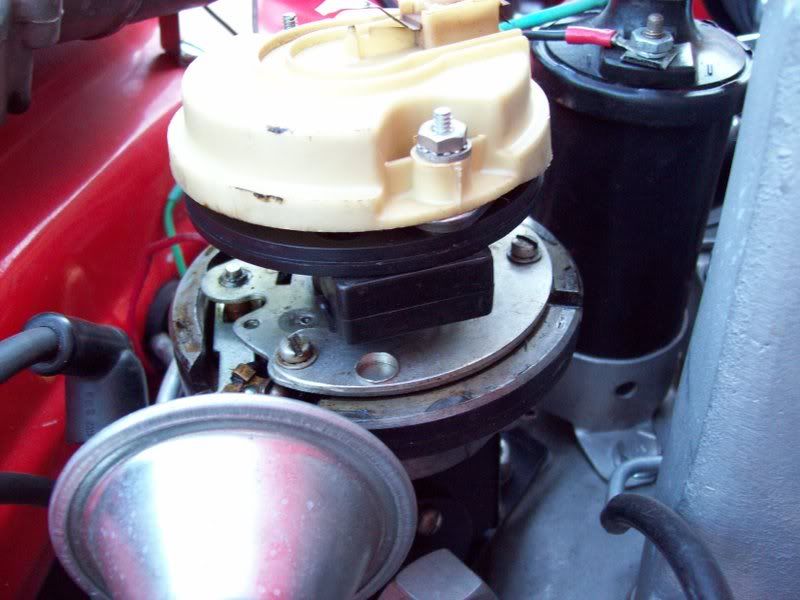
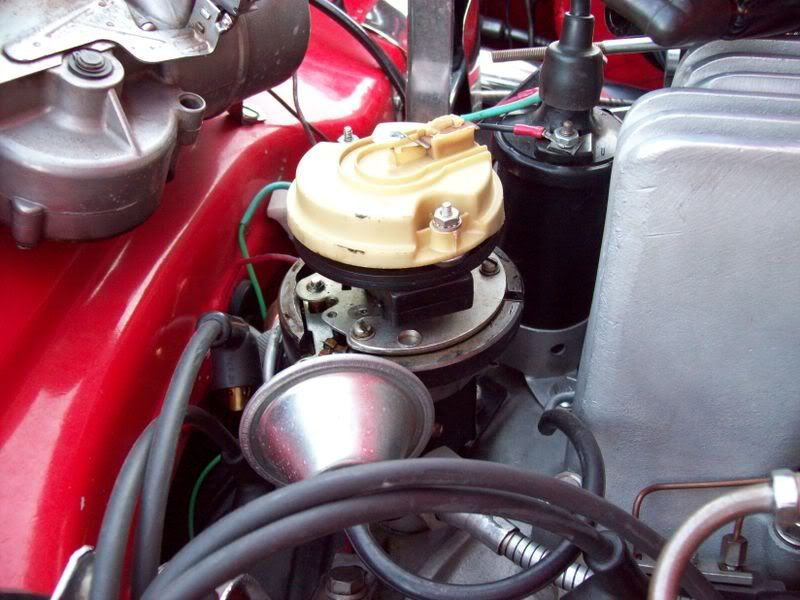
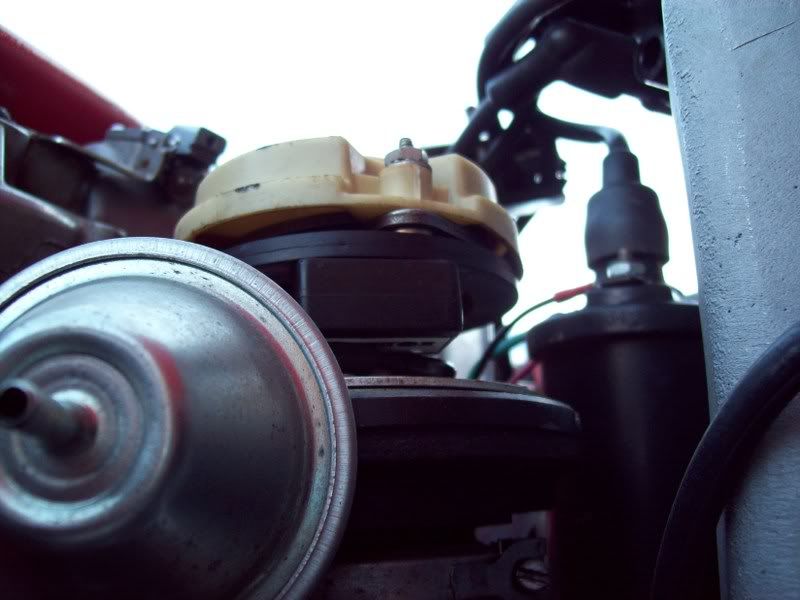
In case anyone wants to know what an installed unit looks like, this is the original version PerTronix (1181) installed in the 65 FI dist in my 56.

Le Mans Master


Joined: Feb 2008
Posts: 7,876
Likes: 9
From: Toronto Ontario
I am admittedly a neophyte when it comes to ignition systems. For that reason, I have been following this thread religiously, trying to understand both points of view and trying to learn something in the process. I have been searching the web on this topic and found this site which I think will be of interest to many forum members. I found this article to be really informative, giving the history of automotive ignition systems and the evolution of same. I'll be reading and rereading this for days to gain a better understanding and comprehension of automotive ignition systems. Here's the link:
http://www.jetav8r.com/Vision/Ignition/CDI.html
I hope some of you find this to be of interest.

- Pat
http://www.jetav8r.com/Vision/Ignition/CDI.html
I hope some of you find this to be of interest.
- Pat

Le Mans Master
Joined: Apr 2004
Posts: 7,106
Likes: 38
From: Newark DE
Corvette Stories
The Best of Corvette for Corvette Enthusiasts

Top 10 Most Explosive Corvettes Ever Made: Power-to-Weight Ratio Ranked!
Joe Kucinski
150 hp to 1,250 hp: Every Corvette Generation Compared by the Specs That Matter
Joe Kucinski
8 Coolest Corvette Pace Cars (and Replicas) of All Time
Verdad Gallardo
Top 10 Corvette Engines RANKED by Peak Torque (70+ Years of Muscle!)
Joe Kucinski
Corvette ZR1X Will Be Pacing the Indy 500, And Could Probably Race, Too!
Verdad Gallardo
Top 10 Corvettes Coming to Mecum Indy 2026!
Brett Foote
Top 10 C9 Corvette MUST-HAVES to Fix These C8 Generation Flaws!
Michael S. Palmer
10 Revolutionary 'Corvette Firsts' Most People Don't Know
Joe Kucinski
5 Reasons to Upgrade to an LS6-Powered Corvette; 5 Reasons to Stay LT2
Michael S. Palmer
Team Owner
Joined: Aug 2007
Posts: 58,061
Likes: 7,145
Army
There seems to be some subconscious thought that these points conversions have some sort of mind of their own and just fail mysteriously....or perhaps there is some shortcoming in the quality control during their production. There is also some perception that Pertronix users are reluctant to perform routine maintenance. I find this amusing since I have to adjust my solid lifters every few thousand miles and points/distrib maintenance is trivial next to that job.
Hall cells are so elegantly simple there is just not a lot to go wrong. I still posit (but cannot prove) that large number of failures are improper installation, mis-matched coil, incorrect wiring etc. The early units probably got a bad rap from folks burning them up leaving the ignition switch in the 'on' position too long. (There was one recent instance of this experienced by 'vettegal').
I will have to be convinced statistically that a properly installed Pertronix system in a well-functioning distributor is less reliable than a set of electro-mechanical moving contacts. The folks that have installed them properly have had great experiences with them including DZAuto and myself.
And saying a Pertronix failure is 'totally irrecoverable' is patently wrong. Its just as easy to carry a spare Pertronix module as a spare points set (albeit more expensive). I've bought Pertronix units for as little as $59. Its two screws and two wires to install - not much different than points.
All of this debate on reliability and durability is specious unless there is a baseline of properly installed Pertronix installations to use for comparison....and based on the many questions that arise on this forum about installation I doubt we have that from what I read here.
I love the discussion about aircraft engineering requirements; I was an engineer on the F-14, A-6 and Harrier early in my career. The first criteria in establishing reliability (and MTBF - Mean Time Between Failures) is a baseline to work from. (Ironically some country's Air Force's are now considering MFOP - Maintenance Free Operating Period as a more relevant measure of reliability)
Saying that, "I don't remember any forum threads about points failures" is not a baseline. Several forum members have cited instances of points failure but again there is only anecdotal evidence driving this discussion and so I say once more - use whatever device you choose as there is no factual basis for saying one is better (more reliable in this context) than the other.
No 'cut and paste' was used in this post. I'm Frank Dreano and I approve this message!
(Aren't you sick of hearing that one!)
Hall cells are so elegantly simple there is just not a lot to go wrong. I still posit (but cannot prove) that large number of failures are improper installation, mis-matched coil, incorrect wiring etc. The early units probably got a bad rap from folks burning them up leaving the ignition switch in the 'on' position too long. (There was one recent instance of this experienced by 'vettegal').
I will have to be convinced statistically that a properly installed Pertronix system in a well-functioning distributor is less reliable than a set of electro-mechanical moving contacts. The folks that have installed them properly have had great experiences with them including DZAuto and myself.
And saying a Pertronix failure is 'totally irrecoverable' is patently wrong. Its just as easy to carry a spare Pertronix module as a spare points set (albeit more expensive). I've bought Pertronix units for as little as $59. Its two screws and two wires to install - not much different than points.
All of this debate on reliability and durability is specious unless there is a baseline of properly installed Pertronix installations to use for comparison....and based on the many questions that arise on this forum about installation I doubt we have that from what I read here.
I love the discussion about aircraft engineering requirements; I was an engineer on the F-14, A-6 and Harrier early in my career. The first criteria in establishing reliability (and MTBF - Mean Time Between Failures) is a baseline to work from. (Ironically some country's Air Force's are now considering MFOP - Maintenance Free Operating Period as a more relevant measure of reliability)
Saying that, "I don't remember any forum threads about points failures" is not a baseline. Several forum members have cited instances of points failure but again there is only anecdotal evidence driving this discussion and so I say once more - use whatever device you choose as there is no factual basis for saying one is better (more reliable in this context) than the other.
No 'cut and paste' was used in this post. I'm Frank Dreano and I approve this message!
(Aren't you sick of hearing that one!)
Last edited by Frankie the Fink; Oct 30, 2008 at 11:52 PM.
Race Director
Joined: Jul 2001
Posts: 15,892
Likes: 42
Incorrect installation would tend to burn them out at a relatively consistent and low TSN. I think.
The majority are installed either with the OEM coil, or a matching coil from pertronixs.
If they do indeed burn out from a simple error such as leaving the key in the run position without the engine running, then that points to a design shortcoming.
My own experience with a unit going dead was in almost the worst possible circumstances with respect to logistical problems in getting help and getting it fixed. The units had been installed as per factory directions approx. 5 years previously and had operated flawlessly during that time period. Annual spring time visual inspection and timing verification gave no indication of impending problems.
Only after the dust settled did the dealer inform me of the high number of returns he had dealt with on this brand of unit and that had I kept the original factory twin point set up, I could have at least limped home even if one set of points had gone bad.
Team Owner
Joined: Aug 2007
Posts: 58,061
Likes: 7,145
Army
Incorrect installation would tend to burn them out at a relatively consistent and low TSN. I think.
The majority are installed either with the OEM coil, or a matching coil from pertronixs.
If they do indeed burn out from a simple error such as leaving the key in the run position without the engine running, then that points to a design shortcoming.
My own experience with a unit going dead was in almost the worst possible circumstances with respect to logistical problems in getting help and getting it fixed. The units had been installed as per factory directions approx. 5 years previously and had operated flawlessly during that time period. Annual spring time visual inspection and timing verification gave no indication of impending problems.
Only after the dust settled did the dealer inform me of the high number of returns he had dealt with on this brand of unit and that had I kept the original factory twin point set up, I could have at least limped home even if one set of points had gone bad.
Only after the dust settled did the dealer inform me of the high number of returns he had dealt with on this brand of unit and that had I kept the original factory twin point set up, I could have at least limped home even if one set of points had gone bad.
Enjoying the repartee but its 1:00am here so its off to bed for me..
Le Mans Master
Joined: Apr 2004
Posts: 7,106
Likes: 38
From: Newark DE

Frank, seriously, I'm not trying to say (and I believe Mike Ward would agree with me on this - he doesn't always or even usually agree with me) that if you install an electronic conversion kit it WILL, as a given, fail. As I said before, that would be a foolish statement and it it was THAT bad they wouldn't still be on the market.
BUT, my point is that if you look at the number of points sold over the years (millions upon millions of them) and take the number that have failed to the degree that the car is inoperable. Than take the number of electronic conversion kits sold during the time since they have been out and how many of those have failed to the degree the car is inoperable.
The PERCENTAGE of failed points is less than the PERCENTAGE of failed electronic conversion kits. Do I have hard numbers to obsolutely prove this, no, of course not. I'm basing it solely on reports of issues and problems I've seen on here and various other forums and talking to other Vette and classic car owners in person. When I first got my '65 I was actually interested in putting in one of the electronic conversion kits until I started to ask around to people and look at threads in the forums on them. There are LOTS of threads with people having problems and failures with these conversion kits and basically no reported issues or very, very few reported issues with points. That's pretty convincing, especially since the number of points sold and still used is way higher than the number of electronic conversion kits. That there tells the story that the percentage of failure on those kits is higher.
Now, WHY are these electronic conversion failing? Early model design flaws? maybe. Incorrect installation? maybe. incompatibility with stock coils rather than using a correct replacement coil? maybe.
But if it's an early design flaw that means the design was bad and it failed. It's still a failure. If a later design change improved the product that great and I hope the company did that for their customers but it still constitutes failed units to be added to the percentage. Incorrect installation? always a possibility but as we all will probably agree, even if points are installed wrong, such as incorrectly gapped the car almost always still runs, albeit poorly, but if incorrect installation causes the conversion unit to fail the car is dead. It may be the customers fault for installing it wrong but it's still a failure of the unit.
What about incompatibility with stock coils? If that's the case and these conversion units shouldn't be used with stock coils than the manufacturer shouldn't sell the conversion kits by themselves, they should only sell them in a "kit" with the correct coil. If using a stock coil makes it fail, it's still a failure, especially if the manufacturer already knows standard stock coils don't work well with these units. Putting a message that they "recommend" using their upgraded coil isn't the same as telling customers "look, forget using your stock coil, it ain't gonna work so if you want to buy my electronic conversion kit you HAVE to buy my associated coil also". If the different coil is so important than make it a kit together because otherwise the stock coil could cause a failure and yep, it's a failure to be counted. Manufacturers tend to like to "recommend" other products in addition to the main product simply because they want to sell more and most people realize this and don't always buy the second product because lots of times it's really not needed, but in this case if the different coil is needed than don't "recommend" it, by god, insist it's used and sell them together.
I happily accept that lots of people run electronic conversion kits and have NEVER had an issue with them and that's great. To be honest, I'd like to see more of that and see less of a percentage of these conversion kits fail because I think the idea behind them is great.
The fact that you, Tom, Vipermike, etc and others, have them and you aren't having a problem is good to hear. I just wish that the percentage of failed units overall on the units improved enough that it was no longer a concern or an issue to have to discuss or debate.
Regardless, this is one of those topics that in most cases nobody is going to change anyone elses mind. You have your opinions and preferences and I have my opinions and preferences as does everyone else on here. As long as we are happy with our own preferences and choices than so be it.

Team Owner
Joined: Mar 2003
Posts: 26,118
Likes: 1,874
From: Greenville, Indiana
[QUOTE=BarryK
BTW, I wonder how many miles Mike has racked up on his '65 on those points he installed back in '72.
"When I bought my '65 coupe in '72, I did a tune-up on it. That included new points, condenser, rotor, cap. I have not touched that distributor but once since. I had to file the points to get it started. They got a little fuzz on them from sitting over the winter in a damp place. I filed them and set the dwell. Points/condenser back then was about $3.50/set."
Here's what I think about the subject. The miles are probably no more than a couple thousand. The miles aren't what is important though to me. What is important to me is that the one time the car did not start due to corrosion on the points face (not uncommon for points that sit unused in damp places) is that it took me about two seconds with a test light to diagnose the problem and another 5 minutes to fix it. The other important thing is you can subtract the $3.50 I paid for the points/condenser, from the price of one of these new fangled electonic conversions and I saved that money too. How much is that?
The reason you don't see any (many) posts on the forums about point failure is because almost anybody can diagnose and fix the problem. So, it's not perceived as a problem. Not so with the electronic conversions. It's mostly a guess when they quit and can be an expensive one at that. Especially if you are on the road or away from home and you get towed to the nearest Midas muffler shop for repairs to get you going.
There are many Corvette owners out there that either don't have a clue how/why ignition points work or what to do if they don't work. Those people are probably just as well off buying an electronic conversion because if the engine quits, with either system, they wouldn't know what to do anyway except call a tow truck.
I have six old Chevys sitting around. Between them, I'll drive maybe 3-4 thousand miles a year. I'm sticking with points for a very good reason. The other stuff would just be a PIA for me if I had it.
PS. When I go for a ride, I don't take tools or spare parts with me. I never did it and I wouldn't want to start now.
BTW, I wonder how many miles Mike has racked up on his '65 on those points he installed back in '72.
"When I bought my '65 coupe in '72, I did a tune-up on it. That included new points, condenser, rotor, cap. I have not touched that distributor but once since. I had to file the points to get it started. They got a little fuzz on them from sitting over the winter in a damp place. I filed them and set the dwell. Points/condenser back then was about $3.50/set."
Here's what I think about the subject. The miles are probably no more than a couple thousand. The miles aren't what is important though to me. What is important to me is that the one time the car did not start due to corrosion on the points face (not uncommon for points that sit unused in damp places) is that it took me about two seconds with a test light to diagnose the problem and another 5 minutes to fix it. The other important thing is you can subtract the $3.50 I paid for the points/condenser, from the price of one of these new fangled electonic conversions and I saved that money too. How much is that?
The reason you don't see any (many) posts on the forums about point failure is because almost anybody can diagnose and fix the problem. So, it's not perceived as a problem. Not so with the electronic conversions. It's mostly a guess when they quit and can be an expensive one at that. Especially if you are on the road or away from home and you get towed to the nearest Midas muffler shop for repairs to get you going.
There are many Corvette owners out there that either don't have a clue how/why ignition points work or what to do if they don't work. Those people are probably just as well off buying an electronic conversion because if the engine quits, with either system, they wouldn't know what to do anyway except call a tow truck.
I have six old Chevys sitting around. Between them, I'll drive maybe 3-4 thousand miles a year. I'm sticking with points for a very good reason. The other stuff would just be a PIA for me if I had it.
PS. When I go for a ride, I don't take tools or spare parts with me. I never did it and I wouldn't want to start now.
Last edited by MikeM; Oct 31, 2008 at 08:38 AM.
Burning Brakes
Joined: Jul 2004
Posts: 825
Likes: 17
From: Rowlett, TX
...and if you had installed twin electronic ignitions in that dual point distributor you would have kept driving along without ever even knowing that one unit had failed.

Pro


Joined: Jun 2005
Posts: 553
Likes: 67
From: Somewhere in NJ
The PERCENTAGE of failed points is less than the PERCENTAGE of failed electronic conversion kits. Do I have hard numbers to obsolutely prove this, no, of course not. I'm basing it solely on reports of issues and problems I've seen on here and various other forums and talking to other Vette and classic car owners in person.
So heres mine

The magnetic pickup has no moving parts, points are purely mechanical.
There is no rubbing block to wear down, no bounce, no float, no springs, no pivot points, no contacts to burn, no maintenance. Mechanical engineering 101 will tell you that fewer moving parts means better reliability.
Im also quite sure that modern engineering of the spark boxes and coils has progressed *somewhat* in the last 40 years or so as well
I can never understand why people cling so fiercly to old, deprecated technology.
Having a modern ignition system is one of the few technologic advances that we can take advantage of with these old cars.
About emission controlled vehicles needing a hotter spark, well as early as 1965 they were trying to move away from them (points). They coulda continued to use points with modern spark boxes for emissions vehicles, yet world wide engineers moved away from points.
Points are cheaper to make too, yet for some reason the auto engineers decided to spend more money for no reason whatsoever? Highly unlikelty given the cost sensitivites of the industry. Further there would be no need for any "points conversion" kits. Yet they make them and thousands buy them. If you believe the luddites, they are all just wasting money.
Im sure if points were ANY advantage, or even *just as good* they would still be using them in new cars. They aren't because they are less reliable, and require more maintenance. I would have to believe that the automotive engineers who were responsible for this transition, did in fact have *hard numbers* available to them.
Last edited by Tiros; Oct 31, 2008 at 11:39 AM.
Race Director
Joined: Jul 2001
Posts: 15,892
Likes: 42
Nice hole you're digging yourself.Again using the lessons the aviation industry has leaned and adopted as a standard, if there is a redundant system to take over the work of a primary system in case of 'failure', the switch over to the secondary must be evident to the crew and/or mtce either in altered (but acceptable) performance or with some sort of continuous warning device.
To NOT have this in place means that you have a hidden, critical fault. The primary system may or may not have failed the first day it was installed- how would you know? Simple, when you coast to halt after the backup fails.
Race Director
Joined: Jul 2001
Posts: 15,892
Likes: 42
[QUOTE=fdreano;1567672996]
If you got 5 flawless years out of them (and they have a 30 month warranty) I'd say you more than got your money's worth...and the money saved on points replacement could have gone towards a spare, emergency unit. {/QUOTE]
Agreed on all 'points' except the above para- and here's the rub (get it, points, rub?)
I'm still driving the vehicle referred to above with the same sets of points installed after the unplanned replacement of the pertonixs unit. That episode was in 1996. I put only a few thousand or even hundred miles (actually KM) on that vehicle per year so the operating cost of the points will never come close to equalling that of a pertronics unit.
Putting the sudden failure issue aside, I can see the benefits of these units on vehicles that are in frequesnt or contant use- taxis, trucks that would 'go through' many sets of points a year. The inconvenience and cost of frequently having the vehicles off the road for mtce. was unacceptable back in the day and is what drove several manufacturers to develop and market the conversion kits.
In our case- with underutilised and overmaintained toys- the commercial justification for the conversion units does not exist. We install them for the sake of spending money, not for saving it. In my case I would have broken even on the cost (had they never failed) somewhere around 2030.
If you got 5 flawless years out of them (and they have a 30 month warranty) I'd say you more than got your money's worth...and the money saved on points replacement could have gone towards a spare, emergency unit. {/QUOTE]
Agreed on all 'points' except the above para- and here's the rub (get it, points, rub?)
I'm still driving the vehicle referred to above with the same sets of points installed after the unplanned replacement of the pertonixs unit. That episode was in 1996. I put only a few thousand or even hundred miles (actually KM) on that vehicle per year so the operating cost of the points will never come close to equalling that of a pertronics unit.
Putting the sudden failure issue aside, I can see the benefits of these units on vehicles that are in frequesnt or contant use- taxis, trucks that would 'go through' many sets of points a year. The inconvenience and cost of frequently having the vehicles off the road for mtce. was unacceptable back in the day and is what drove several manufacturers to develop and market the conversion kits.
In our case- with underutilised and overmaintained toys- the commercial justification for the conversion units does not exist. We install them for the sake of spending money, not for saving it. In my case I would have broken even on the cost (had they never failed) somewhere around 2030.
Team Owner
Joined: Aug 2007
Posts: 58,061
Likes: 7,145
Army
In truth, I changed to a complete Pertonix billet distrib simply because I wanted to preserve my original dual-point, mechanical dizzy (even has the tube oiler) for posterity and I wanted vacuum advance. Not because I thought points were unreliable. My new setup is just less of a hassle for me IMO.
I've enjoyed the 'give-and-take' with Mike Ward and BarryK and I'm sure thread followers know more than they ever wanted to about this controversy. I've got a bigger controversy as I have to decide who to vote for today!
Before I go though I'll need time to let my cathode ray tube TV time to warm up so I can watch the news, then I'll pop in an 8-track on the way to the polls - hell I'll even have some Jiffy Pop cooked over the stove when I get home in time for the Lone Ranger...oh and I need to replace my points...
Best to all and Happy Halloween; I'm outta here...
I've enjoyed the 'give-and-take' with Mike Ward and BarryK and I'm sure thread followers know more than they ever wanted to about this controversy. I've got a bigger controversy as I have to decide who to vote for today!
Before I go though I'll need time to let my cathode ray tube TV time to warm up so I can watch the news, then I'll pop in an 8-track on the way to the polls - hell I'll even have some Jiffy Pop cooked over the stove when I get home in time for the Lone Ranger...oh and I need to replace my points...
Best to all and Happy Halloween; I'm outta here...
Last edited by Frankie the Fink; Oct 31, 2008 at 01:45 PM.
Burning Brakes
Joined: Jul 2004
Posts: 825
Likes: 17
From: Rowlett, TX
...using the lessons the aviation industry has leaned and adopted as a standard, if there is a redundant system to take over the work of a primary system in case of 'failure', the switch over to the secondary must be evident to the crew and/or mtce either in altered (but acceptable) performance or with some sort of continuous warning device.
To NOT have this in place means that you have a hidden, critical fault. The primary system may or may not have failed the first day it was installed- how would you know? Simple, when you coast to halt after the backup fails.
To NOT have this in place means that you have a hidden, critical fault. The primary system may or may not have failed the first day it was installed- how would you know? Simple, when you coast to halt after the backup fails.
Race Director
Joined: Jul 2001
Posts: 15,892
Likes: 42