When you click on links to various merchants on this site and make a purchase, this can result in this site earning a commission. Affiliate programs and affiliations include, but are not limited to, the eBay Partner Network.
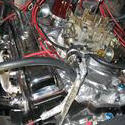
This is what I was telling you about except I used the flat top cap. Use this dist with an HEI module. MSD makes a ready to run distributor but it has a circuit board with a ton of electronics and I've seen them go out. With this 8361 you could use a 6al box but I just used the HEI coil instead so if they are out on the road and it fails they can just plug another readily available one in.
Reading on here I doubt you will notice a difference unless your stock one is wore out and needs rebuilt anyhow. I would think the only time you will know a difference is on a dyno in a RPM range you never drive in.
Unless you need to eliminate an external ignition coil for some reason you'll see no benefit worth mentioning; certainly not a "seat of the pants" improvement over the Pertronix. Take particular note of the chart in this article:
The myth of a hotter spark is right up there with those 45,000 volt systems...
In a properly tuned engine the spark is gonna cross the gap at the typical 15,000-20,000 volt range...
Potential energy spark works as soon as its high enough to jump the gap; it doesn't "build up" to some maximum spec to fire.
Last edited by Frankie the Fink; Dec 26, 2019 at 10:23 AM.
A properly tuned engine without worn ignition components or lean or rich mixtures should only need 8 - 12KV to overcome total resistance in the secondary circuit.
That includes, rotor to cap segment gap, ignition wire resistance and spark plug gap. Mixture will play a role in the resistance of the air gap of a spark plug, richer, less resistance and leaner higher resistance. When mixtures in the 70's were leaned out to a point of almost not running, GM went to large gaps, Oldsmobile went up to .080", to expose more spark to the mixture to ignite the fuel air charge. Those larger gaps needed more voltage to get across the gap and maintain the spark enough to fire the mixture and keep it burning.
This is why HEI was needed. It has the potential for over 40KV and the primary circuit only had 1/2 ohm resistance, when using Ohm's law it could pull up to 24 amps!
As Frankie has stated all this 45K stuff is not needed for our old cars. As this scope pattern will show you, that is my 61 fuelie pattern at idle, it is using under 10KV. The remainder of the voltage produced dissipates to ground. I am using the 0-25KV scale.
The extra voltage that the coil can produce is used during acceleration.
Joe
Here is a wire removed to show the potential voltage output of my stock GM coil, note it is over 25KV!
If your single point distributor is optimized there is no difference. I've run both TI and a "blueprinted" single point on my 340 HP SWC. and the only difference is that TI failed without warning twice in 50K miles... good riddance to it.
...suggest you search for threads started by me, download the distributor blueprint overhaul and breaker points article. It's a simple job to optimize the clearances on a single point and optimize the spark advance map if the shaft bushings are okay, and any competent engine shop should be able to replace them and hone to .001" clearance.
The distributor is the most overlooked component on the engine, and most out there have probably never had the above treatment, but a properly functioning distributor is absolutely necessary to achieving peak output and fuel economy. The single point rarely fails suddenly like electronic ignition systems, but they slowly degrade with time. Dwell angle timing should be checked every 10-15K miles or few years, and an overhaul should be done every 15-20 years in typical low annual mileage accumulation vintage car service. The primary unseen "degradation" is due to the upper bushing grease well drying out over mileage and time.
So, don't they still use an external coil? I guess the module just increases the voltage to the coil? I really don't see the advantage over a magnetic reluctor pickup with an external box similar to the old chrysler ignitions also made for Chevy by Malory and Accel. I have a couple in a box from racing days.
The coil is in the cap on the HEI, and, a Breakerless SE will give much of the same advantages, look completely stock and not "ugly up" your engine bay...and uses your perfectly fitting original distributor.
I think the OP is attempting to come up with "....an ingenious solution to a non-existent problem" to quote Jeff Cooper.
Last edited by Frankie the Fink; Dec 27, 2019 at 08:12 AM.
It would be interesting if one of you guys with a scope would take some HV screen shots during cranking to compare points and any EI system. The focus seems be on how the motor performs once it's running. That there isn't much difference between points and EI is old news. Starting, especially when cold, is another matter. Even the grouchy old man that did a lot of my restoration work, who'd practically sledgehammer anything that didn't come in a GM box, asked me why cars seem to start so much easier and get to a stable idle faster with EI. They seem to, and MSD for one, is really noticeable. Even when points are used as a trigger. I have my own theory, but no proof. Any takers?
From: I tend to be leery of any guy who doesn't own a chainsaw or a handgun.
Originally Posted by Avispa
It would be interesting if one of you guys with a scope would take some HV screen shots during cranking to compare points and any EI system. The focus seems be on how the motor performs once it's running. That there isn't much difference between points and EI is old news. Starting, especially when cold, is another matter. Even the grouchy old man that did a lot of my restoration work, who'd practically sledgehammer anything that didn't come in a GM box, asked me why cars seem to start so much easier and get to a stable idle faster with EI. They seem to, and MSD for one, is really noticeable. Even when points are used as a trigger. I have my own theory, but no proof. Any takers?
There's an Ignition sticky in C3 Tech that will address some of your questions, and point out some of the Ignition old wives' tales that are slow to die.
Thanks for that. Checked out the sticky and it's really good. Didn't see the particular issue discussed, namely, we assume that the condenser always breaks the arc across the points fast enough to avoid substantial energy loss in the point arc. At any speed above a few hundred RPM the scope proves this is the case. What about at cranking speed? Just a hunch, but points act like more of the coil energy gets burned in the arc at cranking speeds because of slow air gap expansion at the points. Does it? EI switching speed is related to how fast the electronic circuit element opens rather than a mechanical switch that arcs, so the distributor speed wouldn't affect the observable switch response at the coil.
From: I tend to be leery of any guy who doesn't own a chainsaw or a handgun.
Originally Posted by Avispa
Thanks for that. Checked out the sticky and it's really good. Didn't see the particular issue discussed, namely, we assume that the condenser always breaks the arc across the points fast enough to avoid substantial energy loss in the point arc. At any speed above a few hundred RPM the scope proves this is the case. What about at cranking speed? Just a hunch, but points act like more of the coil energy gets burned in the arc at cranking speeds because of slow air gap expansion at the points. Does it? EI switching speed is related to how fast the electronic circuit element opens rather than a mechanical switch that arcs, so the distributor speed wouldn't affect the observable switch response at the coil.
You are correct. Twelve volts (battery/alternator voltage) isn't enough to jump the points gap, so that tells us the voltage must be higher than twelve volts across the points when it arcs. That "higher than 12 volts" has to come from somewhere other than the battery/alternator, and that source is the energy stored in the coil's magnetic field. While the arc is happening, we're seeing the coil's magnetic field diminish. Once the points separate enough to "kill" the arc, the collapsing remainder of the magnetic field (the remaining energy in the coil) will build up a voltage across the secondary windings until the voltage builds up high enough to ionize/breakdown the A/F mixture in the plug gap. The energy dumped into the plug gap is then the coil energy (put in during dwell) minus the points gap arc energy that was wasted.
You are correct in your last comment as well. Electronic ignitions don't use a capacitor/condensor on the switch (ie: the transistor). This gives two improvements: There is less coil energy wasted, as there's no arcing anywhere in the primary circuit, and the coil is "allowed" to build more secondary voltage (if needed) due to the faster shutoff of the primary current. (There's a formula to explain this in case anyone is having a geek curiosity moment.)
Thanks for that, too. So there's an actual reason for EI systems to make an old timer start easier at least. You've probably been following the never ending points / EI discussions in this forum, most of which don't shed any more light than points are good enough, which for these cars they are. Finally an actual improvement in something, not trivial, with some theory to back it up. So if the OP wants to stick a modified HEI distributor under his shielding, go for it. There is a reason even if there are other solutions.
From: I tend to be leery of any guy who doesn't own a chainsaw or a handgun.
Originally Posted by Avispa
Thanks for that, too. So there's an actual reason for EI systems to make an old timer start easier at least. You've probably been following the never ending points / EI discussions in this forum, most of which don't shed any more light than points are good enough, which for these cars they are. Finally an actual improvement in something, not trivial, with some theory to back it up. So if the OP wants to stick a modified HEI distributor under his shielding, go for it. There is a reason even if there are other solutions.
I converted my stock distributor years ago to drive a stock HEI module and the stock can coil. Everything fits under the stock shielding, the parts are stone reliable, and I get great plug life with the extra energy of this system.
From: Las Vegas - Just stop perpetuating myths please.
Well 99 I think I will let you do the shopping for a small cap HEI with remote coil as there are so many choices. But it is such a simple conversion with only 1 wire to the distributor for power as it grounds through the body/case to the engine/manifold. Of course the the coil will have 2 wires but you should have a coil like that now with the Pertronix. Now the timing curve is still set with weights and springs and who know what kind of timing curve an aftermarket distributor will have? But myself I wouldn't pay over $100 for a small cap HEI and they make a great solution to points or whatever is in use. In fact they make a great tool box spare for troubleshooting also. Cheap enough to buy two.
Good luck.
Oh BTW you should bypass the old resistance wire to the coil (or ballast resistor if you have one) as its no longer needed.
If your single point distributor is optimized there is no difference. I've run both TI and a "blueprinted" single point on my 340 HP SWC. and the only difference is that TI failed without warning twice in 50K miles... good riddance to it.
...suggest you search for threads started by me, download the distributor blueprint overhaul and breaker points article. It's a simple job to optimize the clearances on a single point and optimize the spark advance map if the shaft bushings are okay, and any competent engine shop should be able to replace them and hone to .001" clearance.
The distributor is the most overlooked component on the engine, and most out there have probably never had the above treatment, but a properly functioning distributor is absolutely necessary to achieving peak output and fuel economy. The single point rarely fails suddenly like electronic ignition systems, but they slowly degrade with time. Dwell angle timing should be checked every 10-15K miles or few years, and an overhaul should be done every 15-20 years in typical low annual mileage accumulation vintage car service. The primary unseen "degradation" is due to the upper bushing grease well drying out over mileage and time.
Duke
THIS^^^. Lars even ran a side by side dyno test on a 302 Ford and had zero difference in HP and TQ when he switched the Buck Rogers Special Zapper back to the stock points distributor. There are more downsides with electronic ignition systems than points. ALL of my mechanic friends agree with this, coming from the same background of tow-ins and roadside stall-outs. NONE of my non-mechanic friends believe in points, and prefer to screw around with their fiddly electronic distributors that always seem to be on the fritz. To the OP: I would leave your Pertronix in place if it's working, and when it dies, I would re-install points. If you're bored and simply looking for something to 'fix', I recommend detailing the car or engine compartment.







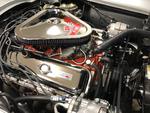


 Small Cap HEI Distributor