









Making progress...PICS!

Thread Starter
Melting Slicks

Joined: May 2009
Posts: 3,079
Likes: 315
2024 C3 of the Year Finalist - Unmodified
 Making progress...PICS!
This is my first restoration and it is taking more time and money than I originally thought. Trying to do a frame on is difficult but that is all I can afford or am able to do. Oh well. Here are some pictures...
Scraped a lot of undercoating off the floor pans.

There was 40 years of grease on the crossmember.

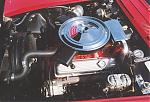
The engine has been completely rebuilt...zero time...balanced and bluprinted. It has a Comp Cams 268H grind in it with .020 over pistons. Made sure only the heads were shaved and not the block. Can't mess with that stamp pad!

Pulled 408 HP and 500 FT-LBS on 93 octane.

Centered the bellhousing with Moroso offset pins. Don't want that clutch to chatter.

New LUK clutch and pressure plate. The flywheel was resurfaced.

Hated to overspray the orange, but "Factory to Boxcar" was the method they used at Tonawanda back in 1969, so NCRS wants to see it. I guess the exhaust manifolds will burn theirs off.

Just mounting loose parts to clear the shelves and awaiting re-installation. Plan on trying to install with the tranny (also rebuilt)attached and the radiator support frame in place.

Scraped a lot of undercoating off the floor pans.
There was 40 years of grease on the crossmember.
The engine has been completely rebuilt...zero time...balanced and bluprinted. It has a Comp Cams 268H grind in it with .020 over pistons. Made sure only the heads were shaved and not the block. Can't mess with that stamp pad!
Pulled 408 HP and 500 FT-LBS on 93 octane.
Centered the bellhousing with Moroso offset pins. Don't want that clutch to chatter.
New LUK clutch and pressure plate. The flywheel was resurfaced.
Hated to overspray the orange, but "Factory to Boxcar" was the method they used at Tonawanda back in 1969, so NCRS wants to see it. I guess the exhaust manifolds will burn theirs off.
Just mounting loose parts to clear the shelves and awaiting re-installation. Plan on trying to install with the tranny (also rebuilt)attached and the radiator support frame in place.
Last edited by Faster Rat; Sep 9, 2009 at 12:01 PM.
GM Cert Corvette Tech


Joined: Apr 2008
Posts: 2,559
Likes: 585
From: Anaheim Hills California
Very Nice It brings back memories of when I finished rebuilding/restoring my #'s matching 68/427..Isn't it a great feeling seeing the progress you make day by day of it going back together.
It brings back memories of when I finished rebuilding/restoring my #'s matching 68/427..Isn't it a great feeling seeing the progress you make day by day of it going back together.
Drifting


Joined: Aug 2003
Posts: 1,327
Likes: 16
From: Fl
Im not to sure the manifolds are supposed to be painted in 1969.
I was looking at the 68-69 TJM and it read more like very early 1968 might have some orange overspary where the bolts are but then Tonowanda quit spraying the manifolds&engine as an assembly up through 1974 production.
Otherwise - DAMN nice job!!!!!!
I was looking at the 68-69 TJM and it read more like very early 1968 might have some orange overspary where the bolts are but then Tonowanda quit spraying the manifolds&engine as an assembly up through 1974 production.
Otherwise - DAMN nice job!!!!!!
Team Owner


Joined: Sep 2006
Posts: 31,270
Likes: 4,362
From: Westminster Maryland
Hi FR,
Thanks very much for the interesting pictures. I always enjoy SEEING what people are working on.
I started work on my 71 thinking the body would stay on the frame, but changed my mind as I progressed.
Quite a nice pad surface.
Regards,
Alan
Thanks very much for the interesting pictures. I always enjoy SEEING what people are working on.
I started work on my 71 thinking the body would stay on the frame, but changed my mind as I progressed.
Quite a nice pad surface.
Regards,
Alan
Corvette Stories
The Best of Corvette for Corvette Enthusiasts

Top 10 Most Expensive Corvettes Ever Sold on Bring A Trailer
Brett Foote
10 Things Every Corvette Owner Needs (2026 Edition)
Michael S. Palmer
8 Most "Only Corvette Owners Understand" Quirks and Problems
Pouria Savadkouei
10 Reasons the C6 Z06 is Still A Performance Benchmark After 20 Years
Joe Kucinski
How Much Horsepower Every Corvette Engine "LOST" in 1972
Joe Kucinski
Top 10 DOs and DON'Ts for Protecting Your Convertible Top!
Michael S. Palmer
Top 10 Most Explosive Corvettes Ever Made: Power-to-Weight Ratio Ranked!
Joe Kucinski
150 hp to 1,250 hp: Every Corvette Generation Compared by the Specs That Matter
Joe Kucinski
8 Coolest Corvette Pace Cars (and Replicas) of All Time
Verdad Gallardo
Thread Starter
Melting Slicks
Joined: May 2009
Posts: 3,079
Likes: 315
2024 C3 of the Year Finalist - Unmodified
The judging manual also says "some post-1968 427 engines had orange paint on the exhaust manifolds and appear to have been painted at Tonawanda with the exhaust manifolds in place." Mine still had yellowish paint residue on them.
I've seen old black and white photographs of them spray painting these engines on the open 427 assembly line, with the manifolds in place and they didn't even use breathing masks. They evidently did not spend a lot of time doing this.
Drifting
Joined: Aug 2003
Posts: 1,327
Likes: 16
From: Fl
I can vouche for the bell housing painting -
I had very little coverage on the bottom side and it was applied very quickly everywhere else
My shifter fork had orange dusting on it, it was directional from the front to the rear.
As for the manifolds - the TJM is a guide. It does not mean that other variations did not happen. It sounds like your engine had paint applied at Tonowanda.
Hell - I put plenty of things back the way I found them durring my restoration. Some of them did not match the TJM and I took a couple point hits for it. For me - reassembling as it was found is WAY more important.
Please keep posting pictures - awsome job!!!
I had very little coverage on the bottom side and it was applied very quickly everywhere else
My shifter fork had orange dusting on it, it was directional from the front to the rear.
As for the manifolds - the TJM is a guide. It does not mean that other variations did not happen. It sounds like your engine had paint applied at Tonowanda.
Hell - I put plenty of things back the way I found them durring my restoration. Some of them did not match the TJM and I took a couple point hits for it. For me - reassembling as it was found is WAY more important.
Please keep posting pictures - awsome job!!!


Race Director


Joined: Aug 1999
Posts: 11,119
Likes: 672
From: SE Pennsylvania
St. Jude Donor '03 thru '26
Oldtimer

Thread Starter
Melting Slicks
Joined: May 2009
Posts: 3,079
Likes: 315
2024 C3 of the Year Finalist - Unmodified
I can guarantee you that I will not pull the body...unless I win the lotto. The "while I'm at its" are really busting the bank. I haven't even contemplated starting on the back end yet. I really need to finish the front end, clear the parts off the shelves and empty my brain. This fastener thing (documenting, cleaning, media-blasting, bagging and labeling) and all the other re-plating (hood support, hood brackets, clutch shaft, "parkerized" floor pans, etc) really add to the job. The stuff that can be done later (like accessible from the top) will just have to wait for another day.
Terrorizing Orange Cones


Joined: Oct 2007
Posts: 2,572
Likes: 17
From: Northern CO
That is beautiful work, Faster Rat.
I am always fascinated by the engineering and assembly involved, back in the day as well as your efforts to date.
If I had the resources, it would be a fun (in a macabre-sort-of-way) to attempt a "correct" restoration of one of these cars.
Good luck and keep sharing your progress. We enjoy watching the car develop!
I am always fascinated by the engineering and assembly involved, back in the day as well as your efforts to date.
If I had the resources, it would be a fun (in a macabre-sort-of-way) to attempt a "correct" restoration of one of these cars.
Good luck and keep sharing your progress. We enjoy watching the car develop!

Thread Starter
Melting Slicks
Joined: May 2009
Posts: 3,079
Likes: 315
2024 C3 of the Year Finalist - Unmodified
More Progress
Here are some more pictures:
Preparation for painting

Engine compartment

Crossmember

Chart from engine dyno

Bored .020 over, forged pistons, Comp Cams High Energy Series, grind #268H with hydraulic lifters, valves, springs, resized rods and crankshaft, etc. Ran with stock carb and 93 pump gas. We used an HEI distributor on the dyno because my rebuilt stock points distributor fell a little short. Plan on trying something with the coil after the engine is installed in the car.
Preparation for painting
Engine compartment
Crossmember
Chart from engine dyno
Bored .020 over, forged pistons, Comp Cams High Energy Series, grind #268H with hydraulic lifters, valves, springs, resized rods and crankshaft, etc. Ran with stock carb and 93 pump gas. We used an HEI distributor on the dyno because my rebuilt stock points distributor fell a little short. Plan on trying something with the coil after the engine is installed in the car.