





The difference between the tri power and regular carbs

Thread Starter
Intermediate

Joined: Jan 2011
Posts: 31
Likes: 0
From: Wexford PA
 The difference between the tri power and regular carbs
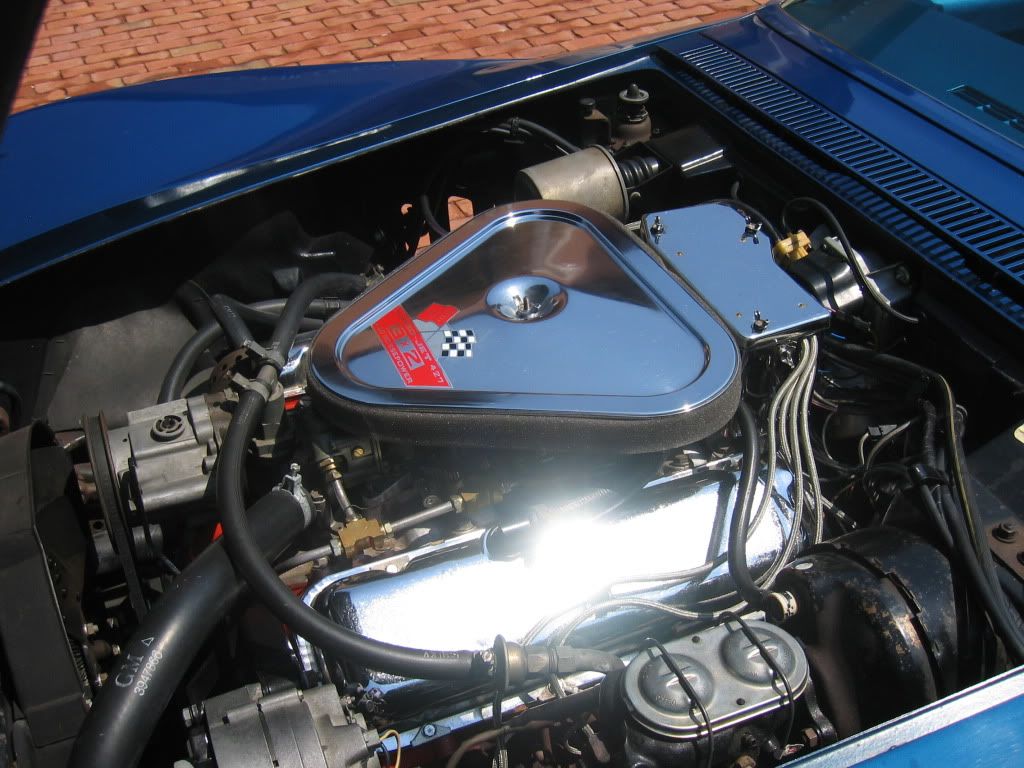
Hey, I have notice that on some vette engines I see there is the triangle carb that says "tri" power and some are just regular round carbs. Was the tri power carb an option?
Le Mans Master


Joined: Nov 2001
Posts: 8,808
Likes: 1,950
From: LONG ISLAND
2025 C3 ('68-'73) of the Year Finalist - Unmodified
2024 C3 of the Year Finalist - Unmodified
2023 C3 of the Year Finalist - Unmodified
..........The difference is a lot more tuning  & a lot more money
& a lot more money

Melting Slicks


Joined: Feb 2001
Posts: 3,330
Likes: 13
From: Europe , Luxembourg
Hi
Tripowers are a great setup and tuning is rather easy. Really it is only a question of correctly adjusting the linkage.
Tripower are cool looking and last but not least are the carb with the best fuel economy when driving correctly, but with fire and lots of power if required.
This because the primary carb ( center ) is rather small designed, hence regulating a correct fuel/air mixture in low RPM ranges and if required, you add 2 ea secondary carbs and open the breath right up.
Best carb for my 68 BB I drove and I tried 650, 750 and 850 DB B4.

Rgds. Günther
Tripowers are a great setup and tuning is rather easy. Really it is only a question of correctly adjusting the linkage.
Tripower are cool looking and last but not least are the carb with the best fuel economy when driving correctly, but with fire and lots of power if required.
This because the primary carb ( center ) is rather small designed, hence regulating a correct fuel/air mixture in low RPM ranges and if required, you add 2 ea secondary carbs and open the breath right up.
Best carb for my 68 BB I drove and I tried 650, 750 and 850 DB B4.
Rgds. Günther
Team Owner


Joined: Sep 2006
Posts: 31,285
Likes: 4,375
From: Westminster Maryland
Hi,
From the very beginning Corvettes have often had multiple carbs.
Even the original 53/54/55 6 cylinder motors had 3 carburetors. Then for a few years there were optional engines with 2- 4 barrel carburetors (56-60?). In the mid-sixties 3-2 barrel set-ups became popular (GTO, Ford, Dodge, Plymouth cars) so along came the 435 hp cars with 3-2 barrel carbs.
Regards,
Alan
From the very beginning Corvettes have often had multiple carbs.
Even the original 53/54/55 6 cylinder motors had 3 carburetors. Then for a few years there were optional engines with 2- 4 barrel carburetors (56-60?). In the mid-sixties 3-2 barrel set-ups became popular (GTO, Ford, Dodge, Plymouth cars) so along came the 435 hp cars with 3-2 barrel carbs.
Regards,
Alan
Corvette Stories
The Best of Corvette for Corvette Enthusiasts

Top 10 Most Expensive Corvettes Ever Sold on Bring A Trailer
Brett Foote
10 Things Every Corvette Owner Needs (2026 Edition)
Michael S. Palmer
8 Most "Only Corvette Owners Understand" Quirks and Problems
Pouria Savadkouei
10 Reasons the C6 Z06 is Still A Performance Benchmark After 20 Years
Joe Kucinski
How Much Horsepower Every Corvette Engine "LOST" in 1972
Joe Kucinski
Top 10 DOs and DON'Ts for Protecting Your Convertible Top!
Michael S. Palmer
Top 10 Most Explosive Corvettes Ever Made: Power-to-Weight Ratio Ranked!
Joe Kucinski
150 hp to 1,250 hp: Every Corvette Generation Compared by the Specs That Matter
Joe Kucinski
8 Coolest Corvette Pace Cars (and Replicas) of All Time
Verdad Gallardo
Team Owner

Joined: Jun 2000
Posts: 38,923
Likes: 1,482
From: Southbound
Cruise-In II Veteran


Melting Slicks
Joined: May 2009
Posts: 3,079
Likes: 315
2024 C3 of the Year Finalist - Unmodified
Hi,
From the very beginning Corvettes have often had multiple carbs.
Even the original 53/54/55 6 cylinder motors had 3 carburetors. Then for a few years there were optional engines with 2- 4 barrel carburetors (56-60?). In the mid-sixties 3-2 barrel set-ups became popular (GTO, Ford, Dodge, Plymouth cars) so along came the 435 hp cars with 3-2 barrel carbs.
Regards,
Alan
From the very beginning Corvettes have often had multiple carbs.
Even the original 53/54/55 6 cylinder motors had 3 carburetors. Then for a few years there were optional engines with 2- 4 barrel carburetors (56-60?). In the mid-sixties 3-2 barrel set-ups became popular (GTO, Ford, Dodge, Plymouth cars) so along came the 435 hp cars with 3-2 barrel carbs.
Regards,
Alan

Safety Car


Joined: Sep 2005
Posts: 4,062
Likes: 104
From: Southeast, Tennessee
St. Jude Donor '09 thru '26
 and it is the difference between having 3 carbs (with 2 barrels each) vs a 4 barrel single carb as mentioned
Team Owner
Joined: Jun 2000
Posts: 38,923
Likes: 1,482
From: Southbound
Cruise-In II Veteran
Advanced

Joined: Dec 2010
Posts: 62
Likes: 0
From: Biloxi Mississippi
I believe the 68 set up on tri power had all 3 carbs at 350cfm for a total of 1050. On my 69 GTX, the center carb is 385 and the 2 outboards are 500 each for a total of 1385 but that does not make it faster than the Vette.


Race Director


Joined: Jul 2000
Posts: 16,510
Likes: 2,400
From: Out Where the Buses Don't Run, Eglin AFB/ Niceville FL
2025 C8 Z06/7/E-Ray of the Year Finalist - Unmodified
2022 Corvette of the Year Finalist -- Modified
2021 C6 of the Year Winner - Modified
2020 C7 of the Year Finalist -- Modified
2020 C6 of the Year Finalist - Modified


Team Owner

Joined: Jan 2006
Posts: 37,637
Likes: 3,118
From: Crossville TN
EFI eliminated the need for carburetors. Carbs attempted to manage fuel flow efficiently throughout the range of engine use; some did better at it than others. A tri-power setup which operated mainly on the center carb with mechanical kick-in on the outer carbs at WOT was economical and powerful. For a carbed engine (which needed that much airflow), tri-power was a great option but was much more expensive than a single 4-barrel carb.
EFI and electronic controls made carbs obsolete (except on vintage cars, of course).
EFI and electronic controls made carbs obsolete (except on vintage cars, of course).
Le Mans Master
Joined: Nov 2001
Posts: 8,808
Likes: 1,950
From: LONG ISLAND
2025 C3 ('68-'73) of the Year Finalist - Unmodified
2024 C3 of the Year Finalist - Unmodified
2023 C3 of the Year Finalist - Unmodified
Just try one...........you will be HOOKED forever, there is NOTHING like a 427 with TRIPS.... NOTHING !!!

 (but it was still a tri-power!)