Engine Compartment Detailing


Team Owner


Joined: Jan 2006
Posts: 37,637
Likes: 3,118
From: Crossville TN

Volatile cleaner: Nothing better than Paint Thinner. You can buy it by the gallon at Lowe's. Brake cleaner is too darn expensive and you can only get it in spray cans, I think.
Polymer protectant: Nu-Vinyl, Meguiar's protectant for plastics, etc. These are not 'oily'; they dry completely and stay shiny for a long time, you can put coat upon coat without problem. Great stuff for interiors, rubber, leather, etc.
Polymer protectant: Nu-Vinyl, Meguiar's protectant for plastics, etc. These are not 'oily'; they dry completely and stay shiny for a long time, you can put coat upon coat without problem. Great stuff for interiors, rubber, leather, etc.


Thread Starter
Le Mans Master


Joined: Sep 2002
Posts: 5,236
Likes: 898
From: Myrtle Beach SC
Update
I'm now ready to paint the block and cleaning it is tough when its not out of its comfy, little compartment. I think I've got it as clean as its going to get. A few lessons or observations...
With the engine ready for paint, exhaust manifolds are off along with valve covers, oil pan, balancer and timing chain cover.
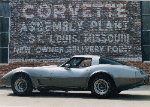
Apparently, the flywheel was attached when the engine plant spray painted the engine...they are blue! The torque converter cover must have been a St Louis assembly plant engine dress item.
Pulleys have part numbers and broadcast codes that match up nicely with a build sheet
An air needle scaler works nice to remove flakey, paint and rust...a tip from 69vett
Pulled the drain plugs and completed draining the block. Driver's side had sufficient gunk that blocked the drain hole. A scribe worked well to open the drain hole.
Wood chisels have a nice sharp edge to remove gaskets and the typical set of three sizes works well for all gasket widths.
Blast cabinet is almost an essential to get everything clean and pretty prior to paint and assembly in an efficient manner.
Don't forget to sift the debris out of the blast cabinet when its starts to clog and fail to "cut" rust and paint.
Yorky, who has done this to his small fleet of late C3s several times, knows well great techniques when the engine is in the compartment.
Its also a great time to change plugs that are now easy to access with exhaust manifolds, heat shields and related emission devices removed that otherwise, stymy easy access to the plugs.
Ok...there's probably more but my mind is numb
With the engine ready for paint, exhaust manifolds are off along with valve covers, oil pan, balancer and timing chain cover.
Apparently, the flywheel was attached when the engine plant spray painted the engine...they are blue! The torque converter cover must have been a St Louis assembly plant engine dress item.
Pulleys have part numbers and broadcast codes that match up nicely with a build sheet
An air needle scaler works nice to remove flakey, paint and rust...a tip from 69vett
Pulled the drain plugs and completed draining the block. Driver's side had sufficient gunk that blocked the drain hole. A scribe worked well to open the drain hole.
Wood chisels have a nice sharp edge to remove gaskets and the typical set of three sizes works well for all gasket widths.
Blast cabinet is almost an essential to get everything clean and pretty prior to paint and assembly in an efficient manner.
Don't forget to sift the debris out of the blast cabinet when its starts to clog and fail to "cut" rust and paint.
Yorky, who has done this to his small fleet of late C3s several times, knows well great techniques when the engine is in the compartment.
Its also a great time to change plugs that are now easy to access with exhaust manifolds, heat shields and related emission devices removed that otherwise, stymy easy access to the plugs.
Ok...there's probably more but my mind is numb