







Close ratio 4 speed?

Team Owner


Joined: Jul 1999
Posts: 26,545
Likes: 46
From: Huntersville NC

If the car is running there is an easy way to tell by checking rpm changes vs speed, but I won't waste your time (or mine) with it if the car is not running. (I would have to look up the gear ratios and do the calculations, or find the last thread where the process was described)
ok.. http://forums.corvetteforum.com/1556491669-post2.html
ok.. http://forums.corvetteforum.com/1556491669-post2.html
Last edited by PRNDL; Sep 23, 2012 at 09:07 PM.

Thread Starter
Melting Slicks


Joined: Aug 2012
Posts: 3,487
Likes: 83
From: Titusville Florida
Corvette Stories
The Best of Corvette for Corvette Enthusiasts

Top 10 Most Expensive Corvettes Ever Sold on Bring A Trailer
Brett Foote
10 Things Every Corvette Owner Needs (2026 Edition)
Michael S. Palmer
8 Most "Only Corvette Owners Understand" Quirks and Problems
Pouria Savadkouei
10 Reasons the C6 Z06 is Still A Performance Benchmark After 20 Years
Joe Kucinski
How Much Horsepower Every Corvette Engine "LOST" in 1972
Joe Kucinski
Top 10 DOs and DON'Ts for Protecting Your Convertible Top!
Michael S. Palmer
Top 10 Most Explosive Corvettes Ever Made: Power-to-Weight Ratio Ranked!
Joe Kucinski
150 hp to 1,250 hp: Every Corvette Generation Compared by the Specs That Matter
Joe Kucinski
8 Coolest Corvette Pace Cars (and Replicas) of All Time
Verdad Gallardo
Melting Slicks

Joined: Apr 2001
Posts: 3,399
Likes: 278
From: Olmsted Falls, Ohio
Might be long gone but:
The first gear ratio was indicated by a 2-digit paint code on the main case below the side cover. "HS" is a 2.64:1 wide ratio, and "HW" is a 2.43:1 close-ratio.
The first gear ratio was indicated by a 2-digit paint code on the main case below the side cover. "HS" is a 2.64:1 wide ratio, and "HW" is a 2.43:1 close-ratio.
Thread Starter
Melting Slicks
Joined: Aug 2012
Posts: 3,487
Likes: 83
From: Titusville Florida
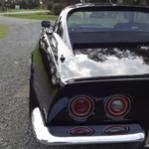
 the tranny looks almost new now
  the part that pleased me the most is it's numbers matching to go with my motor (that I just pulled and will put away).
Drifting

Joined: Jan 2012
Posts: 1,908
Likes: 129
From: Fredericksburg Virginia
I had the same question of my car, so I performed a numerical analysis on the anticipated RPM drop through each gear for the M20 vs. the M21 (and M22, I guess, since their ratios are the same)
This is completely independent of speed, since that can vary based on your rear end ratio. This is STRICTLY the RPM drops by transmission types.
If you shift at 3,000 RPM, these are the respective RPM's for the gear you are shifting INTO.
M20 (shifting at 3,000 RPM):
2nd: 2238 RPM
3rd: 2345 RPM
4th: 2040 RPM
M21 (shifting at 3,000 RPM):
2nd: 2236 RPM
3rd: 2323 RPM
4th: 2362 RPM
Note that there really isn't much difference in first to second or second to third RELATIVE TO EACH OTHER. Of course, if you were driving an M21, you would be traveling faster in each gear versus an M20 since each of those three gears is numerically taller.
The big difference is shifting from third to fourth. This is where the taller gears in the M21 catches up with the identical 1:1 gear in 4th. There is only a ~650 RPM drop in the M21 while there is nearly a 1,000 RPM drop in the M20.
So. If you have a 1,000 RPM drop when shifting from third to fourth, making the shift at 3,000 RPM, then you have an M20.
This is completely independent of speed, since that can vary based on your rear end ratio. This is STRICTLY the RPM drops by transmission types.
If you shift at 3,000 RPM, these are the respective RPM's for the gear you are shifting INTO.
M20 (shifting at 3,000 RPM):
2nd: 2238 RPM
3rd: 2345 RPM
4th: 2040 RPM
M21 (shifting at 3,000 RPM):
2nd: 2236 RPM
3rd: 2323 RPM
4th: 2362 RPM
Note that there really isn't much difference in first to second or second to third RELATIVE TO EACH OTHER. Of course, if you were driving an M21, you would be traveling faster in each gear versus an M20 since each of those three gears is numerically taller.
The big difference is shifting from third to fourth. This is where the taller gears in the M21 catches up with the identical 1:1 gear in 4th. There is only a ~650 RPM drop in the M21 while there is nearly a 1,000 RPM drop in the M20.
So. If you have a 1,000 RPM drop when shifting from third to fourth, making the shift at 3,000 RPM, then you have an M20.
Melting Slicks
Joined: Apr 2001
Posts: 3,399
Likes: 278
From: Olmsted Falls, Ohio
1975 L82 with close ratio trans (still optioned as M21 on the order sheet) would default to the standard (GV7 option) 3.55 rear gears, unless specifically ordered otherwise.
Drifting
Joined: Jan 2012
Posts: 1,908
Likes: 129
From: Fredericksburg Virginia
I'm confused. So you have a "close ratio" transmission that actually has 1st, 2nd, and 3rd gears that DON'T have as much mechanical advantage over the car and you couple that with 2.78 or 3.08 rear gears?
Seems like that would make the thing a real dog off the line.
Unless the car with the M21 and 2.78 rears has a REAL HORSE of an engine, I'd politely offer that my M20 equipped car (with 15% shorter gear in 1st) with 3.73 rear gears would politely spring off the line compared to the other.
Granted, I'd be shifting more often, but I'd honestly rather have the "sprightlyness" of the shorter gears all around.
The benefit to having low rear gears is that my car will run out of steam about 120 MPH, while the 2.78 car would make it to nearer 160 MPH at the same RPM. But, again, at the cost of responsiveness all the way up to 160 MPH. And who among us have made it to 120 in a C3? I've made it to 100 and that's about all I have the stones for...
Seems like that would make the thing a real dog off the line.
Unless the car with the M21 and 2.78 rears has a REAL HORSE of an engine, I'd politely offer that my M20 equipped car (with 15% shorter gear in 1st) with 3.73 rear gears would politely spring off the line compared to the other.
Granted, I'd be shifting more often, but I'd honestly rather have the "sprightlyness" of the shorter gears all around.
The benefit to having low rear gears is that my car will run out of steam about 120 MPH, while the 2.78 car would make it to nearer 160 MPH at the same RPM. But, again, at the cost of responsiveness all the way up to 160 MPH. And who among us have made it to 120 in a C3? I've made it to 100 and that's about all I have the stones for...

Race Director

Joined: Jul 2001
Posts: 15,892
Likes: 42
Drifting
Joined: Jan 2012
Posts: 1,908
Likes: 129
From: Fredericksburg Virginia
I agree with Mike. Looking at my 1970 brocure, the close ratio trans is always mated to higher gear ratio in the rear end.
I ficture that everyone wants the "better" transmission and there is a HALO around the M22 Rock-Crusher.
I was actually happy to have the 'lowly' M20, though. It just makes more sense for street use.
The M21 and M22 make more sense if you're on the track and start/stop, like, twice per race. You spend all your time "in the gears".
If I'm running from stop light to stop light, I'd prefer the first gear in the M20.
I ficture that everyone wants the "better" transmission and there is a HALO around the M22 Rock-Crusher.
I was actually happy to have the 'lowly' M20, though. It just makes more sense for street use.
The M21 and M22 make more sense if you're on the track and start/stop, like, twice per race. You spend all your time "in the gears".
If I'm running from stop light to stop light, I'd prefer the first gear in the M20.