



71 lt-1
Thread Starter
Burning Brakes

Joined: Mar 2010
Posts: 803
Likes: 4
From: Christchurch, New Zealand
 71 lt-1
I still regard myself as a Corvette noob, having owned one for only 3 years or so, but thanks to you guys, I'm learning all the time.
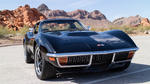
SO, am I right in thinking all ain't right with this LT-1 on eBay that's advertised as a matching numbers car.
http://cgi.ebay.com/ebaymotors/1971-Chevrolet-Corvette-Convertible-LT1-Very-Original-Car-/330897048819?pt=US_Cars_Trucks&hash=item4d0b0044f3As I said, I'm no expert, but isn't that a 327 under the hood?

SO, am I right in thinking all ain't right with this LT-1 on eBay that's advertised as a matching numbers car.
http://cgi.ebay.com/ebaymotors/1971-Chevrolet-Corvette-Convertible-LT1-Very-Original-Car-/330897048819?pt=US_Cars_Trucks&hash=item4d0b0044f3As I said, I'm no expert, but isn't that a 327 under the hood?

Team Owner


Joined: Jan 2007
Posts: 53,648
Likes: 878
From: Southern Cal Ca
St. Jude Donor '22
looks legit.
LT 1 is a package
to include: big block half shafts, 6500 redline, bigger rad
4 speed
rear end
350/330 HP
Solids and steel crank.
if my memory serves.
been a while.
No 327 in 71.
LT 1 is a package
to include: big block half shafts, 6500 redline, bigger rad
4 speed
rear end
350/330 HP
Solids and steel crank.
if my memory serves.
been a while.
No 327 in 71.

Team Owner


Joined: Jan 2006
Posts: 37,637
Likes: 3,118
From: Crossville TN
Well, the '71 LT-1 engine didn't come with an oil fill tube at the front of the intake manifold. And, the valve cover is not right. Either the engine has been changed, or the intake manifold has been changed to a '68 part.
Either way, it's not completely legitimate.
P.S. Another look shows the block stamp with a different VIN derivative than the windshield post plate.
Either way, it's not completely legitimate.
P.S. Another look shows the block stamp with a different VIN derivative than the windshield post plate.
Last edited by 7T1vette; Mar 27, 2013 at 12:41 AM.
Team Owner
Joined: Jan 2007
Posts: 53,648
Likes: 878
From: Southern Cal Ca
St. Jude Donor '22
Well, the '71 LT-1 engine didn't come with an oil fill tube at the front of the intake manifold. And, the valve cover is not right. Either the engine has been changed, or the intake manifold has been changed to a '68 part.
Either way, it's not completely legitimate.
P.S. Another look shows the block stamp with a different VIN derivative than the windshield post plate.
Either way, it's not completely legitimate.
P.S. Another look shows the block stamp with a different VIN derivative than the windshield post plate.
you see the block numbers?

Instructor

Joined: Feb 2013
Posts: 197
Likes: 0
I did not know there were two grades of half-shafts. Can you possibly link me to some reading on this (so as to save yourself the typing?).
It raises a lot of questions for me--one being, do people with a SBC that upgrade to a BBC, or go (potent) crate motor, have to upgrade their half shafts too?
Are catastrophic failures common, for those that don't upgrade?
I'd like to educate myself on the difference in specs, and how to tell one from the other.
Thank you for entertaining a noobs questions.

Peter

Race Director


Joined: Oct 2000
Posts: 12,710
Likes: 3,163
From: Shamong, NJ
There are no "big block" half shafts.
65-74 big blocks, as well as LT-1's, came with different stub axles, than most other small blocks. On the big blocks, the U-joint is attached to the stub axle by a cast iron cap, and 2 bolts. On regular stub axles, the U-joint is secured by a formed strap that wraps around the U-joint, and 2 nuts. The stub axle, is the short side yoke, on each side of the rear end, that the half shafts attach to. Sometimes the big block stub axles, are referred to as heavy duty ones.
Around 75, Chevrolet switched to larger diameter half shafts. People often think that these later larger half shafts are stronger. It's my understanding, that the larger diameter shafts, are made from thinner material, and are no stronger, than the earlier small diameter half shafts.
I've spoken to people. who mistakenly believe that the later large diameter half shafts, where for big blocks. They never were used on a big block.
It's probably not a bad idea, to use the stronger heavy duty stub axles, with a "potent" engine, but I'm not sure it necessary. The factory used the regular stub axles, with the 64-65-66 327/365, and the 64-65 327/375 fuelie. Both of those engines, produced quite a bit of power!
I'd say that failure of the spindle (in the trailing arm), is more common, than the stub axle.
The weakest link in the rear drive train, is probably the U-joints, a lot of people use. The factory used solid ones, without grease fittings. The aftermarket ones, with the grease fittings, may be more convenient, but usually aren't as strong. I know a lot more people who have broken U-joints, than have ever broken a stub axle.
There are now U-joints with the grease fitting, in the end of the U-joint, instead of in the X. These are stronger, but still not as good as the solid ones, at least in my opinion.
65-74 big blocks, as well as LT-1's, came with different stub axles, than most other small blocks. On the big blocks, the U-joint is attached to the stub axle by a cast iron cap, and 2 bolts. On regular stub axles, the U-joint is secured by a formed strap that wraps around the U-joint, and 2 nuts. The stub axle, is the short side yoke, on each side of the rear end, that the half shafts attach to. Sometimes the big block stub axles, are referred to as heavy duty ones.
Around 75, Chevrolet switched to larger diameter half shafts. People often think that these later larger half shafts are stronger. It's my understanding, that the larger diameter shafts, are made from thinner material, and are no stronger, than the earlier small diameter half shafts.
I've spoken to people. who mistakenly believe that the later large diameter half shafts, where for big blocks. They never were used on a big block.
It raises a lot of questions for me--one being, do people with a SBC that upgrade to a BBC, or go (potent) crate motor, have to upgrade their half shafts too?
Are catastrophic failures common, for those that don't upgrade?
The weakest link in the rear drive train, is probably the U-joints, a lot of people use. The factory used solid ones, without grease fittings. The aftermarket ones, with the grease fittings, may be more convenient, but usually aren't as strong. I know a lot more people who have broken U-joints, than have ever broken a stub axle.
There are now U-joints with the grease fitting, in the end of the U-joint, instead of in the X. These are stronger, but still not as good as the solid ones, at least in my opinion.
Team Owner

Joined: Sep 2006
Posts: 31,339
Likes: 4,459
From: Westminster Maryland
Hi Peter,
I believe you'll find that the half shaft itself was the same for sb/bb cars and also of reg. suspension and hd suspension.
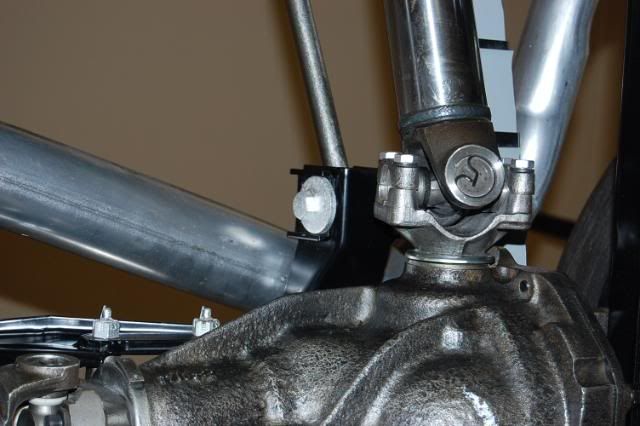
The difference was that sb low horsepower cars had a strap and nuts for the u-joint connection while the sb high performance engine and the bb engine used cap and bolts.
Many of the vendor's catalogues show the 2 different parts.
Hope this helps.
Regards,
Alan
PS: Sorry GB answered while I was looking for my pictures! Too Slow!
Here's the std sb u-bolt and nuts.

Here's the cap and bolt on a bb.
I believe you'll find that the half shaft itself was the same for sb/bb cars and also of reg. suspension and hd suspension.
The difference was that sb low horsepower cars had a strap and nuts for the u-joint connection while the sb high performance engine and the bb engine used cap and bolts.
Many of the vendor's catalogues show the 2 different parts.
Hope this helps.
Regards,
Alan
PS: Sorry GB answered while I was looking for my pictures! Too Slow!
Here's the std sb u-bolt and nuts.
Here's the cap and bolt on a bb.
Corvette Stories
The Best of Corvette for Corvette Enthusiasts

Corvette & Porsche 911: How Two Icons Conquered the Last 25 Years
Joe Kucinski
2027 Chevrolet Silverado 1500 First Look: Everything You NEED to Know!
Michael S. Palmer
5 Best & 5 Worst Corvette Daily Drivers
Joe Kucinski
The Headlights of Every Corvette Generation Explained
Joe Kucinski
5 Best & 5 Most Overrated Corvette Track Packages of All Time!
Joe Kucinski
Every 2027 Corvette Engine Explained
Joe Kucinski
Designer Imagines A Corvette That Looks More Like a Corvette Than the Corvette
Verdad Gallardo
10 Ugly Corvettes That We Still Kinda Love
Joe Kucinski
Top 10 Most Expensive Corvettes Ever Sold on Bring A Trailer
Brett Foote
Safety Car

Joined: May 2008
Posts: 3,756
Likes: 726
From: Lafayette Louisiana
There was a long list of LT-1 attributes on here somewhere.
There was a long list of LT-1 attributes on here somewhere.
I copied into a word doc as follows (on #8 I thought the 70 LT-1 had a different part# intake, the 71 72 had the 3959594) (much thanks to whoever posted this):
There are a few things that only a LT-1 would have , some are pretty easy to change out and some are not very easy at all.in no piticular order.
1st. No 1970 or 1971 LT-1 had A/C
2nd. Emmission sticker on fire wall behind master cylinder should have letters AX on upper left corner for a 71.
3rd. All LT-1's are 4 speeds. (M20 was std , M21/M22 were optional)
4th. Tach has 6,500 RPM red line on 1970 & 1971 and on 72's w/o AC
5th. All 71 LT-1's came with A.I.R. system. If removed should still have manifolds with holes for the tubes, Car may have headers and if so ask to see old manifolds.
6th. LT-1's had copper radiator W/O a overflow canisiter on the passanger side fenderwell. There should also be no holes whers one had been mounted.
7th. All 70 / 71 LT-1's had Tranisitor Ign. system. That may have been removed. But if it is removed look for the 3 holes on the front face of the driver side inner fender well where the Amplifer box was mounter.
Take a flashlight and look in front of the front wheel or open hood and look at it from the front side. 2 holes on bottom and 1 on top.
8th. Should have a Winters snowflake intake manifold with casting # 3959594
9th. LT-1's had a Holley carb. so there is only 1 fuel line , no return line like a quadra-jet carb. Look along frame rail on passanger side for the single line. Also the fuel tank is different. There should be no nipple on the passanger side, side wall for a return line.
If you lay on your back under the rear wheel you can reach your hand up and feel for an indention on the passanger side. If there is a nipple that is capped off , then beware.
Also the single fuel line on a LT-1 was not the same line that was used to feed fuel on the 2 line set up. So if someone removed the return line the look of the 3/8 line is still different. Not a big difference but if you can look at a car with a 2 line set up then you can see what you do not want to find.
10th. LT-1's had solid lifters , but if the car does not then that is not to big a red flag. Many people do not like them and may have replaced with HYD. lifters during a rebuild.
11th. The hardest to fake and most expensive would be the 4 bolt main block. No # on the outside of the block can verify this.
Only way to verify is to remove the pan or have a lighted optical viewer and remove the drain plug.
12th. LT-1's use 2.5" exhaust pipes like the big block cars. But the manifolds were still 2" set up. So the pipes flair from 2 to 2.5" about 6 inches from the manifold. The exhaust hangar at the trans is also different. Look on line at the Corvette Central site and you can see both 2" and 2.5" hangars.
13th. As I recall the highest rear end gear was 3:36 if trans was a M20
And id Trans was a M21 or M22 the 3:55 was highest gear
M20 3:36 Economy
3:55 Standard
3:70 Performance
M21 / M22
3:55 Economy
3:70 Standard
4:11 Performance
14th. The 71 /71 LT-1 Aluminum valve covers should have a rubber oil cap not a twist in. These covers are very hard to find. All the catalouges sell the twist in cap style.
15th. LT-1's have the same heavy duty half shaft retainers as big block cars. look at the rear end side yokes, there should be caps with bolts. Base cars used U bolts with nuts.
16th. The rocker arms have a letter O stamped in them.
17th. The balancer on the crankshaft is an 8" unit not a 6"
That is all I know of. and you could not fake all of this and sell a car for a mid 20's price and be worth the effort / expense.
So until someone finds the lost records from St Louis anyone buying a no base model car will be going out on a limb at little unless you are buying from the original owner.
I copied into a word doc as follows (on #8 I thought the 70 LT-1 had a different part# intake, the 71 72 had the 3959594) (much thanks to whoever posted this):
There are a few things that only a LT-1 would have , some are pretty easy to change out and some are not very easy at all.in no piticular order.
1st. No 1970 or 1971 LT-1 had A/C
2nd. Emmission sticker on fire wall behind master cylinder should have letters AX on upper left corner for a 71.
3rd. All LT-1's are 4 speeds. (M20 was std , M21/M22 were optional)
4th. Tach has 6,500 RPM red line on 1970 & 1971 and on 72's w/o AC
5th. All 71 LT-1's came with A.I.R. system. If removed should still have manifolds with holes for the tubes, Car may have headers and if so ask to see old manifolds.
6th. LT-1's had copper radiator W/O a overflow canisiter on the passanger side fenderwell. There should also be no holes whers one had been mounted.
7th. All 70 / 71 LT-1's had Tranisitor Ign. system. That may have been removed. But if it is removed look for the 3 holes on the front face of the driver side inner fender well where the Amplifer box was mounter.
Take a flashlight and look in front of the front wheel or open hood and look at it from the front side. 2 holes on bottom and 1 on top.
8th. Should have a Winters snowflake intake manifold with casting # 3959594
9th. LT-1's had a Holley carb. so there is only 1 fuel line , no return line like a quadra-jet carb. Look along frame rail on passanger side for the single line. Also the fuel tank is different. There should be no nipple on the passanger side, side wall for a return line.
If you lay on your back under the rear wheel you can reach your hand up and feel for an indention on the passanger side. If there is a nipple that is capped off , then beware.
Also the single fuel line on a LT-1 was not the same line that was used to feed fuel on the 2 line set up. So if someone removed the return line the look of the 3/8 line is still different. Not a big difference but if you can look at a car with a 2 line set up then you can see what you do not want to find.
10th. LT-1's had solid lifters , but if the car does not then that is not to big a red flag. Many people do not like them and may have replaced with HYD. lifters during a rebuild.
11th. The hardest to fake and most expensive would be the 4 bolt main block. No # on the outside of the block can verify this.
Only way to verify is to remove the pan or have a lighted optical viewer and remove the drain plug.
12th. LT-1's use 2.5" exhaust pipes like the big block cars. But the manifolds were still 2" set up. So the pipes flair from 2 to 2.5" about 6 inches from the manifold. The exhaust hangar at the trans is also different. Look on line at the Corvette Central site and you can see both 2" and 2.5" hangars.
13th. As I recall the highest rear end gear was 3:36 if trans was a M20
And id Trans was a M21 or M22 the 3:55 was highest gear
M20 3:36 Economy
3:55 Standard
3:70 Performance
M21 / M22
3:55 Economy
3:70 Standard
4:11 Performance
14th. The 71 /71 LT-1 Aluminum valve covers should have a rubber oil cap not a twist in. These covers are very hard to find. All the catalouges sell the twist in cap style.
15th. LT-1's have the same heavy duty half shaft retainers as big block cars. look at the rear end side yokes, there should be caps with bolts. Base cars used U bolts with nuts.
16th. The rocker arms have a letter O stamped in them.
17th. The balancer on the crankshaft is an 8" unit not a 6"
That is all I know of. and you could not fake all of this and sell a car for a mid 20's price and be worth the effort / expense.
So until someone finds the lost records from St Louis anyone buying a no base model car will be going out on a limb at little unless you are buying from the original owner.
Last edited by 20mercury; Mar 27, 2013 at 10:32 AM.
Team Owner
Joined: Jan 2007
Posts: 53,648
Likes: 878
From: Southern Cal Ca
St. Jude Donor '22
calwldife,
I did not know there were two grades of half-shafts. Can you possibly link me to some reading on this (so as to save yourself the typing?).
It raises a lot of questions for me--one being, do people with a SBC that upgrade to a BBC, or go (potent) crate motor, have to upgrade their half shafts too?
Are catastrophic failures common, for those that don't upgrade?
I'd like to educate myself on the difference in specs, and how to tell one from the other.
Thank you for entertaining a noobs questions.
Peter
I did not know there were two grades of half-shafts. Can you possibly link me to some reading on this (so as to save yourself the typing?).
It raises a lot of questions for me--one being, do people with a SBC that upgrade to a BBC, or go (potent) crate motor, have to upgrade their half shafts too?
Are catastrophic failures common, for those that don't upgrade?
I'd like to educate myself on the difference in specs, and how to tell one from the other.
Thank you for entertaining a noobs questions.
Peter

Race Director

Joined: Jul 2001
Posts: 15,892
Likes: 42
There are no "big block" half shafts.
65-74 big blocks, as well as LT-1's, came with different stub axles, than most other small blocks. On the big blocks, the U-joint is attached to the stub axle by a cast iron cap, and 2 bolts. On regular stub axles, the U-joint is secured by a formed strap that wraps around the U-joint, and 2 nuts. The stub axle, is the short side yoke, on each side of the rear end, that the half shafts attach to. Sometimes the big block stub axles, are referred to as heavy duty ones.
Around 75, Chevrolet switched to larger diameter half shafts. People often think that these later larger half shafts are stronger. It's my understanding, that the larger diameter shafts, are made from thinner material, and are no stronger, than the earlier small diameter half shafts.
I've spoken to people. who mistakenly believe that the later large diameter half shafts, where for big blocks. They never were used on a big block.
65-74 big blocks, as well as LT-1's, came with different stub axles, than most other small blocks. On the big blocks, the U-joint is attached to the stub axle by a cast iron cap, and 2 bolts. On regular stub axles, the U-joint is secured by a formed strap that wraps around the U-joint, and 2 nuts. The stub axle, is the short side yoke, on each side of the rear end, that the half shafts attach to. Sometimes the big block stub axles, are referred to as heavy duty ones.
Around 75, Chevrolet switched to larger diameter half shafts. People often think that these later larger half shafts are stronger. It's my understanding, that the larger diameter shafts, are made from thinner material, and are no stronger, than the earlier small diameter half shafts.
I've spoken to people. who mistakenly believe that the later large diameter half shafts, where for big blocks. They never were used on a big block.
 The only difference with 'big block' half shafts was a narrow band of bead blasting that was done at the welded joint where the tube meets the yoke.
This feature gave a subtle difference in appearance that was lost as soon as corrosion set in.
Melting Slicks

Joined: Jun 2006
Posts: 2,071
Likes: 147
From: S Nevada
Well, I agree with the op,the block ID numbers do not match with the vin tag on the pillar. Also notice that the Block suffix code is not correct for a 71 LT 1 car either. Not that it is not an original LT 1, just that it is not a numbers matching engine, or an even remotely close replacement engine.
Last edited by Sunstroked; Mar 27, 2013 at 12:26 PM.


Thread Starter
Burning Brakes
Joined: Mar 2010
Posts: 803
Likes: 4
From: Christchurch, New Zealand
Well, I agree with the op,the block ID numbers do not match with the vin tag on the pillar. Also notice that the Block suffix code is not correct for a 71 LT 1 car either. Not that it is not an original LT 1, just that it is not a numbers matching engine, or an even remotely close replacement engine.
Dear mrmagrath,
It is a original motor all dates and #s are correct.
- allcorvettes2008

Team Owner
Joined: Sep 2006
Posts: 31,339
Likes: 4,459
From: Westminster Maryland
Hi,
It looks to me like the suffix code is HT (?).
66-67-68 327 L-79 350 hp.
Looks like it WAS an LT-! many years ago.
Regards,
Alan
It looks to me like the suffix code is HT (?).
66-67-68 327 L-79 350 hp.
Looks like it WAS an LT-! many years ago.
Regards,
Alan
Last edited by Alan 71; Mar 27, 2013 at 04:07 PM.
Safety Car
Joined: May 2008
Posts: 3,756
Likes: 726
From: Lafayette Louisiana


Team Owner
Joined: Jan 2006
Posts: 37,637
Likes: 3,118
From: Crossville TN
That L-79 engine is not a bad 'substitute', if it still is in good shape. Nice engine. BUT, it is still a non-factory replacement engine; so the car is NOT as it was originally built. Price should be appropriately reduced.
(I agree that the speedo shows 36k miles...or 136K miles....or 236K miles or....)
(I agree that the speedo shows 36k miles...or 136K miles....or 236K miles or....)