



 Thanks BK3

What about this engine pad...
Thread Starter
Team Owner


Joined: May 2005
Posts: 31,497
Likes: 1,313
From: Huntsville AL

Mike;
I assume you are thinking what I am thinking...factory regrind.
The original suffix code of LA (427 / 390 hp in a passenger car) is clearly visible. Changed to a suffix code of LM (427 / 390 hp in a Corvette).This is a late production (Dec of 1969, build date Q03) car that was banged up about 30 years ago.
It has been in dry storage since then.
I think that the changes between LA and LM were intake manifold, exhaust manifolds, carburetor, distributor.
There seem to be an inordinate number of 69 engine pad "corrections", relative to other years.
Yet another mystery.
I assume you are thinking what I am thinking...factory regrind.
The original suffix code of LA (427 / 390 hp in a passenger car) is clearly visible. Changed to a suffix code of LM (427 / 390 hp in a Corvette).This is a late production (Dec of 1969, build date Q03) car that was banged up about 30 years ago.
It has been in dry storage since then.
I think that the changes between LA and LM were intake manifold, exhaust manifolds, carburetor, distributor.
There seem to be an inordinate number of 69 engine pad "corrections", relative to other years.
Yet another mystery.

Race Director


Joined: Jul 2001
Posts: 15,892
Likes: 42
Yup, factory regrind. Al G has all sorts of info on these. I'll take this engine over one of the 'pretty ones' any day.

Safety Car


Joined: Jul 2009
Posts: 3,719
Likes: 95
From: Saskatchewan, Canada
Thread Starter
Team Owner
Joined: May 2005
Posts: 31,497
Likes: 1,313
From: Huntsville AL
This engine will be questioned the rest of its life, but I think it is explainable.
Corvette Stories
The Best of Corvette for Corvette Enthusiasts

Top 10 Most Expensive Corvettes Ever Sold on Bring A Trailer
Brett Foote
10 Things Every Corvette Owner Needs (2026 Edition)
Michael S. Palmer
8 Most "Only Corvette Owners Understand" Quirks and Problems
Pouria Savadkouei
10 Reasons the C6 Z06 is Still A Performance Benchmark After 20 Years
Joe Kucinski
How Much Horsepower Every Corvette Engine "LOST" in 1972
Joe Kucinski
Top 10 DOs and DON'Ts for Protecting Your Convertible Top!
Michael S. Palmer
Top 10 Most Explosive Corvettes Ever Made: Power-to-Weight Ratio Ranked!
Joe Kucinski
150 hp to 1,250 hp: Every Corvette Generation Compared by the Specs That Matter
Joe Kucinski
8 Coolest Corvette Pace Cars (and Replicas) of All Time
Verdad Gallardo
Thread Starter
Team Owner
Joined: May 2005
Posts: 31,497
Likes: 1,313
From: Huntsville AL
"Factory Engine Pad Regrinds", M. Antonick, Winter 1996 issue
"Real Life 1963-1967 Engine Pads", A. Grenning, Spring 1995
"Looking at Engine Pads from a New Angle", A. Grenning, Fall 1994.
Safety Car
Joined: Jul 2009
Posts: 3,719
Likes: 95
From: Saskatchewan, Canada
Al Grenning and MIke Antonick both wrote articles for The Restorer (NCRS publication) about engine pad grind outs.
"Factory Engine Pad Regrinds", M. Antonick, Winter 1996 issue
"Real Life 1963-1967 Engine Pads", A. Grenning, Spring 1995
"Looking at Engine Pads from a New Angle", A. Grenning, Fall 1994.
"Factory Engine Pad Regrinds", M. Antonick, Winter 1996 issue
"Real Life 1963-1967 Engine Pads", A. Grenning, Spring 1995
"Looking at Engine Pads from a New Angle", A. Grenning, Fall 1994.

Team Owner
Joined: Jun 2000
Posts: 38,923
Likes: 1,482
From: Southbound
Cruise-In II Veteran

Race Director
Joined: Jul 2001
Posts: 15,892
Likes: 42
They were, like this one, most commonly done before the engine was installed in the car so only the engine code was ground out and restamped and not the VIN.
Although a counterfeiter could possibly grind out and restamp a low HP Corvette engine and make it into a high HP version and maybe get away with it, in this case the engine was originally destined for a different car line. It was ground out and stamped before it left Tonawanda.
 ) BK3
) BK3 

Team Owner


Joined: Sep 2006
Posts: 31,279
Likes: 4,372
From: Westminster Maryland
Hi,
Not to steal this thread but....
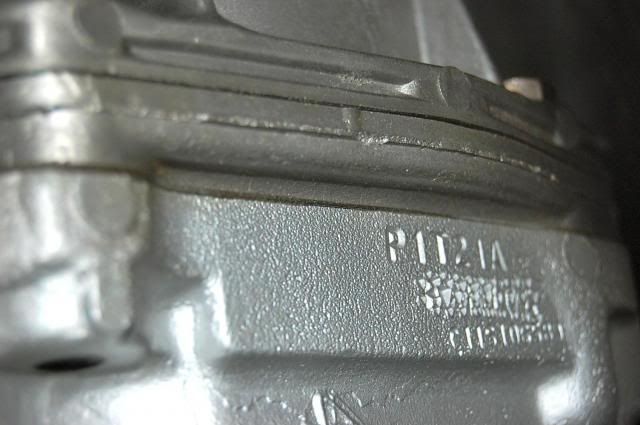
Here's the transmission stamp on my 71.
The code looks fine, but obviously they screwed up the VIN derived stamp. Nice job Xing it out!
It appears they got it right the second time.
Regards,
Alan
'P' Muncie, '1' Model year (not year of production), 'T' December, '21' Day, 'A' Wide Range. Mid January 71 built car.
Not to steal this thread but....
Here's the transmission stamp on my 71.
The code looks fine, but obviously they screwed up the VIN derived stamp. Nice job Xing it out!
It appears they got it right the second time.
Regards,
Alan
'P' Muncie, '1' Model year (not year of production), 'T' December, '21' Day, 'A' Wide Range. Mid January 71 built car.

Melting Slicks

Joined: Sep 2004
Posts: 3,227
Likes: 670
From: Northeast
I tried to find a Restorer article written by Gene Gamache about "M codes" so that I could read it (I am a member)
Emailed the ncrs web people after my search and they said the archived articles can not be read but if I know the year, I would need to buy the cd $50.
Perhaps someone can make a copy of the article you need.
Team Owner
Joined: Sep 2006
Posts: 31,279
Likes: 4,372
From: Westminster Maryland
Hi bkv,
I have those RESTORER issues.
I'll make copies of the articles and mail them to you. (That'll be easier/quicker for me than scanning them.)
Send me a pm with your address, and I'll do it this week.
Regards,
Alan
I have those RESTORER issues.
I'll make copies of the articles and mail them to you. (That'll be easier/quicker for me than scanning them.)
Send me a pm with your address, and I'll do it this week.
Regards,
Alan

Drifting

Joined: Oct 2008
Posts: 1,369
Likes: 12
From: wichita kansas
Thread Starter
Team Owner
Joined: May 2005
Posts: 31,497
Likes: 1,313
From: Huntsville AL
Factory grind outs are rare, but not as rare as some people think. And there is a "pattern" to them that is recognizable once you start looking at them.
And it is almost always a "judgement call".
And it is almost always a "judgement call".
Team Owner
Joined: Sep 2006
Posts: 31,279
Likes: 4,372
From: Westminster Maryland
Hi emc,
Your right about the 'patterns'
They're what makes Al G's presentations so interesting... he shows you a pad that you say NO WAY!.... and then he shows you the next one or two in sequence.... and they're just as ugly!
Regards,
Alan
Your right about the 'patterns'
They're what makes Al G's presentations so interesting... he shows you a pad that you say NO WAY!.... and then he shows you the next one or two in sequence.... and they're just as ugly!
Regards,
Alan