




Interior Heat

Le Mans Master


Joined: Oct 2006
Posts: 6,842
Likes: 285
From: Palmdale CA

Thanks for the stock manifold perspective, John. You mentioned 40-50 miles and that matches up with the 45 minute mark, where I think we all start to feel the heat.
I think it's the engine compartment too. That's a tiny box, that's nearly sealed on all sides, except for the bottom! The radiator, may as well be a seal, or worse, because it's just pulling the hot waste air, through the radiator and into the engine compartment!
I am going to make a copy of the AIM page showing the bare cowl, go out on a good run and then start shooting temps and recording them, top to bottom, side to side and the engine side of the cowl too.
I think it's the engine compartment too. That's a tiny box, that's nearly sealed on all sides, except for the bottom! The radiator, may as well be a seal, or worse, because it's just pulling the hot waste air, through the radiator and into the engine compartment!
I am going to make a copy of the AIM page showing the bare cowl, go out on a good run and then start shooting temps and recording them, top to bottom, side to side and the engine side of the cowl too.
Le Mans Master
Joined: Oct 2006
Posts: 6,842
Likes: 285
From: Palmdale CA
Heat Extraction? Is that the cure? My mind wandered to what I thought would look functionally cool a good while back. I had thought of the grills on the 63' and thought how cool, would that look on C3?

Then I started thinking and found a lot of threads related to heat extraction and in fact, they designed this very feature in the hood of the C7! And this is from GM!
DESIGN MUST PERFORM
HOOD EXTRACTORThis is no bottom breather. A functional hood extractor directs hot air from the front grille up and out of the engine compartment. Each blade is precisely angled for optimal airflow. The result is reduced front-end lift, increased downforce and improved handling at high speeds.
http://gm.ca/gm/english/vehicles/che...014%20corvette

I looked at the hood on the '74 this morning and noted carefully, the structural reinforcements running all the way around and there is room between the structural beams running on the outside of the hood and the cowl induction part of the hood itself.
You could put a 5" wide stainless grill, running lengthwise down each side of the hood, that could be up to four feet long! And they'd be right above the hottest part of the car, the headers! And if you angle them at the front to match the shape of the cowl hood, I think that would be a very cool looking and intuitive design feature, that's functional as well.
I'm thinking, more and more, that the entire engine compartment is to blame for the huge amount of heat that travels through the whole cowl, top to bottom and especially at the top. Sure the bottom gets hot from the exhaust running underneath it, but in a nearly sealed engine compartment, where's all that heat going to go? It's going to go up!
And what's at the bottom of the engine compartment? The frame and the A-arms and what's left for openings? Just that little triangle about two feet by two feet or so, behind the fenders and then the area in front of the a-arms, which isn't much bigger.
Someone on the C4 ZR-1 forum came up with a novel idea to rid his engine compartment of heat. He cut holes in the inner fender and put in mesh grills, that he made up of gutter screen from Home Depot.
Extract:
Tony D's Project corner (Heat extraction vents)
Some of you guys were wondering about my heat extraction vents that I made and I would like to share my endeavors with whom ever is interested.
---------------Project: Heat extraction.
Step 1: Design any pattern you desire to be cut out on your upper inner fender. Make a template then use a Dremel cutter or anything else that will cut plastic.
Step 2: Cut down the screen mesh to size. I went to Lowes and bought some gutter screen and this is what I used.
Step3: I used epoxy to attached the mesh to the back side of the opening. I did this back in 2003, it still is in tack.
This works pretty good at allowing the heat to escape. You can actually feel the heat roll out of the fender. I have not had any issue with water being splashed up inside of my engine compartment because of the pressure created from the movement of air from the radiator. So it works very well.
http://www.zr1.net/forum/showthread.php?t=20316
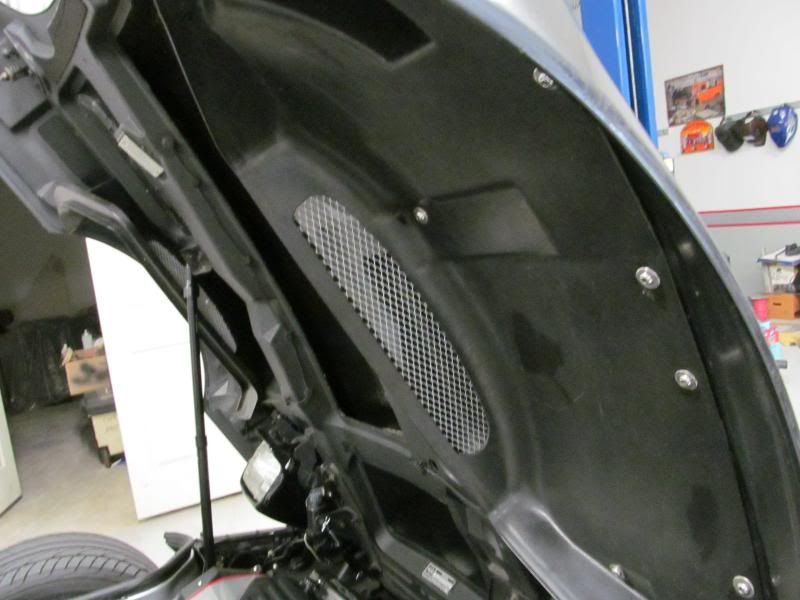
Even the new 2013 Mustang GT addresses this issue!
"Function of the Heat Extractor hood of the Mustang is designed to remove hot air from the engine compartment"
http://automotorcar.com/ford/2013-fo...a_close_button
Let's face it, our C3's were designed before serious windtunnel and computer modeling technology meshed to create comprehensive designs. This is a design fault in these cars, that really, really sucks, as so many of us, suffer from.
Then I started thinking and found a lot of threads related to heat extraction and in fact, they designed this very feature in the hood of the C7! And this is from GM!
DESIGN MUST PERFORM
HOOD EXTRACTORThis is no bottom breather. A functional hood extractor directs hot air from the front grille up and out of the engine compartment. Each blade is precisely angled for optimal airflow. The result is reduced front-end lift, increased downforce and improved handling at high speeds.
http://gm.ca/gm/english/vehicles/che...014%20corvette
I looked at the hood on the '74 this morning and noted carefully, the structural reinforcements running all the way around and there is room between the structural beams running on the outside of the hood and the cowl induction part of the hood itself.
You could put a 5" wide stainless grill, running lengthwise down each side of the hood, that could be up to four feet long! And they'd be right above the hottest part of the car, the headers! And if you angle them at the front to match the shape of the cowl hood, I think that would be a very cool looking and intuitive design feature, that's functional as well.
I'm thinking, more and more, that the entire engine compartment is to blame for the huge amount of heat that travels through the whole cowl, top to bottom and especially at the top. Sure the bottom gets hot from the exhaust running underneath it, but in a nearly sealed engine compartment, where's all that heat going to go? It's going to go up!
And what's at the bottom of the engine compartment? The frame and the A-arms and what's left for openings? Just that little triangle about two feet by two feet or so, behind the fenders and then the area in front of the a-arms, which isn't much bigger.
Someone on the C4 ZR-1 forum came up with a novel idea to rid his engine compartment of heat. He cut holes in the inner fender and put in mesh grills, that he made up of gutter screen from Home Depot.
Extract:
Tony D's Project corner (Heat extraction vents)
Some of you guys were wondering about my heat extraction vents that I made and I would like to share my endeavors with whom ever is interested.
---------------Project: Heat extraction.
Step 1: Design any pattern you desire to be cut out on your upper inner fender. Make a template then use a Dremel cutter or anything else that will cut plastic.
Step 2: Cut down the screen mesh to size. I went to Lowes and bought some gutter screen and this is what I used.
Step3: I used epoxy to attached the mesh to the back side of the opening. I did this back in 2003, it still is in tack.
This works pretty good at allowing the heat to escape. You can actually feel the heat roll out of the fender. I have not had any issue with water being splashed up inside of my engine compartment because of the pressure created from the movement of air from the radiator. So it works very well.
http://www.zr1.net/forum/showthread.php?t=20316
Even the new 2013 Mustang GT addresses this issue!
"Function of the Heat Extractor hood of the Mustang is designed to remove hot air from the engine compartment"
http://automotorcar.com/ford/2013-fo...a_close_button
Let's face it, our C3's were designed before serious windtunnel and computer modeling technology meshed to create comprehensive designs. This is a design fault in these cars, that really, really sucks, as so many of us, suffer from.

Melting Slicks


Joined: Aug 2012
Posts: 3,487
Likes: 83
From: Titusville Florida
Now that you mention using the hood for heat extraction... When I was into jeeping some guys would put louvers in their hood to extract heat, it worked well, or so the reports said.
I was thinking since I have a 76 and the cowl where the cowl induction used to be is glassed over couldn't I cut that out to allow heat to escape? Was also thinking of the L88 hoods, this one has a heat extractor on it, although it's for a C6 couldn't something like that be done for our C3's?
http://www.corvettemods.com/product....FQt1Qgod7EYA0A
I was thinking since I have a 76 and the cowl where the cowl induction used to be is glassed over couldn't I cut that out to allow heat to escape? Was also thinking of the L88 hoods, this one has a heat extractor on it, although it's for a C6 couldn't something like that be done for our C3's?
http://www.corvettemods.com/product....FQt1Qgod7EYA0A
Le Mans Master
Joined: Oct 2006
Posts: 6,842
Likes: 285
From: Palmdale CA
Now that you mention using the hood for heat extraction... When I was into jeeping some guys would put louvers in their hood to extract heat, it worked well, or so the reports said.
I was thinking since I have a 76 and the cowl where the cowl induction used to be is glassed over couldn't I cut that out to allow heat to escape? Was also thinking of the L88 hoods, this one has a heat extractor on it, although it's for a C6 couldn't something like that be done for our C3's?
http://www.corvettemods.com/product....FQt1Qgod7EYA0A
I was thinking since I have a 76 and the cowl where the cowl induction used to be is glassed over couldn't I cut that out to allow heat to escape? Was also thinking of the L88 hoods, this one has a heat extractor on it, although it's for a C6 couldn't something like that be done for our C3's?
http://www.corvettemods.com/product....FQt1Qgod7EYA0A
 Exactly! I think we're on the right track here. I think you could do this, for a C3 hood too, but it'd be major surgery on the front section of the cowl induction or a total redesign, new hood.
Just visited one of my engineering buds in the hangar and he's got an autocad program at home, that we talked about before, with the heat shields and he said, what I'd like to design C2 grill style, would be easy to do.
The C2 grill is a big square, the C3 hood grill would be a long rectangle, running lengthwise down the hood on each side between the cowl induction hump and the outer edge, but clearing the structural beam, that runs lengthwise as well.
Ya know what? I'm going to do it and it ain't gonna take that long, maybe a matter of a few weeks to pull it off. The install wouldn't be hard either. Cut the holes a 1/2" in from the inside edge of the grill and use a router to cut down that 1/2", so the grill would sit flush. Drill and put speed nuts in, put in grill and I'll almost guarantee, you're gonna get heat extraction out of the top of the engine compartment, for the first time ever.
I think that's going to be the key; getting rid of the heat, before it even becomes a problem. Because sooner or later, all that heat, will saturate everything in the engine compartment, including the shields, reflective material, inconel, or whatever you're running and especially the whole firewall on these cars.

Le Mans Master
Joined: Oct 2006
Posts: 6,842
Likes: 285
From: Palmdale CA
I guess we're not the only ones dealing with heat. Back in 05', the Chevy Duramax truck crowd was having problems with so much heat building up in the engine compartment, under heavy use, that the engine would go into 'limp-home' mode.
So GM worked with a some aftermarket SEMA approved companies and Suncoast Creations won the competition to most effective hood.
http://suncoastcreations.com/z-duram...t-fix-cat.html
Early GM Service Parts Organization Concept Development.
"In late 2005, General Motors Service Parts Organization procured and tested several aftermarket ram air hoods from various suppliers, one of which was Suncoast. After GM Engineering's side by side competitive testing, quality checks, and design evaluations, GM selected Suncoast to develop functional ram air hoods for their Silverado, Silverado HD, and Sierra models. Many owners have been having problems while towing moderate to heavy loads or in extreme temperature conditions. According to GM, these models were experiencing overheating issues where, under extreme conditions, the engine control systems sensed an unsafe heat condition and initiated safety precautions to protect the engine. This "limp" mode is a safety system that allows customers to continue to travel, albeit, at a slower pace to seek help and assistance. Just one look at any Duramax forum online proves the issue is real and a bane to the Duramax owner community.
GMSPO Engineering developed criteria under which the Suncoast hood was to be designed to achieve the goal of reducing engine compartment temperature by 35 degrees C and top tank temperature by at least 5 degrees C without effecting engine calibrations..."
And here's the part I liked the best!
"...Additionally, once the engine is shut down, natural convective air currents take over and cool the engine and engine compartment faster by providing an easy path for the hot air to escape rather than be held in by the hood."
Our C3 Corvettes sitting in a parking lot on a hot day? That's just a nearly sealed engine compartment, with no way for the air to escape upwards.
I think we're on to something and I'm excited by it. Believe me, I was bummed at yesterday's two hour test drive. 89 degrees outside and while just waving the BK meter's probe around in the C3 cabin, it's over a hundred degrees inside!!!
So GM worked with a some aftermarket SEMA approved companies and Suncoast Creations won the competition to most effective hood.
http://suncoastcreations.com/z-duram...t-fix-cat.html
Early GM Service Parts Organization Concept Development.
"In late 2005, General Motors Service Parts Organization procured and tested several aftermarket ram air hoods from various suppliers, one of which was Suncoast. After GM Engineering's side by side competitive testing, quality checks, and design evaluations, GM selected Suncoast to develop functional ram air hoods for their Silverado, Silverado HD, and Sierra models. Many owners have been having problems while towing moderate to heavy loads or in extreme temperature conditions. According to GM, these models were experiencing overheating issues where, under extreme conditions, the engine control systems sensed an unsafe heat condition and initiated safety precautions to protect the engine. This "limp" mode is a safety system that allows customers to continue to travel, albeit, at a slower pace to seek help and assistance. Just one look at any Duramax forum online proves the issue is real and a bane to the Duramax owner community.
GMSPO Engineering developed criteria under which the Suncoast hood was to be designed to achieve the goal of reducing engine compartment temperature by 35 degrees C and top tank temperature by at least 5 degrees C without effecting engine calibrations..."
And here's the part I liked the best!
"...Additionally, once the engine is shut down, natural convective air currents take over and cool the engine and engine compartment faster by providing an easy path for the hot air to escape rather than be held in by the hood."
Our C3 Corvettes sitting in a parking lot on a hot day? That's just a nearly sealed engine compartment, with no way for the air to escape upwards.
I think we're on to something and I'm excited by it. Believe me, I was bummed at yesterday's two hour test drive. 89 degrees outside and while just waving the BK meter's probe around in the C3 cabin, it's over a hundred degrees inside!!!

Racer

Joined: Jul 2013
Posts: 385
Likes: 3
From: Leesburg VA
The challenge will be in making it tasteful as well as functional. I'm sure you have seen the fender vents on some Corvette racecars...using that same design for the hood may be nice looking. I do think this may be part of a viable solution to the heat problem, and the opening may not need to be as big as is possible in order to get the job done. Those C2 vents moved further up the C3 hood may be big enough...maybe too big. The CAD program will be a huge help here to visualize what is possible. Opening up the front portion of an L-88 hood may be all you need, along with leaving the back portion of the scoop open at the windshield.
I don't think you should abandon your work on the firewall that we spoke of earlier, but I do think this will get most of the heat out before it can cause interior heating problems. It may be part of an overall solution.
I am watching closely, with great interest.
John
I don't think you should abandon your work on the firewall that we spoke of earlier, but I do think this will get most of the heat out before it can cause interior heating problems. It may be part of an overall solution.
I am watching closely, with great interest.
John
Racer
Joined: Jul 2013
Posts: 385
Likes: 3
From: Leesburg VA
If you squint, can't you see the L-88 hood here? If you opened up the front dip in the L-88 hood and installed louvers as above, then leave the back side of the raised scoop open and unsealed so that fresh air could escape there as well...
The potential problem with the open scoop at the base of the windshield could be the potential for reverse airflow because of the pressure differential created by the airflow impacting the windshield. Regardless though, the front opening would be effective and positioned correctly too.
John
Corvette Stories
The Best of Corvette for Corvette Enthusiasts

Top 10 Most Expensive Corvettes Ever Sold on Bring A Trailer
Brett Foote
10 Things Every Corvette Owner Needs (2026 Edition)
Michael S. Palmer
8 Most "Only Corvette Owners Understand" Quirks and Problems
Pouria Savadkouei
10 Reasons the C6 Z06 is Still A Performance Benchmark After 20 Years
Joe Kucinski
How Much Horsepower Every Corvette Engine "LOST" in 1972
Joe Kucinski
Top 10 DOs and DON'Ts for Protecting Your Convertible Top!
Michael S. Palmer
Top 10 Most Explosive Corvettes Ever Made: Power-to-Weight Ratio Ranked!
Joe Kucinski
150 hp to 1,250 hp: Every Corvette Generation Compared by the Specs That Matter
Joe Kucinski
8 Coolest Corvette Pace Cars (and Replicas) of All Time
Verdad Gallardo
Le Mans Master
Joined: Oct 2006
Posts: 6,842
Likes: 285
From: Palmdale CA
The challenge will be in making it tasteful as well as functional. I'm sure you have seen the fender vents on some Corvette racecars...using that same design for the hood may be nice looking. I do think this may be part of a viable solution to the heat problem, and the opening may not need to be as big as is possible in order to get the job done. Those C2 vents moved further up the C3 hood may be big enough...maybe too big. The CAD program will be a huge help here to visualize what is possible. Opening up the front portion of an L-88 hood may be all you need, along with leaving the back portion of the scoop open at the windshield.
I don't think you should abandon your work on the firewall that we spoke of earlier, but I do think this will get most of the heat out before it can cause interior heating problems. It may be part of an overall solution.
I am watching closely, with great interest.
John
I don't think you should abandon your work on the firewall that we spoke of earlier, but I do think this will get most of the heat out before it can cause interior heating problems. It may be part of an overall solution.
I am watching closely, with great interest.
John
I will take a look at the Corvette racecars, but could you clue me in, on which generation of 'Vettes we're looking at?
I thought about the L88 hood, with the scoop up front and the back open, but for me, that's just waay too big for my taste (tho', I'm not going to knock anybody who has one, it looks great on some flavors of 'Vettes, like the C3 LS guy, who's got that radical turbocharged beast that's running around here).
You're right too, it's got to look tasteful and I too, agree, the C2 grills are too big. No way, that'd work on a C3 hood, but the planned 5" x 48" = 240 Square inches of grill! Even if it's 36", that's still 180 sq. inches as well. (Go on and please correct me, I can take the abuse, I've been under my 74' aaaalll week long!
 ).
).I'll try to post the CAD design when it's done. I was also thinking of a three section grill, that would taper from the top of the hood by the windshield in three rectangular sections, with smaller rectangles for each step down and ending in a narrow rectangle towards the front.
It could be black, stainless, or even the body color.
Last edited by F22; Sep 20, 2013 at 12:58 PM. Reason: Made a boo-boo.
Le Mans Master
Joined: Oct 2006
Posts: 6,842
Likes: 285
From: Palmdale CA
If you squint, can't you see the L-88 hood here? If you opened up the front dip in the L-88 hood and installed louvers as above, then leave the back side of the raised scoop open and unsealed so that fresh air could escape there as well...
The potential problem with the open scoop at the base of the windshield could be the potential for reverse airflow because of the pressure differential created by the airflow impacting the windshield. Regardless though, the front opening would be effective and positioned correctly too.
John

Oh yeah! I thought the same thing too, when looking at it and it's certainly a striking resemblance. I'm going to be chicken (and cheap too!) at this point and go for cutting a pair of long rectangular holes in the hood of my '74, just to see how it works. The hood option may very well work out too, I just haven't seen anybody reporting on what it does, yet and I'm not sure there's a hood like that for a C3. Found them for newer Gen's of Vettes, but not us.
I really can't see why it wouldn't! Holes + Air = Heat Extraction out of the Engine Compartment. How hard can it be?
Racer
Joined: Jul 2013
Posts: 385
Likes: 3
From: Leesburg VA
http://forums.corvetteforum.com/c3-g...rtible-10.html
Check out the top view drawing on this thread. Could it be as simple as two small extraction vents on each side of the hood? I saw this drawing as I was looking for a racecar vent picture.
John
Check out the top view drawing on this thread. Could it be as simple as two small extraction vents on each side of the hood? I saw this drawing as I was looking for a racecar vent picture.
John
Le Mans Master
Joined: Oct 2006
Posts: 6,842
Likes: 285
From: Palmdale CA
http://forums.corvetteforum.com/c3-g...rtible-10.html
Check out the top view drawing on this thread. Could it be as simple as two small extraction vents on each side of the hood? I saw this drawing as I was looking for a racecar vent picture.
John
Check out the top view drawing on this thread. Could it be as simple as two small extraction vents on each side of the hood? I saw this drawing as I was looking for a racecar vent picture.
John
Are these the vents you're talking about? They certainly look really good, but I think they're kind of small for the amount of heat (especially standing still or slow rolling) that these cars generate. It may work well to extract at speed, but I'm not sure about the other characteristics.
Who knows, they may be just 'right-sized' and I'm the dummy here!

The more I think about it, the more a flat, flush sitting, one-piece C2 style grill,(but rectangular of course) will at least be a good start. My '74 will be the guinea pig and it's not going to be that hard to do, versus anything else I've seen suggested (new hood, extensive rework of existing hood for various scoops, etc).
All we have to do, is cut the hole, route the edges, lay the flat metal grill in, mark the screw holes, remove the grill, drill the holes, put in speed nuts over the drilled holes and remount the grill.
And then, we can see if this method works on a C3. As always, I am a pessimist and we will see how well this works under real world testing! I anticipate two-three weeks to design and fab a part in stainless steel, then another week to carefully measure and cut the holes in the hood on the '74 and mount the new grills.
Let's try the simple stuff first and then, if it works (validated results), we can move on to more complex designs, like the L88 hood or the recessed hood extractors on the Menace Vette.
Your input is highly appreciated (all of you!) and I think this has been a really good thread that seriously addresses the tough issue we have with the excess heat in these cars. Thank You!

Regis

Racer
Joined: Jul 2013
Posts: 385
Likes: 3
From: Leesburg VA
I'm with you, but wonder if that is too much area...maybe more than enough is a better phrase. The rectangular area nearest the windshield would probably be sufficient, but I am just guessing.
Proof of concept will work either way. Once you determined how well the concept worked you could tape it off gradually to determine the minimum effective area required to keep the temperatures in check.
John
Proof of concept will work either way. Once you determined how well the concept worked you could tape it off gradually to determine the minimum effective area required to keep the temperatures in check.
John
Le Mans Master
Joined: Oct 2006
Posts: 6,842
Likes: 285
From: Palmdale CA
I'm with you, but wonder if that is too much area...maybe more than enough is a better phrase. The rectangular area nearest the windshield would probably be sufficient, but I am just guessing.
Proof of concept will work either way. Once you determined how well the concept worked you could tape it off gradually to determine the minimum effective area required to keep the temperatures in check.
John
Proof of concept will work either way. Once you determined how well the concept worked you could tape it off gradually to determine the minimum effective area required to keep the temperatures in check.
John
There's really only five or so inches between the cowl hood and the invisible line, where the structural beam runs. I also wanted to narrow down in stages, the grill too, to match up with the outward expanding lines of the overall front end and just because it shows some thinking and aesthetics over, just a straight line, all the way down.
Racer
Joined: Jul 2013
Posts: 385
Likes: 3
From: Leesburg VA
See Eckler's part number 10363 for the fender louvers I was talking about before. Improved they also have a Daytona hood p/n 59163 that has "functional cooling vents", but I am not sure i am jazzed about the styling of it.
John
John
Le Mans Master
Joined: Oct 2006
Posts: 6,842
Likes: 285
From: Palmdale CA
I'll check it out! Also like the idea of doing my own unique design too. We are going to start the CAD design next week and he came up with a couple of very cool tweaks as well. It was five inches across at the top as well.
Le Mans Master
Joined: Oct 2006
Posts: 6,842
Likes: 285
From: Palmdale CA
John, I checked out that Ecklers PN and they look cool, but they're fender louvers and I think they'll only work, if you had no fender liners at all. Speaking of fender liners, last night, I noticed that I had never mounted the A_arm dust flaps, because one of my inner fender liners was hacked and in a way, that's good, because you'd be letting in cool air from below and those are pretty good sized holes. They would also be right under the proposed hood grills too! I'd rather have the air, then the further sealing up of the "Hot Box" against dust!

Safety Car


Joined: Mar 2007
Posts: 3,518
Likes: 37
Might be best to try to remove the hood first, do some testing and see if it really lowers the interior temp. Even if intuitively it should help the overall temp if the engine compartment. Costs less to try that instead of spending big money to cut your hood, paint it and then see if it helps.
Point is that the factory changes are likely focused on cooling the engine and not cooling the interior as this thread is meant to consider.
If you modified your hood first you would be stuck with telling everyone it worked great even if it didn't.
Point is that the factory changes are likely focused on cooling the engine and not cooling the interior as this thread is meant to consider.
If you modified your hood first you would be stuck with telling everyone it worked great even if it didn't.