






69 base model ncrs pics

Thread Starter
Safety Car


Joined: Jun 2013
Posts: 4,399
Likes: 793
 69 base model ncrs pics
Can anyone show me what the heck a 69 base model cooling system should look. There seem to be a choice of radiators, expansion tanks, shrouds etc. Would really like to see for myself. I know its not the big boy of that year but surely someone must have a correct looking model. A big thank you in advance. Noticed that Paragon uses direct fit or dewitts for radiators . Are these folks ok or is there better vendor.
Last edited by SB64; Dec 15, 2013 at 12:14 PM. Reason: add text
Thread Starter
Safety Car
Joined: Jun 2013
Posts: 4,399
Likes: 793
69 vette
Spott 99 thanks that looks super compare to what I had. Is fan stock with what looks like unpainted fan fins and does radiator have a lower hose?? Just trying to get mine closer to correct and as far as I am concerned like your would be perfect. I have the same covers and side pipe headers. thank you

CF Community Team


Joined: Mar 2007
Posts: 9,339
Likes: 360
From: Delaware
St. Jude Donor '25
Can anyone show me what the heck a 69 base model cooling system should look. There seem to be a choice of radiators, expansion tanks, shrouds etc. Would really like to see for myself. I know its not the big boy of that year but surely someone must have a correct looking model. A big thank you in advance.
The cooling systems on the 69 model actually changed a couple times during the production run. Someone with the Bizocco book should be able to tell you what was in your car if you give them the build date.
For example, my Aug 69 build L46 has a copper radiator and no expansion tank (and has hood insulation). Some 69 L46 cars had the aluminum radiator with expansion tank and no insulation. All depends on the build date.
Good luck!

Burning Brakes

Joined: Jan 2009
Posts: 766
Likes: 97
From: Lake Norman, NC
Not sure about '69s, however in '70-'72 small block cars (maybe more years), the copper rad with overflow bag was used when auto trans and/or AC was selected. Alum rad with alum expansion tank was used with manual trans and/or no AC. All L46 and LT1 engines used copper/bag set up.
Big block (LS5 and LS6) used copper/bag too.
I understand this is not directly for your 1969, however, someone with a '69 NCRS Judging Guide should be able to help - it's in the CHASSIS section.
Hope this helps.
Big block (LS5 and LS6) used copper/bag too.
I understand this is not directly for your 1969, however, someone with a '69 NCRS Judging Guide should be able to help - it's in the CHASSIS section.
Hope this helps.
Team Owner


Joined: Sep 2006
Posts: 31,301
Likes: 4,389
From: Westminster Maryland
Hi r,
As Red Roadster posted the BASE motor, 4-speed, car without a/c, used the aluminum radiator, simple steel shroud, and aluminum overflow tank.
The radiator had a large upper and lower hose, and a small hose that ran from a pipe on the right upper corner to the overflow tank mounted on the right side fender apron.
Here's a couple of pictures (71).
Regards,
Alan
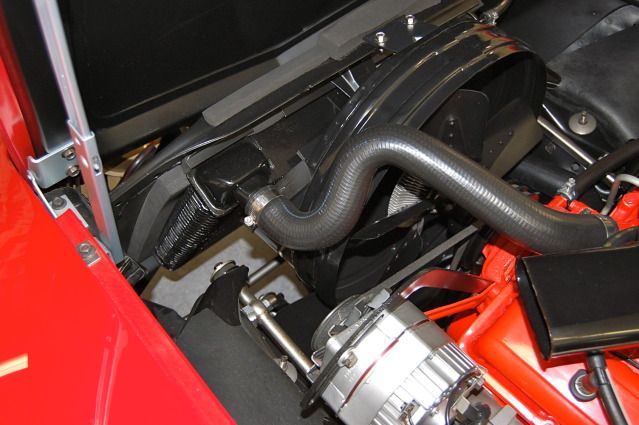
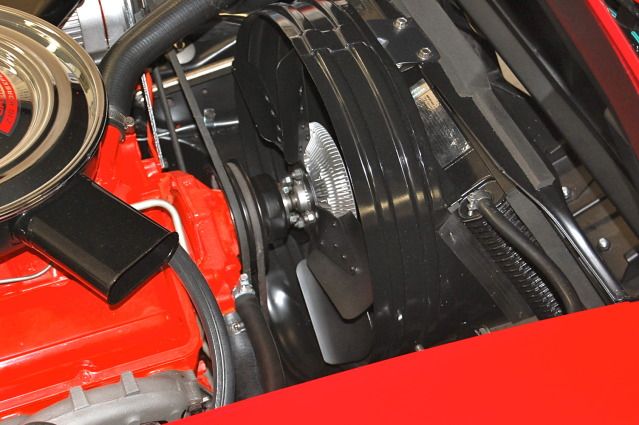

As Red Roadster posted the BASE motor, 4-speed, car without a/c, used the aluminum radiator, simple steel shroud, and aluminum overflow tank.
The radiator had a large upper and lower hose, and a small hose that ran from a pipe on the right upper corner to the overflow tank mounted on the right side fender apron.
Here's a couple of pictures (71).
Regards,
Alan



Team Owner

Joined: Jun 2000
Posts: 38,923
Likes: 1,482
From: Southbound
Cruise-In II Veteran
Purchase the 68-69 NCRS Judging Guide and you will be able to help yourself.
http://www.ncrs.org/shop/index.php?m...dex&cPath=1_68

http://www.ncrs.org/shop/index.php?m...dex&cPath=1_68
Corvette Stories
The Best of Corvette for Corvette Enthusiasts

Every 2027 Corvette Engine Explained
Joe Kucinski
Designer Imagines A Corvette That Looks More Like a Corvette Than the Corvette
Verdad Gallardo
10 Ugly Corvettes That We Still Kinda Love
Joe Kucinski
Top 10 Most Expensive Corvettes Ever Sold on Bring A Trailer
Brett Foote
10 Things Every Corvette Owner Needs (2026 Edition)
Michael S. Palmer
8 Most "Only Corvette Owners Understand" Quirks and Problems
Pouria Savadkouei
10 Reasons the C6 Z06 is Still A Performance Benchmark After 20 Years
Joe Kucinski
How Much Horsepower Every Corvette Engine "LOST" in 1972
Joe Kucinski
Top 10 DOs and DON'Ts for Protecting Your Convertible Top!
Michael S. Palmer
Thread Starter
Safety Car
Joined: Jun 2013
Posts: 4,399
Likes: 793
69 vette
Thanks Alan and Spot99 for those pics. They really help. there seem to be many ways to go but if my car is an early build then it clears uo allot for me. Thank to all of you including Redrstr.

Melting Slicks

Joined: May 2006
Posts: 3,438
Likes: 41
From: Raleigh NC
St. Jude Donor '13-'14

Administrator


Joined: Jul 2000
Posts: 53,997
Likes: 6,213
From: About 1100 miles from where I call home.
Yes look at my picture more closely, the bracket is towards the bottom and is brighter. The fuel lines on top and bottom also hold it in place.

Instructor

Joined: Jan 2005
Posts: 132
Likes: 0
L46 Cooling System Photos
Trying to restore my cooling system. Seems like someone may have installed a different radiator into the car then original, the shroud looks wrong too. Just want some detailed photos if possible?
thanks,
John
thanks,
John
Thread Starter
Safety Car
Joined: Jun 2013
Posts: 4,399
Likes: 793
R
Instructor
Joined: Jan 2005
Posts: 132
Likes: 0
Thread Starter
Safety Car
Joined: Jun 2013
Posts: 4,399
Likes: 793
R

Melting Slicks
Joined: Sep 2007
Posts: 2,150
Likes: 285
From: cary Il
Hi pal,
The cooling systems on the 69 model actually changed a couple times during the production run. Someone with the Bizocco book should be able to tell you what was in your car if you give them the build date.
For example, my Aug 69 build L46 has a copper radiator and no expansion tank (and has hood insulation). Some 69 L46 cars had the aluminum radiator with expansion tank and no insulation. All depends on the build date.
Good luck!
The cooling systems on the 69 model actually changed a couple times during the production run. Someone with the Bizocco book should be able to tell you what was in your car if you give them the build date.
For example, my Aug 69 build L46 has a copper radiator and no expansion tank (and has hood insulation). Some 69 L46 cars had the aluminum radiator with expansion tank and no insulation. All depends on the build date.
Good luck!
Instructor
Joined: Jan 2005
Posts: 132
Likes: 0
thanks
Instructor
Joined: Jan 2005
Posts: 132
Likes: 0
thanks,
John