How Do I Find A Short?

Thread Starter
Intermediate

Joined: Nov 2012
Posts: 37
Likes: 0
From: Summerville SC
 How Do I Find A Short?
OK Gurus,
The power locks were not working at all and I was also having issues with window regulators, so I've decided to rebuilt the doors completely…windows, motor, regulator, panels, arm rests…the works. I purchased 2 new lock switches, 2 lock motors and 2 new pigtails.
Installed all new lock components, pigtails, switches and motors. Connected the battery back up and immediately blew a fuse. So…yeah….there is a short….but where? I blew 2 fuses trying to find it. I did discover that with the switches not attached to the pigtails, no short happens. Help me track down the short or what's causing the short. Pigtail wires are butted to corresponding colors with the exception of the driver's side. Pink(original) to light blue (replacement) and Purple (original) to black (replacement)
Ideas?
The power locks were not working at all and I was also having issues with window regulators, so I've decided to rebuilt the doors completely…windows, motor, regulator, panels, arm rests…the works. I purchased 2 new lock switches, 2 lock motors and 2 new pigtails.
Installed all new lock components, pigtails, switches and motors. Connected the battery back up and immediately blew a fuse. So…yeah….there is a short….but where? I blew 2 fuses trying to find it. I did discover that with the switches not attached to the pigtails, no short happens. Help me track down the short or what's causing the short. Pigtail wires are butted to corresponding colors with the exception of the driver's side. Pink(original) to light blue (replacement) and Purple (original) to black (replacement)
Ideas?

Burning Brakes


Joined: Mar 2014
Posts: 904
Likes: 46
From: Crestline CA
In my experience(not necessarily corvette) most of the problems occur in the wiring conduit between the door and the body where years of opening and closing the door fatigue the wires.
Good Luck, Doug
Good Luck, Doug
Burning Brakes
Joined: Oct 2008
Posts: 1,037
Likes: 14
From: Mobile Alabama
OK Gurus,
The power locks were not working at all and I was also having issues with window regulators, so I've decided to rebuilt the doors completely…windows, motor, regulator, panels, arm rests…the works. I purchased 2 new lock switches, 2 lock motors and 2 new pigtails.
Installed all new lock components, pigtails, switches and motors. Connected the battery back up and immediately blew a fuse. So…yeah….there is a short….but where? I blew 2 fuses trying to find it. I did discover that with the switches not attached to the pigtails, no short happens. Help me track down the short or what's causing the short. Pigtail wires are butted to corresponding colors with the exception of the driver's side. Pink(original) to light blue (replacement) and Purple (original) to black (replacement)
Ideas?
The power locks were not working at all and I was also having issues with window regulators, so I've decided to rebuilt the doors completely…windows, motor, regulator, panels, arm rests…the works. I purchased 2 new lock switches, 2 lock motors and 2 new pigtails.
Installed all new lock components, pigtails, switches and motors. Connected the battery back up and immediately blew a fuse. So…yeah….there is a short….but where? I blew 2 fuses trying to find it. I did discover that with the switches not attached to the pigtails, no short happens. Help me track down the short or what's causing the short. Pigtail wires are butted to corresponding colors with the exception of the driver's side. Pink(original) to light blue (replacement) and Purple (original) to black (replacement)
Ideas?

Team Owner


Joined: Jan 2006
Posts: 37,637
Likes: 3,118
From: Crossville TN
I'm going to take a 'wild stab' at this and mention that the two leads from the window motor are NOT +12vdc and -ground. Those two leads would be the "hot" leads to the motor: one for "UP" and one for "DOWN". The ground has a separate pigtail that runs behind the motor and down to the bottom portion of the door.
If you ran a ground to one of those 'hot' leads, as soon as you tried to run the motor in that direction, it would blow the fuse.
But, that's just a 'wild guess'....
If you ran a ground to one of those 'hot' leads, as soon as you tried to run the motor in that direction, it would blow the fuse.
But, that's just a 'wild guess'....

Drifting


Joined: Dec 2009
Posts: 1,349
Likes: 34
From: Porterville Ca
Well, we know it's between the switch and the windows. Connect one switch and see if the fuse blows. Then you'll know which switch it is. There are short testers that go where the fuse goes. You use a inductive tester over the wire and it has a needle that flicks back and forth as the breaker switches on and off, when it stops flickering you've found the short.
You could also use a low amp, maybe 5 amp circuit breaker, and check voltage along the wire. When you stop getting a voltage reading, the short is between your current position and the last place you checked.
You could also use a low amp, maybe 5 amp circuit breaker, and check voltage along the wire. When you stop getting a voltage reading, the short is between your current position and the last place you checked.

Pro

Joined: Oct 2005
Posts: 505
Likes: 8
From: Houston Tx.

Thread Starter
Intermediate
Joined: Nov 2012
Posts: 37
Likes: 0
From: Summerville SC
Problem solved!!! The 2 new switches I ordered form Davies were crap!!!! China POS!!!! So, I went to autozone and got the generic kind that has no "Lock" and presto! Works Great! Thanks for all the leads! Really helped to hunt down the problem!!!!
Janton
Janton
Corvette Stories
The Best of Corvette for Corvette Enthusiasts

Top 10 Most Expensive Corvettes Ever Sold on Bring A Trailer
Brett Foote
10 Things Every Corvette Owner Needs (2026 Edition)
Michael S. Palmer
8 Most "Only Corvette Owners Understand" Quirks and Problems
Pouria Savadkouei
10 Reasons the C6 Z06 is Still A Performance Benchmark After 20 Years
Joe Kucinski
How Much Horsepower Every Corvette Engine "LOST" in 1972
Joe Kucinski
Top 10 DOs and DON'Ts for Protecting Your Convertible Top!
Michael S. Palmer
Top 10 Most Explosive Corvettes Ever Made: Power-to-Weight Ratio Ranked!
Joe Kucinski
150 hp to 1,250 hp: Every Corvette Generation Compared by the Specs That Matter
Joe Kucinski
8 Coolest Corvette Pace Cars (and Replicas) of All Time
Verdad Gallardo
Le Mans Master


Joined: May 2003
Posts: 8,877
Likes: 3,556
From: Fernandina Beach FL
2023 Restomod of the Year finalist
2020 C3 of the Year Winner - Modified
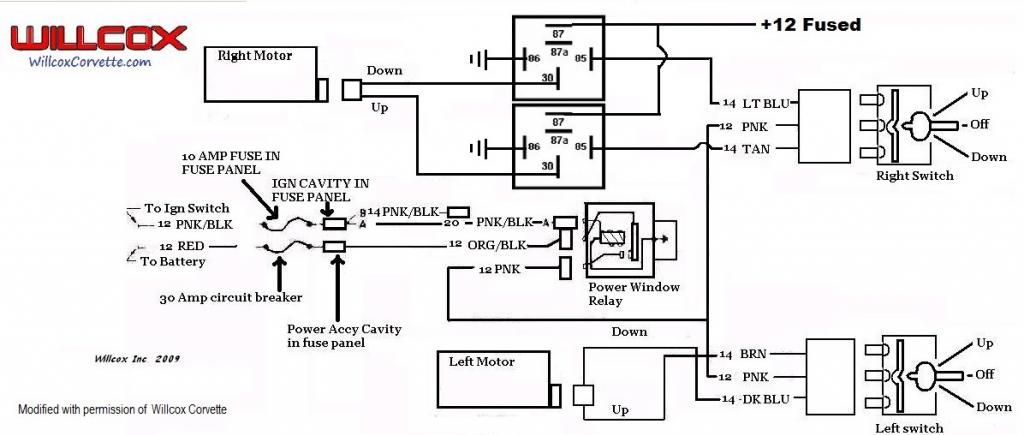
Right side -shows the relays left side-stock and would need two relays as well