




date codes

Thread Starter
Instructor

Joined: Aug 2016
Posts: 160
Likes: 3
From: freeport NY

hi ed,
a 69 motor in a dec 69 built car, what are acceptable casting dates on the exhaust manifolds and intake? I don't have the date code available for the block, the car is in fla.
the block is an 0010 casting, mainly used in 70 and later but the vin # on the block is a match to the car. my question is, is there a date range on castings or do all dates, block heads manifold exhaust have to be the same.
a 69 motor in a dec 69 built car, what are acceptable casting dates on the exhaust manifolds and intake? I don't have the date code available for the block, the car is in fla.
the block is an 0010 casting, mainly used in 70 and later but the vin # on the block is a match to the car. my question is, is there a date range on castings or do all dates, block heads manifold exhaust have to be the same.

Melting Slicks


Joined: Jul 2006
Posts: 3,103
Likes: 802
From: Massapequa Park NY
hi ed,
a 69 motor in a dec 69 built car, what are acceptable casting dates on the exhaust manifolds and intake? I don't have the date code available for the block, the car is in fla.
the block is an 0010 casting, mainly used in 70 and later but the vin # on the block is a match to the car. my question is, is there a date range on castings or do all dates, block heads manifold exhaust have to be the same.
a 69 motor in a dec 69 built car, what are acceptable casting dates on the exhaust manifolds and intake? I don't have the date code available for the block, the car is in fla.
the block is an 0010 casting, mainly used in 70 and later but the vin # on the block is a match to the car. my question is, is there a date range on castings or do all dates, block heads manifold exhaust have to be the same.
In reality most parts on the engine were usually within 2-4 weeks of each other on the more common cars. Some rare high performance engines had a longer date range because they didnt make many of those parts as some were unique to those engines so turnover was not as often as on common engined cars.
It would actually be VERY unusual to have all the parts the same date code.
Hope this helps,
Ed

Team Owner


Joined: Sep 2006
Posts: 31,285
Likes: 4,374
From: Westminster Maryland
Hi b,
For reading/decoding the dates on the numerous parts that are dated through-out the car the NCRS Technical Information Manual & Judging Guide is probably the best source of information.
In addition, through out the manual there is discussion about how close to, or far before the car's build date, the dates on parts 'typically' are.
For example:
The sb engines assembled at the Flint engine plant were often quickly shipped to St.Louis and were in cars only a few days after they had been assembled as Ed noted, An engine cast on December 31, 1970, assembled on January 7th,1971, was installed in a car assembled on January 14th 1971. Knowledgable people report that even 2-3 days was 'possible'.
Carburetor dating can be tricky because carbs were often assembled in 'batches' so there were many carbs with a certain configuration with a single date, and then maybe none for a couple of months until another batch was run.. This can affect the dates seen, especially on carbs with limited applications.
Window glass is seen on original cars with dates preceding production by more than 6 months often enough to indicate it wasn't all that uncommon.
It can all be pretty interesting if you want it to be.
Regards,
Alan
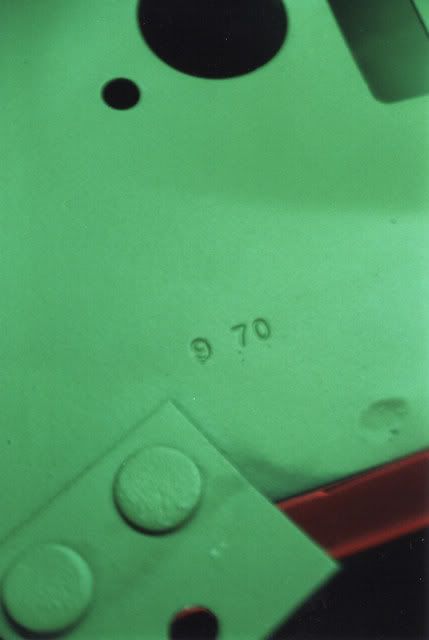
Birdcage date on a car with a Jan.14, 1971 trim tag date.
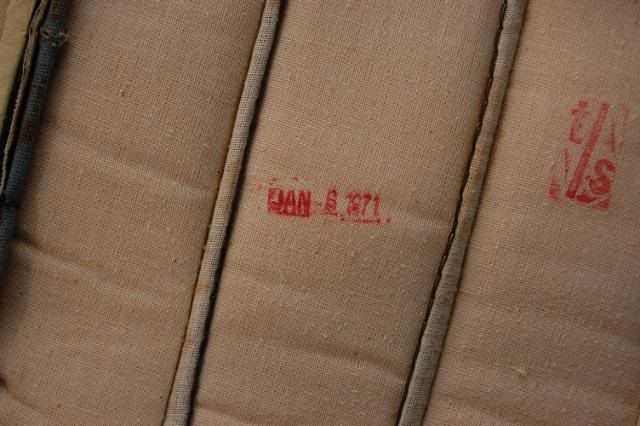
Seat cover on the same Jan. 14th car.
For reading/decoding the dates on the numerous parts that are dated through-out the car the NCRS Technical Information Manual & Judging Guide is probably the best source of information.
In addition, through out the manual there is discussion about how close to, or far before the car's build date, the dates on parts 'typically' are.
For example:
The sb engines assembled at the Flint engine plant were often quickly shipped to St.Louis and were in cars only a few days after they had been assembled as Ed noted, An engine cast on December 31, 1970, assembled on January 7th,1971, was installed in a car assembled on January 14th 1971. Knowledgable people report that even 2-3 days was 'possible'.
Carburetor dating can be tricky because carbs were often assembled in 'batches' so there were many carbs with a certain configuration with a single date, and then maybe none for a couple of months until another batch was run.. This can affect the dates seen, especially on carbs with limited applications.
Window glass is seen on original cars with dates preceding production by more than 6 months often enough to indicate it wasn't all that uncommon.
It can all be pretty interesting if you want it to be.
Regards,
Alan
Birdcage date on a car with a Jan.14, 1971 trim tag date.
Seat cover on the same Jan. 14th car.
Last edited by Alan 71; Sep 7, 2016 at 10:20 AM.
Corvette Stories
The Best of Corvette for Corvette Enthusiasts

Top 10 Most Expensive Corvettes Ever Sold on Bring A Trailer
Brett Foote
10 Things Every Corvette Owner Needs (2026 Edition)
Michael S. Palmer
8 Most "Only Corvette Owners Understand" Quirks and Problems
Pouria Savadkouei
10 Reasons the C6 Z06 is Still A Performance Benchmark After 20 Years
Joe Kucinski
How Much Horsepower Every Corvette Engine "LOST" in 1972
Joe Kucinski
Top 10 DOs and DON'Ts for Protecting Your Convertible Top!
Michael S. Palmer
Top 10 Most Explosive Corvettes Ever Made: Power-to-Weight Ratio Ranked!
Joe Kucinski
150 hp to 1,250 hp: Every Corvette Generation Compared by the Specs That Matter
Joe Kucinski
8 Coolest Corvette Pace Cars (and Replicas) of All Time
Verdad Gallardo
Team Owner


Joined: Jun 2000
Posts: 38,923
Likes: 1,482
From: Southbound
Cruise-In II Veteran
When it arrives, sit down and read through it a time or two, then keep it within handy reach. There is a considerable amount of interesting information in the Judging Guide.

Last edited by Easy Mike; Sep 8, 2016 at 07:01 AM.
Melting Slicks
Joined: Jul 2006
Posts: 3,103
Likes: 802
From: Massapequa Park NY
6 months is acceptable (and on a few parts I believe they give you 12 months) but most often its much closer.
For the date codes, different parts used different formats for the date code. Engine parts that were cast iron would have for example J 23 8 which would be Oct 23 1968. Starter Motors would be the same except they skipped the letter I so J would be September and M would be December. And they have it year first, month then day. Same thing with Alternators. That's where the NCRS book is critical. Carbs use a 4 digit Julian date system. You will see a number like 3638 on the carb which would be the 363th day of 1968. And it could be stamped into the carb body or maybe the base. It depends.
Also I believe things like alternators and carbs could have a date later than the engine build date as they were installed after the engine assembly date was stamped, but its unusual, but acceptable. However it must be before the trim tag date.
Last edited by ed427vette; Sep 7, 2016 at 01:29 PM.



Team Owner

Joined: Feb 2003
Posts: 54,121
Likes: 9,435
From: Sitting in his Nowhere land Hanover Pa
2024 C2 of the Year Finalist - Unmodified
2015 C2 of Year Finalist
If your asking what NCRS accepts as acceptable for judging, then its 6 months on everything. A December built small block (which is what I think you have?) would probably have a block that was built around 7-14 days before the build date of the car itself.
In reality most parts on the engine were usually within 2-4 weeks of each other on the more common cars. Some rare high performance engines had a longer date range because they didnt make many of those parts as some were unique to those engines so turnover was not as often as on common engined cars.
It would actually be VERY unusual to have all the parts the same date code.
Hope this helps,
Ed
In reality most parts on the engine were usually within 2-4 weeks of each other on the more common cars. Some rare high performance engines had a longer date range because they didnt make many of those parts as some were unique to those engines so turnover was not as often as on common engined cars.
It would actually be VERY unusual to have all the parts the same date code.
Hope this helps,
Ed
Team Owner
Joined: Feb 2003
Posts: 54,121
Likes: 9,435
From: Sitting in his Nowhere land Hanover Pa
2024 C2 of the Year Finalist - Unmodified
2015 C2 of Year Finalist
Thread Starter
Instructor
Joined: Aug 2016
Posts: 160
Likes: 3
From: freeport NY
Thread Starter
Instructor
Joined: Aug 2016
Posts: 160
Likes: 3
From: freeport NY
I knew about these stampings and numbers but never dealt with them before. I really appreciate the help and your patience, all of you, this seems to be an art all its own. fall Carlisle here I come.