






First thread ever! Please help. Fuel Canister!

Thread Starter
Advanced

Joined: Dec 2016
Posts: 67
Likes: 1
 First thread ever! Please help. Fuel Canister!
First off. Thank you all, this forum has been great help in the past. Thus car means the world to me and we have been through many hard times, I even recently got it back from being stolen. So I am going through everything with the car. I am a complete novice going onto master mechanic apparently. Now I noticed the vapor hose was disconneceted it and finally bojght a new hose and connected nicely. After a week- 2 week of nothing the cannister starting puking fuel. Now it is drawing a vaccum from the carbarateur. I want to leave it on but it is killing the engine. So
1. How do I remove the vapor Canister?
2. Where is the 1978 corvettes vapor "Check valve"
3. Where is a vapor 1978 system diagram.
4. WHAT COULD BE CAUSING THE VACCUM PULL???
5. What does it look like on inside/how to repair if neccessary?
5. Why is everything falling apart on me lately
PS I tried the forums but I have not yet found a solution. Sigh...
1. How do I remove the vapor Canister?
2. Where is the 1978 corvettes vapor "Check valve"
3. Where is a vapor 1978 system diagram.
4. WHAT COULD BE CAUSING THE VACCUM PULL???
5. What does it look like on inside/how to repair if neccessary?
5. Why is everything falling apart on me lately
PS I tried the forums but I have not yet found a solution. Sigh...
Last edited by Fang333333; Dec 31, 2016 at 08:11 PM. Reason: Bad spelling

Racer

Joined: Apr 2008
Posts: 436
Likes: 2
You don't lose anything by not having it hooked up. You could disconnect the vacuum line from the carb, disconnect the line from the vapor canister to the fuel tank (plug both), and lastly buy a vented gas cap (or vent your unvented one via drill bit). There are some threads on here talking about fixing the canister, but for me it wasn't worth the pain for really no gain (except maybe slightly saving the environment? But lets be honest, these cars no matter what are nowhere in the "help" department when it comes to environment).

Team Owner


Joined: Jan 2006
Posts: 37,637
Likes: 3,118
From: Crossville TN
For that vapor canister to function as intended, it needs to be operational, as do the items to which it is connected.
1. The fuel tank vapors are sent to the canister via a fuel separator unit mounted to the left side of the fuel tank. This is a plastic part and can fail in many ways. When it does, it can allow raw [liquid] fuel to flow to the canister and that can saturate it and create problems like what you are seeing. Check out and/or replace that separator module.
2. The canister is also connected to the carb in two ways: a) The larger "purge" line goes to the base of the carb via the PCV valve (in the valve cover). That is the 'exit' line for fuel vapors when they are to be sent to the engine for including with the fuel charge. But, that can't happen until the other line sends a vacuum signal to the canister. b) That second line signals the canister to turn 'on' and release those vapors. And it MUST be routed to a "Ported/timed" vacuum port...NOT to a "manifold" vacuum port. If you connect it improperly, that canister will always be "on" and sending vapors and excess air to the carb. This will create lots of problems when the engine is idling.
My suggestion is to see if you can resolve the problems with the system...before you discard it. If working, it is beneficial to the environment AND your garage; and there is no real downside to its presence in the car, if it is working properly.
1. The fuel tank vapors are sent to the canister via a fuel separator unit mounted to the left side of the fuel tank. This is a plastic part and can fail in many ways. When it does, it can allow raw [liquid] fuel to flow to the canister and that can saturate it and create problems like what you are seeing. Check out and/or replace that separator module.
2. The canister is also connected to the carb in two ways: a) The larger "purge" line goes to the base of the carb via the PCV valve (in the valve cover). That is the 'exit' line for fuel vapors when they are to be sent to the engine for including with the fuel charge. But, that can't happen until the other line sends a vacuum signal to the canister. b) That second line signals the canister to turn 'on' and release those vapors. And it MUST be routed to a "Ported/timed" vacuum port...NOT to a "manifold" vacuum port. If you connect it improperly, that canister will always be "on" and sending vapors and excess air to the carb. This will create lots of problems when the engine is idling.
My suggestion is to see if you can resolve the problems with the system...before you discard it. If working, it is beneficial to the environment AND your garage; and there is no real downside to its presence in the car, if it is working properly.
Last edited by 7T1vette; Jan 1, 2017 at 02:03 AM.

Team Owner

Joined: Sep 2006
Posts: 31,338
Likes: 4,459
From: Westminster Maryland
Hi f,
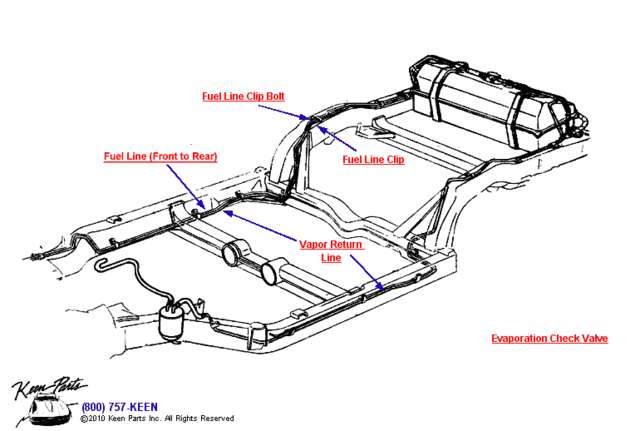
Here's a fuel supply and vapor control system diagram from the Keen site. The vapor system is on the left side.
The 'separator' appears (?) to be mounted on the left side rear near the tank. Or perhaps it's part of the fuel sending unit?
Regards,
Alan
Here's a fuel supply and vapor control system diagram from the Keen site. The vapor system is on the left side.
The 'separator' appears (?) to be mounted on the left side rear near the tank. Or perhaps it's part of the fuel sending unit?
Regards,
Alan
Last edited by Alan 71; Jan 1, 2017 at 09:20 AM.

Burning Brakes


Joined: Oct 2013
Posts: 1,117
Likes: 524
From: McClellandtown, Pa.
First off. Thank you all, this forum has been great help in the past. Thus car means the world to me and we have been through many hard times, I even recently got it back from being stolen. So I am going through everything with the car. I am a complete novice going onto master mechanic apparently. Now I noticed the vapor hose was disconneceted it and finally bojght a new hose and connected nicely. After a week- 2 week of nothing the cannister starting puking fuel. Now it is drawing a vaccum from the carbarateur. I want to leave it on but it is killing the engine. So
1. How do I remove the vapor Canister?
2. Where is the 1978 corvettes vapor "Check valve"
3. Where is a vapor 1978 system diagram.
4. WHAT COULD BE CAUSING THE VACCUM PULL???
5. What does it look like on inside/how to repair if neccessary?
5. Why is everything falling apart on me lately
PS I tried the forums but I have not yet found a solution. Sigh...
1. How do I remove the vapor Canister?
2. Where is the 1978 corvettes vapor "Check valve"
3. Where is a vapor 1978 system diagram.
4. WHAT COULD BE CAUSING THE VACCUM PULL???
5. What does it look like on inside/how to repair if neccessary?
5. Why is everything falling apart on me lately
PS I tried the forums but I have not yet found a solution. Sigh...
Hope this helps,
Jimmy
Last edited by Tooch1; Jan 1, 2017 at 01:14 PM.
Corvette Stories
The Best of Corvette for Corvette Enthusiasts

Corvette & Porsche 911: How Two Icons Conquered the Last 25 Years
Joe Kucinski
2027 Chevrolet Silverado 1500 First Look: Everything You NEED to Know!
Michael S. Palmer
5 Best & 5 Worst Corvette Daily Drivers
Joe Kucinski
The Headlights of Every Corvette Generation Explained
Joe Kucinski
5 Best & 5 Most Overrated Corvette Track Packages of All Time!
Joe Kucinski
Every 2027 Corvette Engine Explained
Joe Kucinski
Designer Imagines A Corvette That Looks More Like a Corvette Than the Corvette
Verdad Gallardo
10 Ugly Corvettes That We Still Kinda Love
Joe Kucinski
Top 10 Most Expensive Corvettes Ever Sold on Bring A Trailer
Brett Foote
Burning Brakes
Joined: Oct 2013
Posts: 1,117
Likes: 524
From: McClellandtown, Pa.
Pics of the top valve spring assembly. Second photo shows original lower filter that holds the charcoal inside the canister. It did tear when I tried to remove it so I just cut out a new one from a thin piece of foam (shown in yellow underneath) that I had on hand. Note this canister is from a 73'. Same inside though, just different amount of ports on top for the 78'.
Last edited by Tooch1; Jan 1, 2017 at 01:20 PM.
Team Owner
Joined: Sep 2006
Posts: 31,338
Likes: 4,459
From: Westminster Maryland
Hi jimmy,
Nice photos of your work. I'm not sure that I've ever seen the actual 'insides' of the case.
Did you notice the number on the top of the canister K posted the photo of?!?
Regards,
Alan
Happy New Year!
Nice photos of your work. I'm not sure that I've ever seen the actual 'insides' of the case.
Did you notice the number on the top of the canister K posted the photo of?!?
Regards,
Alan
Happy New Year!
Last edited by Alan 71; Jan 1, 2017 at 11:08 AM.
Burning Brakes
Joined: Oct 2013
Posts: 1,117
Likes: 524
From: McClellandtown, Pa.
How do you decipher that one as a date code for a 78?
The one above I just bought and restored came off a 73.
Number on it 293!
Jimmy
Team Owner
Joined: Sep 2006
Posts: 31,338
Likes: 4,459
From: Westminster Maryland
Hi Jimmy,
I'm really clueless as to what that means…. maybe it's not a date? I wanted the 3 digits on my canister to be a Julian date because it seemed to make sense. But?
Unless you run into someone with THE knowledge all you can really do is try to document as many as you can and begin to look for any kind of pattern.
There are a surprising number of people doing that for specific parts, options, and cars.
For example a couple of folks have been recording LT-! information for 30+ years.
It's efforts by folks like that which lend credence to the information in the TIM&JG.
Regards,
Alan
I'm really clueless as to what that means…. maybe it's not a date? I wanted the 3 digits on my canister to be a Julian date because it seemed to make sense. But?
Unless you run into someone with THE knowledge all you can really do is try to document as many as you can and begin to look for any kind of pattern.
There are a surprising number of people doing that for specific parts, options, and cars.
For example a couple of folks have been recording LT-! information for 30+ years.
It's efforts by folks like that which lend credence to the information in the TIM&JG.
Regards,
Alan
Last edited by Alan 71; Jan 1, 2017 at 01:44 PM.
Burning Brakes
Joined: Oct 2013
Posts: 1,117
Likes: 524
From: McClellandtown, Pa.

I'm trying!
What's tough about these is where they are located on the cars. Original owners that I've contacted are willing to help, but you can't see these numbers unlesss you remove them, or remove the windshield washer tank, and even the vacuum tank on the earlier C3's. I wouldn't expect anyone to go through all that.
Hope you have a great new year!
Jimmy
Team Owner
Joined: Sep 2006
Posts: 31,338
Likes: 4,459
From: Westminster Maryland
Hi jimmy,
There are generally quite a few canisters for sale at Carlisle so it's a good source of examples, but the likelihood of the seller knowing just what year car the canister is from is slim.
So you only have half of the data you need.
Regards,
Alan
There are generally quite a few canisters for sale at Carlisle so it's a good source of examples, but the likelihood of the seller knowing just what year car the canister is from is slim.
So you only have half of the data you need.
Regards,
Alan

Racer

Joined: Aug 2013
Posts: 339
Likes: 54
From: Fayetteville NC
I was getting a heavy fuel Odor inside the car while driving when the tank was topped off. I did what FlyViper mentioned. Removed the canister, plugged the valve on the tank and bought a vented gas cap. No more fuel odor. Now you have and extra vacuum port on the carb to use.

Had a 1976 L-82, 4-sp

Joined: Mar 2011
Posts: 5,338
Likes: 1,213
From: Some days your the dog and some days your the hydrant.
Royal Canadian Navy
20 yrs ago when I replaced my qj with a Holley, I just plugged the hose that went into the qj from the canister. The canister has remained untouched with the hose plugged. I have yet to smell any gas when I walk into the garage in 20 years.

Advanced
Joined: Jul 2016
Posts: 64
Likes: 4
Tank vent line
You don't lose anything by not having it hooked up. You could disconnect the vacuum line from the carb, disconnect the line from the vapor canister to the fuel tank (plug both), and lastly buy a vented gas cap (or vent your unvented one via drill bit). There are some threads on here talking about fixing the canister, but for me it wasn't worth the pain for really no gain (except maybe slightly saving the environment? But lets be honest, these cars no matter what are nowhere in the "help" department when it comes to environment).
Last edited by blanman61; Jan 2, 2017 at 05:18 PM.
Thread Starter
Advanced
Joined: Dec 2016
Posts: 67
Likes: 1
You guys have offere so much wonderful inputs. I cannot thank enough. I have read some your forums already. So I think what I need to do is is remove the canister first. I plan on keeping it and somehow getting it running but it is KILLING my engine with that hose plugged in. Its pulling vaccume nd sucking that damn carb dry.
1. Where can I take the vapor hose from carb and bypass the vapor tank for temp fix?
2. i will reread these post religiously but I must insist I think the vape line from carb to cannister is sucking fuel from the bowl, filling cannister.
3 any step by steps for this poor soul would be helpful. (Did I mention Im headed for back surgery? me and the car is sick.
4.i remove connection from carb and engine sounds much better.
5. COULD major vaccume leaks from headlight system be giving car fuel cannister extra draw from carb????
6. OH could, SIMPLY it be some kind of drain plug/clog that is stopping the fuel vapor going back to tank or carb? Or does the excessive pull on the vape line make this not matter?
Thank you, mark my words. One day i will be. A lifetime member. My corvette fam.
1. Where can I take the vapor hose from carb and bypass the vapor tank for temp fix?
2. i will reread these post religiously but I must insist I think the vape line from carb to cannister is sucking fuel from the bowl, filling cannister.
3 any step by steps for this poor soul would be helpful. (Did I mention Im headed for back surgery?
me and the car is sick.4.i remove connection from carb and engine sounds much better.
5. COULD major vaccume leaks from headlight system be giving car fuel cannister extra draw from carb????
6. OH could, SIMPLY it be some kind of drain plug/clog that is stopping the fuel vapor going back to tank or carb? Or does the excessive pull on the vape line make this not matter?
Thank you, mark my words. One day i will be. A lifetime member. My corvette fam.
Last edited by Fang333333; Jan 2, 2017 at 08:00 PM. Reason: Im tired
Thread Starter
Advanced
Joined: Dec 2016
Posts: 67
Likes: 1

 OMG!
OMG! Before anyone answers these questions could someone tell me the dangers of this filled vapor canister getting in the fuel supply??? Im getting an awful lot of pingings, engine accel cutouts, possibly grey exhaust). I just fixed these with high qaulity tuneup etc etc. please tell me this could be ok as it runs its course? Or maybe the fuel additive i put in (which i never do) is helping this??? Please respond. Im scared sh**less. The vape line is currently off carb but connected to canister.
Last edited by Fang333333; Jan 3, 2017 at 01:20 AM.
Thread Starter
Advanced
Joined: Dec 2016
Posts: 67
Likes: 1
Well at this point I have no choice but to retire the car. I have no money for mechanic nor would I trust anyone. I guess noone has any further ideas here... I just absolutely cannot believe that after simply plugging in that fuel canister and putting a fuel additive that the car is damn near out of commision. It had minor issues before but I really had it running smoooooth. Now when I first turn on the engine it sounds like the thing wants to explode. Pops and pings and misses. I even have a chemicle/fuel smell. I have run atnleast 8 gallons of top shelf fuel through the system and still the car runs rough and has a loss of HP. .....ALL FROM PLUGGING IN THE CANISTER.....and it doesnt matter now if its unplugged. That was the only change made to the car (plus fuel additive). My car seems to be permanently screwed...but it was just running like a dream a week ago. Its freaking not drivable now and I dunno where to start. I spent all that time and money getting it to run good and then simply plugging in a hose killed the car.
Last edited by Fang333333; Jan 5, 2017 at 02:19 AM.