







Media Blasting Information Needed
Thread Starter
Burning Brakes


Joined: Feb 2008
Posts: 993
Likes: 44
From: Jefferson Hills PA
 Media Blasting Information Needed
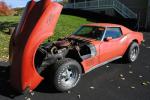
I'm at the stage of media blasting my body. I have done alot of sand blasting and have a good size system set up at home. However I see several types of media being used. I have heard soda blasting leaves a residue that needs to be neutralized with vinegar but there is still a risk of some residue being left behind that could effect the paint. Walnut shells seems popular and come in several sizes. Then there's the plastic media. I guess this is a new process but is supposed to work quite well. The walnut shells and plastic leave no residue, so I'm told. Any feedback and opinions would be appreciated.
Ned
Ned

Drifting

Joined: Jan 2014
Posts: 1,866
Likes: 140
From: Sadieville Kentucky
I'm at the stage of media blasting my body. I have done alot of sand blasting and have a good size system set up at home. However I see several types of media being used. I have heard soda blasting leaves a residue that needs to be neutralized with vinegar but there is still a risk of some residue being left behind that could effect the paint. Walnut shells seems popular and come in several sizes. Then there's the plastic media. I guess this is a new process but is supposed to work quite well. The walnut shells and plastic leave no residue, so I'm told. Any feedback and opinions would be appreciated.
Ned
Ned
I used the plastic as walnut shells do have some oil in shells that may affect paint??
Wes

Team Owner


Joined: Sep 2006
Posts: 31,274
Likes: 4,366
From: Westminster Maryland
Hi Ned,
Perhaps you're aware of this…..
SUCCESSFULLY media blasting a Corvette body takes an experienced operator, using just the right media, at just the right pressure.
Many people advise against using it to remove paint from a Corvette body.
So plan this operation well!
Regards,
Alan
I'm NOT doubting your abilities!!!!!
Perhaps you're aware of this…..
SUCCESSFULLY media blasting a Corvette body takes an experienced operator, using just the right media, at just the right pressure.
Many people advise against using it to remove paint from a Corvette body.
So plan this operation well!
Regards,
Alan
I'm NOT doubting your abilities!!!!!
Last edited by Alan 71; Jan 17, 2017 at 10:40 AM.

Race Director


Joined: Apr 2009
Posts: 19,294
Likes: 2,754
From: Charlotte NC
For what this is worth:
I have dealt with bodies that were blasted and done by someone who did not either watch what they were doing or were not paying attention. And the time it took to fix what they damaged it would have been better for the owner to not do anything at all and let me strip it chemically....or sand it off by hand.
With that said....just be CAREFUL because I know when you have the blaster out and making headway...do not be fooled that you can destroy areas due to you 'being in the moment' and not knowing when to STOP.
DUB
I have dealt with bodies that were blasted and done by someone who did not either watch what they were doing or were not paying attention. And the time it took to fix what they damaged it would have been better for the owner to not do anything at all and let me strip it chemically....or sand it off by hand.
With that said....just be CAREFUL because I know when you have the blaster out and making headway...do not be fooled that you can destroy areas due to you 'being in the moment' and not knowing when to STOP.
DUB
Thread Starter
Burning Brakes
Joined: Feb 2008
Posts: 993
Likes: 44
From: Jefferson Hills PA
I have done more research and will probably have one of two different companies do it for me. I have sand blasted a lot of steel myself but this is completely different I'm sure. One of the companies uses walnut shells which I'm familiar with. The other guy uses Geo Blaster, which uses water and plastic media. I've never heard of Geo Blasting but will look into it before I send it out. I'm taking a spare part with paint on it to the Geo Blaster tomorrow and see how it comes out.
Has anyone ever heard of Geo Blasting ?
Ned
Has anyone ever heard of Geo Blasting ?
Ned
Race Director
Joined: Apr 2009
Posts: 19,294
Likes: 2,754
From: Charlotte NC
I WOULD NOT get it blasted when WATER and ANY type of media are used together to get paint off. The part can be severely damaged. I have had parts that were blasted and water was a part of the 'mix'...and they were so badly damaged...That now...I simply just stay away from that and strip them myself.
That's my take on that..and do as you wish....and I hope you have better success in it....or at least when you get it back you do not find areas that were damaged to the point where you then regret doing it.
DUB
That's my take on that..and do as you wish....and I hope you have better success in it....or at least when you get it back you do not find areas that were damaged to the point where you then regret doing it.
DUB
Corvette Stories
The Best of Corvette for Corvette Enthusiasts

Top 10 Most Expensive Corvettes Ever Sold on Bring A Trailer
Brett Foote
10 Things Every Corvette Owner Needs (2026 Edition)
Michael S. Palmer
8 Most "Only Corvette Owners Understand" Quirks and Problems
Pouria Savadkouei
10 Reasons the C6 Z06 is Still A Performance Benchmark After 20 Years
Joe Kucinski
How Much Horsepower Every Corvette Engine "LOST" in 1972
Joe Kucinski
Top 10 DOs and DON'Ts for Protecting Your Convertible Top!
Michael S. Palmer
Top 10 Most Explosive Corvettes Ever Made: Power-to-Weight Ratio Ranked!
Joe Kucinski
150 hp to 1,250 hp: Every Corvette Generation Compared by the Specs That Matter
Joe Kucinski
8 Coolest Corvette Pace Cars (and Replicas) of All Time
Verdad Gallardo
Melting Slicks

Joined: Jun 2006
Posts: 2,071
Likes: 147
From: S Nevada
I stuck to the old heat gun and a razor blade technique. I custom made a handle to hold a razor knife blade then rounded the corners of the blade to prevent gouging in. I would just touch up the blade on a quality honeing stone I have.
The reason, I didn't want to deal with the potential of stripper leaching out of cracks, or the mess and potential damage caused by media blasting.
It was surprising how quickly the process was. I could do a qtr of the car in a few hrs, when I had enough for the day, I just swept up and walked away from it.
The reason, I didn't want to deal with the potential of stripper leaching out of cracks, or the mess and potential damage caused by media blasting.
It was surprising how quickly the process was. I could do a qtr of the car in a few hrs, when I had enough for the day, I just swept up and walked away from it.
Thread Starter
Burning Brakes
Joined: Feb 2008
Posts: 993
Likes: 44
From: Jefferson Hills PA
I WOULD NOT get it blasted when WATER and ANY type of media are used together to get paint off. The part can be severely damaged. I have had parts that were blasted and water was a part of the 'mix'...and they were so badly damaged...That now...I simply just stay away from that and strip them myself.
That's my take on that..and do as you wish....and I hope you have better success in it....or at least when you get it back you do not find areas that were damaged to the point where you then regret doing it.
DUB
That's my take on that..and do as you wish....and I hope you have better success in it....or at least when you get it back you do not find areas that were damaged to the point where you then regret doing it.
DUB
Drifting

Joined: Oct 2012
Posts: 1,524
Likes: 61
From: Medina Ohio
I'm all about saving time anywhere I can and trying to do things the easiest way if it achieves a quality result. So when it came time to strip my body I went through the same questions and options that you are. Media blasting HAD to be the quickest and easiest in my mind. Especially to pay some money and have the car returned to me "done". Well, through my research and questioning there was just to much unknown and possible risk. When others spoke of razor blading I thought they were absolutely nuts and I would never have time for that.. Well after seeing a youtube video or two, and getting off my *** to actually try it rather then rely on the forum to explain and debate - it was surprisingly quick, and in a way, enjoyable. (Kind of the same enjoyment as peeling dried elmers glue off or dead skin from your feet, etc.  )
)
I only used blades (& a heat gun) on the front clip because the rest of the car must have had a newer paint that did not peel / chip. I used a chemical stripper on the doors and rear which also worked very well (a little messy).
Good luck on your choice.
)I only used blades (& a heat gun) on the front clip because the rest of the car must have had a newer paint that did not peel / chip. I used a chemical stripper on the doors and rear which also worked very well (a little messy).
Good luck on your choice.
Last edited by Ibanez540r; Jan 22, 2017 at 06:32 AM.

Race Director
Joined: Apr 2009
Posts: 19,294
Likes: 2,754
From: Charlotte NC
I stuck to the old heat gun and a razor blade technique. I custom made a handle to hold a razor knife blade then rounded the corners of the blade to prevent gouging in. I would just touch up the blade on a quality honeing stone I have.
The reason, I didn't want to deal with the potential of stripper leaching out of cracks, or the mess and potential damage caused by media blasting.
It was surprising how quickly the process was. I could do a qtr of the car in a few hrs, when I had enough for the day, I just swept up and walked away from it.
The reason, I didn't want to deal with the potential of stripper leaching out of cracks, or the mess and potential damage caused by media blasting.
It was surprising how quickly the process was. I could do a qtr of the car in a few hrs, when I had enough for the day, I just swept up and walked away from it.
But...for those who may read this: I use chemical stripper A LOT. If you have a crack in a panel...you simply mask it off and be conscience of it. It is not like you are not going to have to grind it out and repair it anyway. I have yet to ever have a paint job fail due to me using chemical stripper.
But if you are not comfortable in using chemical stripper....use what makes you fee comfortable.
I am much like 'Ibanez540r'. I HAVE TO consider the time I spend on a task...because I am billing a customer for it. It often times can be a 'balancing act' in getting the test procedure down for that particular Corvette so I know my end result is NOT going to cause for future problems and it is not going to take me forever to get the job done. Sometimes the paint removal procedure takes a lot longer than I like...but...it is what it is.
DUB
Thread Starter
Burning Brakes
Joined: Feb 2008
Posts: 993
Likes: 44
From: Jefferson Hills PA
Alan,
There is the original lacquer paint, then a primer and then an acrylic enamel over that. I'm considering using acrylic lacquer to paint the car so I'm just trying to eliminate any issues down the road. I dont mind using a razor blade or even sanding as suggested by others it's all of the door jamb areas and tight spots I was hoping to get stripped clean by blasting.
There is the original lacquer paint, then a primer and then an acrylic enamel over that. I'm considering using acrylic lacquer to paint the car so I'm just trying to eliminate any issues down the road. I dont mind using a razor blade or even sanding as suggested by others it's all of the door jamb areas and tight spots I was hoping to get stripped clean by blasting.
Thread Starter
Burning Brakes
Joined: Feb 2008
Posts: 993
Likes: 44
From: Jefferson Hills PA
After hearing more information it seems there is a risk with any method. I do prefer to do this myself and not rely on someone to take the care I would expect, since that may not happen. Maybe I remove the large areas by razor blade and sanding and then light blasting with fine plastic media in the hard to get to areas. After talking to the second Media Blaster yesterday, he said he doesn't do cars anymore especially Corvettes. However we talked at length about the process. As suggested I'm going to start with very low pressure, about 40 PSI and see how it goes from there, ever so slowly raising the pressure as needed to remove only paint. I do have the luxury of time on my side and won't be in a hurry. I have to build a make shift containment area to reclaim the plastic media. It's $50.00 for 50 lb. and there would be too much waste without reclaiming it.
Team Owner
Joined: Sep 2006
Posts: 31,274
Likes: 4,366
From: Westminster Maryland
Hi Ned,
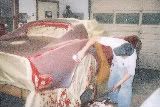
My 71 still had the original paint on it.
The fellow who painted my car suggested we use thick liquid stripper to remove the paint.
The car was then painted with acrylic lacquer.
Regards,
Alan
My 71 still had the original paint on it.
The fellow who painted my car suggested we use thick liquid stripper to remove the paint.
The car was then painted with acrylic lacquer.
Regards,
Alan
Last edited by Alan 71; Jan 21, 2017 at 10:15 AM.
Race Director
Joined: Apr 2009
Posts: 19,294
Likes: 2,754
From: Charlotte NC
After hearing more information it seems there is a risk with any method.
I agree.
BUT...think of it like this. When you are cooking a steak out on the grille....you stand there and keep an eye on it. Chances are...you won't burn it. BUT if you walk away and go watch the Super Bowl...then expect a burnt steak when you walk back to the grille.
Some methods of stripping paint can follow this thought process. BUT...IF you are paying attention and WATCHING what you are doing...you can not screw it up. Because much like your steak. If it was not cooked enough...you can go throw it back on the grille and cook it a bit more. And if using a chemical stripper...you can do the same thing. Carefully apply more and then remove it.
And using a media blaster ...the same thing.....if sanding the car....the same thing....and if scrubbing it with rough steel wool and lacquer thinner....the same thing. So...if you are paying attention...you will not have a problem...regardless of the method you choose.
Now the choice of paint removal method you choose will often times change the amount of time it takes.
I do prefer to do this myself and not rely on someone to take the care I would expect, since that may not happen. Maybe I remove the large areas by razor blade and sanding and then light blasting with fine plastic media in the hard to get to areas.
Strip a small area and see what it takes so you do not go crazy doing the entire car and realize you could have changed the method and save you a butt load of time and physical energy.
After talking to the second Media Blaster yesterday, he said he doesn't do cars anymore especially Corvettes. However we talked at length about the process. As suggested I'm going to start with very low pressure, about 40 PSI and see how it goes from there, ever so slowly raising the pressure as needed to remove only paint. I do have the luxury of time on my side and won't be in a hurry. I have to build a make shift containment area to reclaim the plastic media. It's $50.00 for 50 lb. and there would be too much waste without reclaiming it.
I agree.
BUT...think of it like this. When you are cooking a steak out on the grille....you stand there and keep an eye on it. Chances are...you won't burn it. BUT if you walk away and go watch the Super Bowl...then expect a burnt steak when you walk back to the grille.
Some methods of stripping paint can follow this thought process. BUT...IF you are paying attention and WATCHING what you are doing...you can not screw it up. Because much like your steak. If it was not cooked enough...you can go throw it back on the grille and cook it a bit more. And if using a chemical stripper...you can do the same thing. Carefully apply more and then remove it.
And using a media blaster ...the same thing.....if sanding the car....the same thing....and if scrubbing it with rough steel wool and lacquer thinner....the same thing. So...if you are paying attention...you will not have a problem...regardless of the method you choose.
Now the choice of paint removal method you choose will often times change the amount of time it takes.
I do prefer to do this myself and not rely on someone to take the care I would expect, since that may not happen. Maybe I remove the large areas by razor blade and sanding and then light blasting with fine plastic media in the hard to get to areas.
Strip a small area and see what it takes so you do not go crazy doing the entire car and realize you could have changed the method and save you a butt load of time and physical energy.
After talking to the second Media Blaster yesterday, he said he doesn't do cars anymore especially Corvettes. However we talked at length about the process. As suggested I'm going to start with very low pressure, about 40 PSI and see how it goes from there, ever so slowly raising the pressure as needed to remove only paint. I do have the luxury of time on my side and won't be in a hurry. I have to build a make shift containment area to reclaim the plastic media. It's $50.00 for 50 lb. and there would be too much waste without reclaiming it.
IF you find that you are ...what appears....to be fighting a loosing battle and need to switch methods and that method is using a chemical stripper. Just PM me and I will be more than happy to help you in the procedure and product I use and how to do this.
I know you are not in a hurry...which is good....but I can tell you from doing this for a very, very long time. There is a point where applying my time on something and it taking forever.....I find a method that does NOT sacrifice quality and I can get it done faster and not wear my body out in the process. Yeah...I can cut that tree down in my back yard with my pocket knife...and it would take a while...but I think I might use an ax and get it done quicker.
DUB

Safety Car


Joined: Mar 2003
Posts: 3,583
Likes: 504
From: Indianapolis IN
Finalist 2020 C4 of the Year - Unmodified
C4 of Year Finalist (stock) 2019
About 12 years back I had a 1973 that I had media blasted. They used baking soda (appropriately called "soda blasting"). I attempted chemically stripping before I went this route, but was unsuccessful...I believe the car had at least 2 coats of Imron on it...and man oh man, that stuff was rock hard and seemed almost impossible to remove. The soda blast took it right down to the glass without damaging the panels. It exposed every bonding seam without even damaging the original filler. I was then able to seal, do my bodywork, prime, then paint the car. The whole strip job set me back $600.00, and that included the door jams and engine compartment. The company I used was Indianapolis Dry Strip (Now IDS Blast).
Thread Starter
Burning Brakes
Joined: Feb 2008
Posts: 993
Likes: 44
From: Jefferson Hills PA
About 12 years back I had a 1973 that I had media blasted. They used baking soda (appropriately called "soda blasting"). I attempted chemically stripping before I went this route, but was unsuccessful...I believe the car had at least 2 coats of Imron on it...and man oh man, that stuff was rock hard and seemed almost impossible to remove. The soda blast took it right down to the glass without damaging the panels. It exposed every bonding seam without even damaging the original filler. I was then able to seal, do my bodywork, prime, then paint the car. The whole strip job set me back $600.00, and that included the door jams and engine compartment. The company I used was Indianapolis Dry Strip (Now IDS Blast).