





What makes an engine "numbers matching"?

Thread Starter
Instructor

Joined: Feb 2017
Posts: 130
Likes: 11
From: Millbury Massachusetts
 What makes an engine "numbers matching"?
I am new to the C3 Corvette world, having owned Mustangs and Cougars for the past 10 years or more and C4 Corvettes before that. In the Ford world, I knew that the head or block would sometimes have the last 6 digits of the VIN stamped on it (our 1968 Cougar has that). Absent that, you'd have to judge numbers matching very loosely according to casting numbers.
Are the Corvette engine blocks supposed to have the last 6 digits of the VIN stamped on them or is there some other correlation between the block stampings and the VIN that determines matching or non-matching?
Are the Corvette engine blocks supposed to have the last 6 digits of the VIN stamped on them or is there some other correlation between the block stampings and the VIN that determines matching or non-matching?

Melting Slicks


Joined: Sep 2005
Posts: 2,712
Likes: 902
From: Warminster PA
VIN is stamped on engine pad and transmission. If all three are the same then you have "numbers matching".
Does NOT necessarily mean that they are the original parts to the car though.........
Does NOT necessarily mean that they are the original parts to the car though.........
Last edited by thoyer; Feb 16, 2017 at 08:38 PM.
Racer
Joined: Mar 2016
Posts: 470
Likes: 31
From: Melbourne Victoria
Vin is stamped on transmission as well is it? Would that just be the last 6 numbers and where exactly on the trans on a 72 please?

Race Director


Joined: Oct 2000
Posts: 12,683
Likes: 3,136
From: Shamong, NJ
One set was an engine ID, made up of a letter for the engine assembly plant, four numbers for the month and day that the engine was assembled, and a two or three letter suffix code, that identified the engine type. The second set of numbers was a VIN derivative. The VIN derivative varies some by year, but it always included the last six digits of the VIN, usually proceeded by additional numbers sometimes identifying the model year, the GM brand (1 is Chevrolet), the model (Corvette is 9), and the assembly plant - "S" for St. Louis or "5" for Bowling Green.
The trans stamping is in the same format as the engine VIN derivative, and was stamped at the same time on the assembly line. Where the trans was stamped, varied by year and trans type. 4 speeds were usually stamped on a machined vertical pad, on the right (passenger) side of the trans case, where it attaches to the tail shaft housing.
The block below is a 66 427, but the basic format is the same or similar for most engines and years.


Safety Car


Joined: Feb 2012
Posts: 4,705
Likes: 983
From: Orlando FL

Team Owner

Joined: Jun 2000
Posts: 38,923
Likes: 1,482
From: Southbound
Cruise-In II Veteran
120085 is the consecutive unit number for the car. The consecutive unit number becomes part of the complete VIN.
All 1971 Corvettes have the 1 following the plant code (S for St. Louis). The car in the pic was the 20085th 1971 Corvette assembled. Total production was 21801 cars. #20085 was completed near the end of the 1971 production run (21801 - 20085 = 1716 before end of year.)

All 1971 Corvettes have the 1 following the plant code (S for St. Louis). The car in the pic was the 20085th 1971 Corvette assembled. Total production was 21801 cars. #20085 was completed near the end of the 1971 production run (21801 - 20085 = 1716 before end of year.)

Team Owner


Joined: Sep 2006
Posts: 31,283
Likes: 4,373
From: Westminster Maryland
Hi C3,
The term "Numbers Matching" has become miss-used, and so open to interpretation, that many folks don't use it anymore.
As has been explained, in it's narrowest sense the term refers to the stamped information on the engine's 'pad', the stamped information on the transmission, and that information's similarity and appropriateness to the car's VIN information and assembly date.
There are many, many, parts in the engine compartment and through out the car that have part numbers on them, dates or date codes, and configurations that make them appropriate for a specific car.
Some people are only interested in the engine pad while some are interested in the whole car.
Regards,
Alan
The term "Numbers Matching" has become miss-used, and so open to interpretation, that many folks don't use it anymore.
As has been explained, in it's narrowest sense the term refers to the stamped information on the engine's 'pad', the stamped information on the transmission, and that information's similarity and appropriateness to the car's VIN information and assembly date.
There are many, many, parts in the engine compartment and through out the car that have part numbers on them, dates or date codes, and configurations that make them appropriate for a specific car.
Some people are only interested in the engine pad while some are interested in the whole car.
Regards,
Alan
Last edited by Alan 71; Feb 17, 2017 at 09:21 AM.
Corvette Stories
The Best of Corvette for Corvette Enthusiasts

Top 10 Most Expensive Corvettes Ever Sold on Bring A Trailer
Brett Foote
10 Things Every Corvette Owner Needs (2026 Edition)
Michael S. Palmer
8 Most "Only Corvette Owners Understand" Quirks and Problems
Pouria Savadkouei
10 Reasons the C6 Z06 is Still A Performance Benchmark After 20 Years
Joe Kucinski
How Much Horsepower Every Corvette Engine "LOST" in 1972
Joe Kucinski
Top 10 DOs and DON'Ts for Protecting Your Convertible Top!
Michael S. Palmer
Top 10 Most Explosive Corvettes Ever Made: Power-to-Weight Ratio Ranked!
Joe Kucinski
150 hp to 1,250 hp: Every Corvette Generation Compared by the Specs That Matter
Joe Kucinski
8 Coolest Corvette Pace Cars (and Replicas) of All Time
Verdad Gallardo
Senior Member


Joined: Jan 2008
Posts: 12,146
Likes: 2,038
From: Easton, PA
St. Jude Donor '10
Hi C3,
The term "Numbers Matching" has become miss-used, and so open to interpretation, that many folks don't use it anymore.
As has been explained, in it's narrowest sense the term refers to the stamped information on the engine's 'pad', the stamped information on the transmission, and that information's similarity and appropriateness to the car's VIN information and assembly date.
There are many, many, parts in the engine compartment and through out the car that have part numbers on them, dates or date codes, and configurations that make them appropriate for a specific car.
Some people are only interested in the engine pad while some are invested in the whole car.
Regards,
Alan
The term "Numbers Matching" has become miss-used, and so open to interpretation, that many folks don't use it anymore.
As has been explained, in it's narrowest sense the term refers to the stamped information on the engine's 'pad', the stamped information on the transmission, and that information's similarity and appropriateness to the car's VIN information and assembly date.
There are many, many, parts in the engine compartment and through out the car that have part numbers on them, dates or date codes, and configurations that make them appropriate for a specific car.
Some people are only interested in the engine pad while some are invested in the whole car.
Regards,
Alan
 Well said Alan.
Thread Starter
Instructor
Joined: Feb 2017
Posts: 130
Likes: 11
From: Millbury Massachusetts
I'm pretty sure the motor in the '73 we're looking at is not the original motor. The number stamped on the right/passenger rear part of the block, just behind the head, reads 4024388C, which doesn't follow a VIN pattern. Could this have been a marine motor?
Team Owner
Joined: Jun 2000
Posts: 38,923
Likes: 1,482
From: Southbound
Cruise-In II Veteran
Team Owner
Joined: Sep 2006
Posts: 31,283
Likes: 4,373
From: Westminster Maryland
Hi r44,
There are some folks to whom the 'original' engine is very important, but there are others to whom it means very little.
A really nice car is a really nice car whether it has it's original engine or not!
A car with it's original engine is a bit more valuable, but what the rest of the car is has a much larger effect on that value.
Don't worry about it! Your car is what it is!
Regards,
Alan
Do you think the engine is the one that was in the car when it left St.Louis?
Are the rest of the engine components that have part numbers and date
still the original parts?
There are some folks to whom the 'original' engine is very important, but there are others to whom it means very little.
A really nice car is a really nice car whether it has it's original engine or not!
A car with it's original engine is a bit more valuable, but what the rest of the car is has a much larger effect on that value.
Don't worry about it! Your car is what it is!
Regards,
Alan
Do you think the engine is the one that was in the car when it left St.Louis?
Are the rest of the engine components that have part numbers and date
still the original parts?
Team Owner
Joined: Sep 2006
Posts: 31,283
Likes: 4,373
From: Westminster Maryland
Hi c369,
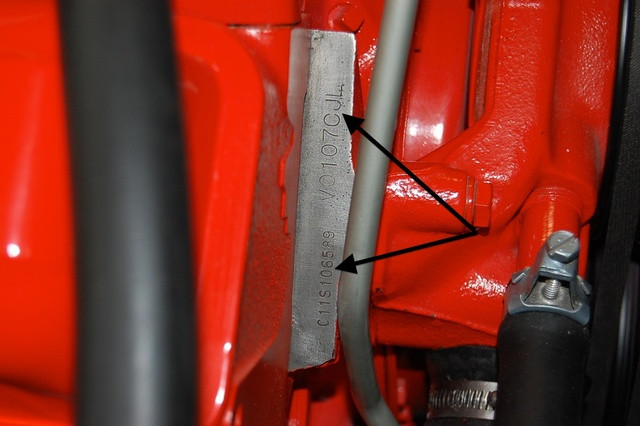
To go along with gbv62's post here's an example of the stamps on a small block pad.
Regards,
Alan
Upper arrow points to the stamped information that describes where, when, and in what configuration the engine was assembled.
The lower arrow indicates what vehicle the engine was first installed in.
To go along with gbv62's post here's an example of the stamps on a small block pad.
Regards,
Alan
Upper arrow points to the stamped information that describes where, when, and in what configuration the engine was assembled.
The lower arrow indicates what vehicle the engine was first installed in.
Last edited by Alan 71; Feb 17, 2017 at 10:25 AM.

Melting Slicks
Joined: Apr 2013
Posts: 3,483
Likes: 1,823
From: McCloud CA
C2 of Year Finalist (appearance mods) 2019
There are casting numbers on the block also they unlike the stamped numbers can not be changed. And do tell some info.It seems strange to me that there are so many bbc c2 and c3s that engines have been rebuilt and still have the stamped numbers. Are there stamps available ?
Thread Starter
Instructor
Joined: Feb 2017
Posts: 130
Likes: 11
From: Millbury Massachusetts
Hi c369,
To go along with gbv62's post here's an example of the stamps on a small block pad.
Regards,
Alan
Upper arrow points to the stamped information that describes where, when, and in what configuration the engine was assembled.
The lower arrow indicates what vehicle the engine was first installed in.
To go along with gbv62's post here's an example of the stamps on a small block pad.
Regards,
Alan
Upper arrow points to the stamped information that describes where, when, and in what configuration the engine was assembled.
The lower arrow indicates what vehicle the engine was first installed in.
Team Owner
Joined: Jun 2000
Posts: 38,923
Likes: 1,482
From: Southbound
Cruise-In II Veteran
 Got my interest, and that isn't always easy to do. I love when mysteries are resolved. Standing bye.
Team Owner
Joined: Sep 2006
Posts: 31,283
Likes: 4,373
From: Westminster Maryland
Hi c369,
The size and shape of the sb stamp pad changed in the later 70s.
Here's an example of each.
Is yours the more square?
Regards,
Alan
This is looking from above with the head removed.

The size and shape of the sb stamp pad changed in the later 70s.
Here's an example of each.
Is yours the more square?
Regards,
Alan
This is looking from above with the head removed.