When you click on links to various merchants on this site and make a purchase, this can result in this site earning a commission. Affiliate programs and affiliations include, but are not limited to, the eBay Partner Network.
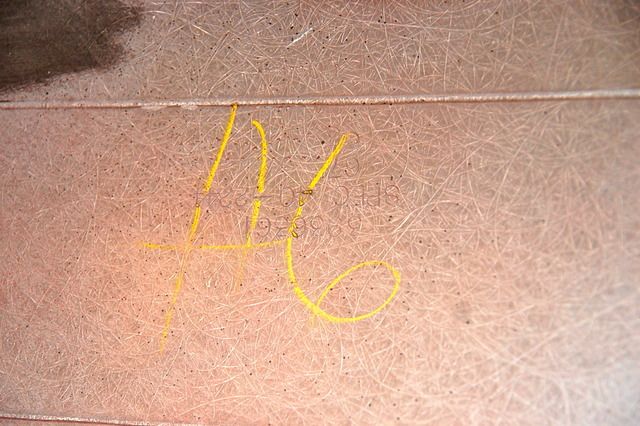
Along the line of Hood Numbers of unknown origin.....
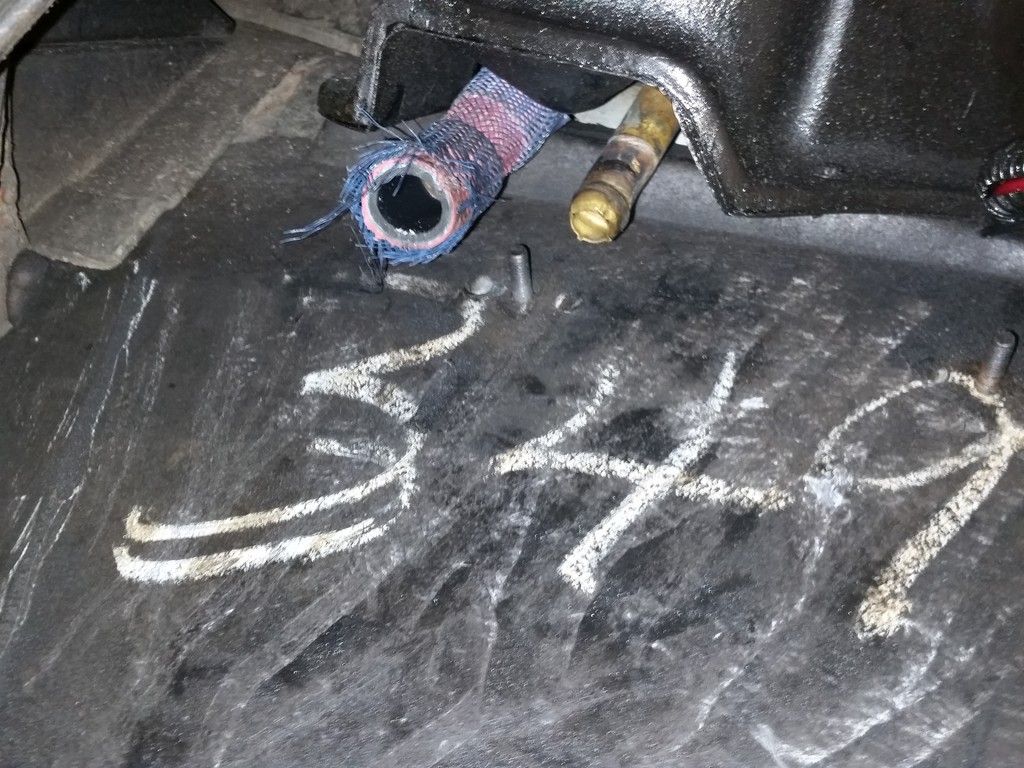
So I'm taking care of what I believe is a leaking Radiator Core on this '73 Coupe, and therefore on my back getting intimate with the Right Front wheel well area.
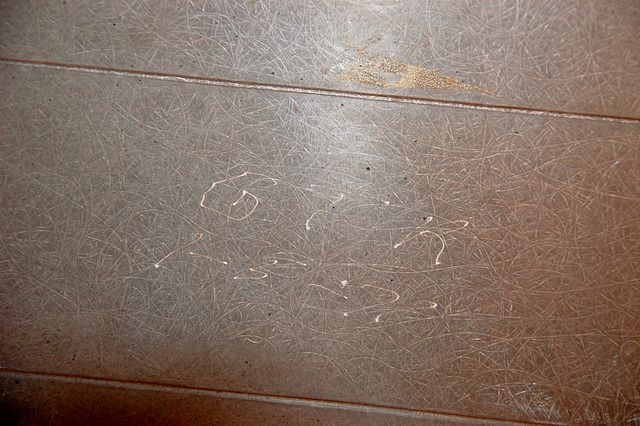
Removed the Heat Shield in order to get a better reach at things, and removed the hoses. And it's just like me: While I'm down there, I'm gonna clean things up. While scraping the crud off the fiberglass, I uncovered this number.
I'm thinking it's the Manufacturing Date, but I don't know. H31 is on the "Door" Data Plate, but 349 is quite a while from March 31st.
Anyone here found a number scribed on their car in this place?
Thanks.
Hi Steve,
At St.Louis each car was given a 'job number' that was used to identify the car during the period it was on the assembly line.
The numbers ran up to 500 and then started over again.
The number was written on the Corvette Order Copy (tank sheet) and several places on the under body.
Regards,
Alan
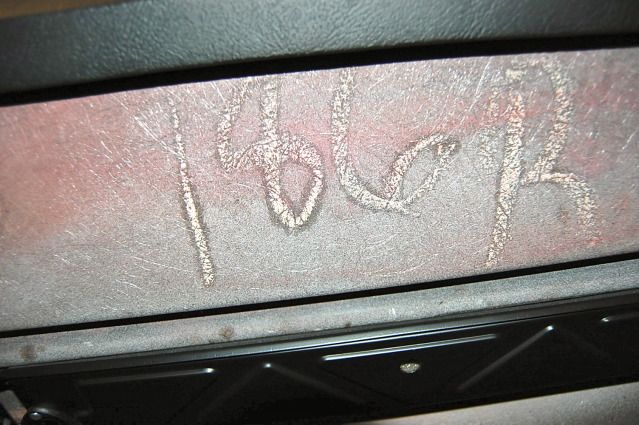
I'm not sure that I've seen one that appears to have been over-written as yours seems to be. Maybe the crayon broke in mid 3?
Here's a 186.
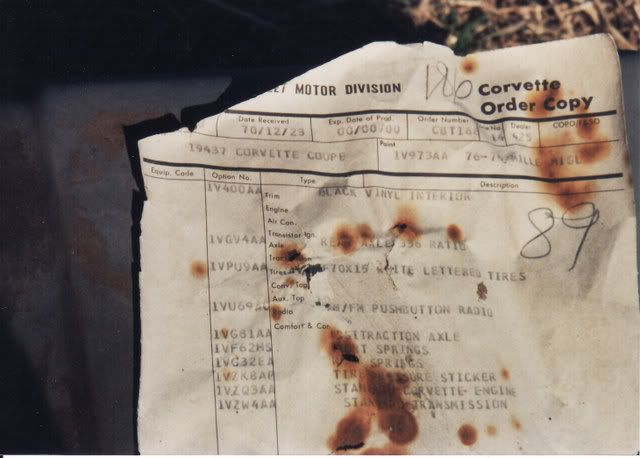
And on the Corvette Order Copy.
The 89 are the last 2 digits of the car's vin sequence number.
Hi Steve,
Nice find on your '73! Do you have the original buildsheet? Even though you say it was in bad shape maybe the top left hand corner box is still legible. 1973 was the first year for the new build sheet format. This new manifest style took the place of the Corvette Order Copy that ended in 72. That box has the schedule number and the proposed complete by date in it. The last three digits of the schedule number were the job numbers written on the cars in various places. Here is a photo from my build sheet and the job number '101' that I found in the same place on my '73. Also note the 05-01 date on mine. That is the proposed completed by date. My trim tag has a l30 (April 30th), build date. So, you see can see it was pretty close. Neat stuff!
That's why great care should always be taken when cleaning the undercarriage of our cars. It's very easy to wash away documentation like you ask about.
It should be noted the job number on the tank sticker is more often than not the same number written on the car at least for 1969. In fact, I have yet to see a 69 where they matched.
I know yours is a 73 and by then it may have been more consistent, but for anyone thinking it may apply to other years, it may not.
Alan's 71 is also a little unusual in that he has both job numbers on his tank sheet.
The wax crayon numbers can literally be anywhere. The rear interior bulkhead is a common place, also under the rear deck above the gas tank. On my 69 roadster it has the job number in that spot (under the rear deck) and also has N14 written next to it as its a side pipe car. If I remember later ill post some pics of the numbers I've found. I find these things very interesting.
Last edited by ed427vette; Apr 13, 2017 at 10:00 AM.
It should be noted the job number on the tank sticker is more often than not the same number written on the car at least for 1969. In fact, I have yet to see a 69 where they matched.
Hi Ed,
I'm sure you are correct. Weren't those numbers assigned from 1-500 then repeated for the Mid 67-72 cars when GM used the Portrait Style Corvette Order Copy? Then in 73 when the buildsheet reflected the GMAD data processing method for creating it, that numbering process changed.
Tooch
Hi Steve,
I think it's really interesting that the number at that location seems to have survived on so many cars. I can understand the numbers located in the interior surviving, but not that one.
I guess it has something to do with the protection that the stone shield provided…. and maybe the make-up of the 'crayon' used.
Regards,
Alan
Hi Steve,
I think it's really interesting that the number at that location seems to have survived on so many cars. I can understand the numbers located in the interior surviving, but not that one.
I guess it has something to do with the protection that the stone shield provided…. and maybe the make-up of the 'crayon' used.
Regards,
Alan
Alan,
It really does! The Build Sheet says it was delivered to City Chevrolet here in San Diego. So spending it's life here in a relatively dry and definitely road salt free environment had to help ensure this as well.
Hi Steve,
Take a peek at the underside of the rear deck directly below the window.
If it's there you can see it with the interior intact.
Regards,
Alan
I'm thinking the R indicates the deck should be cut for an antenna? (Not sure???)
Hi Steve,
Take a peek at the underside of the rear deck directly below the window.
If it's there you can see it with the interior intact.
Regards,
Alan
I'm thinking the R indicates the deck should be cut for an antenna? (Not sure???)
All you guys; I'm much appreciative for your time.
Steve
Awesome Steve!
It's really nice when you have the paperwork, then all the markings start to make sense. I'll share another one I discovered on my car. This date was written upside down on the inside of my driver's side front fender. I flipped the photo to make it easier to read. It's 5-1-73. The same as my projected date on my build sheet above.. So it appears that my car hung around at least for a day or so after the trim tag was attached. Which I believe was common.
Happy Easter!!
Tooch
Awesome Steve!
It's really nice when you have the paperwork, then all the markings start to make sense. I'll share another one I discovered on my car. This date was written upside down on the inside of my driver's side front fender. I flipped the photo to make it easier to read. It's 5-1-73. The same as my projected date on my build sheet above.. So it appears that my car hung around at least for a day or so after the trim tag was attached. Which I believe was common.
Happy Easter!!
Tooch
I'll take a look there also Tooch. Thanks for the help.
Here is one with three numbers. This was behind the tach--the tank stickers are still on the tank, too. The 481 corresponds with the VIN.
Anyone know what happened here, other than they made a mistake and crossed it out?
And no, I'm not worried about someone taking the ident number and faking something from it--it has already been run through NCRS documentation service.
Also, no idea why it uploaded two copies of the first page.
Last edited by 62corvette; Apr 14, 2017 at 10:29 PM.
62corvette
The Ident number is unique to each car so someone taking it to try to create a fake would not work for anything.
Those are nice order sheets. In 72 they went to the purple color type. Great pics. Big block, nice.
Whatever happened you now have some great docs. And a tank sticker on the tank? Just fantastic.
Last edited by ed427vette; Apr 14, 2017 at 10:51 PM.
Awesome Steve!
It's really nice when you have the paperwork, then all the markings start to make sense. I'll share another one I discovered on my car. This date was written upside down on the inside of my driver's side front fender. I flipped the photo to make it easier to read. It's 5-1-73. The same as my projected date on my build sheet above. So it appears that my car hung around at least for a day or so after the trim tag was attached. Which I believe was common.
Remember when the trim tag was attached, it connotes a point in its production that body assembly was completed and painted. It still had to travel through the plant for interior trim, chassis marriage, testing, inspection and assorted other incidentals. So the day or two was essential to completing assembly before rolling out the door.
Yeah...Tooch read the book! As background, understand that throughout the GM plants General Motors Assembly Division (GMAD) was pushing divisions to adopt standardized assembly process and the 1973 - 1982 buildsheets (still used today) became the tank sticker. Prior to 1973, the Order Copy (a sales document) was used as the tank sticker. In 1973, the St Louis plant transitioned to data processing to assign job numbers rather than the body shop, as in the case of the St Louis assembly plant and those are captured on the buildsheet or manifest. It also documents the mechanical broadcast codes along with chassis broadcast codes. Lots of good stuff!
We see that by 1982, the last four digits of the VIN would be used as the job number, thus syncing job number to the VIN, whereas prior to that it was arbitrarily assigned four digit job numbers.
Also note, that the dark characters on the buildsheet snippet are your key codes.
Last edited by hunt4cleanair; Apr 15, 2017 at 05:40 AM.
Steve
Also note, that the dark characters on the buildsheet snippet are your key codes.
h4ca,
I bought the car when it was in "project" condition, and among other things, it had no key for the Alarm Arming Switch/Interior Compartment Lock. It was a truly beautiful and gratifying thing to go to my Locksmith with that code, watch him look into a huge book, cut a key, insert it into the lock, observe it to work "like magic", pay (twenty-five bucks, IIRC) and walk outta there, all under 5 minutes.







 What's This Number Mean?