






NADA will screw you over
Race Director


Joined: Mar 2017
Posts: 11,960
Likes: 4,518
From: Virginia

NADA's numbers seem about right, with Low Retail being a very nice car, but not perfect. Your state's interpretation is all wrong. It is also wrong for them not to accept the sales price, but again, that is a policy decision, not NADA's fault. Should NADA have a special book just for Massachusetts, like you already do with fixed-price auto insurance?
At least the Red Sox are winning!

Thread Starter
Racer


Joined: Mar 2018
Posts: 399
Likes: 53
From: wilmington Ma
NADA's description is for classic collectable cars. Not the kind of cars I drive, yet. My wife's car meets this low threshold (and was priced accordingly), but mine does not (running parts car is more fair).
NADA's numbers seem about right, with Low Retail being a very nice car, but not perfect. Your state's interpretation is all wrong. It is also wrong for them not to accept the sales price, but again, that is a policy decision, not NADA's fault. Should NADA have a special book just for Massachusetts, like you already do with fixed-price auto insurance?
At least the Red Sox are winning!
NADA's numbers seem about right, with Low Retail being a very nice car, but not perfect. Your state's interpretation is all wrong. It is also wrong for them not to accept the sales price, but again, that is a policy decision, not NADA's fault. Should NADA have a special book just for Massachusetts, like you already do with fixed-price auto insurance?
At least the Red Sox are winning!
Race Director
Joined: Mar 2017
Posts: 11,960
Likes: 4,518
From: Virginia
are you telling me you would pay $18,800 for a "20 footer" 1981 vette ? Thats what they are claiming its worth the low retail claims shows wear and tear or a older poor restoration basicly the car runs for 13k add for milage ... sorry not buying it a "20 footer" is a 7-10 k car at least from what I am seeing online.
Here's the description that I couldn't post earlier:
Low Retail Value
This vehicle would be in mechanically functional condition, needing only minor reconditioning. The exterior paint, trim and interior would show normal wear, needing only minor reconditioning. May also be a deteriorated restoration or a very poor amateur restoration. Most usable ‘as-is’. This column does not represent a ‘parts car’ or a non-running vehicle.
Note: Some of the vehicles in this publication could be considered ‘Daily Drivers’ and are not valued as a classic vehicle. When determining a value for a daily driver, it is recommended that the subscriber use the low retail value.
I still contend that the problem is mostly with Massachusetts, and you might get more sympathy in "Off Topic". I agree that it's ridiculous, but NADA's fault is not their prices, but their descriptions, and focus on "classic vehicles". There is no such thing as a collectable 1981 or 1979 Corvette, and yet NADA prices them as if there are, and you see examples sell at auction for stupid prices. There is a lot of perfectly fine Corvettes that are worth far less than the Low Retail Value estimate. But in my particular case, the number is accurate.
This vehicle would be in mechanically functional condition, needing only minor reconditioning. The exterior paint, trim and interior would show normal wear, needing only minor reconditioning. May also be a deteriorated restoration or a very poor amateur restoration. Most usable ‘as-is’. This column does not represent a ‘parts car’ or a non-running vehicle.
Note: Some of the vehicles in this publication could be considered ‘Daily Drivers’ and are not valued as a classic vehicle. When determining a value for a daily driver, it is recommended that the subscriber use the low retail value.
I still contend that the problem is mostly with Massachusetts, and you might get more sympathy in "Off Topic". I agree that it's ridiculous, but NADA's fault is not their prices, but their descriptions, and focus on "classic vehicles". There is no such thing as a collectable 1981 or 1979 Corvette, and yet NADA prices them as if there are, and you see examples sell at auction for stupid prices. There is a lot of perfectly fine Corvettes that are worth far less than the Low Retail Value estimate. But in my particular case, the number is accurate.
Last edited by Bikespace; Jul 31, 2018 at 11:52 PM.
Thread Starter
Racer
Joined: Mar 2018
Posts: 399
Likes: 53
From: wilmington Ma
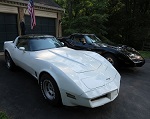
No, I would not. To be fair, my wife's 1979 base model (perhaps a 10 footer, but you can see paint drips on the hood if you look) is a daily driver, and NADA's Low Retail Value price was dead-on accurate. I have receipts for $15K of work done on that car in the past few years (the vast majority done by the PO), and that is just since she was partially restored (frame-on) in 2006 or so, so the value of that car is less than what was spent just recently to maintain her in that condition.
Here's the description that I couldn't post earlier:
Here's the description that I couldn't post earlier:
Low Retail Value
This vehicle would be in mechanically functional condition, needing only minor reconditioning. The exterior paint, trim and interior would show normal wear, needing only minor reconditioning. May also be a deteriorated restoration or a very poor amateur restoration. Most usable ‘as-is’. This column does not represent a ‘parts car’ or a non-running vehicle.
Note: Some of the vehicles in this publication could be considered ‘Daily Drivers’ and are not valued as a classic vehicle. When determining a value for a daily driver, it is recommended that the subscriber use the low retail value.
I still contend that the problem is mostly with Massachusetts, and you might get more sympathy in "Off Topic". I agree that it's ridiculous, but NADA's fault is not their prices, but their descriptions, and focus on "classic vehicles". There is no such thing as a collectable 1981 or 1979 Corvette, and yet NADA prices them as if there are, and you see examples sell at auction for stupid prices. There is a lot of perfectly fine Corvettes that are worth far less than the Low Retail Value estimate. But in my particular case, the number is accurate.
This vehicle would be in mechanically functional condition, needing only minor reconditioning. The exterior paint, trim and interior would show normal wear, needing only minor reconditioning. May also be a deteriorated restoration or a very poor amateur restoration. Most usable ‘as-is’. This column does not represent a ‘parts car’ or a non-running vehicle.
Note: Some of the vehicles in this publication could be considered ‘Daily Drivers’ and are not valued as a classic vehicle. When determining a value for a daily driver, it is recommended that the subscriber use the low retail value.
I still contend that the problem is mostly with Massachusetts, and you might get more sympathy in "Off Topic". I agree that it's ridiculous, but NADA's fault is not their prices, but their descriptions, and focus on "classic vehicles". There is no such thing as a collectable 1981 or 1979 Corvette, and yet NADA prices them as if there are, and you see examples sell at auction for stupid prices. There is a lot of perfectly fine Corvettes that are worth far less than the Low Retail Value estimate. But in my particular case, the number is accurate.


Burning Brakes

Joined: May 2018
Posts: 942
Likes: 243
From: Fruita CO
NADA values on a lot of older "classic" cars are a joke. When I was shopping for my latest Bronco II I talked to several sellers that sighted NADA as justification for their ridiculous asking prices. My answer, "Sell it to NADA!"
Race Director
Joined: Mar 2017
Posts: 11,960
Likes: 4,518
From: Virginia
Corvette Stories
The Best of Corvette for Corvette Enthusiasts

Every 2027 Corvette Engine Explained
Joe Kucinski
Designer Imagines A Corvette That Looks More Like a Corvette Than the Corvette
Verdad Gallardo
10 Ugly Corvettes That We Still Kinda Love
Joe Kucinski
Top 10 Most Expensive Corvettes Ever Sold on Bring A Trailer
Brett Foote
10 Things Every Corvette Owner Needs (2026 Edition)
Michael S. Palmer
8 Most "Only Corvette Owners Understand" Quirks and Problems
Pouria Savadkouei
10 Reasons the C6 Z06 is Still A Performance Benchmark After 20 Years
Joe Kucinski
How Much Horsepower Every Corvette Engine "LOST" in 1972
Joe Kucinski
Top 10 DOs and DON'Ts for Protecting Your Convertible Top!
Michael S. Palmer
Burning Brakes

Joined: Jan 2012
Posts: 1,106
Likes: 168
2018 C2 of Year Finalist
What do you do about a project car? Let's say you buy a nonrunning 68-72 car that's going to take some work but bought for around $7500. When you go to title it are you saying they are going to tax you the same as NADA shows for a driver? I would think with an appraisal and bill of sale you could challenge that law. If there is no flexibility a person could never sell a project in those states.

Instructor
Joined: Jun 2014
Posts: 133
Likes: 6
From: Minnesota
Back around '93, I moved from Alabama to Florida and went to register the '84 Monte Carlo SS I had bought a year earlier. I paid $2500 (probably overpaid, it wasn't much to look at) and had a legit bill of sale and had paid the Alabama car sales tax of 1% or so when I registered it there.
Lady at Florida DMV decides I didn't pay enough sales tax as Florida charges the same for all purchases and "helps me out" (her actual words) by charging me the difference before I can register my car.
Lady at Florida DMV decides I didn't pay enough sales tax as Florida charges the same for all purchases and "helps me out" (her actual words) by charging me the difference before I can register my car.

Melting Slicks


Joined: Dec 2016
Posts: 3,193
Likes: 184
From: Central Bucks County, Pennsylvania
I’m surprised there are not more car collectors in the States that don’t have sales tax. Could it work if you had a legitimate address and incorporated in a tax free State?

Race Director

Joined: Oct 2000
Posts: 12,687
Likes: 3,139
From: Shamong, NJ
If you could prove what you paid for the car with something like a signed affidavit from the seller, or a sales ad for the vehicle from Craigslist, etc., or if you could show the car needed repairs, with parts invoices or repair orders, they usually dropped their claim for additional tax.