When you click on links to various merchants on this site and make a purchase, this can result in this site earning a commission. Affiliate programs and affiliations include, but are not limited to, the eBay Partner Network.
Hi what would be the best thing to do regards venting the valve covers ? . The car is positive earth as the vehicle is a radio command car . there are a lot of radio suppression devices . So we thought best to keep it positive earth .itd 12 volt
I assume there are two holes in each valve cover. It would be of no benefit to put a breather on the drivers side because the PVC would just vacuum oil mist from that valve cover side only. And I would leave the oil fill cap alone.
You need cross-ventilation. Which means a vacuum source on one side, such as PCV, which you have. And a breather on the other side of the engine to allow fresh air in, which you do not have.
Your set-up is doing little if anything because the contaminated air being removed can not be replaced with fresh air. You have two outlets, no (fresh air) inlet.
You need to figure out which vacuum hose to remove. It also appears there is no room under the generator for a breather either. Having said that, I think I would remove the hose on the passenger side rear. Find a nice inlet breather push-in style for that hole, paint in green if you wish. After removing that hose, block off the other end, I assume its under the air cleaner base.
Last edited by HeadsU.P.; Mar 16, 2020 at 09:22 AM.
You have the dreaded square bore Holley to Spread Bore Q-Jet adapter. It will idle ok but you will have all kinds of strange drivability problems and reversion with that adapter.
I would seriously consider getting the correct Q-Jet carb for this engine.
Also routing a hard line to the fuel pump from the Q-Jet.
Wicked cool unit BTW........Never seen anything like that Volvo!
Hi thanks for the info . I am going to try a last ditch attempt with this carb with a new gasket set the power valve looks like it’s had water damage . If that doesn’t work can anyone tell me what carb would be correct for my inlet manifold minus the adapter. Can you give me the number of the carburettor needed . Thanks in advance
Hi thanks for the info . I am going to try a last ditch attempt with this carb with a new gasket set the power valve looks like it’s had water damage . If that doesn’t work can anyone tell me what carb would be correct for my inlet manifold minus the adapter. Can you give me the number of the carburettor needed . Thanks in advance
Replace that Power Valve with a new one.
Due to the fact that it may be difficult for you to secure and refurbish a Q-Jet where you are at....I would use this Q-Jet replacement:
I would set timing per our member Lars timing papers. E-Mail him at V8fastcars@msn.com for info. Correct timing and a proper fuel mixer will make the Volvo run very well.
Hi thanks for the information. The carburettor you mention will that fit onto the basic inlet manifold or the adapter plate . Ivor
This is a direct replacement.....it will bolt right to the intake and you will delete the adapter plate.
It is also jetted very close to a stock 350 Chevrolet so it should respond very well.
It will be important to adjust the floats and the idle mixture but after that you should have no issues.
I thought that was a crappy carb? I recall some bad reviews and bad comments on that last year?
I would source-out something better even if it meant changing out the Intake. Nothing wrong with a Holley, just not that one.
And Hodddball, do you know what Intake you have? GM Spreadbore or an aftermarket?
They actually work very well when setup proper. Nothing wrong with them at all other than half of the people buying them bolting them on to cure timing issues.
My fix would be a 2101 Performer intake and a 0-90670 Holley Truck Avenger with 1204 Fel Pro intake gaskets. This is a $700 setup new but it will run VERY well as long as timing is address and on the money.
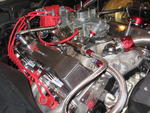
Hi there as I am new to v8 engines I don’t know what a Spreadbore is here is a picture of what I have . Many thanks ivor
That is the standard Spread-Bore intake with a Square Bore adapter bolted to it.
Here is the difference between the two styles......
You can see that using an adapter will cause issues with distribution.....here is another photo of the adapter on a small block Mopar:
Look at the path the air has to make to get to the intake on the primaries.......this is not conducive to distribution or flow......good flow means good signal to the carb and that means a happy running unit
The Holley I gave the link for in the previous post is a spread bore unit. If you want to use a square bore.....change the intake out.
I also see you have a points distributor. Have you set your dwell as well as timing? This is one half of the tuning equation and often the most overlooked and misunderstood.
Hi what you explain makes sense. Why someone would think that would work I have no idea . Thanks for all your input . I will try your suggestions. Thanks ivor
Hi what you explain makes sense. Why someone would think that would work I have no idea . Thanks for all your input . I will try your suggestions. Thanks ivor
Good luck....post here what you decide.....you have a very unique machine there.
Hi what you explain makes sense. Why someone would think that would work I have no idea . Thanks for all your input . I will try your suggestions. Thanks ivor
Why someone would think that . . . . . .
Here in the states, we call that bubba.
Looks like previous owner was a plumber by trade, AKA bubba the plumber.
Who uses water pipe fitting for a vacuum port fitting?
I believe the bigger the inside diameter of the fitting, hose, pipe, the less vacuum the engine can utilize.
Last edited by HeadsU.P.; Mar 17, 2020 at 10:50 AM.
Hi there since my last post I have stripped the carb right down cleaned everything . Replaced the power valve and fitted a new condenser. Engine runs perfect for about 1/2 a mile then cuts out if I leave it for 10 minutes I can move another 200 yards . On getting home after 10 stop starts. I fitted a vacuum gauge on to the fitting to the distributor. No reading unless I rev the engine . Then I fitted the gauge to a vacuumed port closest to the inlet manifold . So any idea what can be the problem in the vacuum block could it be just blocked ? Any idea . Thanks in advance ivor. Ps keep healthy across the pond
Hi there since my last post I have stripped the carb right down cleaned everything . Replaced the power valve and fitted a new condenser. Engine runs perfect for about 1/2 a mile then cuts out if I leave it for 10 minutes I can move another 200 yards . On getting home after 10 stop starts. I fitted a vacuum gauge on to the fitting to the distributor. No reading unless I rev the engine . Then I fitted the gauge to a vacuumed port closest to the inlet manifold . So any idea what can be the problem in the vacuum block could it be just blocked ? Any idea . Thanks in advance ivor. Ps keep healthy across the pond
Vacuum to the distributor should be fitted to full manifold vacuum.....you must have it on the side of the carb which is ported vacuum....you will only have vacuum at this port if you rev it.
Your engine is running out of fuel and you need to figure out why. Start at the tank and work your way to the pump.....then pump to carb.
You need an uninhibited supply of fuel to the pump.....
You have your distributor vacuum line hooked to "Timed Vacuum". That is also known as smog port / low performance port. Your Vac gauge will usually read zero at idle, that's normal. You need to block that carb port off and move the vacuum line to "Full Manifold Vac".
Your 17 inches of Vac is wonderful.
Your issue, running good, then starving for gas might be a fuel tank sock issue.
Last edited by HeadsU.P.; Mar 23, 2020 at 04:32 PM.
Hi thanks for the information . My engine still just cuts out after a short run it runs fine up to that point I now think the problem is over heating . The temp gauge reads 70 the top hose gets hot so I don’t think it’s the thermostat . The inlet manifold gets very hot is this normal . The old carb to inlet gasket was showing signs of heat damage . I will try the timing tomorrow how many degrees before T D C should I be looking for . It has no emission gubins left on the engine Any info will be gratefully received. Thanks in advance . Ivor
Hi thanks for the information . My engine still just cuts out after a short run it runs fine up to that point I now think the problem is over heating . The temp gauge reads 70 the top hose gets hot so I don’t think it’s the thermostat . The inlet manifold gets very hot is this normal . The old carb to inlet gasket was showing signs of heat damage . I will try the timing tomorrow how many degrees before T D C should I be looking for . It has no emission gubins left on the engine Any info will be gratefully received. Thanks in advance . Ivor
Ok....you want 36 degrees @ 3000rpm + or - a couple hundred RPM each way......get it close. Do not concern yourself what the timing is at idle.....but do hook the vacuum cannister hose to full manifold vacuum......if it spark knocks, then put back to the ported position.
On the intake heat.......if you read back, I mention the heat riser passage in the intake and how one would block it. This was GM's way of heating the intake to operate the choke and for emmisions as it also supplied the EGR valve......what happens here is there is a port in the center of each side of the intake that has a passage right to the exhaust port......and as you may wonder, send hot exhaust gas right under the carb making the manifold very hot in this area. The fix is to reseal the intake with a 1204 Fel-Pro intake gasket. this intake gasket has the center blocked off with a piece of stainless and will dramatically reduce intake temperatures by 200 degrees in some cases......which will dramtically lower carb temperature. But wait...there's more! If you run an open heat riser port with retarded engine timing it just makes the problem worse......retarded timing raises exhaust gas temperatures and will make the intake even hotter! This is why we tell everyone to set the timing first.....you could be boiling fuel in the bowl due to heat.....it takes between 200 and 300 degrees in the bowl for fuel to boil/vapor point......
Look at the above gasket in the link and you will see the center block off plate. I block off everyone I work on because it is just not conducive in this day and age and is old poor tech. A cool carb is a happy carb.