When you click on links to various merchants on this site and make a purchase, this can result in this site earning a commission. Affiliate programs and affiliations include, but are not limited to, the eBay Partner Network.
So I posted about a C3 I was thinking about buying last week. Got some good feedback. Thanks to the community. I sent an inspector to look at the car for me since I’m over 6 hours away from the car. It’s a great deal on a 72 Corvette and the inspector found everything to be in great condition except for some paint flaws. I’ll post the pictures to see how much these would run me to fix. I’m not trying to have a show car, just something nice to drive around on the weekends. Ive read that a good paint job sometimes is the most expensive fix on a C3, so that is where I’m concerned. I’m fine driving this car like this for now, but would eventually like to get these taken care of. Especially if i decide to sale in the future..
Should I buy this or look for a more expensive one with less paint work needed?
by the way, this car was repainted this color. The trim tag states it should be Warbonnet Yellow. This looks to be more of a Daytona Yellow from an earlier model. Would painting it the original color shoot the value of this car up much? Or at this point should I just pick the color that speaks to me more and worry about the resale later?
Without knowing what paint was used to repaint and what paint is under the the top coat, it is difficult to determine how to fix it. New paints have reducers that attack the old original primers. While it may look good for awhile, it will easily chip (like what you are seeing). Also it appears that there may be impurities under some of the paint in one of your pictures. As for color difference in price. The money difference is all deducted from what original paint was when new. Original paint was a lacquer and todays lacquer is garbage. All this only matters if you are trying to get it NCRS judged. Anything else is what you or a prospective buyer want because originality is gone. If your painting it to try to make more money because it is 'original', it is an exercise in futility. Make it look the way you want it, drive it and enjoy it.
Last edited by RU7376vettes; Aug 31, 2020 at 10:11 PM.
As a guess, you're probably looking at a couple thousand dollars to repair the 3 pictured areas, color match, and blend them in.
Should I buy this or look for a more expensive one with less paint work needed?
The paint really looks good from what I can see in the surrounding areas. You're unlikely to find a car with near perfect paint unless you are buying a recently restored or repainted one. Just for discussion's sake, repainting seems to run in the $10-20k range - especially with a color change. If you like this tone of yellow, don't worry about putting it back to original color. At least it's in the same color family, so isn't all that far from original. I believe the only folks who would care much are people looking for restoration potential. If you decide to fully restore it to original factory condition, repaint it then.
Was the damage in pic #1 caused by 'contact' with something, or did it just 'pop' off? If it was due to an impact, you can fill/build-up the lost material, prime, touchup or airbrush some new paint (assuming you have some that matches), finish it properly and go your merry way. If not, you have a paint that can pop off at any time and may not have been prepped properly.
The 'bubbles' in pic #2 indicate that the panel was cleaned with a volatile cleaner and the residue was not eliminated prior to paint. How extensive was that faulty cleaning? Who knows?
Damage in pic #3 could be because of same issue as #1 (if it was not due to impact), or could have been caused by over-aggressive machine polishing which put heat into the paint and cracked it. If the owner knows that it was 'heat' damaged, that would not be a "paint" problem.
Take that info into consideration, pose questions to the owner (if you so choose), and make a call as to whether you think the paint is good for the long haul (with some normal "assistance", from time-to-time. At least it is a solid color. Hopefully the owner has some left over paint or, at least, the specific formula details from the last paint job done.
Last edited by 7T1vette; Aug 31, 2020 at 11:43 PM.
#1 Could easily be cured by daubing some paint on the affected area yourself. You'd still be able to tell up close, but for a 15 min repair that cost little $$ (assuming you get some touchup paint that matches) ...you'd hardly notice at 6' away. Or you could have a shop do a little needed bodywork, some paint blending and make it an invisible repair if you decide to take buy the car and take it in.
#2 Could also be moisture trapped under that area of paint during one of the paint coats. How could it happen? Well, a drop of water in the air lines made it past the spray gun, or it fell from the painter's respirator, where the breath condenses ...and he tried to blow it away with the paint gun. That's highly likely being on the edge where the painter leans over the car to paint the center of the hood. I've had it happen a bunch. When ya have a paint flow going, ya don't want to stop half-way while painting a hood, it's kind of wet overspray at the time (hard to stop everything and daub up with a paper towel) ..so the "logical" thing to do is attempt to blow the water away with the spray gun (sometimes but rarely works). It probably didn't look bad after the paint job ....but got worse over time. Problem with a lot of shops is they don't see their work 5 years down the road. The solution now is to sand that area down, through the trapped bubbles, apply primer, light sanding, then paint. Perhaps blend in paint locally and clear the entire hood (is the paint basecoat/clearcoat?), or whatever is necessary there per the type of paint that's on the car. Not difficult work. A really good paint match and it would be undetectable. Yellow isn't terribly difficult to match.
#3 The solution is pretty much the same as #2.
A shop would prepare these all at the same time. It's easy work for a paint shop. Yer looking at perhaps 5-6hrs of work perhaps. How long ago was it painted? How does the rest of the paint look? If it's more than, say, 2-3 years I wouldn't expect very many new hidden boogers to appear.
' the inspector found everything to be in great condition except for some paint flaws.'
If those pictured paint flaws are all the inspector found on this car that appear problematic as stated in your post I would say you probably found a pretty darn good '72 !!!
Where are the bubbles located on the car? If it's on the right side of the hood and the car has AC, sometime in its life, the compressor seal could have blown and pushed oil through the underside of the hood into the top coat of the paint. The fix may require a new hood. There is a lot of info on the C-2 and C-3 forms on this topic. Jerry
I have to agree with 4-vettes. If this is the worst on a 50 year old driver . . .
You wouldn't want to see the shape my 72 paint job is in (ugh!) Doesn't stop me from driving it though!
The car is 40+ years old; but the paint job is not. That appears to be 2-stage paint, so the car has been repainted. And those damaged areas, if they can not be explained from reasons other than poor paint prep, tell a story that there will be future problems with that paint.
Yes, the bubbling can be due to A/C issues. Are they? Does the car have A/C? Was there a seal problem in the past...and did it happen AFTER the new paint job was put on the car?
If you want to know something about the future of the paint on this car, you need to ask the owner some specific questions, and get answers that minimize "paint prep" as a problem.
The lingering question is, how old is the paint? If that’s 10-20 years old, repair/corrections will all likely be viable. If it’s less that 2-3 then steer clear cuz the worst is yet to come.
Thanks for the replies. I asked the seller about these things. The chip on the first picture is due to him getting too close on his motorcycle. The bubbles are apparently from the paint job. Nothing happened under the hood to cause it. All the restorations were done by the previous owner, but he has the paperwork so I’m going to see if the exact color can be found. I’m waiting to hear back the with exact date of the paint job. If it has only been a couple of years I’ll take your advice and walk away. It would be a shame since this was such a good deal on a chrome bumper corvette. But as I have read several times on here, “spend as much as your wallet allows on a C3”. I rather not have to worry about repainting a whole car.
....If it’s less that 2-3 then steer clear cuz the worst is yet to come.
Most paint issues that have to do with materials' issues start to show up right away, or within weeks or months. Some can lurk for 6 or so. If paint problems don't show up in like 2 years (rust not withstanding -- not an issue here), I wouldn't worry. Any body issue can occur with just about any C3 at about any time (cracking etc).
war bonnet yellow is a curious color. I have one and it seems to change depending on angle & intensity of light. Capturing on camera varies as well. Not just mine; others' wby seem likewise.
Would love to see photo's of the entire car.... If the paint does not appear to be 'troublesome' and that is all the inspector made mention of and you like the price it must be pretty clean.
No mention of the cost of the car or the condition of everything else. Not enough info to judge this a good deal or not. Most old cars are repainted poorly, I look at everything else as more important, but I paint my own. In all my years I haven't found a body shop yet that did long lasting quality work, not that they don't exist but the odds are against you.
That color is not War Bonnet Yellow; it appears to be Sunflower Yellow. Since the bubbling appears to be due to paint prep, you can cross your fingers that the same thing won't happen on other panels....but odds are that it will.
This is your call to make. The car is a solid paint color and can be matched without too much trouble. So the damage is repairable without getting a complete paint job. IF the condition of that paint doesn't deteriorate from its present state. None of us can foretell the future.





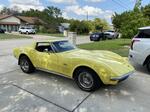

 Paint problems on potential C3












 considering this car is almost 50 years old.