



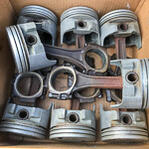

nicely done restamp
Just another Corvette guy


Joined: Feb 1999
Posts: 8,518
Likes: 3,865
From: Palm Springs, CA.

Looks like the whole gang holder idea went right out the window there.
....and if you're going to re-stamp (which I have no problem with) deck it far enough to remove all of the old numbers.
....and if you're going to re-stamp (which I have no problem with) deck it far enough to remove all of the old numbers.

Team Owner


Joined: Feb 2003
Posts: 54,106
Likes: 9,421
From: Sitting in his Nowhere land Hanover Pa
2024 C2 of the Year Finalist - Unmodified
2015 C2 of Year Finalist

Race Director


Joined: Oct 2000
Posts: 12,680
Likes: 3,131
From: Shamong, NJ
At St Louis it was quicker to use the gang holder and change one or two stamps for each block. At passenger car plant like Norwood, Baltimore, Wilmington, etc, they may have only had to stamp the 10th, 50th or 75th block that came by, so it was probably easier and simpler for the person stamping the VIN's to just stamp each digit individually, then to load and unload a gang holder over and over.
I don't have any direct proof of this, it's just an assumption based on what I've observed over the years.
Team Owner
Joined: Feb 2003
Posts: 54,106
Likes: 9,421
From: Sitting in his Nowhere land Hanover Pa
2024 C2 of the Year Finalist - Unmodified
2015 C2 of Year Finalist
Glen I would say your right on no gang holders for passenger car plants prior to 1968. and to put it into perspective on how many engines got stamped for 1966 Chevelles there was a total of 447,364Chevelles built. out of those only SS 396 engines was advertised over 300Hp so those where the only ones stamped only 72,272 where made. But Balitmore assembly plant only made 88,331 of those 447,364 cars or 19.75% of those cars. how many 396 cars made at Balitmore is not known. but as you can figure out, they didn't have to stamp a lot of engines. so being slopy and out of line is normal. and being an early EF block it should be a 962 four bolt main block.
Just another Corvette guy
Joined: Feb 1999
Posts: 8,518
Likes: 3,865
From: Palm Springs, CA.
Before VIN stamping blocks became Federal law in 1968, only the St Louis Corvette plant stamped VIN's on every block. Passenger car plants only stamped VIN's on engines higher than 300 horse power and apparently rarely if ever, used a gang holder. The VIN stamp on that block is very typical of the stamps found on blocks from passenger car plants. It wasn't even standardized as to where the VIN was stamped, with some plants stamping it in other places, like near the oil filter.
At St Louis it was quicker to use the gang holder and change one or two stamps for each block. At passenger car plant like Norwood, Baltimore, Wilmington, etc, they may have only had to stamp the 10th, 50th or 75th block that came by, so it was probably easier and simpler for the person stamping the VIN's to just stamp each digit individually, then to load and unload a gang holder over and over.
I don't have any direct proof of this, it's just an assumption based on what I've observed over the years.
At St Louis it was quicker to use the gang holder and change one or two stamps for each block. At passenger car plant like Norwood, Baltimore, Wilmington, etc, they may have only had to stamp the 10th, 50th or 75th block that came by, so it was probably easier and simpler for the person stamping the VIN's to just stamp each digit individually, then to load and unload a gang holder over and over.
I don't have any direct proof of this, it's just an assumption based on what I've observed over the years.

Team Owner
Joined: Feb 2003
Posts: 54,106
Likes: 9,421
From: Sitting in his Nowhere land Hanover Pa
2024 C2 of the Year Finalist - Unmodified
2015 C2 of Year Finalist
Corvette Stories
The Best of Corvette for Corvette Enthusiasts

Top 10 Most Expensive Corvettes Ever Sold on Bring A Trailer
Brett Foote
10 Things Every Corvette Owner Needs (2026 Edition)
Michael S. Palmer
8 Most "Only Corvette Owners Understand" Quirks and Problems
Pouria Savadkouei
10 Reasons the C6 Z06 is Still A Performance Benchmark After 20 Years
Joe Kucinski
How Much Horsepower Every Corvette Engine "LOST" in 1972
Joe Kucinski
Top 10 DOs and DON'Ts for Protecting Your Convertible Top!
Michael S. Palmer
Top 10 Most Explosive Corvettes Ever Made: Power-to-Weight Ratio Ranked!
Joe Kucinski
150 hp to 1,250 hp: Every Corvette Generation Compared by the Specs That Matter
Joe Kucinski