







Engine Compartment Temperature

Thread Starter
Intermediate

Joined: Jul 2006
Posts: 34
Likes: 0
 Engine Compartment Temperature
I am a new owner of a C3 (1977) Vette. I have had it for a week now and have been busy getting things to work. This is my first ever Vette though I have wanted one since about 1973.
My question is this. After driving for a half hour or so, the engine compartment is hotter than hell.
I have been under the hood of a lot of different vehicles and have never experienced anything like this. I have noted that a previous owner replaced the radiator and it appears that it is not the correct one. But the Temp guage stays at 175 degrees. I also noted that the vents behind the front wheel wells appear to be for air flow out of the engine compartment. Is my assumption correct? Thank you in advance
My question is this. After driving for a half hour or so, the engine compartment is hotter than hell.
I have been under the hood of a lot of different vehicles and have never experienced anything like this. I have noted that a previous owner replaced the radiator and it appears that it is not the correct one. But the Temp guage stays at 175 degrees. I also noted that the vents behind the front wheel wells appear to be for air flow out of the engine compartment. Is my assumption correct? Thank you in advance

Instructor
Joined: Sep 2005
Posts: 194
Likes: 0
From: Hamilton Ontario
The vents behind the front wheels are strictly cosmetic.
As far as engine/cabin heat, it is the nature of the beast. There are many posts about this regarding insulation and heater core bypasses that have been used to lessen it. Unfortunately, stock C3's are like race cars....they get hot.
As far as engine/cabin heat, it is the nature of the beast. There are many posts about this regarding insulation and heater core bypasses that have been used to lessen it. Unfortunately, stock C3's are like race cars....they get hot.
Thread Starter
Intermediate
Joined: Jul 2006
Posts: 34
Likes: 0
Originally Posted by Mark PittPayne
The vents behind the front wheels are strictly cosmetic.
As far as engine/cabin heat, it is the nature of the beast. There are many posts about this regarding insulation and heater core bypasses that have been used to lessen it. Unfortunately, stock C3's are like race cars....they get hot.
As far as engine/cabin heat, it is the nature of the beast. There are many posts about this regarding insulation and heater core bypasses that have been used to lessen it. Unfortunately, stock C3's are like race cars....they get hot.

Melting Slicks


Joined: Mar 2006
Posts: 3,342
Likes: 7
From: Connecticut
Originally Posted by Mark PittPayne
The vents behind the front wheels are strictly cosmetic.
As far as engine/cabin heat, it is the nature of the beast.
As far as engine/cabin heat, it is the nature of the beast.
I wonder why theyre not functional on later models?
And yes, I agree on it being "the nature of the beast"
As soon as I open the hood after a ride its like... WOW! ...right in your face
Instructor
Joined: Sep 2005
Posts: 194
Likes: 0
From: Hamilton Ontario
Originally Posted by Bob Onit
The vents on the 73' are functional and they do move a lot of hot air as you can feel it when the car is sitting still at idle
I wonder why theyre not functional on later models?
And yes, I agree on it being "the nature of the beast"
As soon as I open the hood after a ride its like... WOW! ...right in your face
I wonder why theyre not functional on later models?
And yes, I agree on it being "the nature of the beast"
As soon as I open the hood after a ride its like... WOW! ...right in your face
Corvette Stories
The Best of Corvette for Corvette Enthusiasts

Top 10 Most Expensive Corvettes Ever Sold on Bring A Trailer
Brett Foote
10 Things Every Corvette Owner Needs (2026 Edition)
Michael S. Palmer
8 Most "Only Corvette Owners Understand" Quirks and Problems
Pouria Savadkouei
10 Reasons the C6 Z06 is Still A Performance Benchmark After 20 Years
Joe Kucinski
How Much Horsepower Every Corvette Engine "LOST" in 1972
Joe Kucinski
Top 10 DOs and DON'Ts for Protecting Your Convertible Top!
Michael S. Palmer
Top 10 Most Explosive Corvettes Ever Made: Power-to-Weight Ratio Ranked!
Joe Kucinski
150 hp to 1,250 hp: Every Corvette Generation Compared by the Specs That Matter
Joe Kucinski
8 Coolest Corvette Pace Cars (and Replicas) of All Time
Verdad Gallardo
Melting Slicks
Joined: Mar 2006
Posts: 3,342
Likes: 7
From: Connecticut
Originally Posted by Mark PittPayne
You are right, the hot air escaped, but it was not the designed function of the the vent or "gill", which was strictly for appearance.
Are you saying that theyre open but dont move any air?
Sorry but you lost me


Melting Slicks


Joined: Apr 1999
Posts: 2,675
Likes: 13
From: Sudbury MA
If you read some of the Corvette history books that are out there, it states that the gills on the C3 were necessary to relieve under hood pressure. When GM did tests on the car in the design stages prior to production, they encountered aerodynamic lifting of the front end due to air building up under the front end and in the engine compartment. The venting of the heat was an added benefit but I read that the primary reason for the gills was to reduce the lifting effect at speed.
("The Complete Book of the Corvette" by Richard M. Langworth, pages 159, 160, and 161)
Of course, it was also no secret that Bill Mitchell was hung up on the Shark theme and that probably also contributed to the gills but Duntov made them functional to reduce the lifting problem.
Kurt
("The Complete Book of the Corvette" by Richard M. Langworth, pages 159, 160, and 161)
Of course, it was also no secret that Bill Mitchell was hung up on the Shark theme and that probably also contributed to the gills but Duntov made them functional to reduce the lifting problem.
Kurt
Instructor
Joined: Sep 2005
Posts: 194
Likes: 0
From: Hamilton Ontario
Back in the day they may have experimented with pressure relief due to their limited knowledge at the time, and hot air probably does make its way out of them, but that is just fluke.
They learned fairly early on that to keep a vette on the ground it required a front air dam. The vents were not ground effects, and they are in the wrong place for that function anyways.
The gills were blocked on the mid year cars so obviously their function was nothing.
They learned fairly early on that to keep a vette on the ground it required a front air dam. The vents were not ground effects, and they are in the wrong place for that function anyways.
The gills were blocked on the mid year cars so obviously their function was nothing.

Pro

Joined: Jan 2006
Posts: 548
Likes: 0
Originally Posted by Mark PittPayne
Back in the day they may have experimented with pressure relief due to their limited knowledge at the time, and hot air probably does make its way out of them, but that is just fluke.
They learned fairly early on that to keep a vette on the ground it required a front air dam. The vents were not ground effects, and they are in the wrong place for that function anyways.
The gills were blocked on the mid year cars so obviously their function was nothing.
They learned fairly early on that to keep a vette on the ground it required a front air dam. The vents were not ground effects, and they are in the wrong place for that function anyways.
The gills were blocked on the mid year cars so obviously their function was nothing.

Instructor
Joined: Sep 2005
Posts: 194
Likes: 0
From: Hamilton Ontario
Originally Posted by Nemesis_152
if you look at the aerodynamic test thread, it is pretty obvious that the mid-c3 that did the road testing (74?) experienced a LOT of air evacuation at speed. seems like, whether designed for it or not, the vents are functional.

Melting Slicks
Joined: Mar 2006
Posts: 3,342
Likes: 7
From: Connecticut
Originally Posted by Mark PittPayne
Just read the aero test thread. Saw nothing but speculation on ground effects with air dams and increasing the vent opening. I didn't see anything about cooling. There was only one thread there so if I read the wrong one I would be interested in you sending me the link. Theoretically blowers could be ducted out to evacuate hot air. Hot air will escape where ever it can, be it the hood, wheel wells, or any open area, however heat rises so at idle its only going one way without a blower. At speed you may get some small benefit, but in my opinion not enough to justify cutting the opening. You would still have to run ducting or the tires would throw nasty stuff up the side of your car.
Close the hood and feel the heat blowing out from the vents.... to me this equals "Functional"
This entire thread is VERY confusing to me
Also, I have read many posts stating that " My air dam is missing and my car is overheating..............
So.. In my opinion the Air Dam is "Functional" as well
Instructor
Joined: Sep 2005
Posts: 194
Likes: 0
From: Hamilton Ontario
Originally Posted by Bob Onit
All I have to say is......... take a 73,
Close the hood and feel the heat blowing out from the vents.... to me this equals "Functional"
This entire thread is VERY confusing to me
Also, I have read many posts stating that " My air dam is missing and my car is overheating..............
So.. In my opinion the Air Dam is "Functional" as well
Close the hood and feel the heat blowing out from the vents.... to me this equals "Functional"
This entire thread is VERY confusing to me
Also, I have read many posts stating that " My air dam is missing and my car is overheating..............
So.. In my opinion the Air Dam is "Functional" as well
 .
.Interesting nevertheless. Time to move on and "Be Cool"


Drifting

Joined: Mar 2004
Posts: 1,450
Likes: 40
From: Panama City Beach, Florida
The short answer is, it will be HOT .... very HOT.
Many people put insulation on the interior floors etc. to keep that engine compartment heat out of the interior. Most help only a little, the one that works the best is that ceramic / fiber mat, really expensive though. I have it and it's worth it.
Many people put insulation on the interior floors etc. to keep that engine compartment heat out of the interior. Most help only a little, the one that works the best is that ceramic / fiber mat, really expensive though. I have it and it's worth it.

Drifting
Joined: May 2005
Posts: 1,629
Likes: 4
From: Somers CT
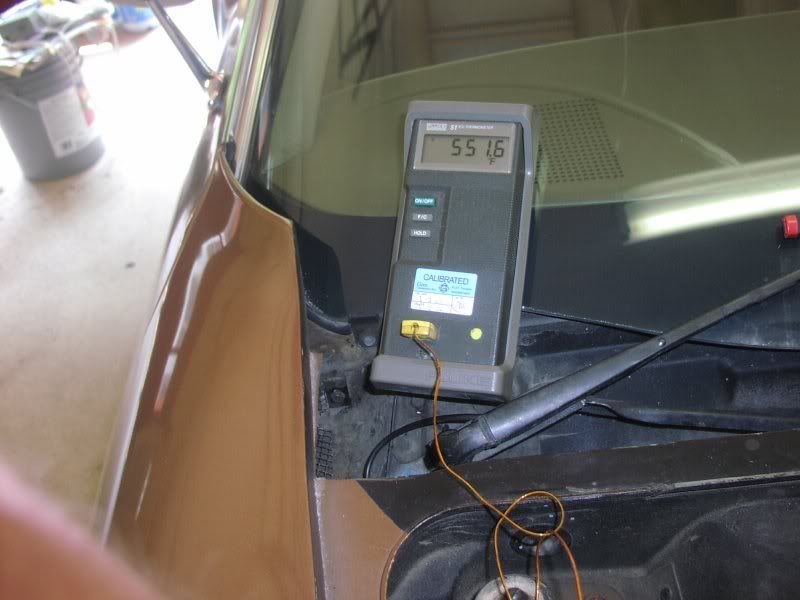
Insulation of one type or another is the best answer to reduce the heat being transferred from the engine compartment to the cab. Comments about insulating the exhaust manifold and exhaust pipes are good ones along with looking into ceramic coated headers. They are a major contributer to excessive engine compartment heat.
I attached a thermocouple to the exhaust manifold after a drive on a summer day last year, here's what you're dealing with:
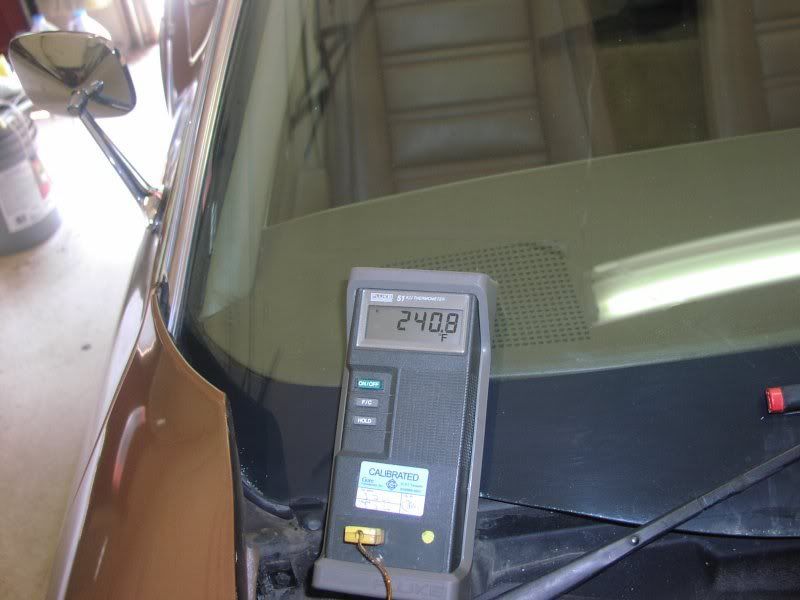
This is the temperature of the heater/AC box right behind the manifold taken at the same time. The other side of this box has an air duct leading to the cabin. No amount of seals on doors will stop the infiltration of this kind of hot air into the cabin.
I did an engine swap this past winter and installed ceramic coated headers and insulated the firewall with ceramic insulation. It made a dramatic difference, the car is actually fun to drive in the summer!
Bill
I attached a thermocouple to the exhaust manifold after a drive on a summer day last year, here's what you're dealing with:
This is the temperature of the heater/AC box right behind the manifold taken at the same time. The other side of this box has an air duct leading to the cabin. No amount of seals on doors will stop the infiltration of this kind of hot air into the cabin.
I did an engine swap this past winter and installed ceramic coated headers and insulated the firewall with ceramic insulation. It made a dramatic difference, the car is actually fun to drive in the summer!
Bill
Last edited by TopGunn; Aug 1, 2006 at 12:51 PM.
