




Getting frustrated!

Team Owner


Joined: Jul 2004
Posts: 40,338
Likes: 786
From: Redondo Beach, California

The new performance crate engine have hydraulic roller tappets. (example the ZZ4) Roller tappets avoid the friction losses of the flat tappets and also the rollers allow better performing cam profiles. This all adds up to give some of the extra performance you see in the new crate engines.
Racer


Joined: Jun 2005
Posts: 409
Likes: 13
From: Lavonia Georgia
I stroked my '68 327-300 to a 383 using a forged eagle crank (internally balanced), added splayed 4-bolt mains, 6" H beam forged Eagle rods, KB hyperutectic pistons, Comp Cams custom grind, 2.02/1.60 valves, ported my double humps, blended bowls, unshrouded the chambers, decked the block (wiped the matching numbers, but I had to make some concessions!) installed a Victor Jr intake ported to match my felpro 1205 ported heads. I also went with full roller rockers so I needed a taller valve cover, but I used the Edlebrock Elite's which look nicely period so it's not all bad. I'm getting a nice flat torque curve (for a single plane anyway) and 312 RWHP at 5900 RPM. I got in under $4k for all the machine work and parts including a Centerforce dual friction clutch, balance and resurfacing on the flywheel and various other goodies (new pan, high flow oil pump, fully adjustable/index-able Cloyes timing chain set, etc.). Now that I think about it, I guess the block and head castings were all that was re-used. I did all the porting/polishing on the heads myself. The shop did the bowl blending CC'ing and unshrouding when they did the valves.
Roller tipped stamped rockers should give you a lot of the benefit of full rollers and let you retain the stock covers. Then the thing you have to consider is, are you willing to stay with the stock manifolds, as they could be the major stumbling block to all the flow enhancements you've made to the rest of the mill. I've always heard that the rams horns are actually very efficient. I got inside mine to smooth out some of the flow inhibitors. All you have to do is look around in there, and several spots jump out at you. I ran them for a month or so, but ultimately I pulled them and put on some side exit headers to match up to my factory sidepipes (yet another non-stock item on my '68).
Again, many people back in the day put on improved intakes (such as the old X-manifolds like the Edlebrock Torker) and headers. So while it may not look completely stock, it can still look period correct with current day technology. I also cleaned up a lot of the excess casting flash on the outside of the block and heads before I painted it so it looks a lot cleaner. But by the time I added braided hoses, spreader bar, electric SPAL, fuel pressure regulator, Holley Street Avenger, Mallory performance tach-drive HEI, 8MM wires, and various other non-stock stuff that just seemed the right thing to do, I now wonder why I didn't just go AFR's and get the flow right out of the box.
Maybe I will.......
Roller tipped stamped rockers should give you a lot of the benefit of full rollers and let you retain the stock covers. Then the thing you have to consider is, are you willing to stay with the stock manifolds, as they could be the major stumbling block to all the flow enhancements you've made to the rest of the mill. I've always heard that the rams horns are actually very efficient. I got inside mine to smooth out some of the flow inhibitors. All you have to do is look around in there, and several spots jump out at you. I ran them for a month or so, but ultimately I pulled them and put on some side exit headers to match up to my factory sidepipes (yet another non-stock item on my '68).
Again, many people back in the day put on improved intakes (such as the old X-manifolds like the Edlebrock Torker) and headers. So while it may not look completely stock, it can still look period correct with current day technology. I also cleaned up a lot of the excess casting flash on the outside of the block and heads before I painted it so it looks a lot cleaner. But by the time I added braided hoses, spreader bar, electric SPAL, fuel pressure regulator, Holley Street Avenger, Mallory performance tach-drive HEI, 8MM wires, and various other non-stock stuff that just seemed the right thing to do, I now wonder why I didn't just go AFR's and get the flow right out of the box.
Maybe I will.......
Thread Starter
Drifting


Joined: Jun 2006
Posts: 1,912
Likes: 12
From: Schaumburg (Chicago) Illinois
In looking at the AFR website they claim the following results for 383 STROKER. 457 TORQUE AT 2500 rpm! Is this believable? If so then they spell it all out and all you need is a strong rotating assembly. Looks like a fantastic street engine to me.
RPM Torque H.P.
2500 457 231
3000 467 273
3500 483 322
4000 511 389
4500 517 443
5000 504 480
5500 481 503
6000 439 502
Dyno Test Criteria
Horsepower:500 HP
Engine:383ci
Heads:AFR Street 195 Cylinder Heads
Compression:9.5
Carburetor:Holley 0-4779 750 cfm
Ignition:MSD Distributor 36° Timing
Cam:comp Cams 12-433-8 Hyd Roller Cam
Exhaust:1 3/4" Headers
Fuel:93 Octane Pump Gas
Engine built and dyno tested by American Speed
ultilizing an Edelbrock RPM Performer Manifold
RPM Torque H.P.
2500 457 231
3000 467 273
3500 483 322
4000 511 389
4500 517 443
5000 504 480
5500 481 503
6000 439 502
Dyno Test Criteria
Horsepower:500 HP
Engine:383ci
Heads:AFR Street 195 Cylinder Heads
Compression:9.5
Carburetor:Holley 0-4779 750 cfm
Ignition:MSD Distributor 36° Timing
Cam:comp Cams 12-433-8 Hyd Roller Cam
Exhaust:1 3/4" Headers
Fuel:93 Octane Pump Gas
Engine built and dyno tested by American Speed
ultilizing an Edelbrock RPM Performer Manifold

Race Director

Joined: May 2005
Posts: 10,674
Likes: 122
From: Millington Illinois
St. Jude Donor '08-'09
In looking at the AFR website they claim the following results for 383 STROKER. 457 TORQUE AT 2500 rpm! Is this believable? If so then they spell it all out and all you need is a strong rotating assembly. Looks like a fantastic street engine to me.
RPM Torque H.P.
2500 457 231
3000 467 273
3500 483 322
4000 511 389
4500 517 443
5000 504 480
5500 481 503
6000 439 502
Dyno Test Criteria
Horsepower:500 HP
Engine:383ci
Heads:AFR Street 195 Cylinder Heads
Compression:9.5
Carburetor:Holley 0-4779 750 cfm
Ignition:MSD Distributor 36° Timing
Cam:comp Cams 12-433-8 Hyd Roller Cam
Exhaust:1 3/4" Headers
Fuel:93 Octane Pump Gas
Engine built and dyno tested by American Speed
ultilizing an Edelbrock RPM Performer Manifold
RPM Torque H.P.
2500 457 231
3000 467 273
3500 483 322
4000 511 389
4500 517 443
5000 504 480
5500 481 503
6000 439 502
Dyno Test Criteria
Horsepower:500 HP
Engine:383ci
Heads:AFR Street 195 Cylinder Heads
Compression:9.5
Carburetor:Holley 0-4779 750 cfm
Ignition:MSD Distributor 36° Timing
Cam:comp Cams 12-433-8 Hyd Roller Cam
Exhaust:1 3/4" Headers
Fuel:93 Octane Pump Gas
Engine built and dyno tested by American Speed
ultilizing an Edelbrock RPM Performer Manifold


Le Mans Master

Joined: Apr 2006
Posts: 5,403
Likes: 95
In looking at the AFR website they claim the following results for 383 STROKER. 457 TORQUE AT 2500 rpm! Is this believable? If so then they spell it all out and all you need is a strong rotating assembly. Looks like a fantastic street engine to me.
RPM Torque H.P.
2500 457 231
3000 467 273
3500 483 322
4000 511 389
4500 517 443
5000 504 480
5500 481 503
6000 439 502
Dyno Test Criteria
Horsepower:500 HP
Engine:383ci
Heads:AFR Street 195 Cylinder Heads
Compression:9.5
Carburetor:Holley 0-4779 750 cfm
Ignition:MSD Distributor 36° Timing
Cam:comp Cams 12-433-8 Hyd Roller Cam
Exhaust:1 3/4" Headers
Fuel:93 Octane Pump Gas
Engine built and dyno tested by American Speed
ultilizing an Edelbrock RPM Performer Manifold
RPM Torque H.P.
2500 457 231
3000 467 273
3500 483 322
4000 511 389
4500 517 443
5000 504 480
5500 481 503
6000 439 502
Dyno Test Criteria
Horsepower:500 HP
Engine:383ci
Heads:AFR Street 195 Cylinder Heads
Compression:9.5
Carburetor:Holley 0-4779 750 cfm
Ignition:MSD Distributor 36° Timing
Cam:comp Cams 12-433-8 Hyd Roller Cam
Exhaust:1 3/4" Headers
Fuel:93 Octane Pump Gas
Engine built and dyno tested by American Speed
ultilizing an Edelbrock RPM Performer Manifold
Thread Starter
Drifting
Joined: Jun 2006
Posts: 1,912
Likes: 12
From: Schaumburg (Chicago) Illinois
Also this is probably a dumb question, but I have asked alot of them and will continue to, Hows the performance?
Why up to 10.4 to1?
What is the rev kit and what does it do for the engine?
Why Tripower?
Race Director
Joined: May 2005
Posts: 10,674
Likes: 122
From: Millington Illinois
St. Jude Donor '08-'09
Bumped compression get better DCR and still run on 93 octane. Desktop dyno puts my Volumetric efficiancy over 100% from 4500 to 6000. Couldn't do that with 9.5 to 1
Rev kit puts internal spings on the lifter body to keep the roller on the cam at high RPM to reduce valve float without heavy valve springs that can damage hydraulic lifters. You can get about 500 more rpm before valve float and my HR cam should still be pulling good @ 6500 RPM
I had tripower on the old motor and loved it. Performed better than the 4 bbl setup it replaced. Built a new 816 CFM tripower setup to feed the 383.
Thread Starter
Drifting
Joined: Jun 2006
Posts: 1,912
Likes: 12
From: Schaumburg (Chicago) Illinois
Well,
After reviewing the AFR website I may be switching gears. I think I am trying to hit a home run first time out and never played the game. Wishful thinking. If I have too many compromises I may not be satisfied that it is either original or as powerful as it could of been if I went all out. Plus I will have forever modified my original heads.
I am sure I can build it but will probably always have alot of things in my mind that I shoulda, woulda, coulda done differently. Is everything ok, is it going to hold up. I may not build another high performance engine again so If I don't go all out I may never do it.
I think I need to cut my teeth on rebuilding the original engine back up.
Heads need new valves and guides & Valve job. ( SInce I have to do that anyway maybe it won't cost more to go to the 2.02/1.6)
Original intake manifold. (need to find one)
Modern cam
A little grinding and polishing
use current crank (need to inspect)
Maybe current rods, ehh probably not
need pistons, I guess Hypers.
Headers.
See what I can do with the drive train.
Once I go through this learning process then I have the 327 medium Journal that is currently in the car that If I still want to I can build up that 500HP torque monster next year. I will have much more confidence and will enjoy it more.
I need to learn in a less risky and more forgiving environment. This mostly stock rebuild will provide that. I don't want the end result to be bittersweet.
I think this makes sense. I appreciate comments to it from at least the regular contributors.
After reviewing the AFR website I may be switching gears. I think I am trying to hit a home run first time out and never played the game. Wishful thinking. If I have too many compromises I may not be satisfied that it is either original or as powerful as it could of been if I went all out. Plus I will have forever modified my original heads.
I am sure I can build it but will probably always have alot of things in my mind that I shoulda, woulda, coulda done differently. Is everything ok, is it going to hold up. I may not build another high performance engine again so If I don't go all out I may never do it.
I think I need to cut my teeth on rebuilding the original engine back up.
Heads need new valves and guides & Valve job. ( SInce I have to do that anyway maybe it won't cost more to go to the 2.02/1.6)
Original intake manifold. (need to find one)
Modern cam
A little grinding and polishing
use current crank (need to inspect)
Maybe current rods, ehh probably not
need pistons, I guess Hypers.
Headers.
See what I can do with the drive train.
Once I go through this learning process then I have the 327 medium Journal that is currently in the car that If I still want to I can build up that 500HP torque monster next year. I will have much more confidence and will enjoy it more.
I need to learn in a less risky and more forgiving environment. This mostly stock rebuild will provide that. I don't want the end result to be bittersweet.
I think this makes sense. I appreciate comments to it from at least the regular contributors.
Last edited by AWilson; Sep 20, 2007 at 09:58 PM.
Corvette Stories
The Best of Corvette for Corvette Enthusiasts

8 Coolest Corvette Pace Cars (and Replicas) of All Time
Verdad Gallardo
Top 10 Corvette Engines RANKED by Peak Torque (70+ Years of Muscle!)
Joe Kucinski
Corvette ZR1X Will Be Pacing the Indy 500, And Could Probably Race, Too!
Verdad Gallardo
Top 10 Corvettes Coming to Mecum Indy 2026!
Brett Foote
Top 10 C9 Corvette MUST-HAVES to Fix These C8 Generation Flaws!
Michael S. Palmer
10 Revolutionary 'Corvette Firsts' Most People Don't Know
Joe Kucinski
5 Reasons to Upgrade to an LS6-Powered Corvette; 5 Reasons to Stay LT2
Michael S. Palmer
2027 Corvette vs The World: Every C8 vs Its Closest Competitor
Joe Kucinski
10 Most Common Corvette Problems of the Last 20 Years!
Joe Kucinski
Le Mans Master

Joined: Jun 2004
Posts: 6,231
Likes: 65
From: Seattle WA
St. Jude Donor '14
billla,
What does receeded mean in this context?
What would heads cost, iron, that would serve the purpose?
What's the value of Aluminum other than the weight off the nose?
Would the Vortec's or Bowtie fit the bill?
I have become gun shy of the hypers for no other reason than many people say they are no good. But I haven't heard why yet.
What does receeded mean in this context?
What would heads cost, iron, that would serve the purpose?
What's the value of Aluminum other than the weight off the nose?
Would the Vortec's or Bowtie fit the bill?
I have become gun shy of the hypers for no other reason than many people say they are no good. But I haven't heard why yet.
There are some very fine iron heads out there up to about 195cc runners, after which almost everything is in aluminum due to easier machining and lighter weight.
Weight is debateable - remember that the 'vette was designed to be close to 50/50 with an iron small-block, so from a handling perspective I'd say zip. Overall, every pound you don't have to carry is an improvement in the HP/weight ratio - which means improved performance.
I completely disagree that hypereutectics are "no good" and I would encourage anyone to state *specific* reasons why this is the case. These are the most commonly used street performance piston used today. The only reason NOT to use a hypereutectic is if you plan to spray, used forced induction of any kind or want to turn over 5500 RPM regularly. We don't need to kick-off a huge debate here as you're the decision maker and you're hearing both sides

Le Mans Master
Joined: Jun 2004
Posts: 6,231
Likes: 65
From: Seattle WA
St. Jude Donor '14
Wait until the teardown to order anything - you may find is that a new aftermarket crank might be cheaper than machining your stock crank...and might be a chance to bump the CID to 350. You won't really know what you need until it's apart.
I honestly don't think a 383 is all that much of an upgrade, but as you're finding it really is hard to know when to stop
. More CID means big heads means bigger cam, which means turning faster, which means 2-bolt mains aren't enough...it goes on forever. This is why I typically start with budget, as it's the single best guide to what you can achieve.
Racer
Joined: Jun 2005
Posts: 409
Likes: 13
From: Lavonia Georgia
Weight is debateable - remember that the 'vette was designed to be close to 50/50 with an iron small-block, so from a handling perspective I'd say zip. Overall, every pound you don't have to carry is an improvement in the HP/weight ratio - which means improved performance.
I completely disagree that hypereutectics are "no good" and I would encourage anyone to state *specific* reasons why this is the case. These are the most commonly used street performance piston used today. The only reason NOT to use a hypereutectic is if you plan to spray, used forced induction of any kind or want to turn over 5500 RPM regularly. We don't need to kick-off a huge debate here as you're the decision maker and you're hearing both sides
 I also disagree with the position that hypereutectics are no good...as does GM, Edelbrock and lots of other builders. The infamous ZZ4 and the Fast Burn 383 (as well as others based on the ZZ4 short block) use hypers and they are considered relatively bullet proof and are backed by the General. The first words out of my machine shop owners mouth were 'I assume you want forged pistons'. I told him I was shooting for 425HP and was never going to spray or used forced induction so I preferred the more thermally stable hypers. He builds only performance engines, and was in total agreement with my decision....it's just that he's used to hearing everybody spouting forged this and billet that.
 Now don't get me wrong...where necessary, forged is good, as in my crank and H-beam rods. But since a lot of my driving is short hops to the local club shows and cruise-ins, I didn't need high dollar forged slugs slapping around in the bores until they heat up and expand to size. Some forged alloy pistons can be more thermally stable too, but if you're building a fun street engine, do you really need them? Your choice!
I will agree that saying 'forged' in front of everything does sound really
 though. I wonder if I can find a forged mug for my Guinness?


Thread Starter
Drifting
Joined: Jun 2006
Posts: 1,912
Likes: 12
From: Schaumburg (Chicago) Illinois
If you're going higher compression, you should have fewer detonation problems because of the quicker cooling effect of the aluminum. Based on the build you're going for, I don't know that they are necessary based on compression, but there seems to be more performance oriented aluminum heads out there. Dart Iron Eagles can be nice performers too if built right though.
I also disagree with the position that hypereutectics are no good...as does GM, Edelbrock and lots of other builders. The infamous ZZ4 and the Fast Burn 383 (as well as others based on the ZZ4 short block) use hypers and they are considered relatively bullet proof and are backed by the General. The first words out of my machine shop owners mouth were 'I assume you want forged pistons'. I told him I was shooting for 425HP and was never going to spray or used forced induction so I preferred the more thermally stable hypers. He builds only performance engines, and was in total agreement with my decision....it's just that he's used to hearing everybody spouting forged this and billet that.
Now don't get me wrong...where necessary, forged is good, as in my crank and H-beam rods. But since a lot of my driving is short hops to the local club shows and cruise-ins, I didn't need high dollar forged slugs slapping around in the bores until they heat up and expand to size. Some forged alloy pistons can be more thermally stable too, but if you're building a fun street engine, do you really need them? Your choice!
I will agree that saying 'forged' in front of everything does sound really though. I wonder if I can find a forged mug for my Guinness?
I also disagree with the position that hypereutectics are no good...as does GM, Edelbrock and lots of other builders. The infamous ZZ4 and the Fast Burn 383 (as well as others based on the ZZ4 short block) use hypers and they are considered relatively bullet proof and are backed by the General. The first words out of my machine shop owners mouth were 'I assume you want forged pistons'. I told him I was shooting for 425HP and was never going to spray or used forced induction so I preferred the more thermally stable hypers. He builds only performance engines, and was in total agreement with my decision....it's just that he's used to hearing everybody spouting forged this and billet that. Now don't get me wrong...where necessary, forged is good, as in my crank and H-beam rods. But since a lot of my driving is short hops to the local club shows and cruise-ins, I didn't need high dollar forged slugs slapping around in the bores until they heat up and expand to size. Some forged alloy pistons can be more thermally stable too, but if you're building a fun street engine, do you really need them? Your choice!
I will agree that saying 'forged' in front of everything does sound really
though. I wonder if I can find a forged mug for my Guinness?
Le Mans Master
Joined: Jun 2004
Posts: 6,231
Likes: 65
From: Seattle WA
St. Jude Donor '14
If you're going higher compression, you should have fewer detonation problems because of the quicker cooling effect of the aluminum. Based on the build you're going for, I don't know that they are necessary based on compression, but there seems to be more performance oriented aluminum heads out there. Dart Iron Eagles can be nice performers too if built right though.
I wonder if I can find a forged mug for my Guinness?
I wonder if I can find a forged mug for my Guinness?
I encourage you to read some of the recent testing with identicial iron and aluminum CNC heads and form your own opinion regarding detonation sensitivity. There are more heads, especially on the high end of the performance spectrum, made of aluminum for sure - but this is for other reasons.I have seen a billet Guiness mug...but bring your VISA
Race Director
Joined: May 2005
Posts: 10,674
Likes: 122
From: Millington Illinois
St. Jude Donor '08-'09
Le Mans Master
Joined: Oct 2002
Posts: 7,098
Likes: 378
From: Las Vegas - Just stop perpetuating myths please.
Any piston will bust from detonation/pre-ignition.
KB wouldn't still be in business selling bad pistons. Truth is KB leads the industry in hyper pistons because of performance, quality and price. Most hyper pistons are so much stronger than stock cast pistons (while they seal just as well) it's not even a fare comparision and KB has/sells the most choices in hypers. Your piston choices are going to be very limited w/o KB.
 I would always use a hyper before any cast piston and never use a forged piston unless i absolutly needed to - don't like the sound of piston slap. More than likely KB will have exactly what i need and at a better price than anyone else.
For your 327" look for hypers with stepped vlv reliefs in your desired c.r./dish - same price more power.: :
cardo0
Most hyper pistons are so much stronger than stock cast pistons (while they seal just as well) it's not even a fare comparision and KB has/sells the most choices in hypers. Your piston choices are going to be very limited w/o KB. I would always use a hyper before any cast piston and never use a forged piston unless i absolutly needed to - don't like the sound of piston slap. More than likely KB will have exactly what i need and at a better price than anyone else. For your 327" look for hypers with stepped vlv reliefs in your desired c.r./dish - same price more power.: :
cardo0
Race Director
Joined: May 2005
Posts: 10,674
Likes: 122
From: Millington Illinois
St. Jude Donor '08-'09
KB wouldn't still be in business selling bad pistons. Truth is KB leads the industry in hyper pistons because of performance, quality and price. Most hyper pistons are so much stronger than stock cast pistons (while they seal just as well) it's not even a fare comparision and KB has/sells the most choices in hypers. Your piston choices are going to be very limited w/o KB. I would always use a hyper before any cast piston and never use a forged piston unless i absolutly needed to - don't like the sound of piston slap. More than likely KB will have exactly what i need and at a better price than anyone else.
For your 327" look for hypers with stepped vlv reliefs in your desired c.r./dish - same price more power.: :
cardo0
Most hyper pistons are so much stronger than stock cast pistons (while they seal just as well) it's not even a fare comparision and KB has/sells the most choices in hypers. Your piston choices are going to be very limited w/o KB. I would always use a hyper before any cast piston and never use a forged piston unless i absolutly needed to - don't like the sound of piston slap. More than likely KB will have exactly what i need and at a better price than anyone else. For your 327" look for hypers with stepped vlv reliefs in your desired c.r./dish - same price more power.: :
cardo0
Last edited by 63mako; Sep 23, 2007 at 12:35 PM.

Burning Brakes

Joined: Sep 2004
Posts: 1,167
Likes: 2
From: Ft.Worth Texas
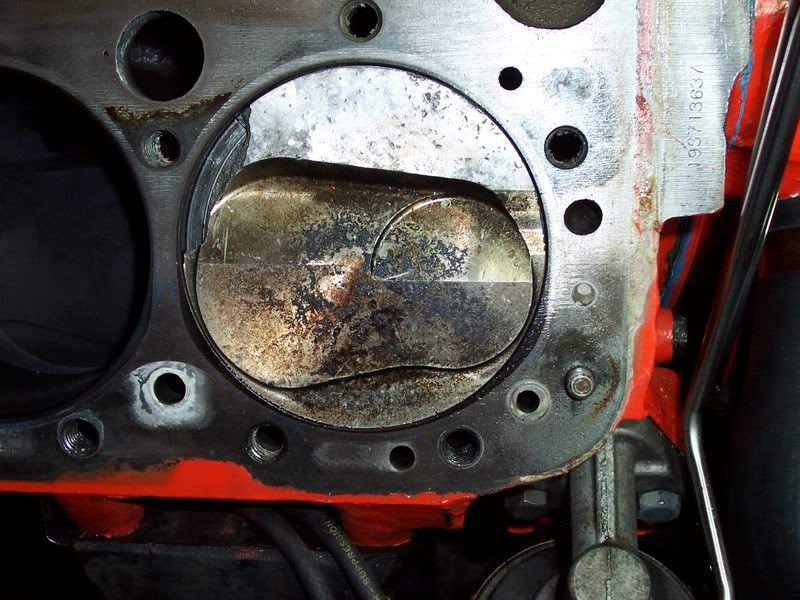
If you look at the amount of material there was left between the bottom of the ring groove and the valve relief, is it any surprise the piston broke there? I am surprised any of them hold up.
I would use Hyper's before cast also, just not KB hyper's. They have a design flaw that hasn't been resolved. 1st ring is real close to the crown and area between is ribbed. They break at the ringland. My engine builder will not use them foir this same reason. Do a search and see how many pictures you find like this: