




Getting frustrated!

Race Director


Joined: May 2005
Posts: 10,674
Likes: 122
From: Millington Illinois
St. Jude Donor '08-'09

This was the second time on this motor I think. msvetteman had a similar failure. I have seen others. Use what you want but with the time and effort put in an engine build I would look for another place to save a few bucks. JMHO 

Le Mans Master


Joined: Jun 2004
Posts: 6,231
Likes: 65
From: Seattle WA
St. Jude Donor '14
I've been using KB for a long time - not doubting your experience at all - but that's a pretty deep valve relief. Can you provide the KB P/N for this one?
Le Mans Master
Joined: Jun 2004
Posts: 6,231
Likes: 65
From: Seattle WA
St. Jude Donor '14
Race Director
Joined: May 2005
Posts: 10,674
Likes: 122
From: Millington Illinois
St. Jude Donor '08-'09
Last edited by 63mako; Sep 24, 2007 at 09:13 AM.
Le Mans Master
Joined: Jun 2004
Posts: 6,231
Likes: 65
From: Seattle WA
St. Jude Donor '14
No flames *at all*, and not doubting the experience at all. Again, I'm just interested in the P/N for that piston. It looks pretty extreme with those deep valve reliefs. It looks like it broke right where's there's a "step down" for the relief, and I'd be interested if the reliefs are factory or cut during the build.
I'm just pretty careful generalizing brand feedback based on failures unless I know the specifics. If the reliefs were cut by the builder, I'd question the size and placement a bit. If the ring package is so compressed, I'd wonder at the compression height, stroke, etc. Was the engine under spray? There are just a bunch of questions I'd ask before making a blanket condemnation.
Again, no pushback on your comments - just looking for more details if you have them.
I'm just pretty careful generalizing brand feedback based on failures unless I know the specifics. If the reliefs were cut by the builder, I'd question the size and placement a bit. If the ring package is so compressed, I'd wonder at the compression height, stroke, etc. Was the engine under spray? There are just a bunch of questions I'd ask before making a blanket condemnation.
Again, no pushback on your comments - just looking for more details if you have them.
Race Director
Joined: May 2005
Posts: 10,674
Likes: 122
From: Millington Illinois
St. Jude Donor '08-'09
No flames *at all*, and not doubting the experience at all. Again, I'm just interested in the P/N for that piston. It looks pretty extreme with those deep valve reliefs. It looks like it broke right where's there's a "step down" for the relief, and I'd be interested if the reliefs are factory or cut during the build.
I'm just pretty careful generalizing brand feedback based on failures unless I know the specifics. If the reliefs were cut by the builder, I'd question the size and placement a bit. If the ring package is so compressed, I'd wonder at the compression height, stroke, etc. Was the engine under spray? There are just a bunch of questions I'd ask before making a blanket condemnation.
Again, no pushback on your comments - just looking for more details if you have them.
I'm just pretty careful generalizing brand feedback based on failures unless I know the specifics. If the reliefs were cut by the builder, I'd question the size and placement a bit. If the ring package is so compressed, I'd wonder at the compression height, stroke, etc. Was the engine under spray? There are just a bunch of questions I'd ask before making a blanket condemnation.
Again, no pushback on your comments - just looking for more details if you have them.
My comments also come from a similar failure about 5 years ago with KB Hypers. The above failure was a 350 350 HP build with 10.5 comp instead of 11 to 1. If you can get a picture of the side profile on their 383 pistons check the distance from the top of the top ring groove to the piston crown.
Last edited by 63mako; Sep 24, 2007 at 06:01 PM.
Le Mans Master
Joined: Jun 2004
Posts: 6,231
Likes: 65
From: Seattle WA
St. Jude Donor '14
http://forums.corvetteforum.com/show....php?t=1722167 Here is the thread the picture came from. Lots more info if you search kb piston failure.
My comments also come from a similar failure about 5 years ago with KB Hypers. The above failure was a 350 350 HP build with 10.5 comp instead of 11 to 1. If you can get a picture of the side profile on their 383 pistons check the distance from the top of the top ring groove to the piston crown.
My comments also come from a similar failure about 5 years ago with KB Hypers. The above failure was a 350 350 HP build with 10.5 comp instead of 11 to 1. If you can get a picture of the side profile on their 383 pistons check the distance from the top of the top ring groove to the piston crown.
I have seen many KB hyper pistons broken like the one in your pic come through my shop. As others have said here - every time it was insufficient top ring gap or detonation or both that caused it.
Regardless, plenty of other great piston manufacturers out there such that you can step away from KB and still have a ton of choices.
Corvette Stories
The Best of Corvette for Corvette Enthusiasts

Top 10 Most Expensive Corvettes Ever Sold on Bring A Trailer
Brett Foote
10 Things Every Corvette Owner Needs (2026 Edition)
Michael S. Palmer
8 Most "Only Corvette Owners Understand" Quirks and Problems
Pouria Savadkouei
10 Reasons the C6 Z06 is Still A Performance Benchmark After 20 Years
Joe Kucinski
How Much Horsepower Every Corvette Engine "LOST" in 1972
Joe Kucinski
Top 10 DOs and DON'Ts for Protecting Your Convertible Top!
Michael S. Palmer
Top 10 Most Explosive Corvettes Ever Made: Power-to-Weight Ratio Ranked!
Joe Kucinski
150 hp to 1,250 hp: Every Corvette Generation Compared by the Specs That Matter
Joe Kucinski
8 Coolest Corvette Pace Cars (and Replicas) of All Time
Verdad Gallardo
Race Director
Joined: May 2005
Posts: 10,674
Likes: 122
From: Millington Illinois
St. Jude Donor '08-'09
Thanks, 63mako - that's an interesting thread. Not sure I'd paint KB with a black brush based on that thread and the thoughts expressed on failure analysis. Again, no pushback on your shop (or anyone else) saying they're junk - I just haven't had any issues at all with 355 or 383 KB pistons. I don't build any "out there" engines, so I'm maybe just not pushing them as hard as some folks are. There's a note in the thread from an unknown builder worthy of some reflection:
I have seen many KB hyper pistons broken like the one in your pic come through my shop. As others have said here - every time it was insufficient top ring gap or detonation or both that caused it.
Regardless, plenty of other great piston manufacturers out there such that you can step away from KB and still have a ton of choices.
I have seen many KB hyper pistons broken like the one in your pic come through my shop. As others have said here - every time it was insufficient top ring gap or detonation or both that caused it.
Regardless, plenty of other great piston manufacturers out there such that you can step away from KB and still have a ton of choices.
 There are thousands of engines running KB hypers with no issues. They do require a lot of end gap which I find strange. They are supposed to be a low expansion alloy with tight cylinder to piston clearances yet they require a bigger gap at the top ring than a lot of forged units.
 I think the minimal material between the top ring and piston crown is a factor, when combined with detonation, a little to tight of gap or running hot contributes to a higher failure rate than some. (Unresolved design flaw) Just my .02.

Safety Car


Joined: Mar 2007
Posts: 3,652
Likes: 49
From: Bridgewater nj
Has Anybody Notice Awilson Hasn't Com't
I think he is cranking everybody up but INMO crate engine are all about the newer style head design that makes or breaks an engine build. With a good set of heads you can choose the compression ratio (combustion chamber cc),flow intake/exhaust,valve lift (rockers)and control spark knock with aluminum. All this with 1 modification!!!
but INMO crate engine are all about the newer style head design that makes or breaks an engine build. With a good set of heads you can choose the compression ratio (combustion chamber cc),flow intake/exhaust,valve lift (rockers)and control spark knock with aluminum. All this with 1 modification!!!
Le Mans Master
Joined: Oct 2002
Posts: 7,098
Likes: 378
From: Las Vegas - Just stop perpetuating myths please.
That example ain't even close.
I can't identify that piston either. Unless u can produce a part number it could be anyones piston. And unless u have the complete engine information - c.r., timing adv, even fuel octane - that pix provides nothing but hearsay.No i don't have the time to searching for broken pistons with unknown mfr id but u are welcome to provide real proof to substantciate any claim that KB hypers are the only hyper failing at the top ring land - under normal conditions. That piston does match KB123 profile - 6" rod 383".
Okay i found that post from DWncchs at http://forums.corvetteforum.com/show...broken+pistons and that engine broke the same #2 piston twice - but none of the others.
 DWcchs posted that same engine broke the same piston in the same hole twice and admitted using 10.5 c.r. with iron heads and then stuck/sucked a vlv after another overhaul - not the best engine builder in my book.
 Running 10.5 c.r. with iron heads will break a forged piston.
 I don't care what the forum genius's post here about cam overlap, listen to what D. Vizard, Lingenfelter, Smokey Y. say - no more than 9.5 c.r. with iron heads - and DWncchs post is a great example. If u can't understand this then i can't help u and this conversation is a waste of my time and now over.
Breaking a KB hyper at 10.5 c.r. with iron heads is no where near an accurate claim that KB pistons have any flaws.

cardo0


Thread Starter
Drifting

Joined: Jun 2006
Posts: 1,912
Likes: 12
From: Schaumburg (Chicago) Illinois
[QUOTE=hugie82;1562050618]I think he is cranking everybody up
I am not cranking everybody up.
I am definitely monitoring. Can't talk and learn at the same time.
But If I am in control, lets forget about the KB's. I have an opinion on them now.
Still trying to decide what to do. As questions come up I will post them. In the mean time I am reading recommended books.
I am not cranking everybody up.
I am definitely monitoring. Can't talk and learn at the same time.
But If I am in control, lets forget about the KB's. I have an opinion on them now.
Still trying to decide what to do. As questions come up I will post them. In the mean time I am reading recommended books.

Le Mans Master
Joined: Apr 2006
Posts: 5,403
Likes: 95
9.5 is a safe nobody will get in any trouble comp. Friend of mine drives
his 11.1 iron head LT1 on pump gas, timing curve is slow, total timing
a little lower, carb fat on fuel. been driving it for yrs still the original
pistons in it never been rebuilt.
his 11.1 iron head LT1 on pump gas, timing curve is slow, total timing
a little lower, carb fat on fuel. been driving it for yrs still the original
pistons in it never been rebuilt.
Last edited by Little Mouse; Sep 25, 2007 at 06:01 PM.
Thread Starter
Drifting
Joined: Jun 2006
Posts: 1,912
Likes: 12
From: Schaumburg (Chicago) Illinois
Yea, it seems like there is an awful lot of temptation to go to the edge of the limits to eek out the most power possible. But that's where people get into trouble. Might work if all you need is a day at the track but for street use it may be best to be somewhat conservative so you have a better balance of power to reliability. The books say 9.5 is safe also. I can't seem to make up my mind yet but one thing I do know is that once I am done, I am done. I don't want to be fiddling around with it all the time. I want to drive it and maintain it. Not change things, modify it, always be tuning it, etc. I can see the fun of it but I will go on to something else.

Le Mans Master


Joined: Dec 2006
Posts: 5,557
Likes: 9
From: Oquirrh Mountains
St. Jude Donor '09
I would use Hyper's before cast also, just not KB hyper's. They have a design flaw that hasn't been resolved. 1st ring is real close to the crown and area between is ribbed. They break at the ringland. My engine builder will not use them foir this same reason. Do a search and see how many pictures you find like this: 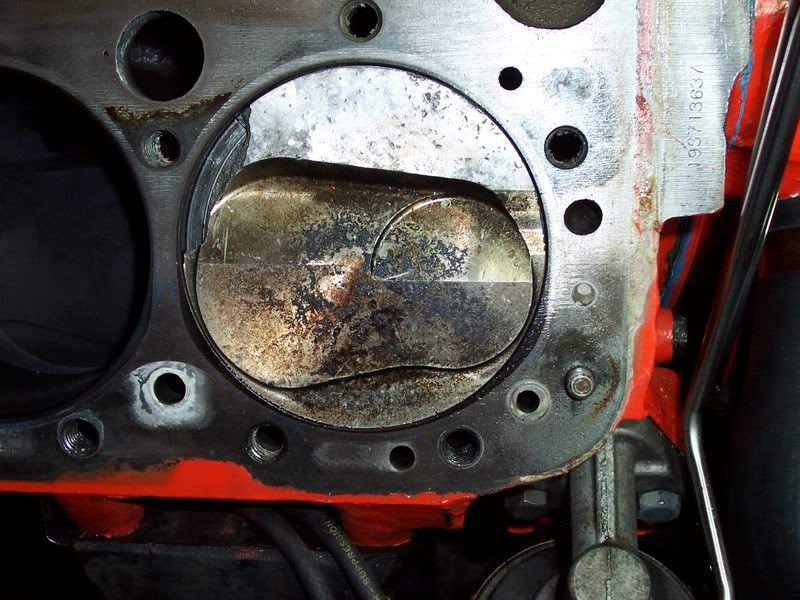
I've seen failures like this in KB Hyper's before. in my experience w/o exception it has been too little top ring gap. In which case it was the builders fault. Do you know what the gap was in this picture?
Le Mans Master
Joined: Jun 2004
Posts: 6,231
Likes: 65
From: Seattle WA
St. Jude Donor '14
Truer words were never spoken 
Most of the overhaul/build "rescue" jobs I've done where the engine either shows up the back of a truck or in my driveway running lousy have been pursuing a power level that wasn't consistent with usage or budget, or using racing parts/configuration on a street engine.
For a lot of us, budget drives these decisions. A realistic budget drives a good design and ultimately an engine that performs well. A mishmosh of parts and no hard look at budget leads to something that either stays on the stand forever or just never delivers the goods in the car.
Thread Starter
Drifting
Joined: Jun 2006
Posts: 1,912
Likes: 12
From: Schaumburg (Chicago) Illinois
Seems correct to me also. But doesn't KB tell you what the gap should be? Why don't they cut the gap for you?
Le Mans Master
Joined: Jun 2004
Posts: 6,231
Likes: 65
From: Seattle WA
St. Jude Donor '14
The piston manufacturer always advises ring gap, and the good ones sell matching rings. There are some "rules of thumb" that get people into trouble with some piston alloys. Proper gap is also based on power adders, etc.
You can buy pre-gapped rings, and many "rebuilder" sets come this way. Most builders prefer to set their own gaps although it is time-consuming when done by hand. For anything making < 1HP/CID I buy the pre-gapped sets, for anything over I do it myself. This has worked for me to date.
You can buy pre-gapped rings, and many "rebuilder" sets come this way. Most builders prefer to set their own gaps although it is time-consuming when done by hand. For anything making < 1HP/CID I buy the pre-gapped sets, for anything over I do it myself. This has worked for me to date.
Le Mans Master
Joined: Dec 2006
Posts: 5,557
Likes: 9
From: Oquirrh Mountains
St. Jude Donor '09
63Mako - Someone owes you an engine!
I would use Hyper's before cast also, just not KB hyper's. They have a design flaw that hasn't been resolved. 1st ring is real close to the crown and area between is ribbed. They break at the ringland. My engine builder will not use them foir this same reason. Do a search and see how many pictures you find like this:
I came up with a gap of 0.009"
 This is WAY WAY to tight. The suggested gap according to KB is .0065 per inch bore (normally aspirated - street), or 0.026 inch. This is three times less than the manufactures recommendation! This piston failed because as the ring expanded, the ring ends butted thogether and then the ring 'locked' itsself in the bore as it continued to expand. This isn't a product failure, It's an installation failure. He apparently doesn't know how to read installation directions. No piston will survive this situation, regardless of manufacturer.
You should get a full replacement from your builder gratis. If not, get a new shop and seriously consider legal action!
-Lurkin
Race Director
Joined: May 2005
Posts: 10,674
Likes: 122
From: Millington Illinois
St. Jude Donor '08-'09
Once upon a time, I used to do some failure analysis for a living. So just for kicks I pulled your picture into AutoCAD and digitized it. Based on a four inch bore, I measured the ring gap in the photo. This is little tough to be exact due to the resolution of the photo; nevertheless it still is fairly close.
I came up with a gap of 0.009" This is WAY WAY to tight. The suggested gap according to KB is .0065 per inch bore (normally aspirated - street), or 0.026 inch. This is three times less than the manufactures recommendation! This piston failed because as the ring expanded, the ring ends butted thogether and then the ring 'locked' itsself in the bore as it continued to expand. This isn't a product failure, It's an installation failure. He apparently doesn't know how to read installation directions. No piston will survive this situation, regardless of manufacturer.
You should get a full replacement from your builder gratis. If not, get a new shop and seriously consider legal action!
-Lurkin
I came up with a gap of 0.009"
This is WAY WAY to tight. The suggested gap according to KB is .0065 per inch bore (normally aspirated - street), or 0.026 inch. This is three times less than the manufactures recommendation! This piston failed because as the ring expanded, the ring ends butted thogether and then the ring 'locked' itsself in the bore as it continued to expand. This isn't a product failure, It's an installation failure. He apparently doesn't know how to read installation directions. No piston will survive this situation, regardless of manufacturer. You should get a full replacement from your builder gratis. If not, get a new shop and seriously consider legal action!
-Lurkin