




New create engine blown...first time at the track

Pro

Joined: Nov 2007
Posts: 741
Likes: 1
From: Woodstock GA

The 1/8-mile 'factor', used by NHRA/IHRA is .64 of the 1/4-mile
(1/4-mile x .64 = 1/8-mile..... 1/8-mile divided-by .64 = 1/4-mile)
but with a 1.8x short-time, I believed the car was hurting before it reached the 1/8-mile mark, and that the 9.5x wasn't a true representation of it's potential:
I will ask Red 69, a regular competitor at Orlando Speed World Dragway, what his incremental times are, as I think his '79 runs 14.30s @ 95-ish MPH..... maybe they will help.

(1/4-mile x .64 = 1/8-mile..... 1/8-mile divided-by .64 = 1/4-mile)
but with a 1.8x short-time, I believed the car was hurting before it reached the 1/8-mile mark, and that the 9.5x wasn't a true representation of it's potential:
I will ask Red 69, a regular competitor at Orlando Speed World Dragway, what his incremental times are, as I think his '79 runs 14.30s @ 95-ish MPH..... maybe they will help.

Race Director


Joined: May 2005
Posts: 10,674
Likes: 122
From: Millington Illinois
St. Jude Donor '08-'09
Your cam is well matched. Larger cam will probably be no benefit. More lift requires stronger springs leading to increased valvetrain wear and issues with no gain in available rpm. You probably can't pull much over 6000 before running into valve float. Your cam probably peaks @ 6200 to 6500 RPM now. Over reving a hydraulic roller is a good way to blow your motor. A rev kit and rev limiter would be a good upgrade. Cheap insurance and more available RPM.
Last edited by 63mako; Apr 26, 2008 at 04:57 PM.

Race Director


Joined: Jan 2003
Posts: 15,176
Likes: 88
From: State of Confusion

1.8x is pretty-stout for an older Corvette.
This might help..... Forum-member BKbroiler goes 1.85, and runs 12.90s @ 104+
http://forums.corvetteforum.com/show....php?t=1746763
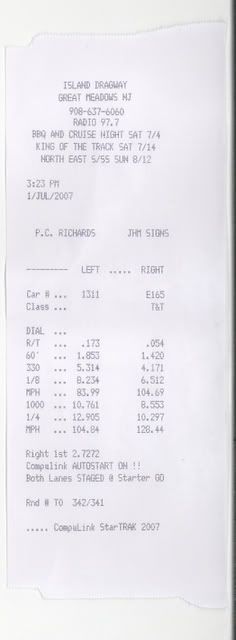
..... and his 1/8-mile time (8.234) is almost dead-on the factor of .64 (12.905 x .64 = 8.259)

Melting Slicks


Joined: Apr 2004
Posts: 2,008
Likes: 38
From: Space Coast Gator Territory
Since no one answered your first question, I will. Don't ask where I got this figure, I don't remember, but a good formula for a 1/4 mile conversion from 1/8th is to multiply the 1/8th ET by 1.538. 9.50 x 1.538= 14.611.Its pretty accurate, at least for most street cars.Not too bad for blowing the motor at half track. Just curious...what happened?
Last edited by Red 69; Apr 27, 2008 at 12:10 AM.
Thread Starter
Pro
Joined: Jun 2004
Posts: 700
Likes: 0
From: Lantana TX
Since no one answered your first question, I will. Don't ask where I got this figure, I don't remember, but a good formula for a 1/4 mile conversion from 1/8th is to multiply the 1/8th ET by 1.538. 9.50 x 1.538= 14.611.Its pretty accurate, at least for most street cars.Not too bad for blowing the motor at half track. Just curious...what happened?
Anybody know where to get a nice complete forged small block?? Don't want to spend more than 3k.
Thread Starter
Pro
Joined: Jun 2004
Posts: 700
Likes: 0
From: Lantana TX
Your cam is well matched. Larger cam will probably be no benefit. More lift requires stronger springs leading to increased valvetrain wear and issues with no gain in available rpm. You probably can't pull much over 6000 before running into valve float. Your cam probably peaks @ 6200 to 6500 RPM now. Over reving a hydraulic roller is a good way to blow your motor. A rev kit and rev limiter would be a good upgrade. Cheap insurance and more available RPM.
Sorry to keep asking questions, but I want to put a lot more thought into this one..no more create engines for me. Now for the question, my builder told me that I need to stay with a 1 pice RM seal if I want to re-use the lifters and cam (as long as they are in good comdition). Does that make sence? He also said that for an extra $25 that I should go with a 6" rod instead of the 5.7"...I do not understand the difference so I just want to make sure.
Thanks again to all!!
Thread Starter
Pro
Joined: Jun 2004
Posts: 700
Likes: 0
From: Lantana TX
1.8x is pretty-stout for an older Corvette.
This might help..... Forum-member BKbroiler goes 1.85, and runs 12.90s @ 104+
http://forums.corvetteforum.com/show....php?t=1746763
..... and his 1/8-mile time (8.234) is almost dead-on the factor of .64 (12.905 x .64 = 8.259)

Burning Brakes

Joined: Dec 2003
Posts: 1,004
Likes: 7
From: Adelaide South Australia
$25 more to go with 6" rods is too good a deal to pass up!!! sounds cheap. Make sure the material composition of those longer rods is equal to the task required..... you are aiming for 650HP+ with N2O
The extra rod length reduces the angle that the conrod swings through for the same stroke. It helps in reducing lateral (sideways) forces as the piston goes up and down, and should make the buildup better able to handle higher cylinder pressures.... as long as the material they are made of is good.
In regards to 1 piece rear main seal... yes. Your current cam and valve train is for the later style 1 piece rear main block which has provision for the roller cam. The 2 piece rear main seal original period blocks require different modifications to retro-fit a roller cam. Your engine builder is advising correctly.
By the way, those 6" rods may require additional clearancing of the block, so count on some additional labour cost factor there.
The extra rod length reduces the angle that the conrod swings through for the same stroke. It helps in reducing lateral (sideways) forces as the piston goes up and down, and should make the buildup better able to handle higher cylinder pressures.... as long as the material they are made of is good.
In regards to 1 piece rear main seal... yes. Your current cam and valve train is for the later style 1 piece rear main block which has provision for the roller cam. The 2 piece rear main seal original period blocks require different modifications to retro-fit a roller cam. Your engine builder is advising correctly.
By the way, those 6" rods may require additional clearancing of the block, so count on some additional labour cost factor there.
Last edited by OzzyTom; Apr 27, 2008 at 08:43 PM.
Corvette Stories
The Best of Corvette for Corvette Enthusiasts

Top 10 Most Expensive Corvettes Ever Sold on Bring A Trailer
Brett Foote
10 Things Every Corvette Owner Needs (2026 Edition)
Michael S. Palmer
8 Most "Only Corvette Owners Understand" Quirks and Problems
Pouria Savadkouei
10 Reasons the C6 Z06 is Still A Performance Benchmark After 20 Years
Joe Kucinski
How Much Horsepower Every Corvette Engine "LOST" in 1972
Joe Kucinski
Top 10 DOs and DON'Ts for Protecting Your Convertible Top!
Michael S. Palmer
Top 10 Most Explosive Corvettes Ever Made: Power-to-Weight Ratio Ranked!
Joe Kucinski
150 hp to 1,250 hp: Every Corvette Generation Compared by the Specs That Matter
Joe Kucinski
8 Coolest Corvette Pace Cars (and Replicas) of All Time
Verdad Gallardo
Thread Starter
Pro
Joined: Jun 2004
Posts: 700
Likes: 0
From: Lantana TX
$25 more to go with 6" rods is too good a deal to pass up!!! sounds cheap. Make sure the material composition of those longer rods is equal to the task required..... you are aiming for 650HP+ with N2O
The extra rod length reduces the angle that the conrod swings through for the same stroke. It helps in reducing lateral (sideways) forces as the piston goes up and down, and should make the buildup better able to handle higher cylinder pressures.... as long as the material they are made of is good.
In regards to 1 piece rear main seal... yes. Your current cam and valve train is for the later style 1 piece rear main block which has provision for the roller cam. The 2 piece rear main seal original period blocks require different modifications to retro-fit a roller cam. Your engine builder is advising correctly.
By the way, those 6" rods may require additional clearancing of the block, so count on some additional labour cost factor there.
The extra rod length reduces the angle that the conrod swings through for the same stroke. It helps in reducing lateral (sideways) forces as the piston goes up and down, and should make the buildup better able to handle higher cylinder pressures.... as long as the material they are made of is good.
In regards to 1 piece rear main seal... yes. Your current cam and valve train is for the later style 1 piece rear main block which has provision for the roller cam. The 2 piece rear main seal original period blocks require different modifications to retro-fit a roller cam. Your engine builder is advising correctly.
By the way, those 6" rods may require additional clearancing of the block, so count on some additional labour cost factor there.
Honestly, I am only shooting for 600-625 with a 125 shot, but longer goals of a 200 shot max!
Race Director
Joined: May 2005
Posts: 10,674
Likes: 122
From: Millington Illinois
St. Jude Donor '08-'09
funny you said everything like you already know the car 100%.
Sorry to keep asking questions, but I want to put a lot more thought into this one..no more create engines for me. Now for the question, my builder told me that I need to stay with a 1 pice RM seal if I want to re-use the lifters and cam (as long as they are in good comdition). Does that make sence? He also said that for an extra $25 that I should go with a 6" rod instead of the 5.7"...I do not understand the difference so I just want to make sure.
Thanks again to all!!
Sorry to keep asking questions, but I want to put a lot more thought into this one..no more create engines for me. Now for the question, my builder told me that I need to stay with a 1 pice RM seal if I want to re-use the lifters and cam (as long as they are in good comdition). Does that make sence? He also said that for an extra $25 that I should go with a 6" rod instead of the 5.7"...I do not understand the difference so I just want to make sure.
Thanks again to all!!
With Ozzytom on the 6"rods, Less side loading on the piston. A $25 upcharge is cheap. You went Hydraulic roller so your looking at street use, low maintainance and longevity and still pull respectable power when you want it. If you use a rev kit you can probably pull an extra 500 RPM before valve float right at your peak power. A rev limiter is cheap considering what a blown engine cost. Valve float at over 6000 RPM is death to your motor especially with the nitrous flowing. Spent the last 2 years designing and builing a similar 383 with a 150 nitrous shot. My specs are real close to yours. Been through most of the questions you have now. Plenty of help here on the forum. Forged bottom end is the only way to go with 500 HP and Nitrous. Check on the low expansion forged pistons. Mahle makes a nice one for a 6" rod 383 and they will handle a 200 shot.
Last edited by 63mako; Apr 27, 2008 at 10:28 PM.
Thread Starter
Pro
Joined: Jun 2004
Posts: 700
Likes: 0
From: Lantana TX
With Ozzytom on the 6"rods, Less side loading on the piston. A $25 upcharge is cheap. You went Hydraulic roller so your looking at street use, low maintainance and longevity and still pull respectable power when you want it. If you use a rev kit you can probably pull an extra 500 RPM before valve float right at your peak power. A rev limiter is cheap considering what a blown engine cost. Valve float at over 6000 RPM is death to your motor especially with the nitrous flowing. Spent the last 2 years designing and builing a similar 383 with a 150 nitrous shot. My specs are real close to yours. Been through most of the questions you have now. Plenty of help here on the forum. Forged bottom end is the only way to go with 500 HP and Nitrous. Check on the low expansion forged pistons. Mahle makes a nice one for a 6" rod 383 and they will handle a 200 shot.I have a rev limiter set at 5800. I hate taknig chances on this engine and would rather be safe than sorry. However, I will push it slightly higher (RPM) on the new one.
What do you think of the cast steel cranks from Eagle? Could they handle 650HP (with NOS)? I don't think so, but I want to be sure.
Race Director
Joined: May 2005
Posts: 10,674
Likes: 122
From: Millington Illinois
St. Jude Donor '08-'09
Again 100% correct. Street use yes, track yes 50/50. One weekend track the next cruise weekend, maybe 2 times per month at the track if I am lucky.
I have a rev limiter set at 5800. I hate taknig chances on this engine and would rather be safe than sorry. However, I will push it slightly higher (RPM) on the new one.
What do you think of the cast steel cranks from Eagle? Could they handle 650HP (with NOS)? I don't think so, but I want to be sure.
I have a rev limiter set at 5800. I hate taknig chances on this engine and would rather be safe than sorry. However, I will push it slightly higher (RPM) on the new one.
What do you think of the cast steel cranks from Eagle? Could they handle 650HP (with NOS)? I don't think so, but I want to be sure.
Racer


Joined: Apr 2008
Posts: 254
Likes: 5
From: ingleside illinois
Throw the cast crank in your lawn mower not in a street -strip car with nitrous.And i no your gonna be hitting it with 200 alot sooner that you think.It always happens.Just make sure you have a separate fuel system for the n2o when approaching those levels,and a fuel shutoff switch-just in case.[IMG] [/IMG]
[/IMG]
Racer
Joined: Apr 2008
Posts: 254
Likes: 5
From: ingleside illinois
1 more thing if your running n2o in your vette i hope you have blow off valves running out of the car.You cant run at the track if you dont-I ran a bulkhead fitting out of the car with some nice lines i made.Make sure bottle pressure is atleast 900 psi and you have a purrge valve also.[IMG] [/IMG]
[/IMG]
Last edited by corvette744; Apr 28, 2008 at 02:03 PM.
Thread Starter
Pro
Joined: Jun 2004
Posts: 700
Likes: 0
From: Lantana TX
1 more thing if your running n2o in your vette i hope you have blow of valves running out of the car.You cant run at the track is you dont-I ran a bulhead fitting out of the car with some nice lines i made.Make sure bottle pressur is atleast 900 psi and you have a purrge valve also.[IMG][/IMG]
[/IMG]All else is set, bottle pressure heater set to 900, rev limiter, WOT switch, RPM window switch etc.

Team Owner


Joined: Apr 1999
Posts: 21,953
Likes: 1,445
From: Reno Nevada
2024 C3 of the Year Finalist- Modified

are you building another 383? You don't use 400 mains in a 350 block.
Thread Starter
Pro
Joined: Jun 2004
Posts: 700
Likes: 0
From: Lantana TX
Thanks... I have not bought anything yet as I am still looking for a short block if I can. However, if I can't find one in the next 2 weeks than I will have my builder start from scratch.
As you can see I am not up to par with most of you folks here. What size mains should I be looking at?
As you can see I am not up to par with most of you folks here. What size mains should I be looking at?

Le Mans Master

Joined: Sep 2001
Posts: 7,739
Likes: 630
From: Unreconstructed, South Carolina
A well-built motor w/ a good iron crank can endure quite a bit.
Seems virtually all the newer LS series motors are OE w/ nodular iron cranks ... including new LS3 ... even GMPP LS376/515hp has nod iron crank & hypereutectic pistons too. Of all the LS series, about the only one w/ OE steel crank is LS7/505hp (also hyper pistons). But hypers not recommended w/ lotsa nitrous.
If it's rev-limited to ~ 6K, forged may not be necessary.
Seems virtually all the newer LS series motors are OE w/ nodular iron cranks ... including new LS3 ... even GMPP LS376/515hp has nod iron crank & hypereutectic pistons too. Of all the LS series, about the only one w/ OE steel crank is LS7/505hp (also hyper pistons). But hypers not recommended w/ lotsa nitrous.
If it's rev-limited to ~ 6K, forged may not be necessary.
Racer
Joined: Apr 2008
Posts: 254
Likes: 5
From: ingleside illinois
A well-built motor w/ a good iron crank can endure quite a bit.
Seems virtually all the newer LS series motors are OE w/ nodular iron cranks ... including new LS3 ... even GMPP LS376/515hp has nod iron crank & hypereutectic pistons too. Of all the LS series, about the only one w/ OE steel crank is LS7/505hp (also hyper pistons). But hypers not recommended w/ lotsa nitrous.
If it's rev-limited to ~ 6K, forged may not be necessary.
Seems virtually all the newer LS series motors are OE w/ nodular iron cranks ... including new LS3 ... even GMPP LS376/515hp has nod iron crank & hypereutectic pistons too. Of all the LS series, about the only one w/ OE steel crank is LS7/505hp (also hyper pistons). But hypers not recommended w/ lotsa nitrous.
If it's rev-limited to ~ 6K, forged may not be necessary.
Race Director
Joined: May 2005
Posts: 10,674
Likes: 122
From: Millington Illinois
St. Jude Donor '08-'09
A cast crank will take a lot but a 500 HP Gen 1 plus a 200 shot of nitrous is asking a lot. I respect Jackson's opinion but I wouldn't chance it. I would go forged bottom end and ARP studs throughout. I used billet main caps too. The weak link always breaks. The way my luck goes the one thing I try to cut corners on or say "that should work" is always what screws up.
Last edited by 63mako; Apr 29, 2008 at 12:17 AM.