Is 210* too high
Thread Starter
Burning Brakes

Joined: Aug 2005
Posts: 1,126
Likes: 0
From: Hudson Falls, N.Y. 76 Vette Modified L-48
 Is 210* too high
The '76 usually runs about 195*, yesterday while traveling thru the city with heavy traffic, sitting and idling in traffic, the temp went up past 200* to roughly 210* which it never has done. Ambient temp was around 83*. Once I got moving again, the temp dropped to just below 200* as it normally runs in the summer.....is that temp (210) possibly a
damaging temp? As soon as I get out from in front of this computer and out of bed, I will check the radiator fluid level, was way to hot yesterday....what do you guys think, a problem? It was hard starting when I stopped and shut it off, then restarted, engine turned over ok, just had to gas it and eventually caught...thanks in advance!!
damaging temp? As soon as I get out from in front of this computer and out of bed, I will check the radiator fluid level, was way to hot yesterday....what do you guys think, a problem? It was hard starting when I stopped and shut it off, then restarted, engine turned over ok, just had to gas it and eventually caught...thanks in advance!!

Team Owner


Joined: Aug 1999
Posts: 30,995
Likes: 99
From: Ontario
I'll try this one and catch heck from the 180* crowd  .
.
The red (danger) zone on your temp gauge is 250*. Water boils at 212* but with an appropriate mix of water/coolant and in a system under 15psi pressure that boiling point is much higher. I would consider a reading of 210* in stop-and-go traffic with an ambient temp of 83* perfectly normal; completely within the cooling capabilities of your car.
.The red (danger) zone on your temp gauge is 250*. Water boils at 212* but with an appropriate mix of water/coolant and in a system under 15psi pressure that boiling point is much higher. I would consider a reading of 210* in stop-and-go traffic with an ambient temp of 83* perfectly normal; completely within the cooling capabilities of your car.
Le Mans Master


Joined: Apr 2004
Posts: 7,106
Likes: 38
From: Newark DE
absolutely NOTHING wrong or dangerous with a 210º operating temp.
my '78 only has 12,000 miles and still has 100% of it's stock factory equipment including the factory 195º t-stat. Normal operating temps are 200-210º without AC and 210-225º with AC on a hot day. This is normal and well within the designed operating parameters of the car.
Remember, these cars were DESIGNED to run at hotter temps since the very early 70's because of emissions reasons, they needed the higher temps to help burn off excess HC.
If you want lower operating temps, such as the "normal" 180º always discussed on here, than remove all the factory emissions equipment off the car, swap out the factory 195º t-stat for a 180º unit, reset your timing to a more advanced timing than the factory curve (36º total timing / approx 12º initial timing), and move your vacuum advance from the factory ported connection to full manifold vacuum.
This will, assuming the cooling system is in good operating condition, help lower your operating temps to below 200º, plus the more advanced timing curve and the move to full manifold vacuum will gain you a slight increase in performance.
Otherwise, leave the car alone and just enjoy it since 210º is perfectly safe and nothing to be concerned about.
Oh, one last note, I just noticed from your post that the temp spiked up a bit when you were at slow driving / traffic conditions. Again, this is pretty normal for the temps to rise in those conditions but it may also be worth just double checking your fan clutch. Get the car up to operating temps than shut the car off. The fan should stop within 1-3 revolutions. If it takes much longer or just free spins than you need a new fan clutch. If it looks good than again just drive the car and enjoy it, no need to worry.
my '78 only has 12,000 miles and still has 100% of it's stock factory equipment including the factory 195º t-stat. Normal operating temps are 200-210º without AC and 210-225º with AC on a hot day. This is normal and well within the designed operating parameters of the car.
Remember, these cars were DESIGNED to run at hotter temps since the very early 70's because of emissions reasons, they needed the higher temps to help burn off excess HC.
If you want lower operating temps, such as the "normal" 180º always discussed on here, than remove all the factory emissions equipment off the car, swap out the factory 195º t-stat for a 180º unit, reset your timing to a more advanced timing than the factory curve (36º total timing / approx 12º initial timing), and move your vacuum advance from the factory ported connection to full manifold vacuum.
This will, assuming the cooling system is in good operating condition, help lower your operating temps to below 200º, plus the more advanced timing curve and the move to full manifold vacuum will gain you a slight increase in performance.
Otherwise, leave the car alone and just enjoy it since 210º is perfectly safe and nothing to be concerned about.
Oh, one last note, I just noticed from your post that the temp spiked up a bit when you were at slow driving / traffic conditions. Again, this is pretty normal for the temps to rise in those conditions but it may also be worth just double checking your fan clutch. Get the car up to operating temps than shut the car off. The fan should stop within 1-3 revolutions. If it takes much longer or just free spins than you need a new fan clutch. If it looks good than again just drive the car and enjoy it, no need to worry.

Race Director


Joined: Jul 2001
Posts: 15,892
Likes: 42
Paul and Barry are correct. There's nothing abnormal or damaging about 210 degrees.
Trying to re-engineer the car to do something that it was not equipped to do, nor was deemed necessary to do by the factory would be pretty futile.
If it still bothers you, try putting black tape over the gauge. The problem will be gone instantly, just like the millions of GM vehicles that never had a temp gauge to start with.
Trying to re-engineer the car to do something that it was not equipped to do, nor was deemed necessary to do by the factory would be pretty futile.
If it still bothers you, try putting black tape over the gauge. The problem will be gone instantly, just like the millions of GM vehicles that never had a temp gauge to start with.

Race Director


Joined: Sep 2001
Posts: 10,560
Likes: 439
From: Wellington, FL
St. Jude Donor '11 thru '25
 But I would check the fan clutch as I don't like the idea of the temp rising in traffic and then dropping after the car is moving again. Could be the sign of the fan clutch going. I live in Florida and my '76 pretty much doesn't go over 200 whether in traffic or not. It stays fairly constant. Is this something that just started regarding higher temps in traffic?

Team Owner


Joined: Jan 2006
Posts: 37,637
Likes: 3,118
From: Crossville TN
210 deg. will not hurt your engine. Oil run at 210 will degrade sooner than oil run at 180 deg. The Chevy V-8 engine was designed to run at 180 deg. F.; that is where it maximizes fuel efficiency, power and reliability (engine life). Emissions requirements caused car manufacturers to move to 195 F. thermostats; but a non-computerized car will run better with a 180 deg. thermostat...even hough it may generate more carbon emissions. [Higher engine temps burn cleaner, I guess.] You can improve your engine's performance, fuel efficiency and life expectancy by changing to a 180 F. thermostat.
Le Mans Master
Joined: Apr 2004
Posts: 7,106
Likes: 38
From: Newark DE
Also, if the car still has the factory emissions equipment installed I'd leave the 195º t-stat there. If the emissions equipment were removed than i'd agree to change the t-stat to a 180º
Corvette Stories
The Best of Corvette for Corvette Enthusiasts

Top 10 Most Expensive Corvettes Ever Sold on Bring A Trailer
Brett Foote
10 Things Every Corvette Owner Needs (2026 Edition)
Michael S. Palmer
8 Most "Only Corvette Owners Understand" Quirks and Problems
Pouria Savadkouei
10 Reasons the C6 Z06 is Still A Performance Benchmark After 20 Years
Joe Kucinski
How Much Horsepower Every Corvette Engine "LOST" in 1972
Joe Kucinski
Top 10 DOs and DON'Ts for Protecting Your Convertible Top!
Michael S. Palmer
Top 10 Most Explosive Corvettes Ever Made: Power-to-Weight Ratio Ranked!
Joe Kucinski
150 hp to 1,250 hp: Every Corvette Generation Compared by the Specs That Matter
Joe Kucinski
8 Coolest Corvette Pace Cars (and Replicas) of All Time
Verdad Gallardo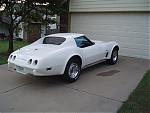
Thread Starter
Burning Brakes
Joined: Aug 2005
Posts: 1,126
Likes: 0
From: Hudson Falls, N.Y. 76 Vette Modified L-48
Thanks guys for all the input...I'm not concerned, but just needed to ask....I haven't noticed this temp before, but on the other hand, she rarely goes into a heavy traffic situation, mostly a wide open road....I was gonna check fluid yesterday, but got side tracked. Now I'm glad I did, I will check the fan clutch as well as the fluid level....and just for an FYI, I do have the Lars all in 36* on the timing...
Again thanks all....you guys are the best!!!
(Oh, britewhite....nice car )
)
Again thanks all....you guys are the best!!!
(Oh, britewhite....nice car
)
Last edited by kb2fzq; Jul 27, 2008 at 07:45 AM.

Le Mans Master

Joined: Oct 2007
Posts: 7,454
Likes: 977
From: RI, Now Franklin/Nashville TN
Thanks guys for all the input...I'm not concerned, but just needed to ask....I haven't noticed this temp before, but on the other hand, she rarely goes into a heavy traffic situation, mostly a wide open road....I was gonna check fluid yesterday, but got side tracked. Now I'm glad I did, I will check the fan clutch as well as the fluid level....and just for an FYI, I do have the Lars all in 36* on the timing...
Again thanks all....you guys are the best!!!
(Oh, britewhite....nice car)
Again thanks all....you guys are the best!!!
(Oh, britewhite....nice car
)
Team Owner
Joined: Aug 1999
Posts: 30,995
Likes: 99
From: Ontario
210 is not an abnormal temp, but I would definitely investigate why the temp is that high if it never was before in those driving conditions and outside temperature. I would not just assume everything is normal if it has never happened before. Something has changed for the condition to suddenly occur!
Le Mans Master
Joined: Oct 2007
Posts: 7,454
Likes: 977
From: RI, Now Franklin/Nashville TN
Le Mans Master
Joined: Oct 2007
Posts: 7,454
Likes: 977
From: RI, Now Franklin/Nashville TN
210 deg. will not hurt your engine. Oil run at 210 will degrade sooner than oil run at 180 deg. The Chevy V-8 engine was designed to run at 180 deg. F.; that is where it maximizes fuel efficiency, power and reliability (engine life). Emissions requirements caused car manufacturers to move to 195 F. thermostats; but a non-computerized car will run better with a 180 deg. thermostat...even hough it may generate more carbon emissions. [Higher engine temps burn cleaner, I guess.] You can improve your engine's performance, fuel efficiency and life expectancy by changing to a 180 F. thermostat.
Thread Starter
Burning Brakes
Joined: Aug 2005
Posts: 1,126
Likes: 0
From: Hudson Falls, N.Y. 76 Vette Modified L-48
Hmmm....what I think you're looking at is the face of a very embarrased C3 owner 
I put almost a gallon of antifreeze in her...(hmmm, running hot, huh Bill? Geez, what a dummy)
I appreciate all your help....she's back to normal again....Thanks!
I put almost a gallon of antifreeze in her...(hmmm, running hot, huh Bill? Geez, what a dummy)
I appreciate all your help....she's back to normal again....Thanks!
Le Mans Master
Joined: Oct 2007
Posts: 7,454
Likes: 977
From: RI, Now Franklin/Nashville TN
Glad you found the problem! Like I thought, if it never did it before, something is not right. A lesson for all C3 owners!

Racer

Joined: Apr 2008
Posts: 436
Likes: 2
My 71 reaches 210 in traffic/under 30mph, but that's w/ an ambient temp of 95+. I drove it yesterday w/ temps near 100 and it never got over 210. At first I was worried about this, but it seems this actually isn't too bad after what I've read on this site.
Melting Slicks

Joined: May 2006
Posts: 3,438
Likes: 41
From: Raleigh NC
St. Jude Donor '13-'14
Here's a good graph that shows CO oxidation as well as various light hydrocarbons.

These are done with a different catalyst, but the chemistry is still the same. Higher temp = greater conversion.
Last edited by LeMans Pete; Aug 3, 2008 at 05:51 PM.