



Piston and Rod Combos

Burning Brakes


Joined: Sep 2005
Posts: 993
Likes: 3
From: Iowa

Yep, that is in deed how the cup engines are put together. Big bore with a short stroke for top end power, and it also helps keep the engine alive at higher RPM. They do it mainly for the bore size though; you can't fit as huge of valves in a 4.030 as you can in a 4.155.

Le Mans Master


Joined: Apr 2006
Posts: 5,403
Likes: 95
Yep, that is in deed how the cup engines are put together. Big bore with a short stroke for top end power, and it also helps keep the engine alive at higher RPM. They do it mainly for the bore size though; you can't fit as huge of valves in a 4.030 as you can in a 4.155.
Burning Brakes
Joined: Sep 2005
Posts: 993
Likes: 3
From: Iowa
Sure but you can only fit so much valve into a 4.030 bore; you can't take a Brodix Canted Valve head and put it on a 4.030 bore engine and use the 2.250 intake valve. The same goes for any of their heads that employ the 58/107, 58/125, or 95/150 valve centerlines; they will not fit on a 4.030 bore. I have to also say that the 23* valve angle in and of itself is not that bad; for many years 410 sprint car engines would use these to hit the 850hp mark... Sure we run a 13.5* GB series head on a lot of them now or even the BD series but that doesn't mean that a 23* valve angle doesn't hold its own.

Thread Starter
Team Owner

Joined: Apr 2002
Posts: 62,198
Likes: 1
From: All humans are vermin in the eyes of Guru VA
Cruise-In IV Veteran
Cruise-In V Veteran
Dart on their forums have a section where they are asking what products we wished dart made.
I said a 18 or 15 degree small port head for street engines, with a single and dual plane intake to match it.
I think the new LS series motors are 15 degree heads, I forget off the top of my head.
So something in the 15 degree range with a 2.02 or 2.05 valve. When you get into the bigger strokers I think they can use the existing products.
I said a 18 or 15 degree small port head for street engines, with a single and dual plane intake to match it.
I think the new LS series motors are 15 degree heads, I forget off the top of my head.
So something in the 15 degree range with a 2.02 or 2.05 valve. When you get into the bigger strokers I think they can use the existing products.
Burning Brakes
Joined: Sep 2005
Posts: 993
Likes: 3
From: Iowa
Well that's been the thinking of many hot rod guys for quite a while now (and there's better performing valve angles than the 18 or 15 degree but a lot of that depends on the type of fuel being used and other wet flow characteristics). You can buy a Brodix 12X12 head bare and have it ported to a fairly small intake runner (and have a street oriented head) but you will still have to use the shaft rocker system (which costs around $1500 for the cheap set) and the peak hp won’t be much, if any higher than a comparable 23* unit. They have a couple different intakes for these heads; most if not all will be single planes versions so that will be a hang up as well. The end factor ends up being this; with a ported -10X (that’s a 23* head from Brodix) that flows over 350cfm if not more (depending upon who worked on it) you can make all the hp most applications will ever need. For example, a 434 with these heads can make well over 700 hp on gas (depending upon operating range, maybe even more) if you put the parts together. So for the most part, no one makes the jump up to an exotic cylinder head like the 12X12s until the engine costs begin to hit the $20,000+ mark. At that point everyone wants a 260cc intake runner or larger and it's a full blown race deal.
Interestingly though, I just had a friend of mine who has the cash flow to start a project in this area, recruit me to help him set something like this up. We talked it over and really wanted to put together a package that utilized a 12* cylinder head with good wet flow characteristics for gasoline along with a custom intake specifically for the hot rod crowd. Unfortunately the deeper we got into it the better the package looked, but the cost became as such that no one would have bought it. The final blow was simple; the package would have been capable of producing around 700 hp...the cost of the rest of the engine was also going to be outside the budget of most consumers especially when the heads, valve train, and intake would have cost around $6,000.
It's a great thought but when you look at what's already available in 23*, and the hp constraints of the commonly used consumer grade parts, there just isn't any room to grow.
Interestingly though, I just had a friend of mine who has the cash flow to start a project in this area, recruit me to help him set something like this up. We talked it over and really wanted to put together a package that utilized a 12* cylinder head with good wet flow characteristics for gasoline along with a custom intake specifically for the hot rod crowd. Unfortunately the deeper we got into it the better the package looked, but the cost became as such that no one would have bought it. The final blow was simple; the package would have been capable of producing around 700 hp...the cost of the rest of the engine was also going to be outside the budget of most consumers especially when the heads, valve train, and intake would have cost around $6,000.
It's a great thought but when you look at what's already available in 23*, and the hp constraints of the commonly used consumer grade parts, there just isn't any room to grow.
Le Mans Master
Joined: Apr 2006
Posts: 5,403
Likes: 95
All the costs the way you would like to have it for real high rpm work shaft system or whatever you would like to talk about is the reason I would rather build a big block. But back to a small block you can put $6000 in a 23 degree top end to you spend $1600 for titanium valves big ported runner heads are very expensive best shaft systems for 23 degree heads are no cheaper in cost.
A brodix part number 1108103, 10X10 23 degree head that flows
352/258 costs $5,635.30 out of brodix catalog it would be only a hair cheaper through summit. this is the package price, the bare heads are $4354.14. Unless a person is restricted by rules to run a 23 Degree head no reason to. $5,635.00 + $1500.00 shaft system $7,135.00.
12 X 12, part number 1128103 12 degree flows 399/263 cost $5,501.64 + $1500.00 shaft system $7,001.64.
Bare head price 1128006 $4,220.26.
I have checked into the costs including pistons at these costs
no reason in the world to use another version of early 1950s
design.
I kind of think the days when the shop forman of the machine shop
would sell me a good four bolt main factory block for $5.00 may be
over to LOL. $5.00 was what the machine shop had in a complete
rebuildable engine.
A brodix part number 1108103, 10X10 23 degree head that flows
352/258 costs $5,635.30 out of brodix catalog it would be only a hair cheaper through summit. this is the package price, the bare heads are $4354.14. Unless a person is restricted by rules to run a 23 Degree head no reason to. $5,635.00 + $1500.00 shaft system $7,135.00.
12 X 12, part number 1128103 12 degree flows 399/263 cost $5,501.64 + $1500.00 shaft system $7,001.64.
Bare head price 1128006 $4,220.26.
I have checked into the costs including pistons at these costs
no reason in the world to use another version of early 1950s
design.
I kind of think the days when the shop forman of the machine shop
would sell me a good four bolt main factory block for $5.00 may be
over to LOL. $5.00 was what the machine shop had in a complete
rebuildable engine.
Last edited by Little Mouse; Oct 10, 2008 at 12:12 PM.
Corvette Stories
The Best of Corvette for Corvette Enthusiasts

How Much Horsepower Every Corvette Engine "LOST" in 1972
Joe Kucinski
Top 10 DOs and DON'Ts for Protecting Your Convertible Top!
Michael S. Palmer
Top 10 Most Explosive Corvettes Ever Made: Power-to-Weight Ratio Ranked!
Joe Kucinski
150 hp to 1,250 hp: Every Corvette Generation Compared by the Specs That Matter
Joe Kucinski
8 Coolest Corvette Pace Cars (and Replicas) of All Time
Verdad Gallardo
Top 10 Corvette Engines RANKED by Peak Torque (70+ Years of Muscle!)
Joe Kucinski
Corvette ZR1X Will Be Pacing the Indy 500, And Could Probably Race, Too!
Verdad Gallardo
Top 10 Corvettes Coming to Mecum Indy 2026!
Brett Foote
Top 10 C9 Corvette MUST-HAVES to Fix These C8 Generation Flaws!
Michael S. Palmer
Thread Starter
Team Owner
Joined: Apr 2002
Posts: 62,198
Likes: 1
From: All humans are vermin in the eyes of Guru VA
Cruise-In IV Veteran
Cruise-In V Veteran
I think your forgetting the additional cost of an intake, that would actually fit your car, and the custom headers.
So probably at least anohter 5k into those things.
Also you might be able to find a set used on the fleabay.
So probably at least anohter 5k into those things.
Also you might be able to find a set used on the fleabay.
Le Mans Master
Joined: Apr 2006
Posts: 5,403
Likes: 95
also requires special headers or make them yourself you will also find intake costs for special 23 degree heads expensive.
Piston cost for a 12 degree head is more money but at these costs
there is no reason to use a 23 degree head unless rules dictate it.
You can put 1/3 the cost in a big block head have the same airflow
as the super high dollar 10 X10 23 degree head plus build big cubes.
High rpm very high hp small blocks last no time. If your really after power big block is the only thing that makes sense.
Last edited by Little Mouse; Oct 10, 2008 at 12:48 PM.
Thread Starter
Team Owner
Joined: Apr 2002
Posts: 62,198
Likes: 1
From: All humans are vermin in the eyes of Guru VA
Cruise-In IV Veteran
Cruise-In V Veteran
If I EVER make another hot rod engine its either going to be an all aluminum big block with as many cubes as I possibly can cram in it.
OR
the biggest Gen 3/4 small block I can make with whatever readily available iron block is for sale. (408 for instance with a truck block)
OR
the biggest Gen 3/4 small block I can make with whatever readily available iron block is for sale. (408 for instance with a truck block)
Burning Brakes
Joined: Sep 2005
Posts: 993
Likes: 3
From: Iowa
Well there are a couple errors in your post; first, pistons that are designed for an odd valve angle get pretty expensive, very expensive actually if you don't like the options (and you very well may not being that some of these are pretty much one race class set ups). An intake for a -10X head will run you $360 (a fully worked sprint car unit will be set up to use a FP 1207 race gasket which means any race manifold will work); you will have to have one built or buy the hilborn injection for around $3000 (the 12X12's that you mentioned are the raised port version that, after having a set, I know first hand what raised port means, they are so tall you will not get anything but a 3 piece hilborn set up to go on it). This is also the case for the meanest heads out there like the BD and GB series. These heads were really designed to go onto sprint car engines and use the hilborn injection system so intakes are not commercially available.
Also, a shaft rocker system for a -10X can be had for around $1200, you also will run an off the shelf 0.180 offset intake lifter. On the other hand, the shaft system for the 12X12 will be more in the area of $1800-2000 (it has to be made better due to it being way out there on the offset), and an 0.180 offset lifter will usually go down the road for something a little further out there like a 0.200; these will cost you as well. Now the valves for the -10X are 0.200 long (pretty simple to get) but the ones for the 12X12RP are going to be made almost specially for them (they have to be very long to make it all way up through the head; they also weigh more..). So the peripheral parts for the exotic head will add to more than just a few bucks here and there. That's the main reason all the 23* stuff is still around; you can get parts off the shelf to run with it; everything about an exotic head is special order and cost a lot of money.
Now here's the big point; what kind of power gains do you expect to see out of the massive 12X12RP over the -10X on say a 410 ci engine that turns 8000 RPM? The common misconception is that since hp out of a cylinder head is all about the flow on the flow bench it's obvious that the 12X12 engine will blow away that old 23* unit... Wrong, in reality on everything but the best sprint car engine we won't see any additional HP! The reason being this; (a good -10X port will hit closer to the 370 cfm mark, but that's still a ways from 400) both heads will flow enough air and be tuned well enough to produce a volumetric efficiency over 1.0. In other words, they are both allowing the engine to receive more air than it can actually use (we are packing the cylinder a little bit). Until the engine reaches around 8800 RPM the only advantage you will find is off peak power that is better with the more current configuration (and we are not talking hundreds of hp here, maybe 15-20). Hence why sprint car engines are not making any more power now than they were year and years ago. Now if you find the funding to take that 410 engine and run it out to say 9500-9800 RPM (which if you have the money and time to freshen the engine after every show or two you can) there will be a hp gain with the improved flow and more importantly the increased minimum cross sectional area of the 12X12RP.
Don't be fooled into thinking that just because most of the 23* headed engines you see are not that fast, that the 23* valve angle is at fault. The main reason you see this is simple; most engines out there have teeny little heads from Dart and AFR that do not employ an offset shaft rocker system. This really frees up what the designer can do and as sprint cars have been showing us for years, the 23* units can be very powerfull.
Now if you want to build a big block to avoid turning big RPM you are going to be very unhappy; big blocks make power the same as a small block and they turn just as many if not more RPM when they go down the track. Sure if you want to compare your big block to a small block you can get away with it, but if you go big block to big block guess what, it's all about getting that big block to 8000 RPM or higher. Just my .02
Also, a shaft rocker system for a -10X can be had for around $1200, you also will run an off the shelf 0.180 offset intake lifter. On the other hand, the shaft system for the 12X12 will be more in the area of $1800-2000 (it has to be made better due to it being way out there on the offset), and an 0.180 offset lifter will usually go down the road for something a little further out there like a 0.200; these will cost you as well. Now the valves for the -10X are 0.200 long (pretty simple to get) but the ones for the 12X12RP are going to be made almost specially for them (they have to be very long to make it all way up through the head; they also weigh more..). So the peripheral parts for the exotic head will add to more than just a few bucks here and there. That's the main reason all the 23* stuff is still around; you can get parts off the shelf to run with it; everything about an exotic head is special order and cost a lot of money.
Now here's the big point; what kind of power gains do you expect to see out of the massive 12X12RP over the -10X on say a 410 ci engine that turns 8000 RPM? The common misconception is that since hp out of a cylinder head is all about the flow on the flow bench it's obvious that the 12X12 engine will blow away that old 23* unit... Wrong, in reality on everything but the best sprint car engine we won't see any additional HP! The reason being this; (a good -10X port will hit closer to the 370 cfm mark, but that's still a ways from 400) both heads will flow enough air and be tuned well enough to produce a volumetric efficiency over 1.0. In other words, they are both allowing the engine to receive more air than it can actually use (we are packing the cylinder a little bit). Until the engine reaches around 8800 RPM the only advantage you will find is off peak power that is better with the more current configuration (and we are not talking hundreds of hp here, maybe 15-20). Hence why sprint car engines are not making any more power now than they were year and years ago. Now if you find the funding to take that 410 engine and run it out to say 9500-9800 RPM (which if you have the money and time to freshen the engine after every show or two you can) there will be a hp gain with the improved flow and more importantly the increased minimum cross sectional area of the 12X12RP.
Don't be fooled into thinking that just because most of the 23* headed engines you see are not that fast, that the 23* valve angle is at fault. The main reason you see this is simple; most engines out there have teeny little heads from Dart and AFR that do not employ an offset shaft rocker system. This really frees up what the designer can do and as sprint cars have been showing us for years, the 23* units can be very powerfull.
Now if you want to build a big block to avoid turning big RPM you are going to be very unhappy; big blocks make power the same as a small block and they turn just as many if not more RPM when they go down the track. Sure if you want to compare your big block to a small block you can get away with it, but if you go big block to big block guess what, it's all about getting that big block to 8000 RPM or higher. Just my .02
Thread Starter
Team Owner
Joined: Apr 2002
Posts: 62,198
Likes: 1
From: All humans are vermin in the eyes of Guru VA
Cruise-In IV Veteran
Cruise-In V Veteran
Don't be fooled into thinking that just because most of the 23* headed engines you see are not that fast, that the 23* valve angle is at fault. The main reason you see this is simple; most engines out there have teeny little heads from Dart and AFR that do not employ an offset shaft rocker system. This really frees up what the designer can do and as sprint cars have been showing us for years, the 23* units can be very powerfull.
Burning Brakes
Joined: Sep 2005
Posts: 993
Likes: 3
From: Iowa
A shaft rocker assembly that will run on a 23* head for a sprint car engine will be offset 0.450 on the intake rocker. Once you couple that with a 0.180 offset intake lifter you will be able to eliminate the pushrod pinch; this causes a lot of problems for most heads being that the way airflow acts when inside the port greatly affects the wet flow characteristics. You will not be able to reach compressible velocity inside the tract so the fluid will have to speed up to make it through the pinch. This presents many problems (especially if this happens to be where you encounter the mcsa) and you also will be very hard pressed to properly tune the intake tract; resulting in a set up that will not provide a V.E of over 100%. It is very, very complicated physics coupled with some tough math to determine what the proper mcsa is; then where you put it (or in most cases where it happens due to the casting) will also affect how much velocity you will be able to achieve. This all goes into why a head makes the power it does; it's not all in the max dry flow number as many want to simplify it down to. Many of the different valve angles are employed to help out with wet flow issues; if you notice that most flow the same numbers when looked upon dry but some make better hp with different fuels. Does that make sense? I have a hard time getting out of the "nerd speak" lol.
Last edited by Deakins; Oct 10, 2008 at 05:57 PM.
Thread Starter
Team Owner
Joined: Apr 2002
Posts: 62,198
Likes: 1
From: All humans are vermin in the eyes of Guru VA
Cruise-In IV Veteran
Cruise-In V Veteran
So your saying the expensive heads you buy that require offset shaft rockers even though they are 23* heads will have better characteristics for some applications?
Le Mans Master
Joined: Apr 2006
Posts: 5,403
Likes: 95
Ive never turned a big block any lower then just hair below 8000 with just a street car. Thats with factory cranks, rods, heavy trw pistons. Big cubic inches you can build today don't require as much revs. My point on a big block you don't have to have extremely high dollar heads to flow air, around a $2000/$2500 dollar AFR head or other versions will flow all the air the $5600.00 10 X10 will. You can build a simple 540 for way less money then you can build an unreal high rpm high dollar everything trying to get power out of a small block. The 540 will last make both tons of HP still have bottom end torque.
Last edited by Little Mouse; Oct 10, 2008 at 11:56 PM.

Race Director


Joined: May 2005
Posts: 10,674
Likes: 122
From: Millington Illinois
St. Jude Donor '08-'09
Ive never turned a big block any lower then just hair below 8000
with just a street car. Thats with factory cranks, rods, heavy trw
pistons. Big cubic inches you can build today don't require as much
revs. My point on a big block you don't have to have extremely
high dollar heads to flow air, around a $2000/$2500 dollar AFR head
or other versions will flow all the air the $5600.00 10 X10 will. You can build a simple 540 for way less money then you can build an unreal
high rpm high dollar everything trying to get power out of a small block. The 540 will last make both tons of HP still have bottom end torque.
with just a street car. Thats with factory cranks, rods, heavy trw
pistons. Big cubic inches you can build today don't require as much
revs. My point on a big block you don't have to have extremely
high dollar heads to flow air, around a $2000/$2500 dollar AFR head
or other versions will flow all the air the $5600.00 10 X10 will. You can build a simple 540 for way less money then you can build an unreal
high rpm high dollar everything trying to get power out of a small block. The 540 will last make both tons of HP still have bottom end torque.
Burning Brakes
Joined: Sep 2005
Posts: 993
Likes: 3
From: Iowa
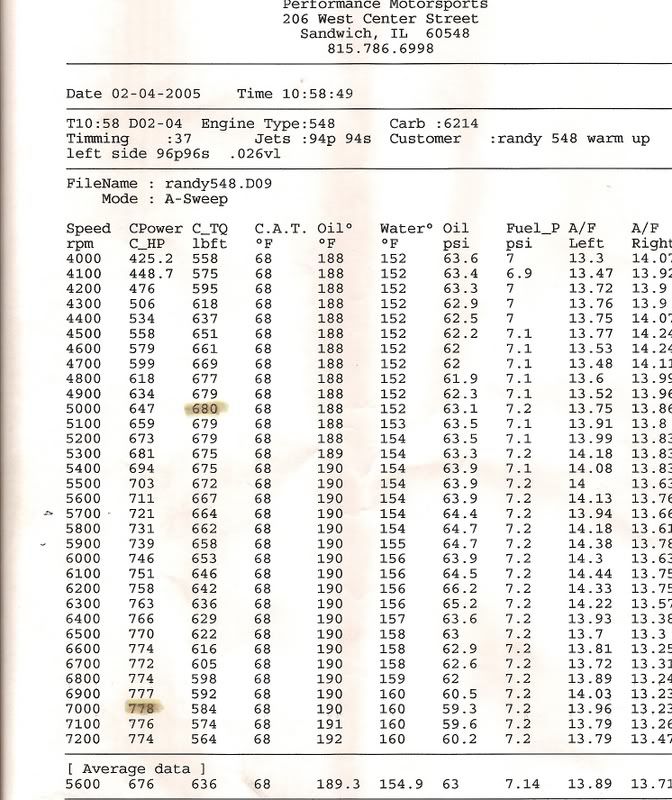
I see your point; but you are still comparing HP numbers of a small block to a big block and ignoring the benefits of the small block. You are also assuming that a head that flows 355cfm is good for a big block; uh let’s see, nope try 450-500cfm! A head for a big block that flows that kind of number will be far more expensive to run than any 23* head offered for a small block. Now the dyno numbers above would be impressive for a small block, they aren't much for a big block... If you start pricing high level components to build a fast big block, you will spend even more than you would spend on a small block. I guess the difference here is in one's perception. To most people that don't work on race engines a 700hp big block is amazing; to me that's a waste of time. Until a big block hits the 1000+ hp mark what are you gaining other than weight and physical size when going to a big block? Have you seen the numbers that a well built 427 small block can put out? We're talking 800+hp (in some cases even more than 900) and 600-700 foot pounds of torque; not to mention if it's done like a sprint car unit it will weigh 350lbs full of oil and ready to run. If you do the math and consider the added weight of even an all aluminum big block you will have to get out to over 1000hp to out run that small block (and that's leaving out what the gearing will do to help the higher RPM engine). I'm not saying if you want to all out drag race you shouldn't have a big block; just don't make the mistake of thinking that it's cheaper hp and the only way to go. It's really just what someone wants and what your frame of reference is, and until the hp levels on the competing big block gets up to 1150 or better I will run a high reving, lightweight small block any day of the week.
Race Director
Joined: May 2005
Posts: 10,674
Likes: 122
From: Millington Illinois
St. Jude Donor '08-'09
The above engine is a 10 to 1 compression, iron head street engine that runs on 91 octane gas and will pull to 7000 RPM. Most reading this are looking at a street build that will run on pump gas. When you start talking race engines there are 2500 HP blown hemi's out there but they don't work too good on the street. If you want a high HP, reliable street engine there is no replacement for displacement. Big blocks have stronger main webs and blocks, beefier cranks, mains and rods, higher flow heads, you can build more power for less money that will be more dependable at high street power levels. To get the strength in the bottom end to handle big street power in a small block it cost much more to attain the required strength than a similar powered big block and the big block has better street manners. That said I built a small block for my car. They have advantages. Less weight= better handling, more room in the engine compartment, fit better under a stock or low rise hood, headers, intakes are plentiful and economical and how much power do you really need on the street? To pull almost 800 HP out of a small block you no longer have a street engine. You can't run pump gas and the life expectancy is low. At this level you have moved into race engine territory. It really depends on what you want and your intended use.
Last edited by 63mako; Oct 13, 2008 at 11:24 AM.
Le Mans Master
Joined: Apr 2006
Posts: 5,403
Likes: 95
I see your point; but you are still comparing HP numbers of a small block to a big block and ignoring the benefits of the small block. You are also assuming that a head that flows 355cfm is good for a big block; uh let’s see, nope try 450-500cfm! A head for a big block that flows that kind of number will be far more expensive to run than any 23* head offered for a small block. Now the dyno numbers above would be impressive for a small block, they aren't much for a big block... If you start pricing high level components to build a fast big block, you will spend even more than you would spend on a small block. I guess the difference here is in one's perception. To most people that don't work on race engines a 700hp big block is amazing; to me that's a waste of time. Until a big block hits the 1000+ hp mark what are you gaining other than weight and physical size when going to a big block? Have you seen the numbers that a well built 427 small block can put out? We're talking 800+hp (in some cases even more than 900) and 600-700 foot pounds of torque; not to mention if it's done like a sprint car unit it will weigh 350lbs full of oil and ready to run. If you do the math and consider the added weight of even an all aluminum big block you will have to get out to over 1000hp to out run that small block (and that's leaving out what the gearing will do to help the higher RPM engine). I'm not saying if you want to all out drag race you shouldn't have a big block; just don't make the mistake of thinking that it's cheaper hp and the only way to go. It's really just what someone wants and what your frame of reference is, and until the hp levels on the competing big block gets up to 1150 or better I will run a high reving, lightweight small block any day of the week.
Last edited by Little Mouse; Oct 13, 2008 at 01:00 PM.