







 how much $$?





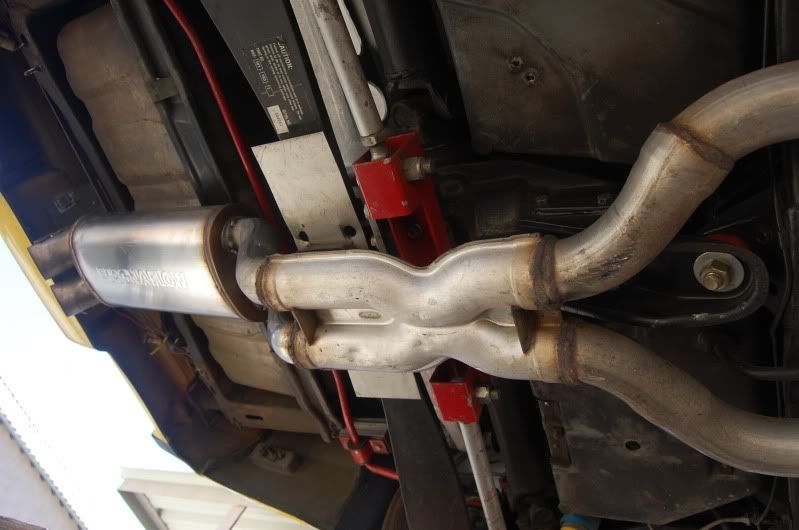
X pipe crossover installed, what a difference

Thread Starter
Safety Car


Joined: Nov 2005
Posts: 3,961
Likes: 573
From: Lompoc, CA. Santa Barbara County

Update, I replaced the two Flowmasters with one dual in dual out Magnaflow muffler. I saved 25lbs. Check out this thread:
http://forums.corvetteforum.com/c3-t...w-exhaust.html
http://forums.corvetteforum.com/c3-t...w-exhaust.html
Thread Starter
Safety Car
Joined: Nov 2005
Posts: 3,961
Likes: 573
From: Lompoc, CA. Santa Barbara County

Bee Jay

Drifting

Joined: Oct 2010
Posts: 1,972
Likes: 6
From: Chester Virginia
Here is a link of photos on vir with a sound clip of my 76 with new straight duals through twin bullet ceramic grid cat converters and into flowmasters which are great so long as you don't drive at 32 mph where they drone. deep sound and when at highway speeds it's all left behind you but winding up through the gears it sounds good...no H or X pipe on mine. the clip is the music to the photo slideshow and is a recent local drive sound clip. Got rid of the 2-1-2 through pellet cat converter...yuk to the EPA.
http://albums.phanfare.com/slideshow...T&a_id=5066328
http://albums.phanfare.com/slideshow...T&a_id=5066328
Corvette Stories
The Best of Corvette for Corvette Enthusiasts

5 Best & 5 Worst Corvette Daily Drivers
Joe Kucinski
The Headlights of Every Corvette Generation Explained
Joe Kucinski
5 Best & 5 Most Overrated Corvette Track Packages of All Time!
Joe Kucinski
Every 2027 Corvette Engine Explained
Joe Kucinski
Designer Imagines A Corvette That Looks More Like a Corvette Than the Corvette
Verdad Gallardo
10 Ugly Corvettes That We Still Kinda Love
Joe Kucinski
Top 10 Most Expensive Corvettes Ever Sold on Bring A Trailer
Brett Foote
10 Things Every Corvette Owner Needs (2026 Edition)
Michael S. Palmer
8 Most "Only Corvette Owners Understand" Quirks and Problems
Pouria Savadkouei
Team Owner


Joined: Apr 1999
Posts: 21,953
Likes: 1,445
From: Reno Nevada
2024 C3 of the Year Finalist- Modified
What else does the 4-7 swap do other than changing the sound? More power? Smoother running? Better gas milage? More torque? Better exhaust scavenging? I can't seem to get a straight answer. I know that GM did the 4-7 swap on the new LS engines. Why? You know me, I'll try anything once, twice if I like it.
Bee Jay
Bee Jay
His only disclaimer is that mildy modded carburated motors with single plane intakes tend to run #7 cylinder leaner and the 4-7 helps balance this out. In a sequential fuel injected motor this would not matter.
So the gain is the exhaust sound. When you are timing cars flying by on the main straight wall The Fords and 4/7 swap chevy motors just have a nice scream to them at 8000 rpm compared to the chevy small and big blocks.
IMO - your best gain would be a stroker crank.
Thread Starter
Safety Car
Joined: Nov 2005
Posts: 3,961
Likes: 573
From: Lompoc, CA. Santa Barbara County
The local chevy drag race shop that has two cars that compete on the national level of NHRA sportsman racing told me "No Difference" These guys make their own sheet metal intakes and us up to 1.000 inch lifts in small block chevy motors that do 10,000 rpm.
His only disclaimer is that mildy modded carburated motors with single plane intakes tend to run #7 cylinder leaner and the 4-7 helps balance this out. In a sequential fuel injected motor this would not matter.
So the gain is the exhaust sound. When you are timing cars flying by on the main straight wall The Fords and 4/7 swap chevy motors just have a nice scream to them at 8000 rpm compared to the chevy small and big blocks.
IMO - your best gain would be a stroker crank.
His only disclaimer is that mildy modded carburated motors with single plane intakes tend to run #7 cylinder leaner and the 4-7 helps balance this out. In a sequential fuel injected motor this would not matter.
So the gain is the exhaust sound. When you are timing cars flying by on the main straight wall The Fords and 4/7 swap chevy motors just have a nice scream to them at 8000 rpm compared to the chevy small and big blocks.
IMO - your best gain would be a stroker crank.
Bee Jay




Race Director


Joined: Oct 2005
Posts: 12,470
Likes: 1,548
From: Camp Verde AZ
C1 of Year Finalist (performance mods) 2019
2017 C1 of Year Finalist
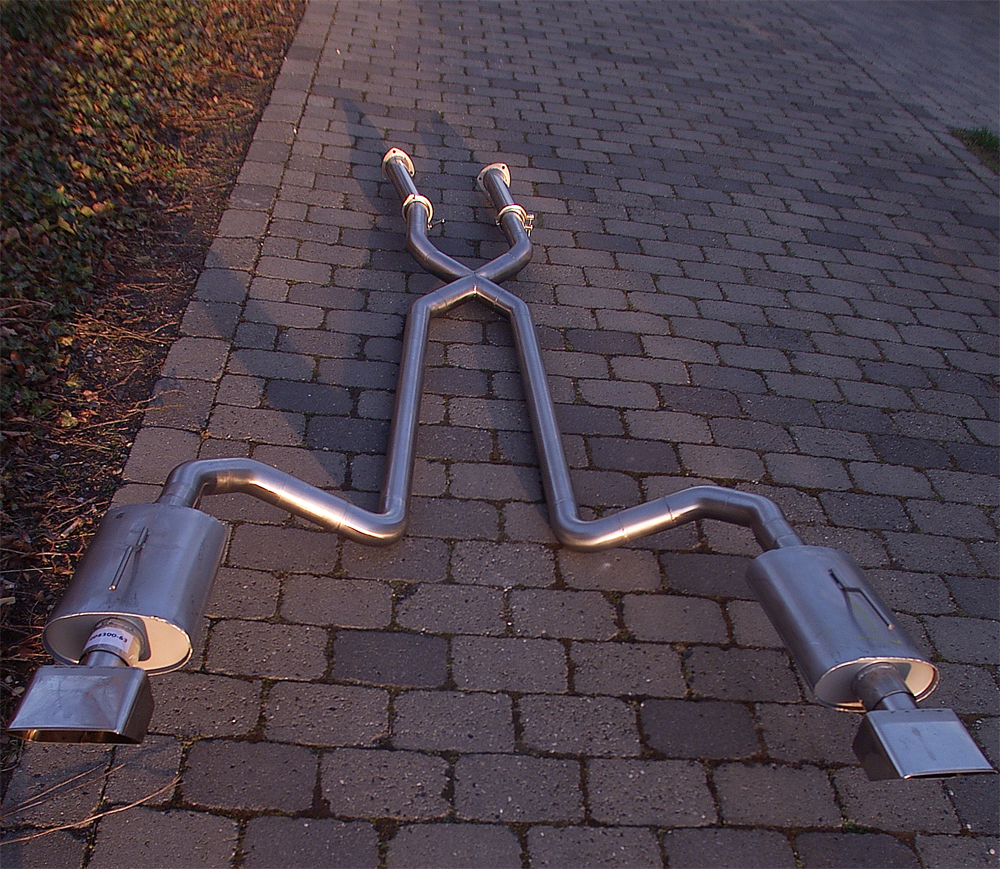
I am a little late to this thread, but adding an H pipe, of the same 2.5" diameter as the rest of the exhaust system, about 6" from the header collector, gave me an extra 125 ft-lb of RW torque at 1500 RPM up through about 3000 RPM, where the effect started to rapidly go away and everything equaled out over 3500 RPM vs no H pipe.
Doug

Burning Brakes


Joined: Feb 2006
Posts: 1,223
Likes: 4
From: Regina Saskatchewan
I am a little late to this thread, but adding an H pipe, of the same 2.5" diameter as the rest of the exhaust system, about 6" from the header collector, gave me an extra 125 ft-lb of RW torque at 1500 RPM up through about 3000 RPM, where the effect started to rapidly go away and everything equaled out over 3500 RPM vs no H pipe.
Doug
Doug
Race Director
Joined: Oct 2005
Posts: 12,470
Likes: 1,548
From: Camp Verde AZ
C1 of Year Finalist (performance mods) 2019
2017 C1 of Year Finalist
The H pipe, on my motor, no other changes, raised the RWTq to 400 ft-lb at 1500 RPM on the small block in my '61, and also got rid of an annoying reversion issue at around 2300 RPM. This is an EFI motor, but that mainly has to do with tuning.
1.62" hedman headers, full 2.5" exhaust out to the behind the rear wheels with Borla muffs
It is a pretty quick, yet mild mannered, street car
Doug

Doug


