






Tire Pressure

Racer


Joined: Jun 2006
Posts: 476
Likes: 0
From: Easton PA

Your door is about 30 years old. When looking for tire specs you should always go by what is stamped on the tire. Read that door again and it will include a load rating at that max pressure. Mine says max capacity is 2 passengers plus 150lbs of luggage with an estimated combined total of 450lbs. But, since the car weighs almost 3500lbs anyway it doesn't make much difference whether it's 200lbs or 450lbs as far as the tire pressure is concerned.
It's also a good idea to watch for uneven wear patterns. If you see the tires wearing in the middle more then reduce the tire pressue and if you see more wear in on the edges then increase the tire pressure. But, with a treadwear of 500 or more you won't notice anything for several years.
It's also a good idea to watch for uneven wear patterns. If you see the tires wearing in the middle more then reduce the tire pressue and if you see more wear in on the edges then increase the tire pressure. But, with a treadwear of 500 or more you won't notice anything for several years.
Racer
Joined: Jun 2006
Posts: 476
Likes: 0
From: Easton PA
here is a bulliten that all dealers and shops go by.........(its still applies to our old cars)
INFORMATION
Bulletin No.: 00-00-90-002J
Date: January 28, 2009
Subject:
Information on Proper Tire Pressure
Models:
2010 and Prior GM Passenger Cars and Light Duty Trucks (including Saturn)
2009 and Prior HUMMER H2, H3, H3T
2005-2009 Saab 9-7X
Supercede:
This bulletin is being revised to add model years and clarify additional information. Please discard Corporate Bulletin Number 00-00-90-002I (Section 00 - General Information).
Important: ^ Adjustment of tire pressure for a customer with a Low Tire Pressure Monitor (TPM) light on and no codes in the TPM system is NOT a warrantable repair. Claims to simply adjust the tire pressure will be rejected.
^ ALL tires (including the spare tire) MUST be set to the recommended inflation pressure stated on the vehicle's tire placard (on driver's door) during the PRE-DELIVERY INSPECTION (PDI). Recommended inflation pressure is not the pressure printed on tire sidewall.
^ Tires may be over-inflated from the assembly plant due to the mounting process.
^ Generally a 5.6°C (10°F) temperature change will result in (is equivalent to) a 6.9 kPa (1 psi) tire pressure change.
^ 2008-2009 HUMMER H2 Only - The H2 comes standard with Light Truck "D" Load Range tires with a recommended cold inflation pressure of 289 kPa (42 psi). These tires will alert the driver to a low pressure situation at roughly 262 kPa (38 psi) due to a requirement in FMVSS 138 which specifies a Minimum Activation Pressure for each tire type. This creates a relatively narrow window of "usable" pressure values and the warning will be more sensitive to outside temperature changes during the colder months. As with other cold temperature/tire pressure issues, there is nothing wrong with the system itself. If a vehicle is brought in with this concern, check for tire damage and set all tires to the Recommended Cold Inflation Pressure shown on the vehicle placard.
Accurate tire pressures ensure the safe handling and appropriate ride characteristics of GM cars and trucks. It is critical that the tire pressure be adjusted to the specifications on the vehicle¡Çs tire placard during PDI.
Ride, handling and road noise concerns may be caused by improperly adjusted tire pressure.
The first step in the diagnosis of these concerns is to verify that the tires are inflated to the correct pressures. The recommended tire inflation pressure is listed on the vehicle¡Çs tire placard. The tire placard is located on the driver¡Çs side front or rear door edge, center pillar, or the rear compartment lid.
Tip
^ Generally a 5.6°C (10°F) temperature increase will result in (is equivalent to) a 6.9 kPa (1 psi) tire pressure increase.
^ The definition of a "cold" tire is one that has been sitting for at least 3 hours, or driven no more than 1.6 km (1 mi).
^ On extremely cold days, if the vehicle has been indoors, it may be necessary to compensate for the low external temperature by adding additional air to the tire during PDI.
^ During cold weather, the Tire Pressure Monitor (TPM) indicator light (a yellow horseshoe with an exclamation point) may illuminate. If this indicator turns off after the tires warm up (reach operating temperature), the tire pressure should be reset to placard pressure at the cold temperature.
^ The TPM system will work correctly with nitrogen in tires.
^ The TPM system is compatible with the GM Vehicle Care Tire Sealant but may not be with other commercially available sealants.
Important: ^ Do not use the tire pressure indicated on the tire itself as a guide.
^ Always inspect and adjust the pressure when the tires are cold.
^ Vehicles that have different pressures for the front and the rear need to be adjusted after tire rotation.
Improper tire inflation may result in any or all of the following conditions:
^ Premature tire wear
^ Harsh ride
^ Excessive road noise
^ Poor handling
^ Reduced fuel economy
^ Low Tire Pressure Monitor (TPM) Light ON
^ Low Tire Pressure Message on the Drivers Information Center (DIC)
INFORMATION
Bulletin No.: 00-00-90-002J
Date: January 28, 2009
Subject:
Information on Proper Tire Pressure
Models:
2010 and Prior GM Passenger Cars and Light Duty Trucks (including Saturn)
2009 and Prior HUMMER H2, H3, H3T
2005-2009 Saab 9-7X
Supercede:
This bulletin is being revised to add model years and clarify additional information. Please discard Corporate Bulletin Number 00-00-90-002I (Section 00 - General Information).
Important: ^ Adjustment of tire pressure for a customer with a Low Tire Pressure Monitor (TPM) light on and no codes in the TPM system is NOT a warrantable repair. Claims to simply adjust the tire pressure will be rejected.
^ ALL tires (including the spare tire) MUST be set to the recommended inflation pressure stated on the vehicle's tire placard (on driver's door) during the PRE-DELIVERY INSPECTION (PDI). Recommended inflation pressure is not the pressure printed on tire sidewall.
^ Tires may be over-inflated from the assembly plant due to the mounting process.
^ Generally a 5.6°C (10°F) temperature change will result in (is equivalent to) a 6.9 kPa (1 psi) tire pressure change.
^ 2008-2009 HUMMER H2 Only - The H2 comes standard with Light Truck "D" Load Range tires with a recommended cold inflation pressure of 289 kPa (42 psi). These tires will alert the driver to a low pressure situation at roughly 262 kPa (38 psi) due to a requirement in FMVSS 138 which specifies a Minimum Activation Pressure for each tire type. This creates a relatively narrow window of "usable" pressure values and the warning will be more sensitive to outside temperature changes during the colder months. As with other cold temperature/tire pressure issues, there is nothing wrong with the system itself. If a vehicle is brought in with this concern, check for tire damage and set all tires to the Recommended Cold Inflation Pressure shown on the vehicle placard.
Accurate tire pressures ensure the safe handling and appropriate ride characteristics of GM cars and trucks. It is critical that the tire pressure be adjusted to the specifications on the vehicle¡Çs tire placard during PDI.
Ride, handling and road noise concerns may be caused by improperly adjusted tire pressure.
The first step in the diagnosis of these concerns is to verify that the tires are inflated to the correct pressures. The recommended tire inflation pressure is listed on the vehicle¡Çs tire placard. The tire placard is located on the driver¡Çs side front or rear door edge, center pillar, or the rear compartment lid.
Tip
^ Generally a 5.6°C (10°F) temperature increase will result in (is equivalent to) a 6.9 kPa (1 psi) tire pressure increase.
^ The definition of a "cold" tire is one that has been sitting for at least 3 hours, or driven no more than 1.6 km (1 mi).
^ On extremely cold days, if the vehicle has been indoors, it may be necessary to compensate for the low external temperature by adding additional air to the tire during PDI.
^ During cold weather, the Tire Pressure Monitor (TPM) indicator light (a yellow horseshoe with an exclamation point) may illuminate. If this indicator turns off after the tires warm up (reach operating temperature), the tire pressure should be reset to placard pressure at the cold temperature.
^ The TPM system will work correctly with nitrogen in tires.
^ The TPM system is compatible with the GM Vehicle Care Tire Sealant but may not be with other commercially available sealants.
Important: ^ Do not use the tire pressure indicated on the tire itself as a guide.
^ Always inspect and adjust the pressure when the tires are cold.
^ Vehicles that have different pressures for the front and the rear need to be adjusted after tire rotation.
Improper tire inflation may result in any or all of the following conditions:
^ Premature tire wear
^ Harsh ride
^ Excessive road noise
^ Poor handling
^ Reduced fuel economy
^ Low Tire Pressure Monitor (TPM) Light ON
^ Low Tire Pressure Message on the Drivers Information Center (DIC)
Last edited by straub18045; May 15, 2010 at 06:06 PM.
Racer


Joined: Nov 2005
Posts: 305
Likes: 50
Hello Fellow Vetteheads,
Last week I purchased a set of Firestone Firehawk Indy 500's. While the tire tech was mounting the tires I asked him what pressures he had inflated them to and he said 35#s, I told him that the front tires according to the door sticker reads 20#s and the rears 26#s he gave this speech about wear at such a low pressure and I assured him that the last tires I had for many years wore very well at these pressures. Where have I gone wrong or have I ?
Thank You in Advance
Last week I purchased a set of Firestone Firehawk Indy 500's. While the tire tech was mounting the tires I asked him what pressures he had inflated them to and he said 35#s, I told him that the front tires according to the door sticker reads 20#s and the rears 26#s he gave this speech about wear at such a low pressure and I assured him that the last tires I had for many years wore very well at these pressures. Where have I gone wrong or have I ?
Thank You in Advance
1. The guys at Firestone are generally pretty stupid when it comes to specialty stuff. I *might* listen to them about my wife's 2000 Accord, but I wear earplugs when they try to say anything about my Vette.
2. I ran 32#s (cold) all around, and the centers wore out first. But it rode well, handled well, and the wear was pretty close, so I'm going to keep them at 30-31 now - that should be about right.

Intermediate

Joined: Sep 2009
Posts: 40
Likes: 0
From: Fox Lake Illinois
Ford's in the middle of huge amount of lawsuit litigation due to Firestone suggesting they lower the pressures on their SUV tires from the low 30s to somewhere in the 20s. We all know what happened. Tires overheated at the lower pressure, blew out and killed people. A 2500 lb Honda would be just fine on 26lbs which is what my door says my 77 should be. But folks, we drive cars that are closer to 3500lbs than 2500lbs. There's current mid size 5 passenger 4 doors that weigh less than our Vettes. I've been running 32# for 10 years and cannot tell any difference in wear from inside to outside on the tread. Yeah, it rides a bit rougher at 32 over 26, but it also handles better. You'll also get better gas mileage at the higher pressure due to less rolling resistance. Something else to keep in mind.... how many miles a year do you put on your C3 Vette. I'm around 1000 miles per year and that rate, even if my tire wear was uneven they're going to dry rot before I wear them out. Just MHO.
Bottom line: Play with the pressures. You know 26 is spec and 35 is probably too much. So play in between until you find a compromise between handling and ride quality.
PS: I tried 35 for a few days. Had to go visit the dentist to get a cavity refilled. I like 32 and the ride is acceptable.
Bottom line: Play with the pressures. You know 26 is spec and 35 is probably too much. So play in between until you find a compromise between handling and ride quality.
PS: I tried 35 for a few days. Had to go visit the dentist to get a cavity refilled. I like 32 and the ride is acceptable.
Last edited by iblive; Sep 24, 2010 at 05:28 PM.

Drifting


Joined: Feb 2010
Posts: 1,551
Likes: 10
From: Kulpmont PA
Whatever the cost of your tires, it is (at least for me) significantly less than the value of my C3. Tires inflated to 35#, and the torture track roads in PA, pretty much serve to bounce me and the car to pieces. Tires are cheap by comparison. I've dropped my tire pressure to 30# and am much happier with the overall driving experience. Even if the tires would wear out prematurely because of this pressure -- i dont put enough miles on it to be a problem. Most likely those tires will be replaced because of age before tread wear.
Corvette Stories
The Best of Corvette for Corvette Enthusiasts

5 Best & 5 Worst Corvette Daily Drivers
Joe Kucinski
The Headlights of Every Corvette Generation Explained
Joe Kucinski
5 Best & 5 Most Overrated Corvette Track Packages of All Time!
Joe Kucinski
Every 2027 Corvette Engine Explained
Joe Kucinski
Designer Imagines A Corvette That Looks More Like a Corvette Than the Corvette
Verdad Gallardo
10 Ugly Corvettes That We Still Kinda Love
Joe Kucinski
Top 10 Most Expensive Corvettes Ever Sold on Bring A Trailer
Brett Foote
10 Things Every Corvette Owner Needs (2026 Edition)
Michael S. Palmer
8 Most "Only Corvette Owners Understand" Quirks and Problems
Pouria Savadkouei
Instructor
Joined: Jan 2010
Posts: 109
Likes: 0
From: Caldwell Idaho
If I'm not mistaken the pressure on the sidewall of the tire is the pressure required for the tire to carry its maximum rated load, not necessarily what it should be inflated to for your car. The manufacturer's recommended inflation for your car is on the tag inside the drivers door.
Intermediate
Joined: Sep 2009
Posts: 40
Likes: 0
From: Fox Lake Illinois
Something to keep in mind on this subject. I sold tires in the 70s when you still had a choice of bias ply or radials when you needed to purchase tires. The radial tires we purchase today are vastly different than the radials we bought in 1975. They're the same in name only. We didn't fully understand radials and all their advantages at the time. In 1975 the sidewalls on some radials were nearly as thick as the tread part of the tire.
Look at a comparable car/tire combination today and see what the manufacturer recommends vs what they recommended in the 70s. Two cars. Same size tires. Pretty close to same weight. (Both cars sit in my garage)
1977 Corvette - Manufacturers recommended tire pressure = 26psi.
1999 Dodge Intrepid - Manufacturers recommended tire pressure = 32psi.
I remember the first set of radials I put on a car, which was somewhere around 1974. Set at the recommended tire pressure on a car that weighed approximately 3700# - 4000#, I could actually feel the tire roll over if I pushed it cornering. Jacked the pressure up closer to 30-32psi and no more problem.
Look at a comparable car/tire combination today and see what the manufacturer recommends vs what they recommended in the 70s. Two cars. Same size tires. Pretty close to same weight. (Both cars sit in my garage)
1977 Corvette - Manufacturers recommended tire pressure = 26psi.
1999 Dodge Intrepid - Manufacturers recommended tire pressure = 32psi.
I remember the first set of radials I put on a car, which was somewhere around 1974. Set at the recommended tire pressure on a car that weighed approximately 3700# - 4000#, I could actually feel the tire roll over if I pushed it cornering. Jacked the pressure up closer to 30-32psi and no more problem.

Le Mans Master

Joined: Dec 2003
Posts: 5,727
Likes: 39
From: Fremont CA
As I think it has already been pointed out, that sticker is for a set of bias-ply tires while the modern tires are radials. Rough rule of thumb I use is 1PSI inflation for every 100Lbs of weight so a 3500Lb Vette would be 35PSI inflation. It's better to be overinflated than underinflated. Tire tread wear patterns will help you decide on any final inflation settings.
Intermediate
Joined: Sep 2009
Posts: 40
Likes: 0
From: Fox Lake Illinois
Had an 86 Cavalier with 195R70-13s and I ran 32psi. Got 70K out of one set of tires with perfect tire wear. That was probably more than needed for that light a car, but I never slowed down takin' corners.

Pro

Joined: Jan 2010
Posts: 533
Likes: 18
From: Boca Raton Florida
I think there's a simple test to help you decide the right pressure for your tires. Find an empty parking lot and mark out a reasonably tight turn (some pebbles should do). With your tires inflated to 26 psi, see how fast you can negotiate the turn before the tires break loose. Increase the pressure to 32 psi and try the same turn. If your tires break loose at a lower speed, drop your pressure back down to 26.
I don't check my tires often enough but as soon as I hear screeching going around a corner, I know I've got a problem. I keep one of those $10 air pumps that plug into the cigarette lighter in all my cars.
I don't check my tires often enough but as soon as I hear screeching going around a corner, I know I've got a problem. I keep one of those $10 air pumps that plug into the cigarette lighter in all my cars.
Intermediate
Joined: Sep 2009
Posts: 40
Likes: 0
From: Fox Lake Illinois
I think there's a simple test to help you decide the right pressure for your tires. Find an empty parking lot and mark out a reasonably tight turn (some pebbles should do). With your tires inflated to 26 psi, see how fast you can negotiate the turn before the tires break loose. Increase the pressure to 32 psi and try the same turn. If your tires break loose at a lower speed, drop your pressure back down to 26..
If one never pushes their car to the limit, never tries to straighten out a curvy country road or attempt a curve marked 30mph at 50 mph+, then 26-28psi is all you need. Your Vette will ride better. But I'll put out the challenge to try that 30mph curve at 50 with 26# in you tires and then do it again at 32#. You will feel a difference. You'll feel more in control at 32psi.
Pro
Joined: Jan 2010
Posts: 533
Likes: 18
From: Boca Raton Florida
If one never pushes their car to the limit, never tries to straighten out a curvy country road or attempt a curve marked 30mph at 50 mph+, then 26-28psi is all you need. Your Vette will ride better. But I'll put out the challenge to try that 30mph curve at 50 with 26# in you tires and then do it again at 32#. You will feel a difference. You'll feel more in control at 32psi.
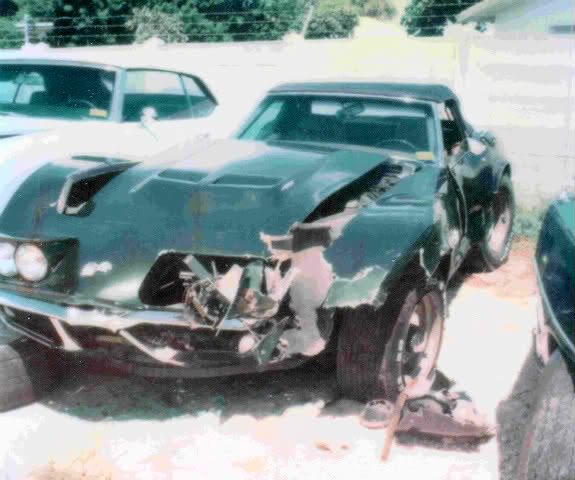
Of course I understand that comfort is a prime consideration when driving a C3 Corvette.
Last edited by Bob Heine; Sep 27, 2010 at 08:50 AM. Reason: Picture worth ???
Intermediate
Joined: Sep 2009
Posts: 40
Likes: 0
From: Fox Lake Illinois
Pro
Joined: Jan 2010
Posts: 533
Likes: 18
From: Boca Raton Florida
Intermediate
Joined: Sep 2009
Posts: 40
Likes: 0
From: Fox Lake Illinois
That really sucks! That would be one downside of fiberglass vs metal. Fiberglass doesn't bend... it just sorta explodes. It looks pretty bad. Was it a write off or were you able to put her back together?
Pro
Joined: Jan 2010
Posts: 533
Likes: 18
From: Boca Raton Florida
Walked away with one small scratch but the entire car was bent or broken. Didn't have collision so I sold the wreck for $600 to a Corvette Club friend. Wrote the rest off as casualty loss on income tax. Bought the 72 in my avatar two months later (still have it).
Intermediate
Joined: Sep 2009
Posts: 40
Likes: 0
From: Fox Lake Illinois
Glad you walked away and weren't hurt. Not the way I'd want to part with a 69 though. I'd much rather have a 68/69..... but a 77 was all I could afford.