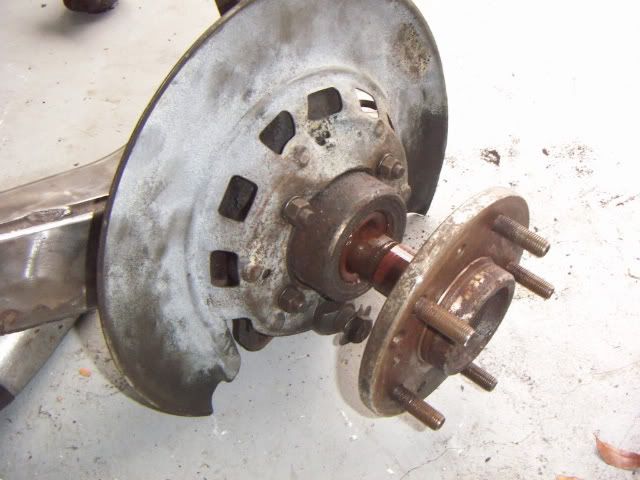
Wheel bearing assembly



Former Vendor
Joined: Nov 2006
Posts: 2,482
Likes: 3
From: Carmichael ca

Are you talking about replacing the trailing arm or just the bearings? Replacing the bearings requires some special tools. The trailing arm doesn't, but can be a pain if any rust is envolved.
Burning Brakes

Joined: May 2008
Posts: 1,116
Likes: 5
From: Middleburg Florida
Replacing the bearings on the bearing assembly is much more involved than simply removing and replacing the assembly itself. You can leave the TA's in place, however, it the pivot bushings need to be replaced, or are suspect, this is a great time to tackle that job too.
Basically you remove the shock, strut rods, half shafts, the yoke or flange on the spindle (depending on the year of the car), the brake caliper, parking brake cable, the rotor, the backing plate and the four bolts through the spindle support.
Pulling the strut rods is where it could get interesting. If the shock support is stuck in the spindle support, that could be a challange. Typically you use a tool to protect the threads (or a nut on them works too) and you knock it through with a BFH. The strut bushings can be rusted on though making that difficult. In that case you'll find people have cut through the struts, or cut the shock support to get it out. You can buy replacements so it's not a disaster if you destroy them getting them out. Just be careful of the spindle supprt. That's bascially the bearing housing and you don't want to ruin that part.
The assembly comes out of the trailing arm from the outside. Not too bad if there isn't a bunch of rust, and basic hand tools are all that's usually needed.
Basically you remove the shock, strut rods, half shafts, the yoke or flange on the spindle (depending on the year of the car), the brake caliper, parking brake cable, the rotor, the backing plate and the four bolts through the spindle support.
Pulling the strut rods is where it could get interesting. If the shock support is stuck in the spindle support, that could be a challange. Typically you use a tool to protect the threads (or a nut on them works too) and you knock it through with a BFH. The strut bushings can be rusted on though making that difficult. In that case you'll find people have cut through the struts, or cut the shock support to get it out. You can buy replacements so it's not a disaster if you destroy them getting them out. Just be careful of the spindle supprt. That's bascially the bearing housing and you don't want to ruin that part.
The assembly comes out of the trailing arm from the outside. Not too bad if there isn't a bunch of rust, and basic hand tools are all that's usually needed.
Pro


Joined: Jan 2010
Posts: 533
Likes: 18
From: Boca Raton Florida
To answer your question, here's how I removed the rear wheel bearing assembly:
1. With rear of car up on jack stands, remove the wheel.
2. Remove half-shaft from the bearing assembly (bolts are locked in place by little metal tabs - "french locks").
3. Remove cotter key and then the large nut and axle flange from the axle stub (you just exposed it in step 2).
4. Remove the two bolts holding the caliper on and hang the caliper out of the way with a strong piece of wire -- don't hang it from the hose.
5. Remove the rotor.
6. Remove the e-brake shoes and hardware. This is a painful three handed process for most.
7. Remove the four nuts that hold the wheel bearing assembly in place.
8. Push/pry the wheel bearing assembly out. This is not easy - it's probably rusted solid to the trailing arm. Take your time and use lots of penetrating oil (like PB Blaster) around the joint in the back of the trailing arm housing.
This picture of the spindle removed is more than you asked about but it's just to show the four nuts that hold the bearing assembly in place.