






 [/IMG]



HEI Ignition Module Surgery

Thread Starter
Drifting


Joined: May 2005
Posts: 1,629
Likes: 4
From: Somers CT
 HEI Ignition Module Surgery
I thought some of you might find this interesting. I went out the other morning to go to breakfast and the car wouldn't start. Tracked it down to no spark and decided to replace the ignition module in my GM HEI dist. with the one that came with the car in 1975! Bingo..started in 1/2 revolution. This is the second time I've had a HEI dist failure, the first time the button fell out from the coil that contacts the rotor. Incredibly, both times it happened in my garage so someone is looking out after me for sure!!
Anyway, out of curiosity I took the thing apart, carefully removed the silicone potting material to see what was inside these things. The second enlarged picture below shows an open component lead which seems to be the culpret. It's located in the bottom left corner of the first image. I guess these things are really prone to failure when used in boats (according to the NAPA guy), must be the high vibration levels. That failed part is attached to a piece of copper bonded to the steel base. My guess is that's what gets hot in this thing and is the reason for the thermal grease under it. I bought a new one and stuck the 1975 version in my glove box
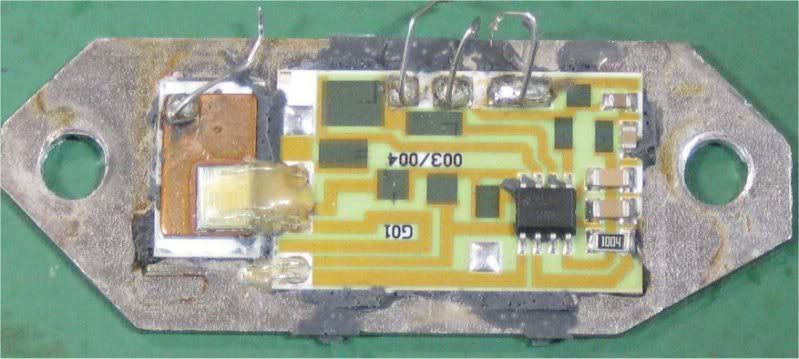
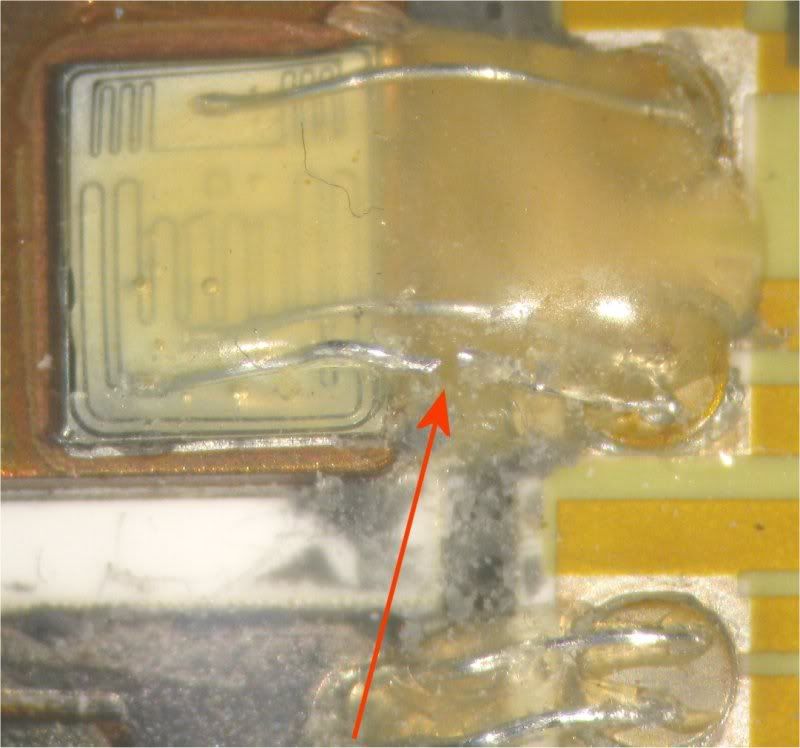
Anyway, out of curiosity I took the thing apart, carefully removed the silicone potting material to see what was inside these things. The second enlarged picture below shows an open component lead which seems to be the culpret. It's located in the bottom left corner of the first image. I guess these things are really prone to failure when used in boats (according to the NAPA guy), must be the high vibration levels. That failed part is attached to a piece of copper bonded to the steel base. My guess is that's what gets hot in this thing and is the reason for the thermal grease under it. I bought a new one and stuck the 1975 version in my glove box
Last edited by TopGunn; Oct 7, 2010 at 01:57 PM.

Tech Contributor


Joined: Jun 2004
Posts: 20,905
Likes: 962
From: I tend to be leery of any guy who doesn't own a chainsaw or a handgun.
May I ask why you would repeatedly spend money on semi-reliable aftermarket modules and only use the unbeatably reliable OEM module as glovebox ballast?
Tech Contributor
Joined: Jun 2004
Posts: 20,905
Likes: 962
From: I tend to be leery of any guy who doesn't own a chainsaw or a handgun.
Thread Starter
Drifting
Joined: May 2005
Posts: 1,629
Likes: 4
From: Somers CT
Ha! Well actually that's a good question...I just figured a new Echlin might be more reliable than a 35 year old one but maybe not! The one in the picture that failed is from a GM Performance crate motor.
Thread Starter
Drifting
Joined: May 2005
Posts: 1,629
Likes: 4
From: Somers CT
Tech Contributor
Joined: Jun 2004
Posts: 20,905
Likes: 962
From: I tend to be leery of any guy who doesn't own a chainsaw or a handgun.
I would prefer a 35 year old Delco part rather than these brand X modules I see floating around. Aftermarket suppliers can't compare or compete with the amount of engineering and durability testing done by Delco.
Corvette Stories
The Best of Corvette for Corvette Enthusiasts

Top 10 Most Expensive Corvettes Ever Sold on Bring A Trailer
Brett Foote
10 Things Every Corvette Owner Needs (2026 Edition)
Michael S. Palmer
8 Most "Only Corvette Owners Understand" Quirks and Problems
Pouria Savadkouei
10 Reasons the C6 Z06 is Still A Performance Benchmark After 20 Years
Joe Kucinski
How Much Horsepower Every Corvette Engine "LOST" in 1972
Joe Kucinski
Top 10 DOs and DON'Ts for Protecting Your Convertible Top!
Michael S. Palmer
Top 10 Most Explosive Corvettes Ever Made: Power-to-Weight Ratio Ranked!
Joe Kucinski
150 hp to 1,250 hp: Every Corvette Generation Compared by the Specs That Matter
Joe Kucinski
8 Coolest Corvette Pace Cars (and Replicas) of All Time
Verdad Gallardo




Race Director

Joined: May 2006
Posts: 16,528
Likes: 53
From: Dayton, Ohio


Melting Slicks


Joined: Feb 2003
Posts: 3,053
Likes: 4
St. Jude Donor '03,'11
Onced matched with with an MSD coil its been working for years. Seems i get better cold starts but i could be fooling myself.
Tech Contributor
Joined: Jun 2004
Posts: 20,905
Likes: 962
From: I tend to be leery of any guy who doesn't own a chainsaw or a handgun.
The MSD part claims a 7.5 amp primary current rating. This is significantly higher (approx 30%) than the Delco module's active current limit of 5.8 amps (to assure long module and coil life). At low RPMs the available dwell time will allow the primary current to hit the 7.5 amp target, at which point the ignition coil will be dissipating higher wattage with the MSD part. Wattage is obviously heat, and rumors are this extra heat may "fry a stock coil".
You'll get more spark energy with the higher current of course, but rarely do systems not supply enough energy at low engine speeds.Now, at high engine speeds, it's a different matter. Here the coil's inductance is the main determinant of peak coil primary current, and the resulting energy stored in the coil. (Note to newcomers: Nowhere in this description do I mention coil/spark voltage, as that's just a marketing gimmick to hook new customers.) It doesn't matter what the module is calibrated to limit the current to, chances are the primary current won't be able to hit the peak target anyway. So, in this example, the coil/plug energy levels at high RPMs are unchanged from stock.
The module and coil should be electrically "matched". Not only to obtain the desired energy storage, but also to insure system durability. As the MSD module in question allows higher current to flow through the coil windings, a coil that is designed to operate safely at higher currents should be selected. However, that's harder to do than it appears. A wrong choice will result in a coil that stores less, not more energy. It's also entirely possible to inadvertently (but safely) run a low amperage (3A) coil if the inductance was so high that the available dwell time would never allow it to reach high enough amperage to fry. It would also not deliver much energy at the higher engine speeds.
So, this is what "frustrates" me about the ignition aftermarket. Unlike cams, which are supplied with a data sheet indicating all the applicable specs to assist you in making an intelligent parts purchase, the ignition aftermarket is filled with endless bling descriptions and darn little technical information.
JMHO
