






Intake Manifold Gasket Help

Thread Starter
Navigator


Joined: Jul 2005
Posts: 9
Likes: 0
From: Plymouth Meeting, PA
 Intake Manifold Gasket Help
Hello,
I am not real knowledgeable about engines and was hoping you guys could help me with a few questions about intake manifold gaskets. Mine seems to be leaking oil around what I think is called the heat crossover area on the driver’s side (I have done a lot of searching on this forum, so I hope I have that term correct). I did try to tighten all the bolts, but it still is leaking. I replaced the valve cover gaskets and the leak doesn't seem to be coming from there. I posted a couple of pictures below.
1. My car has an oil consumption problem, about 1 quart every 200 miles or so. I have been keeping an eye on the area of the manifold and it doesn’t seem to be leaking that much from there. It doesn’t pool any more then what you can see in the pictures. I guess it can be leaking inside and the oil burning, is that possible? There is no blue smoke out the exhaust. Could it just be burning off from the heat of the manifold? I don’t see any smoke though. I have spray carb cleaner around the area to check for leaks and the fluid doesn’t bubble. I have pull the plugs and the ones (1, 3, 5 & 7) on the side of the leak don’t seem to bad, but the ones on the other side do seem fouled with oil.
2. If I am rolling along at low rpm’s in 1st, 2nd or 3rd and punch it, the car has a slight stumble, then will pull real nice up to 4500-5000 rpm’s (I don’t go more then this, don’t want to ruin anything). Could this manifold leak cause this? I have had the original Q-jet rebuilt by a shop I saw recommended here on the forum. I have set the timing to “all in” according to the sticky on timing.
3. I plan on replacing the intake gaskets this winter. Should I get the manifold gaskets that block the heat crossovers? I don’t drive the car that much in the cold weather. It does have the choke with the spring on the manifold. Will it just take a little longer for the choke to come off? Should I use Fel-Pro or Mr. Gasket gaskets and which part numbers? Summit lists a few Fel-Pro sets that look to only differ by port size. Is there a way to tell which I have, or do I need to wait until the manifold is off? I have read to only put a small amount of Gasgacinch around the water ports on the head side and not to use the end gaskets, just use a nice bead of sealant. I have read many posts on what gaskets to use and how and where to use sealant, but would appreciate any additional suggestions you can give.
The car is a 1971 with the 350/270hp. I believe it has (I did not install, but have receipt from a previous owner) a Compcam 270H Magnum cam. It has the original Q-jet and a stock exhaust setup.


I am not real knowledgeable about engines and was hoping you guys could help me with a few questions about intake manifold gaskets. Mine seems to be leaking oil around what I think is called the heat crossover area on the driver’s side (I have done a lot of searching on this forum, so I hope I have that term correct). I did try to tighten all the bolts, but it still is leaking. I replaced the valve cover gaskets and the leak doesn't seem to be coming from there. I posted a couple of pictures below.
1. My car has an oil consumption problem, about 1 quart every 200 miles or so. I have been keeping an eye on the area of the manifold and it doesn’t seem to be leaking that much from there. It doesn’t pool any more then what you can see in the pictures. I guess it can be leaking inside and the oil burning, is that possible? There is no blue smoke out the exhaust. Could it just be burning off from the heat of the manifold? I don’t see any smoke though. I have spray carb cleaner around the area to check for leaks and the fluid doesn’t bubble. I have pull the plugs and the ones (1, 3, 5 & 7) on the side of the leak don’t seem to bad, but the ones on the other side do seem fouled with oil.
2. If I am rolling along at low rpm’s in 1st, 2nd or 3rd and punch it, the car has a slight stumble, then will pull real nice up to 4500-5000 rpm’s (I don’t go more then this, don’t want to ruin anything). Could this manifold leak cause this? I have had the original Q-jet rebuilt by a shop I saw recommended here on the forum. I have set the timing to “all in” according to the sticky on timing.
3. I plan on replacing the intake gaskets this winter. Should I get the manifold gaskets that block the heat crossovers? I don’t drive the car that much in the cold weather. It does have the choke with the spring on the manifold. Will it just take a little longer for the choke to come off? Should I use Fel-Pro or Mr. Gasket gaskets and which part numbers? Summit lists a few Fel-Pro sets that look to only differ by port size. Is there a way to tell which I have, or do I need to wait until the manifold is off? I have read to only put a small amount of Gasgacinch around the water ports on the head side and not to use the end gaskets, just use a nice bead of sealant. I have read many posts on what gaskets to use and how and where to use sealant, but would appreciate any additional suggestions you can give.
The car is a 1971 with the 350/270hp. I believe it has (I did not install, but have receipt from a previous owner) a Compcam 270H Magnum cam. It has the original Q-jet and a stock exhaust setup.
Last edited by bobc327; Oct 15, 2010 at 09:40 PM. Reason: Forgot to add info

Burning Brakes


Joined: Sep 2009
Posts: 1,003
Likes: 48
From: hickory NC
C4 of Year Finalist (appearance mods) 2019
2017 C4 of Year Finalist
Hard to tell in those pics, but check to see if the valve covers aren't touching the intake. Some discoloration in those areas, made me think they are touching.

Le Mans Master


Joined: Oct 2006
Posts: 7,123
Likes: 433
From: Gladstone MO
C3 of Year Finalist (appearance mods) 2019
Some of the intake bolts can "wick" oil up from below the intake too. A touch of thread sealer will stop that.
Your stumble can be the accelerator pump shot being a little slow.
I just about always block heat from under the carb. Kind of an old school performance thing. Keep the intake as cool as I can. I rarely even worry about a choke- Ol' Red's Demon doesn't have one, and the 77's Edelbrock carb has never been hooked up.
Your stumble can be the accelerator pump shot being a little slow.
I just about always block heat from under the carb. Kind of an old school performance thing. Keep the intake as cool as I can. I rarely even worry about a choke- Ol' Red's Demon doesn't have one, and the 77's Edelbrock carb has never been hooked up.
Thread Starter
Navigator
Joined: Jul 2005
Posts: 9
Likes: 0
From: Plymouth Meeting, PA
Thanks for the replys.
I checked the value covers and they are not touching the manifold.
Thanks for the info that some of the bolts can "wick" oil up from below the intake too. I didn't realize this. I will try thread sealer now on that one bolt by the leak and see if it stops, and definitely use thread sealer on all the bolts when I replace the gaskets.
I will do more searches on the subject and look for the one with step by step instructions. In my earlier searches I just wasn't 100% clear on the best way to apply the sealant to the gaskets. I.E., just around the water ports on the head side only or on both sides, or on the entire gasket on the head side only, or a thin coating on both sides of the gaskets. I think I will go with the gaskets that block the heat crossovers. I like the idea of keeping the intake manifold as cool as possible.
I checked the value covers and they are not touching the manifold.
Thanks for the info that some of the bolts can "wick" oil up from below the intake too. I didn't realize this. I will try thread sealer now on that one bolt by the leak and see if it stops, and definitely use thread sealer on all the bolts when I replace the gaskets.
I will do more searches on the subject and look for the one with step by step instructions. In my earlier searches I just wasn't 100% clear on the best way to apply the sealant to the gaskets. I.E., just around the water ports on the head side only or on both sides, or on the entire gasket on the head side only, or a thin coating on both sides of the gaskets. I think I will go with the gaskets that block the heat crossovers. I like the idea of keeping the intake manifold as cool as possible.
Race Director


Joined: Sep 2002
Posts: 10,362
Likes: 5
From: San Diego - Deep Within The State of CONFUSION!
You're using a lot of oil, and that's a problem. I'd replace that intake gasket set as soon as possible. When the intake was installed last, did they use Permatex BLACK on the gasket? If not then yea that's oil you are seeing and it should not be there.
It does look like oil and if so, it's possible that bad/burned up intake gaskets are allowing oil to be sucked into the cylinders. That will MOST CERTAINLY cause high oil consumption. I've never seen this condition look like yours but just 'cause I ain't seen it does NOT mean it isn't happening. Us engine builders have certainly seen intake gaskets cause consumption of oil though - GM had an issue with this during the '80s on factory motors. So it's not too much of a stretch to think that a rebuilder could do the same.
It does look like oil and if so, it's possible that bad/burned up intake gaskets are allowing oil to be sucked into the cylinders. That will MOST CERTAINLY cause high oil consumption. I've never seen this condition look like yours but just 'cause I ain't seen it does NOT mean it isn't happening. Us engine builders have certainly seen intake gaskets cause consumption of oil though - GM had an issue with this during the '80s on factory motors. So it's not too much of a stretch to think that a rebuilder could do the same.
Last edited by SanDiegoPaul; Oct 16, 2010 at 11:52 AM.
Team Owner


Joined: Jan 2006
Posts: 37,637
Likes: 3,118
From: Crossville TN
As far as the 'stumble' you are experiencing with the carb, there are two possible issues that can cause your problem:
1) even though the carb was redone not too long ago, the ethanol in modern gasoline can cause the poly seal on the accelerator pump to swell and actually come off the piston. The engine would then act just like the accel pump in the carb was non-functional. I don't think this is the most likely problem, but wanted to make you aware of this issue.
2) the secondary [upper flap] air valve could be misadjusted so that it is getting [either] too little or too much fuel when you go to WOT. There is a little adjustment on that valve...it has a small screw on the side of the upper carb body that locks/unlocks the ability to adjust it. Then, the adjustment underneath that lock screw either tightens the spring or loosens it. That adjustment is very sensitive, so you want to barely unlock it but keep some pressure on the adj. screw so that the spring does not change its position while you are working on it. The 'base' setting for this spring is to back it off to the point that the spring just makes contact with the mechanism but there is no spring pressure applied to the valve flap. Then tighten the adj screw 1/2 turn and lock it down in place. Then try the car to see if you have a 'bog' or not. From that point, you can do more testing...in 1/4 turn increments....(keep a written record of what changes you make as it becomes confusing the more adj you make) until you find the "sweet spot" where there is no "bog" but the engine is most responsive. Either side of that point, the carb will begin to have poorer performance.
Hope that is of some help and you can get it fixed.
1) even though the carb was redone not too long ago, the ethanol in modern gasoline can cause the poly seal on the accelerator pump to swell and actually come off the piston. The engine would then act just like the accel pump in the carb was non-functional. I don't think this is the most likely problem, but wanted to make you aware of this issue.
2) the secondary [upper flap] air valve could be misadjusted so that it is getting [either] too little or too much fuel when you go to WOT. There is a little adjustment on that valve...it has a small screw on the side of the upper carb body that locks/unlocks the ability to adjust it. Then, the adjustment underneath that lock screw either tightens the spring or loosens it. That adjustment is very sensitive, so you want to barely unlock it but keep some pressure on the adj. screw so that the spring does not change its position while you are working on it. The 'base' setting for this spring is to back it off to the point that the spring just makes contact with the mechanism but there is no spring pressure applied to the valve flap. Then tighten the adj screw 1/2 turn and lock it down in place. Then try the car to see if you have a 'bog' or not. From that point, you can do more testing...in 1/4 turn increments....(keep a written record of what changes you make as it becomes confusing the more adj you make) until you find the "sweet spot" where there is no "bog" but the engine is most responsive. Either side of that point, the carb will begin to have poorer performance.
Hope that is of some help and you can get it fixed.
Thread Starter
Navigator
Joined: Jul 2005
Posts: 9
Likes: 0
From: Plymouth Meeting, PA
Thanks SanDiegoPaul. I am not sure about when the intake was last installed. I have only owned the car for about a year. I have a stack of reciepts, but nothing on intake manifold gaskets. I am guessing the last time the gaskets were replaced was in 2003 when the cam and lifters were done which I have a receipt for.
Thanks 7T1vette. After about 2 weeks of having the rebuilt carb on I went out one day to start the car up. The pedal went about half way down and stopped dead. I first thought the linkage was binding. Checked that and it seemed fine. Searched the forum (this forum is really great) and saw all the posts about bad accelerator pumps. Took the air horn off and found that the metal shaft had come apart from the plastic piece that has the rubber cup. Called the rebuilder and he sent me a new pump. But based on some forum posts I went ahead and ordered a pump from Cliff's Carburetors. Install Cliff's pump and no problems since. It has been about 5 months.
I have also played with the secondary spring adjustment. I have tried adjustments from 1/4 turn to a full turn, with 3/4 turn just slightly being the best. Maybe I will try a setting above a full turn.
I read some of Lars papers on Q-jets. Wow, alot of good info in these. Right now some of the stuff is just over my head, I guess I need to read them over and over again until it sinks in more. When I had the air horn off I did check the primary and secondary rods against the numbers in Lars paper. Unfortunately I didn't pull the jets out and check them. The carb is 7041213. The primary rods in the carb were 45 and Lars paper says 44. The secondary in the carb is CP and Lars paper has AR. I mentioned this to the rebulder when I called about the accel pump and he said these rods are what they use in this carb and would work fine. Actually could never talk to the main guy directly, always got his assistant when I called and he would say that he can answer all my questions. So, I just left this as is, figuring that they know better then me. And the car does pull real nice all the way up to 5000 rpm's once it gets by the stumble, so I thought maybe the problem is something else. Maybe I should look into changing the rods and jets to what Lars has in his papers.
Sorry I didn't mention this carb info in the original post, was trying to keep the post as short as possible and mainly on the intake manifold gaskets.
Thanks 7T1vette. After about 2 weeks of having the rebuilt carb on I went out one day to start the car up. The pedal went about half way down and stopped dead. I first thought the linkage was binding. Checked that and it seemed fine. Searched the forum (this forum is really great) and saw all the posts about bad accelerator pumps. Took the air horn off and found that the metal shaft had come apart from the plastic piece that has the rubber cup. Called the rebuilder and he sent me a new pump. But based on some forum posts I went ahead and ordered a pump from Cliff's Carburetors. Install Cliff's pump and no problems since. It has been about 5 months.
I have also played with the secondary spring adjustment. I have tried adjustments from 1/4 turn to a full turn, with 3/4 turn just slightly being the best. Maybe I will try a setting above a full turn.
I read some of Lars papers on Q-jets. Wow, alot of good info in these. Right now some of the stuff is just over my head, I guess I need to read them over and over again until it sinks in more. When I had the air horn off I did check the primary and secondary rods against the numbers in Lars paper. Unfortunately I didn't pull the jets out and check them. The carb is 7041213. The primary rods in the carb were 45 and Lars paper says 44. The secondary in the carb is CP and Lars paper has AR. I mentioned this to the rebulder when I called about the accel pump and he said these rods are what they use in this carb and would work fine. Actually could never talk to the main guy directly, always got his assistant when I called and he would say that he can answer all my questions. So, I just left this as is, figuring that they know better then me. And the car does pull real nice all the way up to 5000 rpm's once it gets by the stumble, so I thought maybe the problem is something else. Maybe I should look into changing the rods and jets to what Lars has in his papers.
Sorry I didn't mention this carb info in the original post, was trying to keep the post as short as possible and mainly on the intake manifold gaskets.
Corvette Stories
The Best of Corvette for Corvette Enthusiasts

Top 10 Most Expensive Corvettes Ever Sold on Bring A Trailer
Brett Foote
10 Things Every Corvette Owner Needs (2026 Edition)
Michael S. Palmer
8 Most "Only Corvette Owners Understand" Quirks and Problems
Pouria Savadkouei
10 Reasons the C6 Z06 is Still A Performance Benchmark After 20 Years
Joe Kucinski
How Much Horsepower Every Corvette Engine "LOST" in 1972
Joe Kucinski
Top 10 DOs and DON'Ts for Protecting Your Convertible Top!
Michael S. Palmer
Top 10 Most Explosive Corvettes Ever Made: Power-to-Weight Ratio Ranked!
Joe Kucinski
150 hp to 1,250 hp: Every Corvette Generation Compared by the Specs That Matter
Joe Kucinski
8 Coolest Corvette Pace Cars (and Replicas) of All Time
Verdad Gallardo
Team Owner
Joined: Jan 2006
Posts: 37,637
Likes: 3,118
From: Crossville TN
I would recommend that you send an e-mail to Lars directly [V8fastcars@msn.com] and request his advice on your carb situation. You can reference this thread in your e-mail so that he can read up on what you have already been through. I'm sure he will have other alternatives for dealing with a WOT 'bog' condition...assuming that your secondary air valve work and the accel pump repair are correctly done.
Good luck.
Good luck.

Burning Brakes
Joined: Dec 2007
Posts: 889
Likes: 0
When I dropped a Performer into my car a couple months ago, I noticed that the original intake bolts seem to 'wick' a lot of oil. I used thread sealer during the aluminum manifold install to prevent it. I also used new bolts! Just replace your bolts one at a time.
Last edited by mar; Oct 16, 2010 at 07:27 PM.
Thread Starter
Navigator
Joined: Jul 2005
Posts: 9
Likes: 0
From: Plymouth Meeting, PA
Thanks Mar. I am going to try the thread sealer on the one bolt for now. Will get new bolts and use thread sealer on all when I replace the gaskets.
It looks like your motor is stock besides the intake manifold. The carb, distributor and exhaust manifolds all look stock. Did you notice a big difference in power with just the new intake? Did you have any problem with hood clearance? Was there anything else that you had to change because of the new intake? I am trying to keep the car stock looking, but you have me thinking now, if I have to take the old manifold off to replace the gaskets, maybe I should replace the intake.
It looks like your motor is stock besides the intake manifold. The carb, distributor and exhaust manifolds all look stock. Did you notice a big difference in power with just the new intake? Did you have any problem with hood clearance? Was there anything else that you had to change because of the new intake? I am trying to keep the car stock looking, but you have me thinking now, if I have to take the old manifold off to replace the gaskets, maybe I should replace the intake.
Burning Brakes
Joined: Dec 2007
Posts: 889
Likes: 0
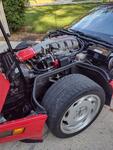
My motor had slightly higher compression pistons, mild cam, new lifters/pushrods and high pressure oil pump installed by the PO. Carb, distro are stock (although I don't think this carb is from a 74' Vette), and I found a cheap set of used, non-AIR exhaust manifolds at Carlisle this year and had them beadblasted and new exhaust pipe studs installed and then painted with the gold stuff that turns silver after a good hot soak. As you can see, the engine has not been run enough to turn the manifolds 'silver'. I have not run the car on the street since installing the new manifold, but it starts and idles great! With a 1/4" Phenolic carb spacer from Canton, my hood will barely close on my stock air cleaner with the thick sealing gasket removed. I am considering sourcing a drop base air cleaner assembly to free up hood space. If I can do that, I might be able to install a thicker phenolic spacer should I desire to experiment with carb spacers.
I found a used Performer manifold at Carlisle that facilitated a choke stove and simply installed the choke stove from my stock manifold. I had to source some miscellaneous pipe plugs and assorted odds & ends to properly install the manifold. (As you can see I made up a real neat heater core shutoff valve earlier this Summer and it fits nice, looks almost stock and works great!!!) If you want to maintain a 'stock' look, simple painted your manifold with Chevy engine orange before installing it! I seriously considered shooting it in Chevy engine orange, but decided at the last minute that the aluminum manifold would look great against my new aluminum valve covers I think a 3" open air cleaner will finish it off just right (even though the stock induction system provides cooler air at WOT through the base of the windshield ala Smokey Yunick!)
I found a used Performer manifold at Carlisle that facilitated a choke stove and simply installed the choke stove from my stock manifold. I had to source some miscellaneous pipe plugs and assorted odds & ends to properly install the manifold. (As you can see I made up a real neat heater core shutoff valve earlier this Summer and it fits nice, looks almost stock and works great!!!) If you want to maintain a 'stock' look, simple painted your manifold with Chevy engine orange before installing it! I seriously considered shooting it in Chevy engine orange, but decided at the last minute that the aluminum manifold would look great against my new aluminum valve covers
I think a 3" open air cleaner will finish it off just right (even though the stock induction system provides cooler air at WOT through the base of the windshield ala Smokey Yunick!) Thanks Mar. I am going to try the thread sealer on the one bolt for now. Will get new bolts and use thread sealer on all when I replace the gaskets.
It looks like your motor is stock besides the intake manifold. The carb, distributor and exhaust manifolds all look stock. Did you notice a big difference in power with just the new intake? Did you have any problem with hood clearance? Was there anything else that you had to change because of the new intake? I am trying to keep the car stock looking, but you have me thinking now, if I have to take the old manifold off to replace the gaskets, maybe I should replace the intake.
It looks like your motor is stock besides the intake manifold. The carb, distributor and exhaust manifolds all look stock. Did you notice a big difference in power with just the new intake? Did you have any problem with hood clearance? Was there anything else that you had to change because of the new intake? I am trying to keep the car stock looking, but you have me thinking now, if I have to take the old manifold off to replace the gaskets, maybe I should replace the intake.
Last edited by mar; Oct 17, 2010 at 11:09 AM.
Thread Starter
Navigator
Joined: Jul 2005
Posts: 9
Likes: 0
From: Plymouth Meeting, PA
Thanks Mar for the info. Nice job with the manifold setup. The aluminum manifold does look great. You'll have to let us know how it runs once you get it out on the street. I definitely have to give some thought to replacing my manifold.

