



 Nice to know...


Fan clearance.

Thread Starter
Drifting


Joined: May 2002
Posts: 1,546
Likes: 282
From: Back in Nebraska
 Fan clearance.
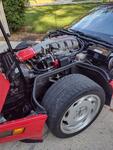
As you can see in the photo the fan does not go very far into the shroud. There is a good 3 ½ inches from the edge of the fan and the radiator inside the shroud. The fan and clutch came from a previous small block that was in the car. Is this normal or should the fan and clutch fit further into the shroud? 1970 Base 350 with A/C.


Tech Contributor


Joined: Aug 1999
Posts: 14,382
Likes: 6,402
From: At my Bar drinking and wrenching in Lafayette Colorado
I used to design and test airflow systems for aircraft:
That fan placement is actually optimum for maximizing airflow through the shroud - peak efficiency is achieved with the trailing edges of the blades exposed outside of the shroud.
Lars
That fan placement is actually optimum for maximizing airflow through the shroud - peak efficiency is achieved with the trailing edges of the blades exposed outside of the shroud.
Lars
Team Owner


Joined: Jan 2006
Posts: 37,637
Likes: 3,118
From: Crossville TN
Interesting!!! Would that be from achieving a greater pressure differential at the shroud outlet due to a better ability for the fan [with that configuration] to expel the airflow?
Last edited by 7T1vette; Nov 5, 2010 at 02:53 PM.
Tech Contributor
Joined: Aug 1999
Posts: 14,382
Likes: 6,402
From: At my Bar drinking and wrenching in Lafayette Colorado
The airflow testing I did showed that the fan will operate more effectively in a shroud or duct if you pull the blades partially out of the duct due to the airflow coming off the fan tips radially. If you shroud the fan tips, this radial airflow causes a thick boundary layer of turbulent air at the surface of the shroud or duct, rendering the outer portions of the blades ineffective. By pulling the fan partially out of the duct, this turbulent air is simply flung outwards without affecting efficient flow through the shroud, thus feeding the outer, most effective, parts of the blades smooth airflow. Depending on blade design, there was always an optimum distance for the blades to be outside of the shroud to achieve maximum flow and efficiency - this was usually in the range of 1/4 to 1/3 of the blade depth inside the shroud with the rest exposed outside the shroud.
Lars
Lars
Last edited by lars; Nov 5, 2010 at 03:03 PM.
Burning Brakes


Joined: Mar 1999
Posts: 1,047
Likes: 3
From: CA
I always thought the fan should be half-way into the shroud. I agree that it appears your fan in more out of the shroud than in. I looked at my car and here is what I think is wrong with yours...
GM offered a heavy duty cooling system that included a heavy duty fan clutch and a matching fan with more a more aggressive pitch in the blades. Its appears that you have a the heavy duty fan with the regular duty fan clutch. That could be causing the rear shift in the fan. I'll see if I can post a photo of mine. As a note, my car had the regular fan and fan clutch. When I installed a DeWitts radiator I also installed the heavy-duty clutch and matching fan with them more aggressive pitch in the blades.
I just re-read your post. As you have a 70 with air, I think you have the correct fan clutch for your car but the wrong fan.

GM offered a heavy duty cooling system that included a heavy duty fan clutch and a matching fan with more a more aggressive pitch in the blades. Its appears that you have a the heavy duty fan with the regular duty fan clutch. That could be causing the rear shift in the fan. I'll see if I can post a photo of mine. As a note, my car had the regular fan and fan clutch. When I installed a DeWitts radiator I also installed the heavy-duty clutch and matching fan with them more aggressive pitch in the blades.
I just re-read your post. As you have a 70 with air, I think you have the correct fan clutch for your car but the wrong fan.
Last edited by 71406; Nov 5, 2010 at 07:30 PM.
Tech Contributor
Joined: Aug 1999
Posts: 14,382
Likes: 6,402
From: At my Bar drinking and wrenching in Lafayette Colorado

I have to agree with Mike. The car looks correct.
...and before someone comments on it or argues it:
A "ducted fan", which is fully encased in a duct, is a different animal than a simple "fan in a shroud." Ducted fans, or axial flow fans (including turbines) use very tight tip clearances and much higher blade velocities to achieve incredible flow efficiency and velocity while being fully inserted into, or encased by, the duct. The sloppy clearances required between an engine cooling fan and a radiator shroud (due to engine movement and assembly tolerances) do not allow ducted fan principles to be employed, so the fan is positioned as shown in the photos above to achieve best airflow for the design condition.
Lars
Corvette Stories
The Best of Corvette for Corvette Enthusiasts

Every 2027 Corvette Engine Explained
Joe Kucinski
Designer Imagines A Corvette That Looks More Like a Corvette Than the Corvette
Verdad Gallardo
10 Ugly Corvettes That We Still Kinda Love
Joe Kucinski
Top 10 Most Expensive Corvettes Ever Sold on Bring A Trailer
Brett Foote
10 Things Every Corvette Owner Needs (2026 Edition)
Michael S. Palmer
8 Most "Only Corvette Owners Understand" Quirks and Problems
Pouria Savadkouei
10 Reasons the C6 Z06 is Still A Performance Benchmark After 20 Years
Joe Kucinski
How Much Horsepower Every Corvette Engine "LOST" in 1972
Joe Kucinski
