






Vacuum canister help...do I need?

Thread Starter
Advanced

Joined: Jan 2011
Posts: 72
Likes: 0
 Vacuum canister help...do I need?
So I have been replacing my vacuum lines and I have a few questions. First I am having a problem connecting the lines to the canister (hard to get too) which got me thinking...what exactly does that canister do? There are 2 lines that I need to connect, one goes from top of the carb. The other is a small line that runs to the to a y connection which runs to a port. Do I need those lines? Do I need the canister? If so, how can I get to the canister to connect the hoses????
Please help the mechanically impaired.
Please help the mechanically impaired.

Drifting


Joined: May 2008
Posts: 1,647
Likes: 5
From: Roseville CA
You need all the lines if you want everything to work as designed. My best guess is the Can is used to supply a consistent source of vacuum. For example, if you were flooring it and turned the lights on, they would probably open really slow, or not at all. The Can can (ha) store vacuum for those situations. I don't think it was meant to hold vacuum indefinitely, especially with the engine off. There's too many sources for slow leaks. I guess if everything was perfect it would hold vacuum forever.

Racer

Joined: Feb 2007
Posts: 271
Likes: 25
From: Buena Vista Colorado
...what exactly does that canister do? There are 2 lines that I need to connect, one goes from top of the carb. The other is a small line that runs to the to a y connection which runs to a port.
I would bet that you are looking at and trying to connect hoses to the fuel vapor canister located under the power brake booster can on the driver's side fender. Connections are to the gas tank and the carb with a "Y" fitting in between connected to the PCV valve. Other C3 years have different canisters and connections. You might find what you need by doing forum searches on vapor canister. If you don't send me a PM with your email address and I'll send you a scan of the vapor canister hose connections diagram in my Assembly Manual.
BTW: Do yourself a favor and get an AIM (or Assembly Information Manual) for your '78. It shows how stuff in you car goes together. Forum vendors and ebay are sources. Especially important for us "mechanically impaired" types. Also consider getting the "Service Manual" for your '78. Found mine on ebay.
Thread Starter
Advanced
Joined: Jan 2011
Posts: 72
Likes: 0
I think you are right. I just assumed it was for vacuum. I do need an aim. Is there an east way to take it off tonget tonthe top so I can connect the hoses?
'78s do not have a vacuum canister - at least mine doesn't. The vacuum reservoir is a tubular part of the front frame structure and you can see it in front of the hood when open. It has two larger and one smaller port in the top with two large yellow-striped hoses connecting to the headlight relays and one smaller hose connecting to the pull-down switch under the steering column in the cockpit.
I would bet that you are looking at and trying to connect hoses to the fuel vapor canister located under the power brake booster can on the driver's side fender. Connections are to the gas tank and the carb with a "Y" fitting in between connected to the PCV valve. Other C3 years have different canisters and connections. You might find what you need by doing forum searches on vapor canister. If you don't send me a PM with your email address and I'll send you a scan of the vapor canister hose connections diagram in my Assembly Manual.
BTW: Do yourself a favor and get an AIM (or Assembly Information Manual) for your '78. It shows how stuff in you car goes together. Forum vendors and ebay are sources. Especially important for us "mechanically impaired" types. Also consider getting the "Service Manual" for your '78. Found mine on ebay.
I would bet that you are looking at and trying to connect hoses to the fuel vapor canister located under the power brake booster can on the driver's side fender. Connections are to the gas tank and the carb with a "Y" fitting in between connected to the PCV valve. Other C3 years have different canisters and connections. You might find what you need by doing forum searches on vapor canister. If you don't send me a PM with your email address and I'll send you a scan of the vapor canister hose connections diagram in my Assembly Manual.
BTW: Do yourself a favor and get an AIM (or Assembly Information Manual) for your '78. It shows how stuff in you car goes together. Forum vendors and ebay are sources. Especially important for us "mechanically impaired" types. Also consider getting the "Service Manual" for your '78. Found mine on ebay.
Drifting
Joined: May 2008
Posts: 1,647
Likes: 5
From: Roseville CA
Maybe remove the gill panel and reach up. I've poked around on my 71 and was able to reach them OK. But I haven't actually replaced the hoses.

Team Owner


Joined: Sep 2006
Posts: 31,335
Likes: 4,449
From: Westminster Maryland
Hi UCV,
I believe the vacuum canister is used to store enough vacuum to be able to open the wiper door and headlights without starting the engine, at least once.
The vacuum system was sealed well enough that when new, (and now, if the systems in good shape), the car could sit for a week or more without having the headlights 'wink' or the wiper door 'dance' when the car was started.
The easiest access to the canister is from the top. The vapor canister blocks most of the access through the side grill opening.
Good Luck!
Regards,
Alan
I believe the vacuum canister is used to store enough vacuum to be able to open the wiper door and headlights without starting the engine, at least once.
The vacuum system was sealed well enough that when new, (and now, if the systems in good shape), the car could sit for a week or more without having the headlights 'wink' or the wiper door 'dance' when the car was started.
The easiest access to the canister is from the top. The vapor canister blocks most of the access through the side grill opening.
Good Luck!
Regards,
Alan
Corvette Stories
The Best of Corvette for Corvette Enthusiasts

5 Best & 5 Worst Corvette Daily Drivers
Joe Kucinski
The Headlights of Every Corvette Generation Explained
Joe Kucinski
5 Best & 5 Most Overrated Corvette Track Packages of All Time!
Joe Kucinski
Every 2027 Corvette Engine Explained
Joe Kucinski
Designer Imagines A Corvette That Looks More Like a Corvette Than the Corvette
Verdad Gallardo
10 Ugly Corvettes That We Still Kinda Love
Joe Kucinski
Top 10 Most Expensive Corvettes Ever Sold on Bring A Trailer
Brett Foote
10 Things Every Corvette Owner Needs (2026 Edition)
Michael S. Palmer
8 Most "Only Corvette Owners Understand" Quirks and Problems
Pouria Savadkouei
Team Owner
Joined: Sep 2006
Posts: 31,335
Likes: 4,449
From: Westminster Maryland
Hi UCV,
You're right 7t9, I was thinking VACUUM!!!!
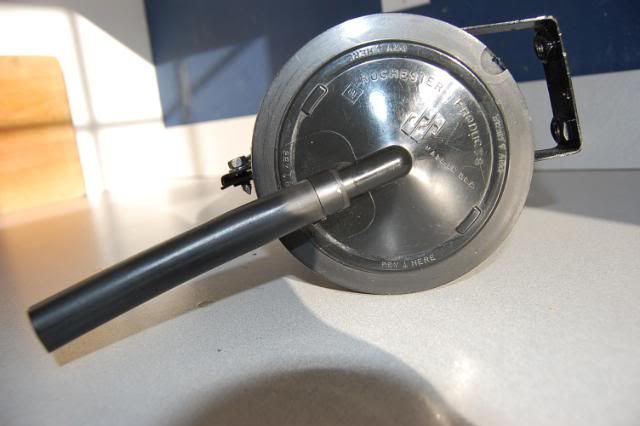
Here's some pictures of the vapor canister and hoses. 1 hose from the tank, one large hose to the pvc valve and carb, and 1 hose to the carb.
If you can't make the connections from above you can loosen the three bolts that hold the canister's bracket to the wheel-well so it drops down a bit and then reach through the grill opening.
Since the gas tank is sealed the vapor canister captures the gas fumes and they're routed to the carb.
Good Luck!
Regards,
Alan
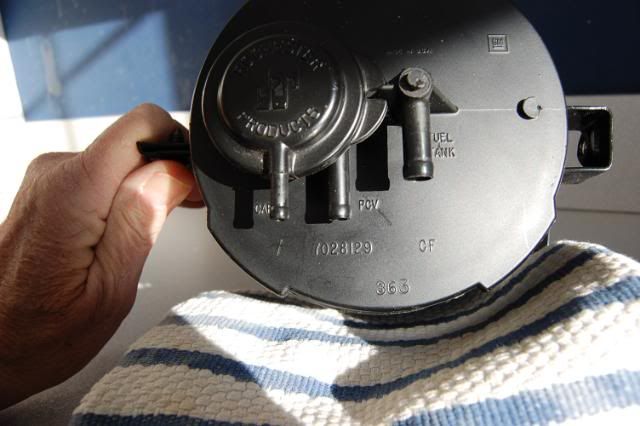
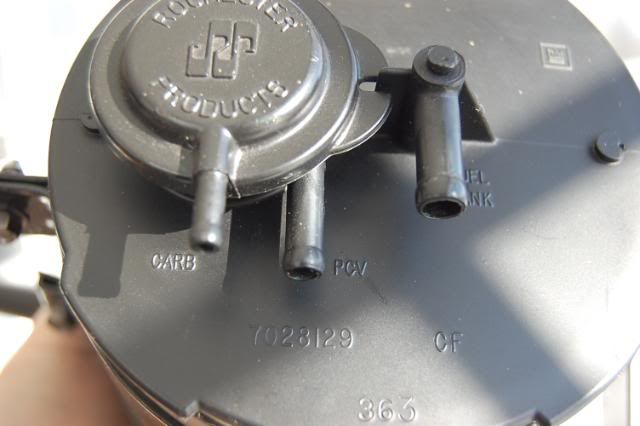
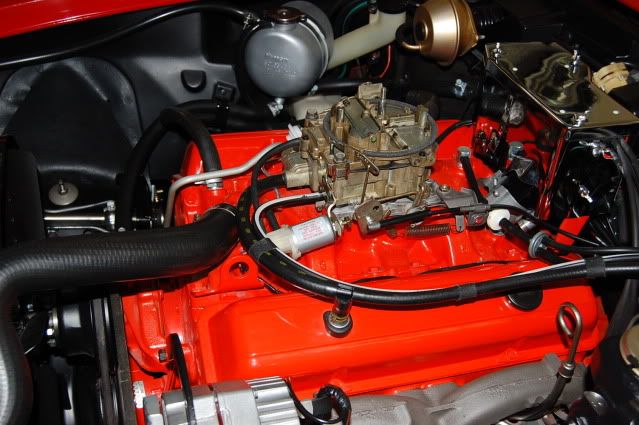
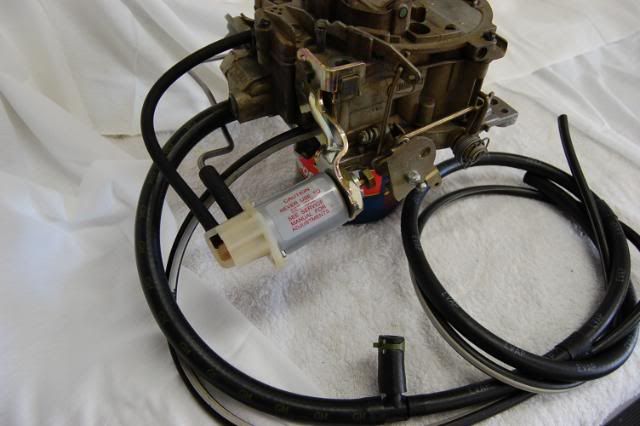
You're right 7t9, I was thinking VACUUM!!!!
Here's some pictures of the vapor canister and hoses. 1 hose from the tank, one large hose to the pvc valve and carb, and 1 hose to the carb.
If you can't make the connections from above you can loosen the three bolts that hold the canister's bracket to the wheel-well so it drops down a bit and then reach through the grill opening.
Since the gas tank is sealed the vapor canister captures the gas fumes and they're routed to the carb.
Good Luck!
Regards,
Alan

Burning Brakes

Joined: May 2007
Posts: 1,022
Likes: 33
From: Lokeren, Belgium
Not to hijack, but if the vapor canistor is removed wouldn't this create fuel odor problems? I'm asking this because the tank is connected to the canistar, but non of the other ports are connected. Would it help if this Gm part http://www.rmsautoparts.com/prodimages/10033125.jpg is connected to the vapor hose at the tank side to prevent odors? Its a one way check valve so the tank is still vented.
Regards
Nick
Regards
Nick
Team Owner
Joined: Sep 2006
Posts: 31,335
Likes: 4,449
From: Westminster Maryland
Hi Nick,
I believe your right. I'm not familiar with the part you linked.
The vapor canister and system really isn't any trouble except that the charcoal in some canisters needs to be replaced after all these years.
There's also a flat felt filter under the bottom cap of the canister that's easy to replace.
Regards,
Alan
I believe your right. I'm not familiar with the part you linked.
The vapor canister and system really isn't any trouble except that the charcoal in some canisters needs to be replaced after all these years.
There's also a flat felt filter under the bottom cap of the canister that's easy to replace.
Regards,
Alan
Last edited by Alan 71; Apr 10, 2011 at 05:19 PM.

Racer
Joined: Dec 2009
Posts: 380
Likes: 0
From: Glendale AZ
I'm completely emissions exempt in my state. That said, I ended up making my vapor canister functional again.
It's really worth the time and effort just due to the sheer amount of bad smells the thing gets rid of. If you park your car in a garage, having the canister working right prevents it from making everything in there smell like gas.
Even without having to pass emissions, I would still recommend it be put in and made functional.
It's really worth the time and effort just due to the sheer amount of bad smells the thing gets rid of. If you park your car in a garage, having the canister working right prevents it from making everything in there smell like gas.
Even without having to pass emissions, I would still recommend it be put in and made functional.

Le Mans Master

Joined: Jan 2003
Posts: 6,575
Likes: 1
From: Tuttle OK
Cruise-In VIII Veteran

Le Mans Master
Joined: Aug 2006
Posts: 7,431
Likes: 1,562
From: mount holly NC
2025 c3 ('74-'82) of the Year Finalist - Unmodified
2019 C3 of Year Finalist (appearance mods)
Yes Alan's car looks better with every pic!!!
About the vapor canister...you made me look and I see only 2 hoses on my 74, one to the tank & the other "T"s with the pcv. If there is a 3rd connection where on the carb does it go? To ported vacuum?
About the vapor canister...you made me look and I see only 2 hoses on my 74, one to the tank & the other "T"s with the pcv. If there is a 3rd connection where on the carb does it go? To ported vacuum?

Melting Slicks


Joined: Sep 2010
Posts: 2,414
Likes: 59
From: Emerald Isle NC
I'm with Avette4me. Chuck it if you can. I have no more fuel smell than I did before. This doesn't surprise me as the can was nothing but a hollow plastic shell. Plus, you have the benefit of getting rid of those pesky excess lines getting in the way and cluttering everything up.
Racer
Joined: Feb 2007
Posts: 271
Likes: 25
From: Buena Vista Colorado
Is there an easy way to take it off to get to the top so I can connect the hoses?
I had a strong fuel smell that was caused by the short hose connecting the canister to the hard line from the fuel tank. It had rotted badly. But the canister and its filter were in good shape, and replacing all the hoses solved the smell problem.
Ditch the can? Don't know. Before you do that, you might try capping off all the hoses to & from the canister for a while and see if you do or don't end up with a fuel smell problem.