




Vacuum canister help...do I need?

Heel & Toe

Joined: Nov 2004
Posts: 19
Likes: 0
From: Antelope Valley Cal

This is a great thread. I like the pictures Alan. My '78 seems to have a gross vacuum leak someplace and I can almost get the engine to run more towards normal if I pull and block the large vacuum port from the bottom of the carb. It goes to the canister. Is the canister leaking? or just a diaphragm in it? Looks like a bear to get to with that cruise module in the way.

Pro


Joined: Jan 2001
Posts: 511
Likes: 66
From: Timnath, CO
Resurrecting an old thread. I would like to remove my canister to check / replace the filter and activated carbon. However it is not clear to me what the best way to remove the canister is as it is quite crowded around it. I have the AIM showing how it bolts to the inner fender, but not sure if I need to remove anything else to make room to extract it. I'm also worried about how hard it will be to bolt it back in. Any tips would be appreciated.

Team Owner


Joined: Sep 2006
Posts: 31,267
Likes: 4,362
From: Westminster Maryland
Hi G,
If your car is the one in your avatar I think its easiest to remove the lower metal splash shield and also the side egg-crate grill. (Removing the spas shield requires removing the rocker trim in order to have access to 2 of the splash shield bolts.
This will give you good access.
Then find and remove the 3 small hex-headed bolts in the rear of the wheel well that hold the canister's bracket in place.
Drop the whole thing down, take the canister out of the bracket, do your maintenance, put it back in the bracket, and then put it back in place from the bottom.
Not too bad a job!
Regards,
Alan
Splash shield. You can also see the 2 lower bolts that mount the bracket to the wheelwell.

Canister access through side grill opening.

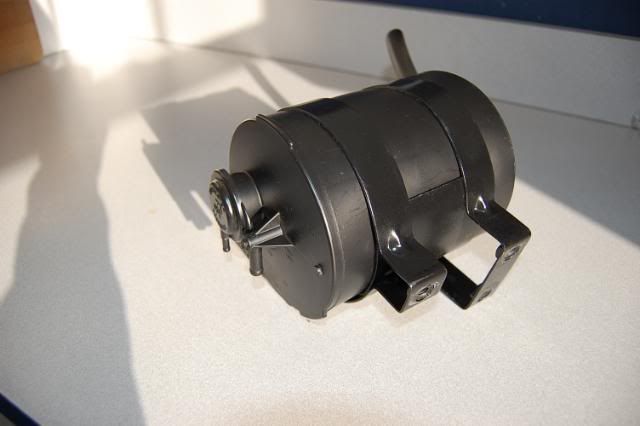
Canister removed, but still in bracket. It's laying on it's side.
If your car is the one in your avatar I think its easiest to remove the lower metal splash shield and also the side egg-crate grill. (Removing the spas shield requires removing the rocker trim in order to have access to 2 of the splash shield bolts.
This will give you good access.
Then find and remove the 3 small hex-headed bolts in the rear of the wheel well that hold the canister's bracket in place.
Drop the whole thing down, take the canister out of the bracket, do your maintenance, put it back in the bracket, and then put it back in place from the bottom.
Not too bad a job!
Regards,
Alan
Splash shield. You can also see the 2 lower bolts that mount the bracket to the wheelwell.
Canister access through side grill opening.
Canister removed, but still in bracket. It's laying on it's side.
Last edited by Alan 71; Jul 23, 2014 at 02:49 PM.

Team Owner

Joined: Jan 2006
Posts: 37,637
Likes: 3,118
From: Crossville TN
The fuel vapor canister also acts as the fuel tank VENT for cars having one. Thus, the filler cap for a car with vapor cansiter (hooked up) should be a NON-vented cap. If the canister is removed, the fuel cap needs to be replace with a VENTED cap...or the fuel tank could collapse.
The vapor canister causes NO HARM; it only captures/stores and then dispenses fuel vapors from the tank to the carb (when engine is running). The "carb" hose should go to a 'ported' manifold fitting on the carb; the "PCV" hose should get T-ed to the output of the PCV valve, and then transfer to the front baseplate fitting on your carb; the "Tank" line should run to the fuel separator gizmo on the side of your fuel tank.
The vapor canister causes NO HARM; it only captures/stores and then dispenses fuel vapors from the tank to the carb (when engine is running). The "carb" hose should go to a 'ported' manifold fitting on the carb; the "PCV" hose should get T-ed to the output of the PCV valve, and then transfer to the front baseplate fitting on your carb; the "Tank" line should run to the fuel separator gizmo on the side of your fuel tank.
Pro
Joined: Jan 2001
Posts: 511
Likes: 66
From: Timnath, CO
Alan - thank you. Looks like your approach will save me lots of time and frustration.
7T1 - Thanks for the alert. I do not plan to run the car without the canister. I am just planning to go through my fuel system and see if I can find any areas contributing to a mild fuel odor in the garage on hot Houston days. When I got the car it had a vented cap, and the vapor line from the tank to the canister was not hooked up. I have added a sealed cap and hooked up the vent (and by the way I about crushed my arm trying to reach up to hook it up). There is no pressure or vacuum build up in the tank. I suspect I will ultimately find the odor coming from old tank gaskets but want to start with the canister.
7T1 - Thanks for the alert. I do not plan to run the car without the canister. I am just planning to go through my fuel system and see if I can find any areas contributing to a mild fuel odor in the garage on hot Houston days. When I got the car it had a vented cap, and the vapor line from the tank to the canister was not hooked up. I have added a sealed cap and hooked up the vent (and by the way I about crushed my arm trying to reach up to hook it up). There is no pressure or vacuum build up in the tank. I suspect I will ultimately find the odor coming from old tank gaskets but want to start with the canister.
Pro
Joined: Jan 2001
Posts: 511
Likes: 66
From: Timnath, CO
So here's what I found.

Diaphragm seems to be in good shape. The PCV port was slightly moist with an engine oil smell. Not sure exactly what the diaphragm does / how it works. I think maybe it shuts off flow through the canister to PCV unless there is high enough vacuum to the carb port (just a guess - probably wrong).


I removed the lower filter below the plastic screen (would have been at the top of the picture since canister is upside down). Not sure if this filter was original. There was additional filter material above the plastic screen (as seen in this picture). It had deteriorated such that when the lower filter was removed, the activated carbon can easily fall out. I replaced the lower filter.
Finally, I smelled the activated charcoal and it has a hydrocarbon smell to it - not sure if it is gasoline or engine oil type of smell (but I have a headache now). Perhaps it is because the car has been sitting a week and the charcoal is doing it's job. I'm thinking I should try and find some charcoal somewhere and replace it.
Would appreciate any of your expertise on how to proceed. Thanks.

Diaphragm seems to be in good shape. The PCV port was slightly moist with an engine oil smell. Not sure exactly what the diaphragm does / how it works. I think maybe it shuts off flow through the canister to PCV unless there is high enough vacuum to the carb port (just a guess - probably wrong).


I removed the lower filter below the plastic screen (would have been at the top of the picture since canister is upside down). Not sure if this filter was original. There was additional filter material above the plastic screen (as seen in this picture). It had deteriorated such that when the lower filter was removed, the activated carbon can easily fall out. I replaced the lower filter.
Finally, I smelled the activated charcoal and it has a hydrocarbon smell to it - not sure if it is gasoline or engine oil type of smell (but I have a headache now). Perhaps it is because the car has been sitting a week and the charcoal is doing it's job. I'm thinking I should try and find some charcoal somewhere and replace it.
Would appreciate any of your expertise on how to proceed. Thanks.
Corvette Stories
The Best of Corvette for Corvette Enthusiasts

Top 10 Most Expensive Corvettes Ever Sold on Bring A Trailer
Brett Foote
10 Things Every Corvette Owner Needs (2026 Edition)
Michael S. Palmer
8 Most "Only Corvette Owners Understand" Quirks and Problems
Pouria Savadkouei
10 Reasons the C6 Z06 is Still A Performance Benchmark After 20 Years
Joe Kucinski
How Much Horsepower Every Corvette Engine "LOST" in 1972
Joe Kucinski
Top 10 DOs and DON'Ts for Protecting Your Convertible Top!
Michael S. Palmer
Top 10 Most Explosive Corvettes Ever Made: Power-to-Weight Ratio Ranked!
Joe Kucinski
150 hp to 1,250 hp: Every Corvette Generation Compared by the Specs That Matter
Joe Kucinski
8 Coolest Corvette Pace Cars (and Replicas) of All Time
Verdad Gallardo
Racer
Joined: Jan 2014
Posts: 334
Likes: 6
(Assuming we are talking about the gas vapor canister, not the vacuum reservoir here.)
The activatated charcoal is available at any pet store with the fish/ aquarium stuff. Just dump the old stuff and replace it.
Can't remember if the Corvette vendors sell the filters or not. Might need to cut filter paper to shape.
The activatated charcoal is available at any pet store with the fish/ aquarium stuff. Just dump the old stuff and replace it.
Can't remember if the Corvette vendors sell the filters or not. Might need to cut filter paper to shape.
Pro
Joined: Jan 2001
Posts: 511
Likes: 66
From: Timnath, CO

I replaced the activated charcoal and was curious whether the old charcoal that smelled of hydrocarbon would easily ignite. I put a lighter to it and it ignited instantly. A couple of spoonfulls burned for several minutes, so it seems there was quite a bit of hydrocarbon on the charcoal. I'm hoping this is a function of the age of the charcoal rather than a problem with the EVAP system.



Pro
Joined: Jan 2001
Posts: 511
Likes: 66
From: Timnath, CO
It lit instantly and the activated charcoal did not burn. When it finished burning, the material looked just like it did before I started - black granular carbon. There was no ash whatsoever, and the hydrocarbon smell was gone. Maybe over time the activated charcoal loses it's ability to desorb the hydrocarbons.
Team Owner
Joined: Jan 2006
Posts: 37,637
Likes: 3,118
From: Crossville TN
That little diaphragm at the top of the canister is the valve which initiates the PURGE of collected vapors. And, that diaphragm is triggered by a vacuum signal line connected to a "timed" or "ported" vacuum fitting on the carb. When the carb is at idle, there is no vacuum signal coming from a ported/timed fitting. But, as soon as the throttle plates are cracked, the vacuum in a ported line approaches the vacuum level of "manifold" vacuum.
Thus, at idle, the canister just sits there holding on to any collected vapors. When the throttle is opened, the ported line gains vacuum and the diaphragm switch is actuated. This allows vapors in the canister to transfer into the base of the carb, where it is ingested with the fuel charge.
If the diaphragm switch is not functioning, there are no vapors being purged by that canister.
P.S. You really don't want the diaphragm switch connected to 'manifold' vacuum, as it would negatively affect idle quality.
Thus, at idle, the canister just sits there holding on to any collected vapors. When the throttle is opened, the ported line gains vacuum and the diaphragm switch is actuated. This allows vapors in the canister to transfer into the base of the carb, where it is ingested with the fuel charge.
If the diaphragm switch is not functioning, there are no vapors being purged by that canister.
P.S. You really don't want the diaphragm switch connected to 'manifold' vacuum, as it would negatively affect idle quality.
Pro
Joined: Jan 2001
Posts: 511
Likes: 66
From: Timnath, CO
That little diaphragm at the top of the canister is the valve which initiates the PURGE of collected vapors. And, that diaphragm is triggered by a vacuum signal line connected to a "timed" or "ported" vacuum fitting on the carb. When the carb is at idle, there is no vacuum signal coming from a ported/timed fitting. But, as soon as the throttle plates are cracked, the vacuum in a ported line approaches the vacuum level of "manifold" vacuum.
Thus, at idle, the canister just sits there holding on to any collected vapors. When the throttle is opened, the ported line gains vacuum and the diaphragm switch is actuated. This allows vapors in the canister to transfer into the base of the carb, where it is ingested with the fuel charge.
If the diaphragm switch is not functioning, there are no vapors being purged by that canister.
P.S. You really don't want the diaphragm switch connected to 'manifold' vacuum, as it would negatively affect idle quality.
Thus, at idle, the canister just sits there holding on to any collected vapors. When the throttle is opened, the ported line gains vacuum and the diaphragm switch is actuated. This allows vapors in the canister to transfer into the base of the carb, where it is ingested with the fuel charge.
If the diaphragm switch is not functioning, there are no vapors being purged by that canister.
P.S. You really don't want the diaphragm switch connected to 'manifold' vacuum, as it would negatively affect idle quality.
