






Timing problems...
Thread Starter
Advanced

Joined: Apr 2011
Posts: 51
Likes: 3
From: Arlington Texas
 Timing problems...
I'm chasing temperature issues (it cruises at 205* when I'm not in the pedal - goes to about 210 if I'm in the pedal and over heats if I drive it really really hard). So I'm looking into my timing.
I hooked up the timing light, set the dial to zero, started the car and the looked for the TDC mark. I could not see the TDC mark.
I then bumped the motor to align TDC mark to zero position according to the marking plate. I took the rotor cap off to see the position of the rotor and it was pointing closer to the #8 post...hmmm.
So I turned the distributor to align the rotor with the #1 post but the vacuum advance thingy is bumping against a metal plate that used to have wires running through it (i guess). That makes me think I'm all messed up! All drawing I've looked at show the #1 and #8 posts parallel to the windshield. If I made this rotation, the #1 & #8 would be about 30* from parallel wrt the windshield.
Thoughts?
I hooked up the timing light, set the dial to zero, started the car and the looked for the TDC mark. I could not see the TDC mark.
I then bumped the motor to align TDC mark to zero position according to the marking plate. I took the rotor cap off to see the position of the rotor and it was pointing closer to the #8 post...hmmm.
So I turned the distributor to align the rotor with the #1 post but the vacuum advance thingy is bumping against a metal plate that used to have wires running through it (i guess). That makes me think I'm all messed up! All drawing I've looked at show the #1 and #8 posts parallel to the windshield. If I made this rotation, the #1 & #8 would be about 30* from parallel wrt the windshield.
Thoughts?

Pro

Joined: May 2003
Posts: 593
Likes: 0
From: London England
A possibility is that someone has put the wires on the cap, one or two positions out, then tried to correct it by doing a huge turn on the distributor.
If you're trying to sort a problem, get the basics right first. Get the engine to TDC on No1 and put the distributor in approximately the correct position, then move the plug wires on the cap to match. You should then have the distributor in roughly the right place, with the rotor pointing at No1 and No 1 plug wire attached to the nearest post on the cap.
If you're trying to sort a problem, get the basics right first. Get the engine to TDC on No1 and put the distributor in approximately the correct position, then move the plug wires on the cap to match. You should then have the distributor in roughly the right place, with the rotor pointing at No1 and No 1 plug wire attached to the nearest post on the cap.
Race Director


Joined: Sep 2002
Posts: 10,362
Likes: 5
From: San Diego - Deep Within The State of CONFUSION!

as long as you use the correct firing order, the wires can be anywhere and the engine could still run. the proper place for no.1 on the HEI distributor is just to the left of the box where the wires are plugged into the distributor cap.

Team Owner


Joined: Jan 2006
Posts: 37,637
Likes: 3,118
From: Crossville TN
Don't assume that the #1 wire is in any "standard" location on the distributor cap. Those get moved...especially on Corvette engines, so that the vacuum advance can is positioned for better access. You need to 'chase' the wiring to assure yourself which wire is really going to the #1 plug. There are all kinds of assembly missteps folks can do to throw off the TDC situation...then you are left scratching your head about it all.First, verify and mark/label all the plug wires so that you know where they really go. Then remove the #1 plug [and the main distributor feed wire so that the car cannot start] and have someone crank the car while you hold your thumb about 1/2" away from the plug hole. Now, watch the damper to see when the "0" timing mark is coming up to the index scale. When you feel a shot of pressurized air come out the plug hole (just before the mark aligns), you are on the compression stroke. When the marks are lined up, that is actual TDC (the alignment of marks on the next rotation is the exhaust stroke and is NOT TDC).
When you get those two things accomplished, you can then look to see if the rotor contact is aligned with the #1 plug contact--wherever that #1 wire is truely located on the cap--and go from there. Good luck.
Thread Starter
Advanced
Joined: Apr 2011
Posts: 51
Likes: 3
From: Arlington Texas
I chased the wires and moved all wires one port clockwise, turned the distributor and the car stated right up. Timing at idle was 45*. Turned distributor and got about 10* idle and 35* at 3000 rpm. Engine idles better, but performs not so well...
The intent of all this was to lower engine temperature....it still is at 205ish under normal foot. Btw it is 95* here in Texas today. I'm thinking of going after water pump or radiator now....
The intent of all this was to lower engine temperature....it still is at 205ish under normal foot. Btw it is 95* here in Texas today. I'm thinking of going after water pump or radiator now....
Corvette Stories
The Best of Corvette for Corvette Enthusiasts

Top 10 Most Expensive Corvettes Ever Sold on Bring A Trailer
Brett Foote
10 Things Every Corvette Owner Needs (2026 Edition)
Michael S. Palmer
8 Most "Only Corvette Owners Understand" Quirks and Problems
Pouria Savadkouei
10 Reasons the C6 Z06 is Still A Performance Benchmark After 20 Years
Joe Kucinski
How Much Horsepower Every Corvette Engine "LOST" in 1972
Joe Kucinski
Top 10 DOs and DON'Ts for Protecting Your Convertible Top!
Michael S. Palmer
Top 10 Most Explosive Corvettes Ever Made: Power-to-Weight Ratio Ranked!
Joe Kucinski
150 hp to 1,250 hp: Every Corvette Generation Compared by the Specs That Matter
Joe Kucinski
8 Coolest Corvette Pace Cars (and Replicas) of All Time
Verdad Gallardo
Team Owner
Joined: Jan 2006
Posts: 37,637
Likes: 3,118
From: Crossville TN
Your engine's operating temperature is a function of: 1) the thermostat's rated temperature, and 2) the cooling cababilities of the cooling system. To see where you really are, remove the T-stat and run it to see what happens. If you had (have) a 195* stat (standard issue for your engine), it will run in the 200-210*F range all the time. If you have no stat, the engine will naturally seek its own operating temperature and stabilize where the cooling system allows. If your cooling system is "up to par", it will operate in the 170-190*F range. If it runs hotter than that, you could improve things (and lower engine temps) with a little bit of work.
Should the engine (without stat) run significantly lower, stick a 180*F stat in there and call it a day!
Should the engine (without stat) run significantly lower, stick a 180*F stat in there and call it a day!

Burning Brakes


Joined: Oct 2003
Posts: 1,090
Likes: 74
From: New Carlisle IN
Have you checked you fan clutch? My 76 had a (horrible) flex fan on it when I bought it. It would always run hot. I was starting to over heat in between autocross runs so I switched the fan out with the one on my 73. That fan clutch was completely worn out, but it still dropped the temps down a good 30* to the 210-220 range. I then ordered a new clutch and the car will run around 180 all day long.
If you are having cooling issues and the car runs fine, then most likely it is a cooling problem. Do you have an AC condenser? If so make sure there isn't debris in between the condenser and the radiator. Make sure your fan/clutch are doing their job. Thermostats are cheap. Throw a new one in and see what happens. Next have radiator checked for proper operation.
Your timing marks on the dampener may not be lined up with TDC. This can happen when the rubber in the dampener cracks or de-laminates from the steel and the outer ring will start to rotate somewhat independently of the inner ring. You will manually need to find TDC to check this. After the timing marks are verified to be true, then you can go about checking the orientation of the distributor and wires. Then check the timing. Timing should be checked without the vacuum advance hooked up. As a general rule, 12* TDC for idle and 32* TDC at 3000 RPM are good numbers. That should be used as a baseline and then adjusted from there depending on how the car performs.
If you are having cooling issues and the car runs fine, then most likely it is a cooling problem. Do you have an AC condenser? If so make sure there isn't debris in between the condenser and the radiator. Make sure your fan/clutch are doing their job. Thermostats are cheap. Throw a new one in and see what happens. Next have radiator checked for proper operation.
Your timing marks on the dampener may not be lined up with TDC. This can happen when the rubber in the dampener cracks or de-laminates from the steel and the outer ring will start to rotate somewhat independently of the inner ring. You will manually need to find TDC to check this. After the timing marks are verified to be true, then you can go about checking the orientation of the distributor and wires. Then check the timing. Timing should be checked without the vacuum advance hooked up. As a general rule, 12* TDC for idle and 32* TDC at 3000 RPM are good numbers. That should be used as a baseline and then adjusted from there depending on how the car performs.
Melting Slicks


Joined: Dec 2009
Posts: 3,233
Likes: 657
From: Thunder Bay
You need to check your timing with the vacuum advance disconnected. Plug the vacuum line with a golf tee. Your timing should be about 10-14 deg. advanced without the vacuum advance connected. If you are getting 10 deg. with the vac advance hooked up you're way retarded. Er, the engine is retarded - not you, probably. I'll shut up now... 
Thread Starter
Advanced
Joined: Apr 2011
Posts: 51
Likes: 3
From: Arlington Texas
Fan clutch! I'll look into that - not sure what to look for - but I did notice that the fan rotated by hand rather easily when the motor was off which made me go...'huh, is that right??'
Indeed I did do wrong by setting the timing with the vacuum advance on, so I'll correct that first.
I do have a AC condenser, so ill look there as well (but I already hit it good with a hose and i didnt see much come out)
I've taken out the t-stat, that didn't do nothin; temp is still around 205*. The lower hose looks in good shape, so I don't think it's collapsing.
I ran the car with the radiator plug out of the bottom while flushing the system with a water hose. Nothing interesting came out the bottom.
My dad says you can have someone physically clean a radiator...can that be right? That sounds expensive.
Fan shroud is new and fits tight.
Indeed I did do wrong by setting the timing with the vacuum advance on, so I'll correct that first.
I do have a AC condenser, so ill look there as well (but I already hit it good with a hose and i didnt see much come out)
I've taken out the t-stat, that didn't do nothin; temp is still around 205*. The lower hose looks in good shape, so I don't think it's collapsing.
I ran the car with the radiator plug out of the bottom while flushing the system with a water hose. Nothing interesting came out the bottom.
My dad says you can have someone physically clean a radiator...can that be right? That sounds expensive.
Fan shroud is new and fits tight.
Last edited by '77 DomOnicDave; May 30, 2011 at 10:55 PM.
Pro
Joined: Oct 2006
Posts: 734
Likes: 0
From: Bryan Texas
If you can wait till the weekend, I can show you how to time it and check the dist install. I'll be in Arlington for a graduation. I aslo have a temp gun, so we could check the actual temps against your gauge if you like. I'd do that before pulling the radiator.
Pro
Joined: May 2003
Posts: 593
Likes: 0
From: London England
Your timing marks on the dampener may not be lined up with TDC. This can happen when the rubber in the dampener cracks or de-laminates from the steel and the outer ring will start to rotate somewhat independently of the inner ring. You will manually need to find TDC to check this. After the timing marks are verified to be true, then you can go about checking the orientation of the distributor and wires. Then check the timing. Timing should be checked without the vacuum advance hooked up. As a general rule, 12* TDC for idle and 32* TDC at 3000 RPM are good numbers. That should be used as a baseline and then adjusted from there depending on how the car performs.
Regarding your cooling, does your car have the fan shroud fitted?
Team Owner
Joined: Jan 2006
Posts: 37,637
Likes: 3,118
From: Crossville TN
OK, running 210* without a T-stat...your system needs some 'help'. The most common causes are missing radiator shroud seals and/or extension piece (at the bottom of the shroud) and/or crudded up radiator. Radiator "flush" will not get lime deposits out of the radiator fins; to do that, you need to use radiator "cleaner"...found in the same area of the car parts store. Follow directions on the label; don't cut corners on getting the job done or it won't do what you need.
If you still have the thermostatic fan on your engine, you can check its operation by getting the engine up to full op temp (drive it on the highway for a few minutes), then letting it idle while you open the hood and focus on the movement of the fan. Now, turn the engine OFF and watch to see how many full revolutions the fan makes. If it is in good shape, it will stop in 2-3 revolutions. If the thermostatic function is not working as it should, it will turn several revolutions (freewheel). The faster it stops, the better it works [unless it is totally locked-up]. If you have a 'cold' engine and you try that test, the fan should spin more as the thermo fluid will not be warm enough to offer resistance.
Check out those items and report results.
If you still have the thermostatic fan on your engine, you can check its operation by getting the engine up to full op temp (drive it on the highway for a few minutes), then letting it idle while you open the hood and focus on the movement of the fan. Now, turn the engine OFF and watch to see how many full revolutions the fan makes. If it is in good shape, it will stop in 2-3 revolutions. If the thermostatic function is not working as it should, it will turn several revolutions (freewheel). The faster it stops, the better it works [unless it is totally locked-up]. If you have a 'cold' engine and you try that test, the fan should spin more as the thermo fluid will not be warm enough to offer resistance.
Check out those items and report results.
Thread Starter
Advanced
Joined: Apr 2011
Posts: 51
Likes: 3
From: Arlington Texas
I get off work a little early tomorrow, so I'll do the timing without the vacuum advance, warm the motor up, and check the fan rotation. I'll post some pics of the shroud for some feed back. Lasty, I'll run it up to the auto store for some cleaner. Thanks for the help guys!
Thread Starter
Advanced
Joined: Apr 2011
Posts: 51
Likes: 3
From: Arlington Texas
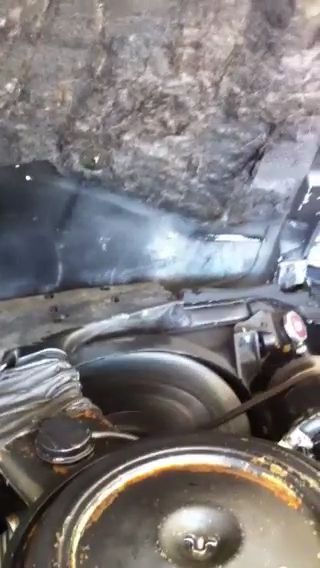
I adjusted the timing with vacuum advance off..car runs good but still is running 200-205*. Look at the pictures below for some info on fan clutch and shroud...My ryobi thermo meter confirms the engine temp at 198. I've looked for radiator cleaner and not found any, will CLD work (calcium lime deposit remover used for house hold plumbing issues)?


Last edited by '77 DomOnicDave; Jun 1, 2011 at 05:41 PM.
Thread Starter
Advanced
Joined: Apr 2011
Posts: 51
Likes: 3
From: Arlington Texas
