






Neutral Safety Switch Wiring Oddity

Thread Starter
Race Director

Joined: May 2006
Posts: 16,528
Likes: 53
From: Dayton, Ohio
 Neutral Safety Switch Wiring Oddity
I guess I never noticed this (and maybe I did but the oldtimers erased it) but thought I would take a pic in case someones testing and runs into this.
I was talking with a CF member about his neutral safety switch and he noted the purple and purple/white flip from the car harness to the NS switch harness. I went out to check my old harness and it was the same.
So if your looking for 12 volts coming IN to the NS switch on the purple/white FROM the ignition switch make sure you follow the wires up to the connector to make sure your on the correct wire.
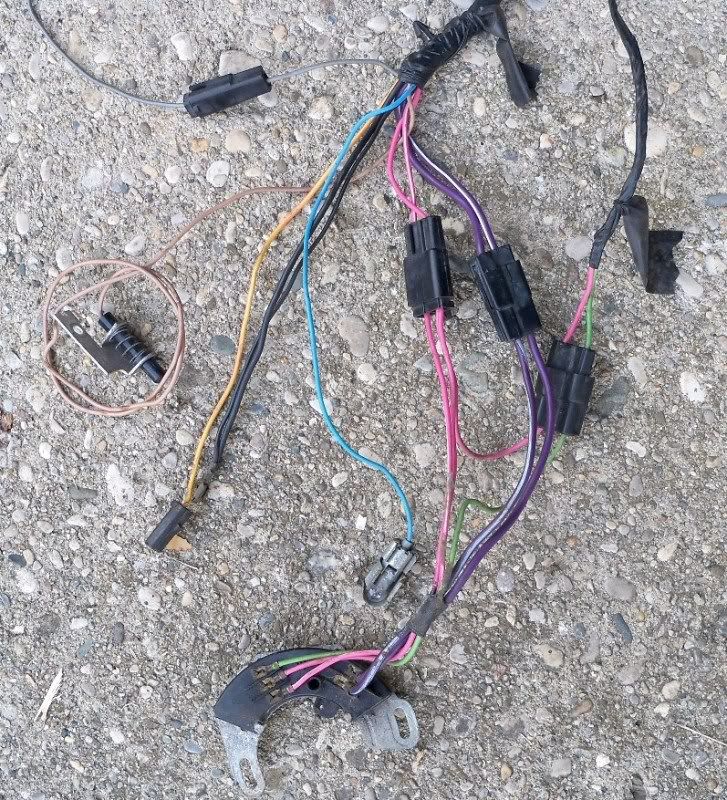
I was talking with a CF member about his neutral safety switch and he noted the purple and purple/white flip from the car harness to the NS switch harness. I went out to check my old harness and it was the same.
So if your looking for 12 volts coming IN to the NS switch on the purple/white FROM the ignition switch make sure you follow the wires up to the connector to make sure your on the correct wire.

Race Director

Joined: Aug 2007
Posts: 10,977
Likes: 19
From: Canboro Ontario
Roger, I had not noticed that, until now that you brought it up. I am assuming that the plug, only goes one way, and that it is correct that they flip like that, or are they suppose to be the same ?????
Thread Starter
Race Director
Joined: May 2006
Posts: 16,528
Likes: 53
From: Dayton, Ohio
This might be difficult to understand but I'll try.
During "testing" (not guessing) if one of our members is asking for help and goes to the switch and puts a 12v test light on the exposed terminal of the purple/white and the test light fails to light he is going to assume at that point there is no power coming from the ignition switch because he was testing the WRONG wire.
We've all experienced these little wrong turns while diagnosing an electrical problem ,which for some of us is a momentary hmmm but for a rookie it can have him dropping the steering column to inspect the ignition switch and then "Corvette electrical system overload".
During "testing" (not guessing) if one of our members is asking for help and goes to the switch and puts a 12v test light on the exposed terminal of the purple/white and the test light fails to light he is going to assume at that point there is no power coming from the ignition switch because he was testing the WRONG wire.
We've all experienced these little wrong turns while diagnosing an electrical problem ,which for some of us is a momentary hmmm but for a rookie it can have him dropping the steering column to inspect the ignition switch and then "Corvette electrical system overload".
Thread Starter
Race Director
Joined: May 2006
Posts: 16,528
Likes: 53
From: Dayton, Ohio
Thread Starter
Race Director
Joined: May 2006
Posts: 16,528
Likes: 53
From: Dayton, Ohio
I have 3 older purple-purple type harness's my others are later purple-green or purple-yellow harness's.
2 of the older ones (73 and back) are the same with the , flipped. The other one bubba got hold of and put a jumper in to take the place of the switch but wires in the car harness plug are in the same location.
I'm hoping some others will chime in with their experiences on this very boring subject.


Race Director


Joined: Sep 2001
Posts: 10,560
Likes: 439
From: Wellington, FL
St. Jude Donor '11 thru '25
While not 100% related to the subject, and hope I not hi-jacking, I just posted that in attempting replacement of this switch, I can't seem to separate the connectors for the back-up lights from the switch to the console wires. Roger, if you wouldn't mind, could you please look at the switch's harness in your pic and see if there is a tab holding the 2 back up connectors together or do they just pull apart? I don't see a tab but I don't have a lot of room to work. Jud
Last edited by Jud Chapin; Jul 8, 2011 at 11:23 AM.
Corvette Stories
The Best of Corvette for Corvette Enthusiasts

10 Reasons the C6 Z06 is Still A Performance Benchmark After 20 Years
Joe Kucinski
How Much Horsepower Every Corvette Engine "LOST" in 1972
Joe Kucinski
Top 10 DOs and DON'Ts for Protecting Your Convertible Top!
Michael S. Palmer
Top 10 Most Explosive Corvettes Ever Made: Power-to-Weight Ratio Ranked!
Joe Kucinski
150 hp to 1,250 hp: Every Corvette Generation Compared by the Specs That Matter
Joe Kucinski
8 Coolest Corvette Pace Cars (and Replicas) of All Time
Verdad Gallardo
Top 10 Corvette Engines RANKED by Peak Torque (70+ Years of Muscle!)
Joe Kucinski
Corvette ZR1X Will Be Pacing the Indy 500, And Could Probably Race, Too!
Verdad Gallardo
Top 10 Corvettes Coming to Mecum Indy 2026!
Brett Foote
Thread Starter
Race Director
Joined: May 2006
Posts: 16,528
Likes: 53
From: Dayton, Ohio
While not 100% related to the subject, and hope I not hi-jacking, I just posted that in attempting replacement of this switch, I'm can't seem to separate the connectors for the back-up lights from the switch to the console wires. Roger, if you wouldn't mind, could you please look at the switch's harness in your pic and see if there is a tab holding the 2 back up connectors together or do they just pull apart? I don't see a tab but I don't have a lot of room to work. Jud
 I just posted to your thread. You'll just have to pull but use 2 pair of pliers so you don't pull on the wires. No tab.
I did go out and pulled apart the one in the pic.

Race Director
Joined: Sep 2001
Posts: 10,560
Likes: 439
From: Wellington, FL
St. Jude Donor '11 thru '25
Race Director
Joined: Sep 2001
Posts: 10,560
Likes: 439
From: Wellington, FL
St. Jude Donor '11 thru '25



Team Owner


Joined: Jan 2006
Posts: 37,637
Likes: 3,117
From: Crossville TN
Roger...
Your scenario is correct, if you are using a test light. Personally, I'm not a 'test light' kind of guy...I'd rather use an ohmmeter and check out the circuits without power running in them. Nasty things happen to some folks when they leave power on while diagnosing an electrical problem. (the modicon is not really meant to be a "Rock On!" symbol in this case; I just thought the little sucker looked like he just got hit with 220 volts!)
Your scenario is correct, if you are using a test light. Personally, I'm not a 'test light' kind of guy...I'd rather use an ohmmeter and check out the circuits without power running in them. Nasty things happen to some folks when they leave power on while diagnosing an electrical problem.
(the modicon is not really meant to be a "Rock On!" symbol in this case; I just thought the little sucker looked like he just got hit with 220 volts!)
Thread Starter
Race Director
Joined: May 2006
Posts: 16,528
Likes: 53
From: Dayton, Ohio
Roger...
Your scenario is correct, if you are using a test light. Personally, I'm not a 'test light' kind of guy...I'd rather use an ohmmeter and check out the circuits without power running in them. Nasty things happen to some folks when they leave power on while diagnosing an electrical problem. (the modicon is not really meant to be a "Rock On!" symbol in this case; I just thought the little sucker looked like he just got hit with 220 volts!)
Your scenario is correct, if you are using a test light. Personally, I'm not a 'test light' kind of guy...I'd rather use an ohmmeter and check out the circuits without power running in them. Nasty things happen to some folks when they leave power on while diagnosing an electrical problem.
(the modicon is not really meant to be a "Rock On!" symbol in this case; I just thought the little sucker looked like he just got hit with 220 volts!)I'm always open to ways different from my own to diagnose problems.
Thanks

Race Director
Joined: Mar 2006
Posts: 14,112
Likes: 28
From: Florida
I agree an ohm meter is a useful tool,would you mind describing the steps you would take using an ohm meter to diagnose a problem described as "no starter engagement when turning the key to the start position" ?
I'm always open to ways different from my own to diagnose problems.
Thanks
I'm always open to ways different from my own to diagnose problems.
Thanks


Team Owner
Joined: Jan 2006
Posts: 37,637
Likes: 3,117
From: Crossville TN
Determine the wiring path from the schematic; pull fuse [if necessary]; put probes on either side of switch circuit; turn ignition switch to see if connection is made. If you need to 'see' voltage, leave battery connected and switch meter to DCV scale...check for 12v.  [But, you already know all of this stuff....]
[But, you already know all of this stuff....]

Team Owner


Joined: Jul 1999
Posts: 65,492
Likes: 230
From: Orange Park Florida
Determine the wiring path from the schematic; pull fuse [if necessary]; put probes on either side of switch circuit; turn ignition switch to see if connection is made. If you need to 'see' voltage, leave battery connected and switch meter to DCV scale...check for 12v. [But, you already know all of this stuff....]
[But, you already know all of this stuff....]