



gas tank question?

Race Director


Joined: Apr 2011
Posts: 11,183
Likes: 3,334
From: North of Toronto - Ontario

Depending on the year, the cap is vented (I think it was vented caps prior to about 72.. 73.. 74 (California and all that), after that the caps were non-vented and the venting came from the evap-emission system)
Hope it helps
Mooser

Thread Starter
Intermediate

Joined: Nov 2011
Posts: 27
Likes: 0
Air has to get into the tank to replace the volume of gas leaving the tank
Depending on the year, the cap is vented (I think it was vented caps prior to about 72.. 73.. 74 (California and all that), after that the caps were non-vented and the venting came from the evap-emission system)
Hope it helps
Mooser
Depending on the year, the cap is vented (I think it was vented caps prior to about 72.. 73.. 74 (California and all that), after that the caps were non-vented and the venting came from the evap-emission system)
Hope it helps
Mooser
But if I order a new cap for my 69 will I have to make sure that it is a vented cap? or will all gas caps be vented? \\
Also how can I test or be sure that the venting is actually working? Is there a test or some way to know if this is working properly?

Melting Slicks

Joined: Feb 2006
Posts: 3,428
Likes: 5
From: Japan
Looking at my Corvette America catalog all the listed gas caps specify whether vented or non-vented...I suspect it's that way for all the vendors out there. Just make sure you order the cap for your year Corvette because the switch from vented to non-vented occurred in 1970.

Former Vendor
Joined: Aug 2006
Posts: 76,656
Likes: 1,851
From: Jeffersonville Indiana 812-288-7103
St. Jude Donor '08-'09-'10-'11-'12-'13-'14-'15
Race Director
Joined: Apr 2011
Posts: 11,183
Likes: 3,334
From: North of Toronto - Ontario
The evap-canister under the driver's front fender is the tell-tail for non-vented caps (venting is through the charcoal can instead of the cap)
Also how can I test or be sure that the venting is actually working? Is there a test or some way to know if this is working properly?
Its basically just an air hole in the cap (well there is gaskets and a passage way that the air needs to snake around so gas doesn't just splash out but you get the idea) so there is really not much to go wrong unless it gets full of gunk, which shouldn't happen
Without blowing air into the tank through one of the fuel lines to see if it leaks out the only sign I can think of is if you open the cap on a hot day or right after a drive and hear a big whoosh of air getting sucked in....it's not working
(of course having the car quit while driving because it can't suck any gas from the tank is also a sign but.....)
Mooser

Team Owner


Joined: Sep 2006
Posts: 31,198
Likes: 4,287
From: Westminster Maryland
Hi,
I beleve that in 1971 when the gas cap was changed to a sealed type the tanks were built with a button valve for relief. It's about the size of a quarter and located on the top of the tank just to the left of the filler neck.
You can just see it in this picture. It looks like a little disc pressed into the surface of the tank.
Regards,
Alan
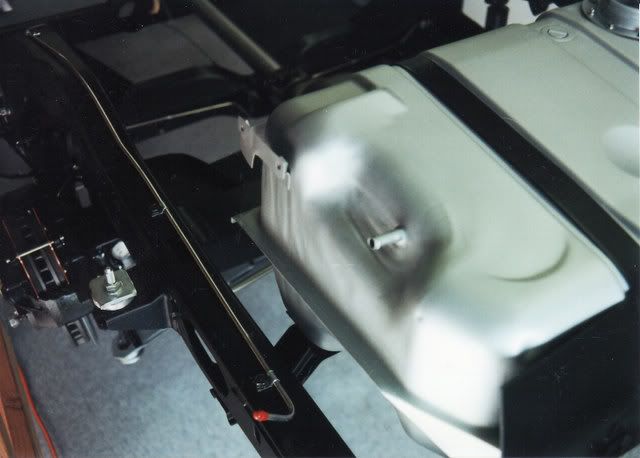
I beleve that in 1971 when the gas cap was changed to a sealed type the tanks were built with a button valve for relief. It's about the size of a quarter and located on the top of the tank just to the left of the filler neck.
You can just see it in this picture. It looks like a little disc pressed into the surface of the tank.
Regards,
Alan
Former Vendor
Joined: Aug 2006
Posts: 76,656
Likes: 1,851
From: Jeffersonville Indiana 812-288-7103
St. Jude Donor '08-'09-'10-'11-'12-'13-'14-'15
The caps went sealed in 1970 and the separator valve that mounted on that bracket was actually about 3" x 2.5". Just as it was named it separated the fuel from the fumes and vented back in the tank or the canister under the inner fender.

I took some good shots of this on the 71 we just did

I took some good shots of this on the 71 we just did
Corvette Stories
The Best of Corvette for Corvette Enthusiasts

150 hp to 1,250 hp: Every Corvette Generation Compared by the Specs That Matter
Joe Kucinski
8 Coolest Corvette Pace Cars (and Replicas) of All Time
Verdad Gallardo
Top 10 Corvette Engines RANKED by Peak Torque (70+ Years of Muscle!)
Joe Kucinski
Corvette ZR1X Will Be Pacing the Indy 500, And Could Probably Race, Too!
Verdad Gallardo
Top 10 Corvettes Coming to Mecum Indy 2026!
Brett Foote
Top 10 C9 Corvette MUST-HAVES to Fix These C8 Generation Flaws!
Michael S. Palmer
10 Revolutionary 'Corvette Firsts' Most People Don't Know
Joe Kucinski
5 Reasons to Upgrade to an LS6-Powered Corvette; 5 Reasons to Stay LT2
Michael S. Palmer
2027 Corvette vs The World: Every C8 vs Its Closest Competitor
Joe Kucinski
Race Director
Joined: Apr 2011
Posts: 11,183
Likes: 3,334
From: North of Toronto - Ontario

Thread Starter
Intermediate
Joined: Nov 2011
Posts: 27
Likes: 0
is it letting out pressure or is it sucking air in? I would assume that if there is any air sucking in or out that the cap is not working correctly. If it was venting there should be no pressure build up right?
Race Director
Joined: Apr 2011
Posts: 11,183
Likes: 3,334
From: North of Toronto - Ontario
I'm pretty sure the old ones (pre 70 according to the info above) they let the air/fuel move both ways.
Now, if you buy a newly made, old cap will it vent totally or hold a few pounds? That I don't know, maybe someone like Wilcox could verify.
Drilling a small hole in the cap to let it vent totally would take care of it though.
Mooser

Burning Brakes


Joined: Apr 2007
Posts: 1,186
Likes: 41
From: Pinecrest FL
2015 C3 of the Year Finalist
It holds 8-10 pounds of pressure. Sort of hard to spin the cap off sometimes.
Is there anything wrong with the pressurize tank or should I just ignore it?
I am using a new vented 69 cap. Locking style chrome gas cap was still on the car when I purchased it...probably from the 60's or early 70's. Car was parked in 86.
Gary
Is there anything wrong with the pressurize tank or should I just ignore it?
I am using a new vented 69 cap. Locking style chrome gas cap was still on the car when I purchased it...probably from the 60's or early 70's. Car was parked in 86.
Gary
Former Vendor
Joined: Aug 2006
Posts: 76,656
Likes: 1,851
From: Jeffersonville Indiana 812-288-7103
St. Jude Donor '08-'09-'10-'11-'12-'13-'14-'15
If the tank can't replace the volume of fuel with air, the fuel pump will collapse the tank. On sealed cap cars the tank is vented, on vented cap cars the thank is not vented.
Race Director
Joined: Apr 2011
Posts: 11,183
Likes: 3,334
From: North of Toronto - Ontario
It holds 8-10 pounds of pressure. Sort of hard to spin the cap off sometimes.
Is there anything wrong with the pressurize tank or should I just ignore it?
I am using a new vented 69 cap. Locking style chrome gas cap was still on the car when I purchased it...probably from the 60's or early 70's. Car was parked in 86.
Gary
Is there anything wrong with the pressurize tank or should I just ignore it?
I am using a new vented 69 cap. Locking style chrome gas cap was still on the car when I purchased it...probably from the 60's or early 70's. Car was parked in 86.
Gary
Your pump should have had a return line, sound like it's somehow pressurizing the tank.
69 should have had the old style vented cap that let air in and out
I've got one of the locking chrome caps, mine is non-vented (72 so it has the charcoal can)
If the tank is pressurized, the only thing I've ever heard going wrong is that the mechanical fuel pump can leak inside and this could dump fuel into the oil pan.
One hand - if it ain't broke.....
Other hand - drill a small hole in the cap and forget about it.
my 2 cents
Mooser
Burning Brakes
Joined: Apr 2007
Posts: 1,186
Likes: 41
From: Pinecrest FL
2015 C3 of the Year Finalist
Problem solved. I tried to blow air through the hole on the vented cap from the inside and didnt have any luck.
I had an extra vented cap sitting in a box...tried to blow air through it and it vented fine.
Thanks
Gary
I had an extra vented cap sitting in a box...tried to blow air through it and it vented fine.
Thanks
Gary

Former Vendor
Joined: Aug 2006
Posts: 76,656
Likes: 1,851
From: Jeffersonville Indiana 812-288-7103
St. Jude Donor '08-'09-'10-'11-'12-'13-'14-'15


Racer
Joined: Sep 2010
Posts: 302
Likes: 14
From: Northern Ca.
The caps went sealed in 1970 and the separator valve that mounted on that bracket was actually about 3" x 2.5". Just as it was named it separated the fuel from the fumes and vented back in the tank or the canister under the inner fender.
I took some good shots of this on the 71 we just did
I took some good shots of this on the 71 we just did
