



Automatic Transmission Cooler
Thread Starter
Intermediate

Joined: Apr 2011
Posts: 30
Likes: 0
From: Aviano
 Automatic Transmission Cooler
I recently purchased a new radiator and electric fans set for my 71 vette. I got it installed and found that there are no ports for the hoses from my automatic transmission. I spoke with the company and they agreed to swap it but I would have to pay for shipping since I am in Italy... I was wondering if an automatic transmission cooler would work for me (Link below) without going through the radiator.. Since this option would be cheaper then sending the radiator back.
http://www.ecklerscorvette.com/autom...on-cooler.html
Also, Where would this mount up on my car?
Thanks, Steven
http://www.ecklerscorvette.com/autom...on-cooler.html
Also, Where would this mount up on my car?
Thanks, Steven

Team Owner


Joined: Jan 2006
Posts: 37,637
Likes: 3,116
From: Crossville TN
I believe that cooler is intended as an additional unit [to the one that is integral to the radiator for an auto trans car] when high loading of the transmission is anticipated (towing, etc.). I doubt that an add-on unit would be adequate to cool the entire transmission.
I'm sure that there are coolers which would serve as the primary cooler, but it would be a much larger unit. As far as where to install it....in front of the radiator would be the logical choice. It would be externally mounted, instead of internally mounted like the standard A/T radiator would be. But, it would get the job done.
Contact someone in the business of selling air/oil coolers for trucks and see if they can advise you on an appropriate unit for your car. Of course, the best choice would be to get the correct radiator for your car. But, since you now need just the trans cooler, that approach should work for you.
I'm sure that there are coolers which would serve as the primary cooler, but it would be a much larger unit. As far as where to install it....in front of the radiator would be the logical choice. It would be externally mounted, instead of internally mounted like the standard A/T radiator would be. But, it would get the job done.
Contact someone in the business of selling air/oil coolers for trucks and see if they can advise you on an appropriate unit for your car. Of course, the best choice would be to get the correct radiator for your car. But, since you now need just the trans cooler, that approach should work for you.

Team Owner


Joined: Jul 1999
Posts: 65,492
Likes: 230
From: Orange Park Florida
ATF coolers are basically just generic parts, so check the room you have in front, and if you have a/c it goes in front of the a/c condenser also....
then go to a junkyard and buy the largest cooler off any vehicle you can find, now you can even use a a/c condensor for a ATF cooler, I have done that in the past, and it works fine...even being the only cooler for the tranny.....


then go to a junkyard and buy the largest cooler off any vehicle you can find, now you can even use a a/c condensor for a ATF cooler, I have done that in the past, and it works fine...even being the only cooler for the tranny.....

Pro

Joined: May 2011
Posts: 581
Likes: 5
From: BC
I know it's done all the time, but the literature I've read says it's a poor idea to substitute a fluid to a fluid cooler for a fluid to air cooler. They site the far greater efficiency of the liquid to liquid as the reason. The example used is how well a piece of hot steel cools by immersing it in water vs blowing air over it.
I don't know if it applies in your climate, but bringing the trans up to temp is a consideration in colder climes.
An alternative would be to have your rad people ship you the end tank and cooler and have a local rad shop swap it out. It's a small job and shouldn't cost that much.
Steve g
I don't know if it applies in your climate, but bringing the trans up to temp is a consideration in colder climes.
An alternative would be to have your rad people ship you the end tank and cooler and have a local rad shop swap it out. It's a small job and shouldn't cost that much.
Steve g
Team Owner
Joined: Jul 1999
Posts: 65,492
Likes: 230
From: Orange Park Florida
I know it's done all the time, but the literature I've read says it's a poor idea to substitute a fluid to a fluid cooler for a fluid to air cooler. They site the far greater efficiency of the liquid to liquid as the reason. The example used is how well a piece of hot steel cools by immersing it in water vs blowing air over it.
I don't know if it applies in your climate, but bringing the trans up to temp is a consideration in colder climes.
An alternative would be to have your rad people ship you the end tank and cooler and have a local rad shop swap it out. It's a small job and shouldn't cost that much.
Steve g
I don't know if it applies in your climate, but bringing the trans up to temp is a consideration in colder climes.
An alternative would be to have your rad people ship you the end tank and cooler and have a local rad shop swap it out. It's a small job and shouldn't cost that much.
Steve g
which is why I recommended a larger cooler, or the a/c cond.....


Melting Slicks


Joined: Apr 2004
Posts: 2,008
Likes: 38
From: Space Coast Gator Territory
http://www.jegs.com/i/B%26amp%3BM/130/70264/10002/-1
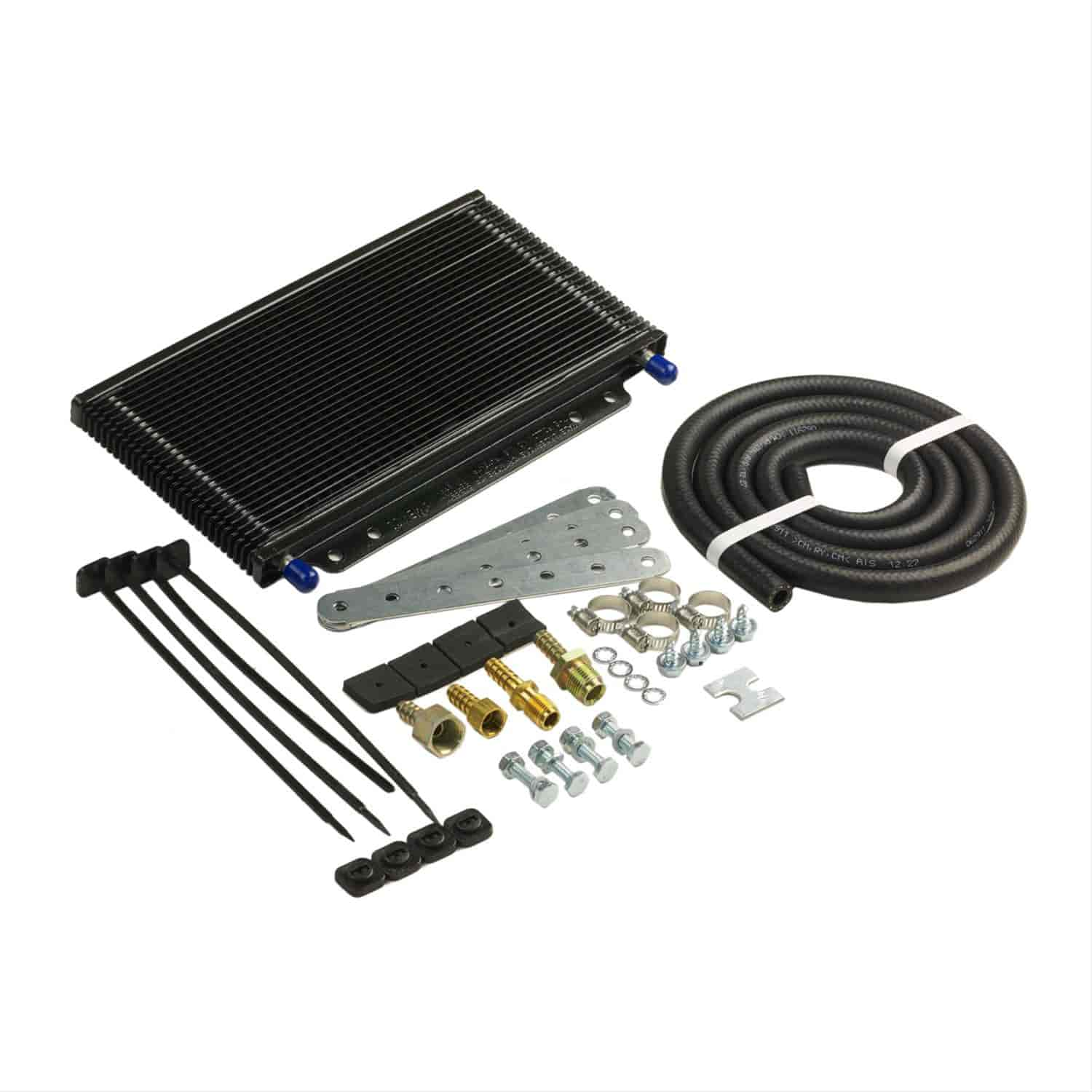
B&M sells what they call a super cooler and a phone call to their tech dept will get you more info. A few months ago, Car Craft magazine had an article on installing an auxillary cooler. If placed in front of your radiator or AC condenser, they suggest 3/8ths-1/2" open air space for optimal efficiency. You don't want direct metal to metal contact to avoid transfer of heat and allow cool air to flow through. A temp gauge in your trans pan will help keep an eye on it. BTW...it can be mounted in any orientation to suit the space you have. Making your own mounting brackets can be a PITA and using tie wraps through the radiator is not recommended.
Last edited by Red 69; Jan 17, 2012 at 03:32 PM.

Burning Brakes


Joined: Sep 2009
Posts: 1,003
Likes: 48
From: hickory NC
C4 of Year Finalist (appearance mods) 2019
2017 C4 of Year Finalist
And here is where I mounted mine. Used as the only cooler. After going thru a couple autos, in other "toys" I've had in the past, I don't use the radiator cooler at all.


Corvette Stories
The Best of Corvette for Corvette Enthusiasts

150 hp to 1,250 hp: Every Corvette Generation Compared by the Specs That Matter
Joe Kucinski
8 Coolest Corvette Pace Cars (and Replicas) of All Time
Verdad Gallardo
Top 10 Corvette Engines RANKED by Peak Torque (70+ Years of Muscle!)
Joe Kucinski
Corvette ZR1X Will Be Pacing the Indy 500, And Could Probably Race, Too!
Verdad Gallardo
Top 10 Corvettes Coming to Mecum Indy 2026!
Brett Foote
Top 10 C9 Corvette MUST-HAVES to Fix These C8 Generation Flaws!
Michael S. Palmer
10 Revolutionary 'Corvette Firsts' Most People Don't Know
Joe Kucinski
5 Reasons to Upgrade to an LS6-Powered Corvette; 5 Reasons to Stay LT2
Michael S. Palmer
2027 Corvette vs The World: Every C8 vs Its Closest Competitor
Joe Kucinski
Pro
Joined: May 2011
Posts: 581
Likes: 5
From: BC
But what you really want the high efficiencey heat transfer for is the times when you build it on the brake and cause the temp in the convertor to spike. Service manuals forever have cautioned about limiting any kind of stall testing to a few seconds because of how high and how fast the temps in the converter rise. When you hold it on the brakes you can shoot that fluid up over 300 in no time at all and the liquid to liquid cooler brings it back down to eng temp very quickly. An air to fluid will get it down eventually, but you want to bring it down under 200 as quickly as you can.
Steve g
Le Mans Master

Joined: Mar 2008
Posts: 5,948
Likes: 72
From: Oxford MA-----You just lost the game!!!!
Yeah, liquid cooling is always better. What some people don't realize, is that the transmission cooler inside the radiator is using engine coolant that has gone thru the radiator and been cooled somewhat. The temp gauge tells you the temp of the coolant before it gets to the radiator.
Scott
Scott

Melting Slicks
Joined: Mar 2008
Posts: 2,989
Likes: 198
From: Meriden CT
The temps should be near the same temp, engine coolant temp is the correct temp for trans fluid to run at. The fluids are designed to run at those temps and I've never heard of any advantage to running them cooler. A lot of current trans designs lock out overdrive until the trans warms some. Without the a/f cooler you'd go a long time without od in cold climates.
But what you really want the high efficiencey heat transfer for is the times when you build it on the brake and cause the temp in the convertor to spike. Service manuals forever have cautioned about limiting any kind of stall testing to a few seconds because of how high and how fast the temps in the converter rise. When you hold it on the brakes you can shoot that fluid up over 300 in no time at all and the liquid to liquid cooler brings it back down to eng temp very quickly. An air to fluid will get it down eventually, but you want to bring it down under 200 as quickly as you can.
Steve g
But what you really want the high efficiencey heat transfer for is the times when you build it on the brake and cause the temp in the convertor to spike. Service manuals forever have cautioned about limiting any kind of stall testing to a few seconds because of how high and how fast the temps in the converter rise. When you hold it on the brakes you can shoot that fluid up over 300 in no time at all and the liquid to liquid cooler brings it back down to eng temp very quickly. An air to fluid will get it down eventually, but you want to bring it down under 200 as quickly as you can.
Steve g

I use an "auxiliary" cooler along with the cooler inside the radiator. I believe they're marketed as auxiliary and not intended as primary coolers. I use a temperature sender mounted in the pan for a little peace of mind.
Consider the radiator shipping costs VS a transmission re-build.
Le Mans Master
Joined: Sep 2002
Posts: 5,236
Likes: 898
From: Myrtle Beach SC
I pulled my radiator for repair and have replaced the cooling lines and hoses. I'm finding the hoses are not simply easing over the lip of the cooling lines. Even tried putting some tranny fluid on the lines to ease the hose over but its just giving. Looks like a snake that is attempting to swallow a possum!
Suggestions?
Suggestions?
Le Mans Master
Joined: Sep 2002
Posts: 5,236
Likes: 898
From: Myrtle Beach SC
Team Owner
Joined: Jul 1999
Posts: 65,492
Likes: 230
From: Orange Park Florida
The temps should be near the same temp, engine coolant temp is the correct temp for trans fluid to run at. The fluids are designed to run at those temps and I've never heard of any advantage to running them cooler. A lot of current trans designs lock out overdrive until the trans warms some. Without the a/f cooler you'd go a long time without od in cold climates.
But what you really want the high efficiencey heat transfer for is the times when you build it on the brake and cause the temp in the convertor to spike. Service manuals forever have cautioned about limiting any kind of stall testing to a few seconds because of how high and how fast the temps in the converter rise. When you hold it on the brakes you can shoot that fluid up over 300 in no time at all and the liquid to liquid cooler brings it back down to eng temp very quickly. An air to fluid will get it down eventually, but you want to bring it down under 200 as quickly as you can.
Steve g
But what you really want the high efficiencey heat transfer for is the times when you build it on the brake and cause the temp in the convertor to spike. Service manuals forever have cautioned about limiting any kind of stall testing to a few seconds because of how high and how fast the temps in the converter rise. When you hold it on the brakes you can shoot that fluid up over 300 in no time at all and the liquid to liquid cooler brings it back down to eng temp very quickly. An air to fluid will get it down eventually, but you want to bring it down under 200 as quickly as you can.
Steve g
Team Owner
Joined: Jul 1999
Posts: 65,492
Likes: 230
From: Orange Park Florida
I use an "auxiliary" cooler along with the cooler inside the radiator. I believe they're marketed as auxiliary and not intended as primary coolers. I use a temperature sender mounted in the pan for a little peace of mind.
Consider the radiator shipping costs VS a transmission re-build.
Pro
Joined: May 2011
Posts: 581
Likes: 5
From: BC
I rebuild my own trannies , and so remove all that temp sense stuff, lockup is when 4th gear hits, or if I flip a switch on the dash, for the motor home, the computer or manual any gear for the vette which also has a switch.....ever tranny I have ever had shifts far better when cold than when hot...I use Trans Go shift kits too, which frames my comment about 30f running if I could....I like a solid WACK from gear to gear, not some wimpy smooth slider like it was a old Dynaflow....
We're in a cold snap of around -25C and my old Cummins shifts far too soon until it warms up. Without a fluid to fluid cooler it would probably take forever for it to shift properly, if it did at all. Cold fluid doesn't get in tight places and lube as well. I know you can bypass cold temp safety features and give yourself od, but I believe they had a reason for spending the money to put them there.
Managing trans fluid temps in high torque diesels has been a challenge for engineers. The old Dodges came factory with a fluid to fluid and an air to fluid cooler in front of the rad. For heavy duty applications there was an optional 3rd cooler mounted under the bed. I'm confident that they kept the fluid cooler and made it first in line out of the trans for a reason.
Just saying that trans fluid running engine temp will last just as long as fluid running below it and the fluid cooler gets a jump on things when they're climbing fast.
Steve g
Burning Brakes

Joined: May 2009
Posts: 1,232
Likes: 6
From: Tucson AZ
St. Jude Donor '12
Wow, I went from panic to placid over this thread. I made the mistake of choosing not to use the radiator to cool the trans.
My reasoning was that I want the radiator to be dedicated to cooling the 700+ HP small block engine - I don't want the trans to add to that cooling requirement and I expect the engine will still run pretty hot so I don't want the trans cooling limited by the engine.
Now I see my logic is incomplete without mentioning the smoothing effect the efficiency of fluid to fluid heat exchange provides.
The trans is a 700r4 with (a stronger version of) 4L80e internals and a 10" 3200 stall TC.
I'll be running dual B&M 70268 11" X 7½" Super Coolers in series with (2) 9" pusher Spal fans thermostatically switched at 185on/165off. mounted about 1½" in front of the radiator.
¿¿Will this be enough to get the job done?? (I imagine the answer is "It depends") but I'd like to hear you guys weigh in.
ps. MrVette, you are a transmission common sense rockstar(complete with the rockstar hair)!
My reasoning was that I want the radiator to be dedicated to cooling the 700+ HP small block engine - I don't want the trans to add to that cooling requirement and I expect the engine will still run pretty hot so I don't want the trans cooling limited by the engine.
Now I see my logic is incomplete without mentioning the smoothing effect the efficiency of fluid to fluid heat exchange provides.
The trans is a 700r4 with (a stronger version of) 4L80e internals and a 10" 3200 stall TC.
I'll be running dual B&M 70268 11" X 7½" Super Coolers in series with (2) 9" pusher Spal fans thermostatically switched at 185on/165off. mounted about 1½" in front of the radiator.
¿¿Will this be enough to get the job done?? (I imagine the answer is "It depends") but I'd like to hear you guys weigh in.
ps. MrVette, you are a transmission common sense rockstar(complete with the rockstar hair)!
Le Mans Master
Joined: May 2006
Posts: 9,993
Likes: 1,136
From: League City Tx
You guys are crazy over this cooler stuff....man you'd swear you guys are driving car haulers or tour buses.....LOL
Pretty much any decent quality 20,000 btu cooler (running alone, no radiator cooler, no fans) will be PLENTY for pretty much anything in a vette....
I use the biggest B&M Super Cooler, I think its a 30,000 in my Vette, I run a 3600 (flash) stall converter and drive in traffic thru brutal Houston Summers and never had a tranny overheating problem..
I have used this same B&M cooler in other street/strip cars with 4000+ stall converters and never had tranny problems...Been running tranny coolers only (no radiator cooling) on my hot rods for 20 years...
There is no need to re-invent the wheel here.......Now if you are thinking about towing 10-15k lbs up through the Ozark mountains or something then yes, you need additional cooling capacity but.....not for a 3500lb Vette...
Pretty much any decent quality 20,000 btu cooler (running alone, no radiator cooler, no fans) will be PLENTY for pretty much anything in a vette....
I use the biggest B&M Super Cooler, I think its a 30,000 in my Vette, I run a 3600 (flash) stall converter and drive in traffic thru brutal Houston Summers and never had a tranny overheating problem..
I have used this same B&M cooler in other street/strip cars with 4000+ stall converters and never had tranny problems...Been running tranny coolers only (no radiator cooling) on my hot rods for 20 years...
There is no need to re-invent the wheel here.......Now if you are thinking about towing 10-15k lbs up through the Ozark mountains or something then yes, you need additional cooling capacity but.....not for a 3500lb Vette...
Burning Brakes
Joined: May 2009
Posts: 1,232
Likes: 6
From: Tucson AZ
St. Jude Donor '12
You guys are crazy over this cooler stuff....man you'd swear you guys are driving car haulers or tour buses.....LOL
Pretty much any decent quality 20,000 btu cooler (running alone, no radiator cooler, no fans) will be PLENTY for pretty much anything in a vette....
I use the biggest B&M Super Cooler, I think its a 30,000 in my Vette, I run a 3600 (flash) stall converter and drive in traffic thru brutal Houston Summers and never had a tranny overheating problem..
I have used this same B&M cooler in other street/strip cars with 4000+ stall converters and never had tranny problems...Been running tranny coolers only (no radiator cooling) on my hot rods for 20 years...
There is no need to re-invent the wheel here.......Now if you are thinking about towing 10-15k lbs up through the Ozark mountains or something then yes, you need additional cooling capacity but.....not for a 3500lb Vette...
Pretty much any decent quality 20,000 btu cooler (running alone, no radiator cooler, no fans) will be PLENTY for pretty much anything in a vette....
I use the biggest B&M Super Cooler, I think its a 30,000 in my Vette, I run a 3600 (flash) stall converter and drive in traffic thru brutal Houston Summers and never had a tranny overheating problem..
I have used this same B&M cooler in other street/strip cars with 4000+ stall converters and never had tranny problems...Been running tranny coolers only (no radiator cooling) on my hot rods for 20 years...
There is no need to re-invent the wheel here.......Now if you are thinking about towing 10-15k lbs up through the Ozark mountains or something then yes, you need additional cooling capacity but.....not for a 3500lb Vette...