







Cam change under way...

Melting Slicks


Joined: Mar 2010
Posts: 2,967
Likes: 43
From: Bradenton Florida
2017 C4 of the Year Finalist
No-IL Events Coordinator
St. Jude Donor '12-'13-'14-'15-'16-'17

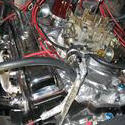
I just finished my cam swap. 12 hours start to finish. I pulled the pan, to install the front cover, not due to a mechanical problem. Drop the idler arm and you have plenty of clearance. You will need to remove the trans inspection cover also. Car runs great now.
[IMG] [/IMG]
[IMG] [/IMG]
[IMG] [/IMG]
[IMG]
[/IMG][IMG]
[/IMG][IMG]
[/IMG]
Le Mans Master


Joined: Oct 2002
Posts: 7,098
Likes: 378
From: Las Vegas - Just stop perpetuating myths please.
Use a calibrated torque wrench if u can.
I have new lifters and the new XE274 ready to go in. What's involved in pulling the rod and main bearing caps? Can you do it with the engine in the car? I'm familiar with the top part of the engine and working on it, below the block I'm a bit of a noob and I have no good way to pull the engine.
I did this after my last wiped cam as i found chunks on the oil pickup screen.
 Had a tiny particle scrape on one of the rod bearings and a considerable particle scrape on one of the mains (sorry can't recall which bearing numbers). I decided to replace the bad bearings and polish the crank journal by hand - yes while under the car.
Bearings are cheap so $$ not a issue. But i recall using strips of 400 then 600 paper to polish until no sharp ridges with my finger nail test. BTW i rolled out the old top brg with a cotter pin and rolled the replacement back in the same way.
Car runs ok. I had a knock from the bellhousing inspection cover that scared me for a while but now all is quite down below.
I can say where i really had to do that or not with my low mileage low power crate motor. I have seen cranks with some nasty large gouges rebearinged and returned to service with a smooth polish on the journal. But it was done mostly for my own piece of mind i guess.

Hope this helps,
cardo0


Drifting


Joined: Nov 2002
Posts: 1,691
Likes: 202
From: Loveland, CO
I would be curious also as to what oil you were using. Reworked engine with newer cam and aftermarket high seat pressure springs are recipe for disaster without proper oil. I think this engine still had flat tappets, didn't it?
Ralph.
Ralph.

Race Director


Joined: Apr 2003
Posts: 19,350
Likes: 654
From: Tampa, Florida
My old 79' L82 also had a broken main bolt. I think I saw it first through the drain hole.
Yep, just pull the steering out of the way. I had to also drill out the broken bolt while the engine was in the car. I used a trash bag to mask off the engine internals. It worked.
Yep, just pull the steering out of the way. I had to also drill out the broken bolt while the engine was in the car. I used a trash bag to mask off the engine internals. It worked.
I'm over on Downs Ave by the golf course. If you need a hand let me know.

Thread Starter
Pro

Joined: Oct 2007
Posts: 587
Likes: 0
From: Overland Park Kansas
Hrm, I took the filter off today.
http://www.telusplanet.net/public/dj...re_adapter.jpg
As far as I can tell mine looks like that. So that means it wasn't plugged right?
http://www.telusplanet.net/public/dj...re_adapter.jpg
As far as I can tell mine looks like that. So that means it wasn't plugged right?

Drifting
Joined: Dec 2005
Posts: 1,360
Likes: 3
From: NORTHEAST
Hrm, I took the filter off today.
http://www.telusplanet.net/public/dj...re_adapter.jpg
As far as I can tell mine looks like that. So that means it wasn't plugged right?
http://www.telusplanet.net/public/dj...re_adapter.jpg
As far as I can tell mine looks like that. So that means it wasn't plugged right?
Corvette Stories
The Best of Corvette for Corvette Enthusiasts

Top 10 Most Expensive Corvettes Ever Sold on Bring A Trailer
Brett Foote
10 Things Every Corvette Owner Needs (2026 Edition)
Michael S. Palmer
8 Most "Only Corvette Owners Understand" Quirks and Problems
Pouria Savadkouei
10 Reasons the C6 Z06 is Still A Performance Benchmark After 20 Years
Joe Kucinski
How Much Horsepower Every Corvette Engine "LOST" in 1972
Joe Kucinski
Top 10 DOs and DON'Ts for Protecting Your Convertible Top!
Michael S. Palmer
Top 10 Most Explosive Corvettes Ever Made: Power-to-Weight Ratio Ranked!
Joe Kucinski
150 hp to 1,250 hp: Every Corvette Generation Compared by the Specs That Matter
Joe Kucinski
8 Coolest Corvette Pace Cars (and Replicas) of All Time
Verdad Gallardo
Melting Slicks
Joined: Aug 2008
Posts: 2,200
Likes: 3
From: Lehigh county Pennsylvania
Thread Starter
Pro
Joined: Oct 2007
Posts: 587
Likes: 0
From: Overland Park Kansas
Should I just get a flathead and push hard and see if it moves? As for the filter, it was a Fram TG or whatever their better ones are.
Melting Slicks
Joined: Aug 2008
Posts: 2,200
Likes: 3
From: Lehigh county Pennsylvania
It won't take that much pushing with a straight slot screwdriver to see if it's operable. You could also remove the 2 capscrews that mount the adapter to the block. There is no seal to replace.

Melting Slicks

Joined: Oct 2002
Posts: 2,317
Likes: 111
From: St Louis MO
Hrm, I took the filter off today.
http://www.telusplanet.net/public/dj...re_adapter.jpg
As far as I can tell mine looks like that. So that means it wasn't plugged right?
http://www.telusplanet.net/public/dj...re_adapter.jpg
As far as I can tell mine looks like that. So that means it wasn't plugged right?
I'd guess that in your case, your bypass disk will move if you press on it - in this case, the probable times for filter bypass operation would be when oil is thick such as cold start-up, or when filter and oil become dirty.
Good luck!

Race Director
Joined: May 2005
Posts: 10,674
Likes: 122
From: Millington Illinois
St. Jude Donor '08-'09
A crankshaft requires a precision finish. Sanding it by hand in the car is not what I would be recommending especially when your removing enough material to take out a scratch you can feel with your nail.
The oil film between the journals on the crankshaft and the loaded portion of the main and rod bearings is only about .00005" thick when the engine is running. If the journals are too rough or have burrs, particles or other debris that sticks up above the surface, it can abrade the bearings and increase bearing wear and the risk of bearing seizure. Cast iron cranks typically contain about 4% carbon. The carbon forms little nodules of graphite surrounded by a relatively soft form of iron called "ferrite." When the crankshaft journals are ground and polished, the ferrite around the graphite nodules forms little burrs or jagged flaps that protrude above the surface. The height of these burrs can be as much as .00035", which is more than enough to cut across the oil film and dig into the bearings.
Ferrite burrs create a sawtooth-like finish on the surface that is directional, usually facing away from the direction the journal was ground or polished. If the sharp edges face away from the direction that the crankshaft normally rotates, it is said to be a "favorable" orientation because the burrs are less likely to dig into the bearings. On the other hand, if the sharp edges are towards the same direction of rotation, it is an "unfavorable" orientation and is much more likely to cause problems
Think you got it to less than 5/100,000 of true all the way across and perfectly round? If so you have skills.

Last edited by 63mako; Jan 30, 2012 at 08:34 PM.