




Vacuum or Mechanical secondaries

Thread Starter
Advanced


Joined: Mar 2011
Posts: 65
Likes: 3
 Vacuum or Mechanical secondaries
Hi all,I purchased an edelbrock 650 with vacuum secondaries,I,ve got a 4 speed and when I kick it down it does not feel like I,ve got any secondaries at all.I,m thinking now that I should have went with maybe a holly with mechanical secondaries and if so would I get that seat of the pants pull when they kick in.Personally I,d rather have the secondaries come in when I want them to rather than by vacuum.Any thoughts on this .Thanx in advance J.S.H.

Had a 1976 L-82, 4-sp


Joined: Mar 2011
Posts: 5,338
Likes: 1,213
From: Some days your the dog and some days your the hydrant.
Royal Canadian Navy
Hi all,I purchased an edelbrock 650 with vacuum secondaries,I,ve got a 4 speed and when I kick it down it does not feel like I,ve got any secondaries at all.I,m thinking now that I should have went with maybe a holly with mechanical secondaries and if so would I get that seat of the pants pull when they kick in.Personally I,d rather have the secondaries come in when I want them to rather than by vacuum.Any thoughts on this .Thanx in advance J.S.H.
 So I went with a Holley 650 Street HP for my 355, 4-sp. Love it!

Le Mans Master

Joined: Sep 2004
Posts: 5,116
Likes: 5
From: Livonia MI
Truth is, you can't just pull a carb out of the box, and expect it to be properly set up for your application. Carb tuning can be a lengthy process to get right, but well worth it. I always use vacuum secondary Q-Jets on the street, and when set up right, nothing will touch these. Instant throttle response everywhere, and pretty good fuel economy when cruising.

Melting Slicks

Joined: Feb 2006
Posts: 3,428
Likes: 5
From: Japan
When properly set up a vacuum-secondary carb can feel like a rocket sled when the secondaries come in. That said, a correctly-jetted Holley double pumper is almost always a better choice for performance in a manual-transmission car simply because the driver has control over secondary actuation. As said before, though, some tuning is still almost always going to be necessary to get it running perfectly...
Corvette Stories
The Best of Corvette for Corvette Enthusiasts

Top 10 Most Expensive Corvettes Ever Sold on Bring A Trailer
Brett Foote
10 Things Every Corvette Owner Needs (2026 Edition)
Michael S. Palmer
8 Most "Only Corvette Owners Understand" Quirks and Problems
Pouria Savadkouei
10 Reasons the C6 Z06 is Still A Performance Benchmark After 20 Years
Joe Kucinski
How Much Horsepower Every Corvette Engine "LOST" in 1972
Joe Kucinski
Top 10 DOs and DON'Ts for Protecting Your Convertible Top!
Michael S. Palmer
Top 10 Most Explosive Corvettes Ever Made: Power-to-Weight Ratio Ranked!
Joe Kucinski
150 hp to 1,250 hp: Every Corvette Generation Compared by the Specs That Matter
Joe Kucinski
8 Coolest Corvette Pace Cars (and Replicas) of All Time
Verdad Gallardo
Le Mans Master

Joined: Mar 2008
Posts: 5,948
Likes: 72
From: Oxford MA-----You just lost the game!!!!
You're not really supposed to feel the secondaries "kick in". When you can feel the secondaries "kick in", it's because there is an ever-so-slight stumble when they first come on. people who know how to tune a carb usually can't help but be amused when they hear people talking about "...feeling the secondaries kick in!"
That being said, it's your car, and if that's what floats your boat, then who is anybody else to criticize it, right? AVS stands for Adjustable Valve Secondary. Have you tried Adjusting the Secondary Valve opening rate? Adjust them to open sooner, until you get a bog, then slowly, a tiny bit at a time, adjust the Secondary Valve to open a little later, until you have juuuuust enough of a bog to be able to feel those babies kickin' in! Let us know how it works out for ya, and good luck!
Keep the shiny side up!
Scott
That being said, it's your car, and if that's what floats your boat, then who is anybody else to criticize it, right? AVS stands for Adjustable Valve Secondary. Have you tried Adjusting the Secondary Valve opening rate? Adjust them to open sooner, until you get a bog, then slowly, a tiny bit at a time, adjust the Secondary Valve to open a little later, until you have juuuuust enough of a bog to be able to feel those babies kickin' in! Let us know how it works out for ya, and good luck!
Keep the shiny side up!
Scott
Burning Brakes

Joined: Jan 2012
Posts: 943
Likes: 73
Before you dump that AVS, you need to adjust the secondary opening. Edelbrock made them easy to adjust and that's why they have the AVS model. If it's a daily driver, I have found that AVS carb is actually a pretty dependable running 650.
Safety Car

Joined: May 2003
Posts: 3,814
Likes: 105
From: Dearborn Heights Michigan
Ran a Holley 670 SA with vacuum secondary on a ZZ4 and now a Holley 750 double Pumper mechanical on a 383. Both performed great after much tuning with jet sizes and squirters on the DP.
As someone said above, it takes proper tuning whichever kind you run.
As someone said above, it takes proper tuning whichever kind you run.

Had a 1976 L-82, 4-sp
Joined: Mar 2011
Posts: 5,338
Likes: 1,213
From: Some days your the dog and some days your the hydrant.
Royal Canadian Navy
Mech'l secondaries leaves no doubt if they are working - just look down and blip the throttle. If the VS are not working, you'll probably begin to notice a lack of power above 4000 rpm no matter how hard you mash the accelerator.
Last edited by resdoggie; Jul 28, 2012 at 09:25 AM.

Tech Contributor


Joined: Aug 1999
Posts: 14,379
Likes: 6,390
From: At my Bar drinking and wrenching in Lafayette Colorado
...and you're right - I've shown several times through dyno testing numbers that it's tough to beat the performance of a Q-Jet on a street-driven car:
http://forums.corvetteforum.com/c3-t...-question.html
Lars
V8FastCars@msn.com
Last edited by lars; Jul 28, 2012 at 12:24 PM.

Le Mans Master


Joined: Oct 2000
Posts: 8,897
Likes: 1,357
From: Santa Ana CA
Lars,
Is it possible that using a smaller Holley (e.g., 650) could create a stronger signal across the venturies resulting in a fatter curve and more torque in the 3,500-4,000 range, maybe at the expense of a couple hp on the top end? My 600 dp certainly doesn't show a similar dip in that area.

Is it possible that based on their design, you can't strickly compare the two carbs of the same rated CFM?
Wouldn't an advantage of the Holley be that they offer a wider range of flow ratings than the Q-jet to better taylor the torque curve to the engine and driving style, assuming you have the time and expertise?
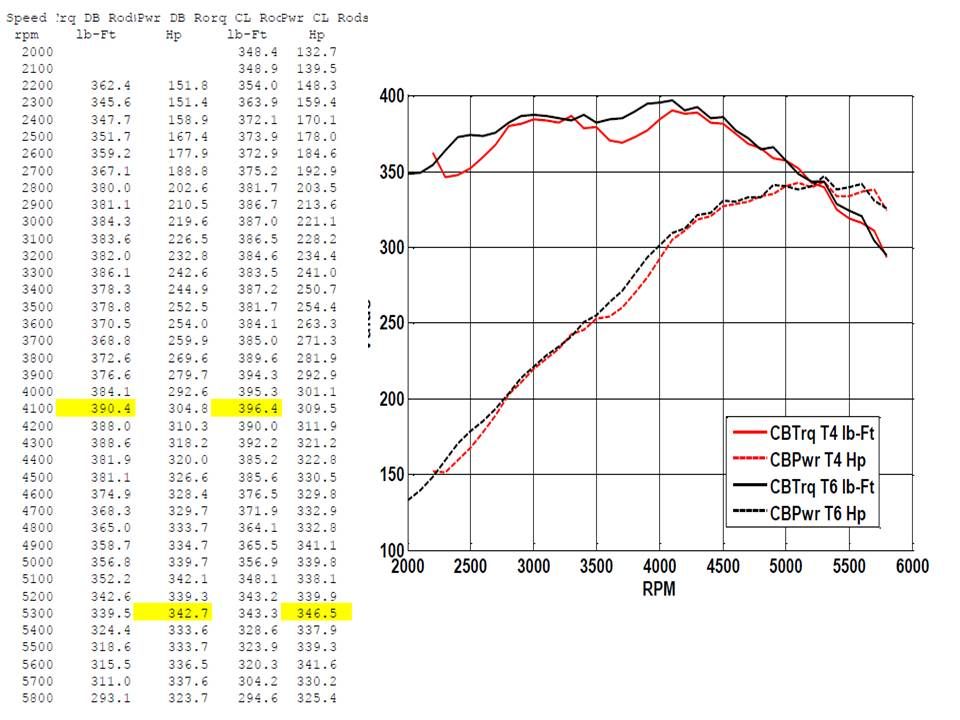
Is it possible that using a smaller Holley (e.g., 650) could create a stronger signal across the venturies resulting in a fatter curve and more torque in the 3,500-4,000 range, maybe at the expense of a couple hp on the top end? My 600 dp certainly doesn't show a similar dip in that area.
Is it possible that based on their design, you can't strickly compare the two carbs of the same rated CFM?
Wouldn't an advantage of the Holley be that they offer a wider range of flow ratings than the Q-jet to better taylor the torque curve to the engine and driving style, assuming you have the time and expertise?
Last edited by toddalin; Jul 28, 2012 at 02:24 PM.
Racer
Joined: Apr 2004
Posts: 370
Likes: 0
New England Events Coordinator
Scottyp, and/or Lars, I have a 70 350/300 with the Qjet, I do not have any issues with the carb but, I question if the secondaries open. Should I notice a huge kick at say 70MPH when I stomp on it, or hear a big sucking noise or surge in speed. What is the simplest way to test if the secondaries open at WOT?

Instructor
Joined: May 2012
Posts: 103
Likes: 0
From: Warren MI
Scottyp, and/or Lars, I have a 70 350/300 with the Qjet, I do not have any issues with the carb but, I question if the secondaries open. Should I notice a huge kick at say 70MPH when I stomp on it, or hear a big sucking noise or surge in speed. What is the simplest way to test if the secondaries open at WOT?
Tech Contributor
Joined: Aug 1999
Posts: 14,379
Likes: 6,390
From: At my Bar drinking and wrenching in Lafayette Colorado
Scottyp, and/or Lars, I have a 70 350/300 with the Qjet, I do not have any issues with the carb but, I question if the secondaries open. Should I notice a huge kick at say 70MPH when I stomp on it, or hear a big sucking noise or surge in speed. What is the simplest way to test if the secondaries open at WOT?
Lars
V8FastCars@msn.com

Team Owner

Joined: Oct 2004
Posts: 81,241
Likes: 3,063
From: altered state
St. Jude Donor '05
Just fix what you got. If adjusted properly the motor only uses what it needs anyway. Should be a nice smooth transition and pull like the others say. If its a sudden lurch something isnt tuned right.