


Mallory 5048201H timing


Thread Starter
Cruising

Joined: Oct 2012
Posts: 10
Likes: 0
 Mallory 5048201H timing
Car info:
1969 Corvette base
350CI 300hp (3970010)
4 speed manual
headers
edelbrock thunder series 650cfm carb
edelbrock performer intake manifold
291-heads not sure if 1.94 or 2.02
electric fuel pump holley red
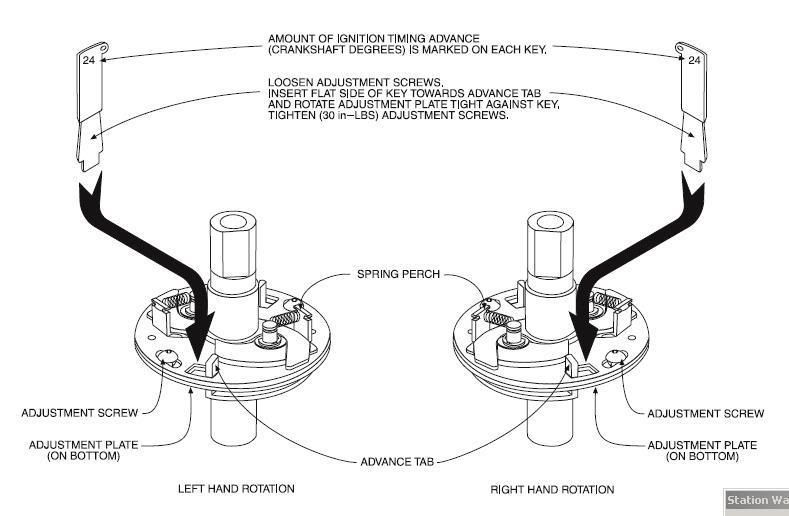
Distributor: Mallory 5048201H YH Magnetic Pickup, Mechanical Advance, Chevy, Big/Small Block, Each
need to get Advance curve change kit.
currently running 14* initial timing waiting on my dial back timing light to see what my total timing is.
my question if anyone has this distributor what springs are you running or recommendations on what springs i should be running
1969 Corvette base
350CI 300hp (3970010)
4 speed manual
headers
edelbrock thunder series 650cfm carb
edelbrock performer intake manifold
291-heads not sure if 1.94 or 2.02
electric fuel pump holley red
Distributor: Mallory 5048201H YH Magnetic Pickup, Mechanical Advance, Chevy, Big/Small Block, Each
need to get Advance curve change kit.
currently running 14* initial timing waiting on my dial back timing light to see what my total timing is.
my question if anyone has this distributor what springs are you running or recommendations on what springs i should be running
Thread Starter
Cruising
Joined: Oct 2012
Posts: 10
Likes: 0

Tech Contributor


Joined: Aug 1999
Posts: 14,377
Likes: 6,377
From: At my Bar drinking and wrenching in Lafayette Colorado
Some general comments and suggestions on your setup:
Your heads do not have efficient chambers, and want a bit of timing advance to make best torque. Plan on running total timing in the 36 - 38 range.
Without vacuum advance, you want to run a very short mechanical curve with a bunch if initial, so you get the benefit of good throttle response off idle and reduced engine temps at cruise. You don't have a bunch of compression on that engine if the bottom end and heads are stock, so you can run your initial timing up in the 20 - 24 degree range without any trouble starting the engine. So run a short, 14-degree advance curve to give it a bunch of initial and limit total as noted above to 36 - 38. Get it "all-in" by 2800 rpm.
For as mild as your engine is, you would really be better off running a distributor with vacuum advance...
Lars
Your heads do not have efficient chambers, and want a bit of timing advance to make best torque. Plan on running total timing in the 36 - 38 range.
Without vacuum advance, you want to run a very short mechanical curve with a bunch if initial, so you get the benefit of good throttle response off idle and reduced engine temps at cruise. You don't have a bunch of compression on that engine if the bottom end and heads are stock, so you can run your initial timing up in the 20 - 24 degree range without any trouble starting the engine. So run a short, 14-degree advance curve to give it a bunch of initial and limit total as noted above to 36 - 38. Get it "all-in" by 2800 rpm.
For as mild as your engine is, you would really be better off running a distributor with vacuum advance...
Lars
Tech Contributor
Joined: Aug 1999
Posts: 14,377
Likes: 6,377
From: At my Bar drinking and wrenching in Lafayette Colorado
The "best" distributor and ignition system to use is the one you're comfortable with setting up and tuning. Any two systems, set up with the same timing curve, will perform virtually the same on a mild street car. For a mild performance street-driven car, I also highly recommend getting one with vacuum advance, and there are many to chose from.
To demonstrate the equivalent performance from one system to another, I actually did dyno testing at Westech with Hot Rod Magazine several years ago. Here are the results that I've published here on the Forum before:
A few years ago, I did a bit of dyno testing at Westech Performance with Matt King, former Editor of Hot Rod Magazine. We tested several of the aftermarket capacitive discharge systems and top-end distributors against a plain ol' points-type distributor. The engine was a nice street-type 302 Ford putting out 370 horsepower. We tested ignition systems and distributors from Crane, MSD, and Mallory, making sure that each distributor had exactly the same centrifugal advance curve in it with the same total timing. Once these nice aftermarket systems were tested, we went out in the parking lot and pulled the stock points distributor out of Matt King's crap Falcon: We set it up with the same advance curve on Westech's distributor machine and dropped it in the 302 test engine. Results: There was no change in the engine's performance whatsoever at any point on the rpm curve. Absolutely none.
So here's the recommendation: Run whatever distributor you're comfortable with tuning and curving, and set it up with a good performance curve to match the needs of your engine. Whether this is a tach-drive points-type distributor, an HEI, or an MSD ProBillet is completely irrelevant as long as you can get it set up right. Buy something of good quality that is easily tunable, and make sure you run vacuum advance on any street-driven engine. Trigger boxes, amplifiers, huge coils, and fancy systems will not gain you anything on a moderate performance street engine - spend your time getting the curve and total timing set up right on whatever system you use - that's where the power is.
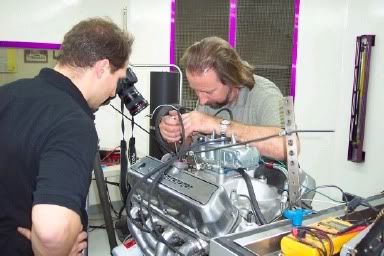
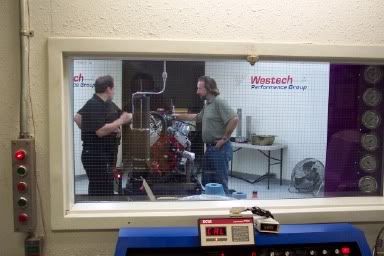
Here's Matt King (black shirt) and me setting up the points distributor from his Falcon in the 302 test engine to run head-to-head against the top-end capacitive discharge systems:
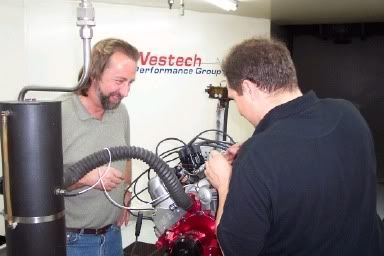
Notice that we even used the old crap wires out of Matt's Falcon for the testing:
Here's the same engine with one of the fancy aftermarket systems in it and some really nice red plug wires:
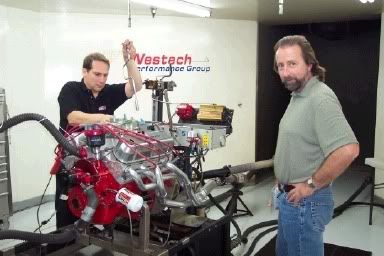
Famed Westech Dyno Operator Steve Brule (left) overseeing the testing:
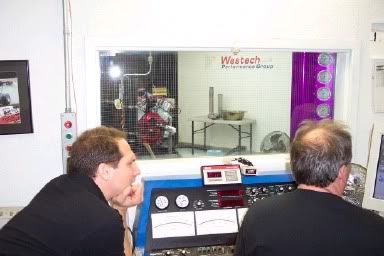
Results: Absolutely no change in power whatsoever from one system to another, as long as the advance curve remained the same (note Matt King's astounded "I can't freakin believe it" expression):
 [/QUOTE]
To demonstrate the equivalent performance from one system to another, I actually did dyno testing at Westech with Hot Rod Magazine several years ago. Here are the results that I've published here on the Forum before:
A few years ago, I did a bit of dyno testing at Westech Performance with Matt King, former Editor of Hot Rod Magazine. We tested several of the aftermarket capacitive discharge systems and top-end distributors against a plain ol' points-type distributor. The engine was a nice street-type 302 Ford putting out 370 horsepower. We tested ignition systems and distributors from Crane, MSD, and Mallory, making sure that each distributor had exactly the same centrifugal advance curve in it with the same total timing. Once these nice aftermarket systems were tested, we went out in the parking lot and pulled the stock points distributor out of Matt King's crap Falcon: We set it up with the same advance curve on Westech's distributor machine and dropped it in the 302 test engine. Results: There was no change in the engine's performance whatsoever at any point on the rpm curve. Absolutely none.
So here's the recommendation: Run whatever distributor you're comfortable with tuning and curving, and set it up with a good performance curve to match the needs of your engine. Whether this is a tach-drive points-type distributor, an HEI, or an MSD ProBillet is completely irrelevant as long as you can get it set up right. Buy something of good quality that is easily tunable, and make sure you run vacuum advance on any street-driven engine. Trigger boxes, amplifiers, huge coils, and fancy systems will not gain you anything on a moderate performance street engine - spend your time getting the curve and total timing set up right on whatever system you use - that's where the power is.
Here's Matt King (black shirt) and me setting up the points distributor from his Falcon in the 302 test engine to run head-to-head against the top-end capacitive discharge systems:
Notice that we even used the old crap wires out of Matt's Falcon for the testing:
Here's the same engine with one of the fancy aftermarket systems in it and some really nice red plug wires:
Famed Westech Dyno Operator Steve Brule (left) overseeing the testing:
Results: Absolutely no change in power whatsoever from one system to another, as long as the advance curve remained the same (note Matt King's astounded "I can't freakin believe it" expression):
[/QUOTE]
Last edited by lars; Nov 12, 2012 at 08:41 AM.









