






Carb CFM size

Thread Starter
Advanced

Joined: Sep 2012
Posts: 86
Likes: 2
From: Rochester NY
 Carb CFM size
Hello,
My '79 has a 350 with what the previous owner describes as a radical cam. It has a 10.5 : 1 compression. I have a 750 Edelbrock that I'm unhappy with because I cant get it to stop stalling on turns (yes the floats are where Edelbrock claims they should be). It runs well other wise. Strong accelaration but no ability to turn unless I give it gas. Of course then the rear tires break loose and I fish tail.
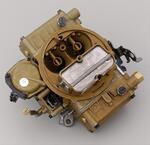
If I get a Holley carb to replace it someday should I get a 750 again? It seems that the 650 is more appropriate to my car when I punch the numbers into the CFM calculators, but maybe the 750 the right one. The previous owner was a mechanic and I am not, so I think he knows what he was doing. (We don't speak so I can't ask him).
If I use 7000 as my max RPM with a .95% volumetric efficiency it ='s 673.46 CFM. I dont know my max RPM but I have never buried the needle and it only goes up to 7000. So doesn't a 650 carb make more sense?
Thoughts and help appreciated, thanks!
My '79 has a 350 with what the previous owner describes as a radical cam. It has a 10.5 : 1 compression. I have a 750 Edelbrock that I'm unhappy with because I cant get it to stop stalling on turns (yes the floats are where Edelbrock claims they should be). It runs well other wise. Strong accelaration but no ability to turn unless I give it gas. Of course then the rear tires break loose and I fish tail.
If I get a Holley carb to replace it someday should I get a 750 again? It seems that the 650 is more appropriate to my car when I punch the numbers into the CFM calculators, but maybe the 750 the right one. The previous owner was a mechanic and I am not, so I think he knows what he was doing. (We don't speak so I can't ask him).
If I use 7000 as my max RPM with a .95% volumetric efficiency it ='s 673.46 CFM. I dont know my max RPM but I have never buried the needle and it only goes up to 7000. So doesn't a 650 carb make more sense?
Thoughts and help appreciated, thanks!

Team Owner


Joined: Jan 2006
Posts: 37,637
Likes: 3,118
From: Crossville TN
If you want the carb to limit the potential power of the engine, then use a carb with slightly less capacity than the engine. However, most folks do not want the carb to be the limiting factor and they select a carb with somewhat more capacity than the engine. I would think that a 750cfm carb or a Q-jet (that is self-regulating) would be about right for your car. I do not think much of the Edelbrock 750cfm carb, as it is a remake of the old Carter AFB made in the early 60's and is an 'antique', IMO. It is functional and can be made to perform well at WOT, but it is relatively inefficient and not well balanced for normal driving situations. What carb you get depends on what type intake manifold you have (squarebore or spreadbore design) and how well it will flow. Since you [probably] have a squarebore manifold on your car, a rebuild/repair of your present carb or a replacement Holley with 750cfm capacity would be the simplest options.
Thread Starter
Advanced
Joined: Sep 2012
Posts: 86
Likes: 2
From: Rochester NY
Ugg, how do I ensure I have a square bore? What should I be looking at? Do I have to remove the carb to determine that?
Burning Brakes


Joined: Oct 2011
Posts: 956
Likes: 86
From: McDonough Georgia
Your car will only pull as much air as it needs. Most guys think huge cfm is good. Usually it is a waste of gas.
If you are like most of us, and drive a mildly hotrodded mouse motor, you will rarely, of ever, run at 6-7000 rpm or higher.
Regardless how enormous your motor, manifold, etc., if you are normally, like the vast majority of us, driving no more than 5-6000 rpm, a nice lightweight 650 cfm Holley is perfect.
If you are like most of us, and drive a mildly hotrodded mouse motor, you will rarely, of ever, run at 6-7000 rpm or higher.
Regardless how enormous your motor, manifold, etc., if you are normally, like the vast majority of us, driving no more than 5-6000 rpm, a nice lightweight 650 cfm Holley is perfect.

Le Mans Master


Joined: Oct 2006
Posts: 8,940
Likes: 35
From: El Cajon California
Spreadbore - The primary holes are smaller than the secondary holes
Squarebore - All bores are the same size
A nice Holley 650 vacuum secondary carb will work out just fine, if you have a manual transmission and steep gears consider a double pump however your gas mileage will suffer.
Squarebore - All bores are the same size
A nice Holley 650 vacuum secondary carb will work out just fine, if you have a manual transmission and steep gears consider a double pump however your gas mileage will suffer.
Race Director


Joined: May 2006
Posts: 18,734
Likes: 2,582
You can use a 750 if you stick with a vacuum secondary model. Look at you choices at this site
http://www.holley.com/types/Street%2...raditional.asp
http://www.holley.com/types/Street%2...raditional.asp
Thread Starter
Advanced
Joined: Sep 2012
Posts: 86
Likes: 2
From: Rochester NY
Thanks everyone. I currently have a mechanical secondary. Does this matter if I bought a new carb that is vacuum or do I need to stick with mechanical? Is one better than the other?
Also, I understand what the square bore and spread bore look like, but I can't tell by just looking at the engine can I? What do I need to remove to make sure which bore I have? I am assuming I nee this information before getting a new carb.
Thanks again.
Also, I understand what the square bore and spread bore look like, but I can't tell by just looking at the engine can I? What do I need to remove to make sure which bore I have? I am assuming I nee this information before getting a new carb.
Thanks again.
Corvette Stories
The Best of Corvette for Corvette Enthusiasts

Top 10 Most Expensive Corvettes Ever Sold on Bring A Trailer
Brett Foote
10 Things Every Corvette Owner Needs (2026 Edition)
Michael S. Palmer
8 Most "Only Corvette Owners Understand" Quirks and Problems
Pouria Savadkouei
10 Reasons the C6 Z06 is Still A Performance Benchmark After 20 Years
Joe Kucinski
How Much Horsepower Every Corvette Engine "LOST" in 1972
Joe Kucinski
Top 10 DOs and DON'Ts for Protecting Your Convertible Top!
Michael S. Palmer
Top 10 Most Explosive Corvettes Ever Made: Power-to-Weight Ratio Ranked!
Joe Kucinski
150 hp to 1,250 hp: Every Corvette Generation Compared by the Specs That Matter
Joe Kucinski
8 Coolest Corvette Pace Cars (and Replicas) of All Time
Verdad Gallardo
Burning Brakes
Joined: Jan 2009
Posts: 845
Likes: 54
From: Bangor, Northern Ireland
Thanks everyone. I currently have a mechanical secondary. Does this matter if I bought a new carb that is vacuum or do I need to stick with mechanical? Is one better than the other?
Also, I understand what the square bore and spread bore look like, but I can't tell by just looking at the engine can I? What do I need to remove to make sure which bore I have? I am assuming I nee this information before getting a new carb.
Thanks again.
Also, I understand what the square bore and spread bore look like, but I can't tell by just looking at the engine can I? What do I need to remove to make sure which bore I have? I am assuming I nee this information before getting a new carb.
Thanks again.
Post a pic of your setup as it's easier for people to see what's going on.
Aaron.

Melting Slicks


Joined: Oct 2002
Posts: 2,317
Likes: 111
From: St Louis MO
What is your intended usage? Daily driver, or competition?
What kind of exhaust system?
What kind of intake manifold? Square bore, spread bore, or dual bolt pattern?
Type of camshaft and lifters? Duration? Lobe separation?
Is the Edelbrock carb a 750 cfm Quadrajet, or the Edelbrock AFB look alike?
What kind of exhaust system?
What kind of intake manifold? Square bore, spread bore, or dual bolt pattern?
Type of camshaft and lifters? Duration? Lobe separation?
Is the Edelbrock carb a 750 cfm Quadrajet, or the Edelbrock AFB look alike?

Drifting

Joined: Mar 2009
Posts: 1,253
Likes: 4
From: East Wenatchee (2hours from n e where) WA
What is your intended usage? Daily driver, or competition?
What kind of exhaust system?
What kind of intake manifold? Square bore, spread bore, or dual bolt pattern?
Type of camshaft and lifters? Duration? Lobe separation?
Is the Edelbrock carb a 750 cfm Quadrajet, or the Edelbrock AFB look alike?
What kind of exhaust system?
What kind of intake manifold? Square bore, spread bore, or dual bolt pattern?
Type of camshaft and lifters? Duration? Lobe separation?
Is the Edelbrock carb a 750 cfm Quadrajet, or the Edelbrock AFB look alike?
 2 more must know;
trans and rear gear.
couple easy rules;
autos generally like vac secondarys. Manuals like mechanicals.
355 to 6-6500rpm w/ good low mid responce 650 square bore or a 750 spread bore.
355 over 6500 750cfm.
street oval and rr will usually like 100cfm less than drag race
good all around Q Jet!
I spent a lot of time trying to get a AFB to run on a short oval car years ago. Even with a 8* spacer it blubbered like a pig in the corner.

Le Mans Master
Joined: Mar 2008
Posts: 5,948
Likes: 72
From: Oxford MA-----You just lost the game!!!!
It sounds like what you need is not a new carb, but wider rear tires!
Your engine probably doesn't need a 750 cfm carb, but the thing is, with Holley's anyway, that the bigger carbs tend to just run better on an engine that has a really big cam. The big, long duration cam tends to make an engine that has relatively low manifold vacuum at idle, and so, doesn't pull fuel through the idle circuit as well. It doesn't get a good "signal", as they say. The larger Holley will have a larger idle circuit, and so, will tend to run better on an engine with a big cam. A smaller carb could be made to run well, but it's smaller idle circuit would need to be modified. Someone who really knows their way around a carb could do it pretty easily, but if you are at a level where trying to figure out if your carb is a square bore or not has you scratching your head, it's not something I would recommend taking a shot at. I don't mean any offense by that, it's just the way it is. For someone like you, a 750 would probably be the best choice. I think it would just be easier for you to get running well. If you wanted to take a crack at rebuilding a carb, you could go online and try to find a Holley 3310 that's not missing any pieces, buy a rebuild kit, and learn an awful lot about how a carb works in the process. Save some money, too.
I am pretty sure from your description that you are dealing with a square bore Edelbrock carb. It has a fuel float on each side of it, right? And those carbs are known for the behavior that you describe. (stalling while turning) Just to make sure, here is a pic of a square bore Edelbrock carb:
http://www.summitracing.com/parts/edl-1411/media/images
And here is a spread bore Edelbrock carb:
http://www.ebay.com/itm/Edelbrock-Q-...p2047675.l2557
Keep the shiny side up!
Scott
Your engine probably doesn't need a 750 cfm carb, but the thing is, with Holley's anyway, that the bigger carbs tend to just run better on an engine that has a really big cam. The big, long duration cam tends to make an engine that has relatively low manifold vacuum at idle, and so, doesn't pull fuel through the idle circuit as well. It doesn't get a good "signal", as they say. The larger Holley will have a larger idle circuit, and so, will tend to run better on an engine with a big cam. A smaller carb could be made to run well, but it's smaller idle circuit would need to be modified. Someone who really knows their way around a carb could do it pretty easily, but if you are at a level where trying to figure out if your carb is a square bore or not has you scratching your head, it's not something I would recommend taking a shot at. I don't mean any offense by that, it's just the way it is. For someone like you, a 750 would probably be the best choice. I think it would just be easier for you to get running well. If you wanted to take a crack at rebuilding a carb, you could go online and try to find a Holley 3310 that's not missing any pieces, buy a rebuild kit, and learn an awful lot about how a carb works in the process. Save some money, too.
I am pretty sure from your description that you are dealing with a square bore Edelbrock carb. It has a fuel float on each side of it, right? And those carbs are known for the behavior that you describe. (stalling while turning) Just to make sure, here is a pic of a square bore Edelbrock carb:
http://www.summitracing.com/parts/edl-1411/media/images
And here is a spread bore Edelbrock carb:
http://www.ebay.com/itm/Edelbrock-Q-...p2047675.l2557
Keep the shiny side up!
Scott

Team Owner
Joined: Oct 2004
Posts: 81,241
Likes: 3,063
From: altered state
St. Jude Donor '05
prefer a double pumper with a stick car you can feel with your foot so you can stay in the primaries whenever you want.
750 is a good universal # for most hot 350s on up..I will say yrs ago I got ahold of a well tuned 650 dp for my old 350 (dart heads Isky 280 etc) that made a world of difference over the 750 I had. On the street the smallest carb you can use that makes good power would be my choice.
Easy to get sucked into bigger is better just like cams and everything else.
750 is a good universal # for most hot 350s on up..I will say yrs ago I got ahold of a well tuned 650 dp for my old 350 (dart heads Isky 280 etc) that made a world of difference over the 750 I had. On the street the smallest carb you can use that makes good power would be my choice.
Easy to get sucked into bigger is better just like cams and everything else.