When you click on links to various merchants on this site and make a purchase, this can result in this site earning a commission. Affiliate programs and affiliations include, but are not limited to, the eBay Partner Network.
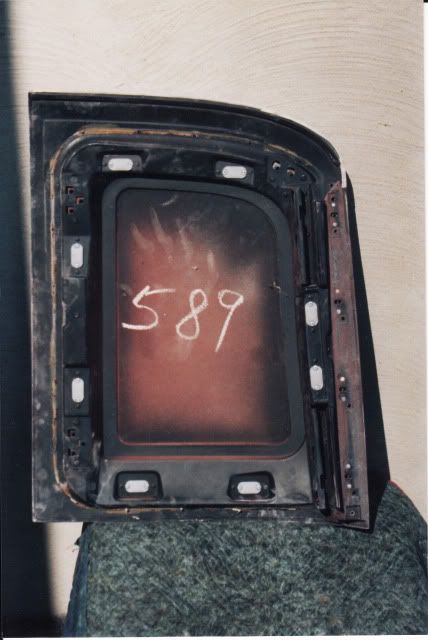
Can anyone offer a comprehensive source of information that shows (pictures) and describes factory assembly or inspection marks used on various components? I found the number "74" hand written in green on the inside surface of both T-top roof panels, and the digits 74 are the last two digits of the VIN of my 1972 coupe, so I believe these are the original roof panels from the factory. I would like to confirm this. I have found and preserved other similar marks since my coupe is unmolested for the most part and I intend to preserve as much of the original equipment, including these marks, as possible. Another example are the yellow mark on the fan hub and a green mark on the fan pulley, both of which are adjacent to the part numbers. - Any useful information will be much appreciated.
I am not aware of a "comprehensive" reference for assembly line marks and shorthand. Several different publications discuss some of them, but none mention all of them. Purchase the 70-72 NCRS Judging Guide for specific marks.
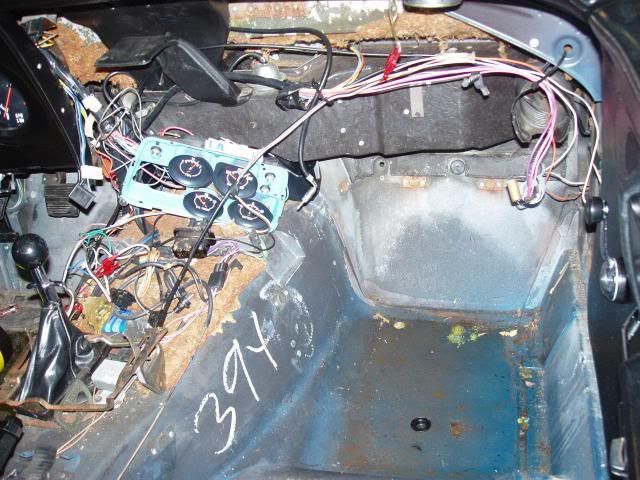
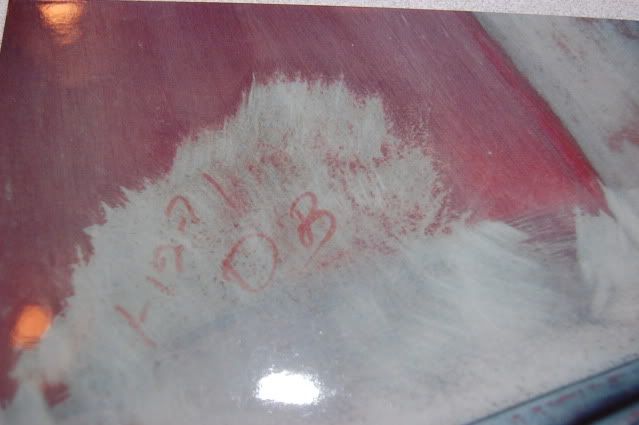
The 77 you found is likely to be a shortened version of the last three characters of your VIN and also serves as the job number. The job number would have appeared on the rear of the underbody (fuel tank could make it difficult to see), possibly on the passenger's side of the tranny hump -394 on this one:
394 could also have been abbreviated "94".
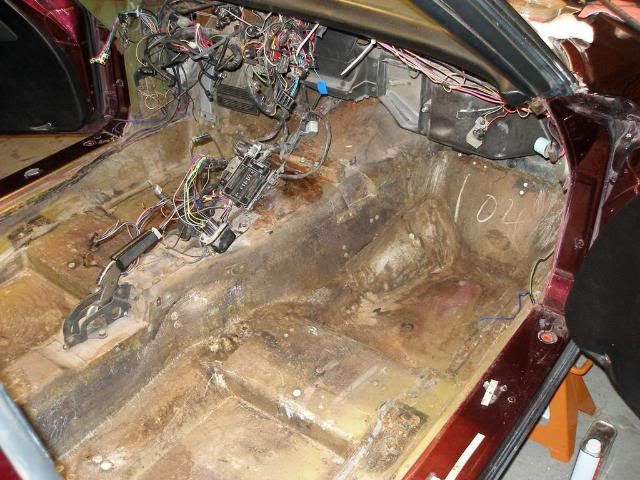
104 on the toe kick here:
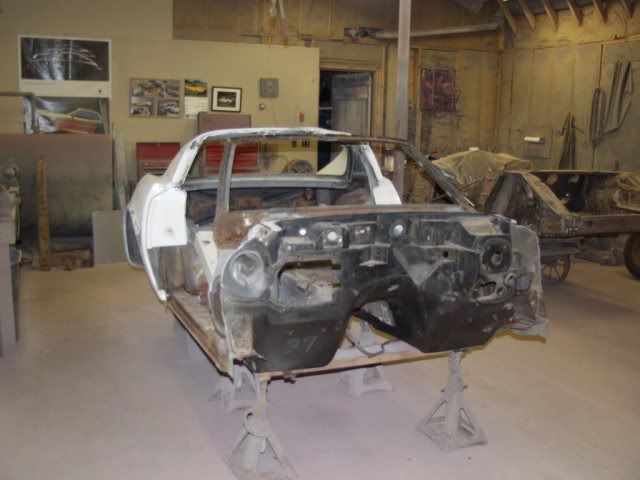
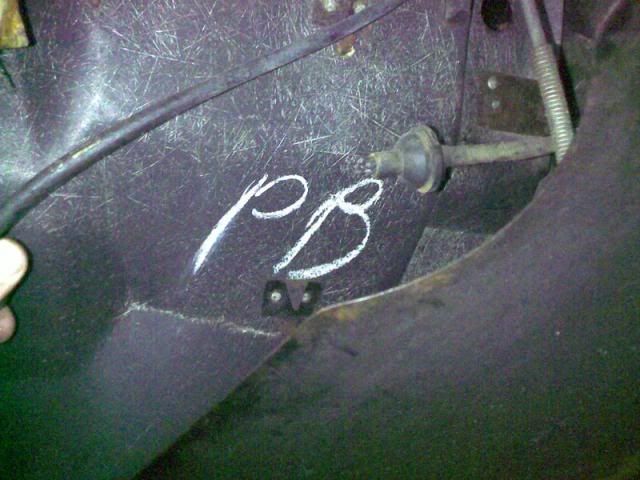
and passenger's toe kick under the hood. "27" here.
Shorthand for power brakes.
For 68-75 while convertibles were in production, you can also find these types of marks:
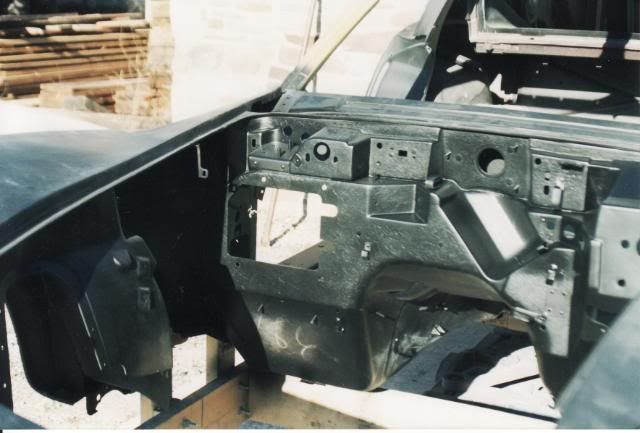
437 indicates an underbody prepared for a coupe; M40 for automatic transmission meaning the AT bump out has been added; and factory alarm (UA6). Pic with 104 on the toe kick above shows the TH400 bump out on the side of the tranny tunnel. Compare with the footwell shown for #394.
Your frame might show shim marks beside the body mounts.
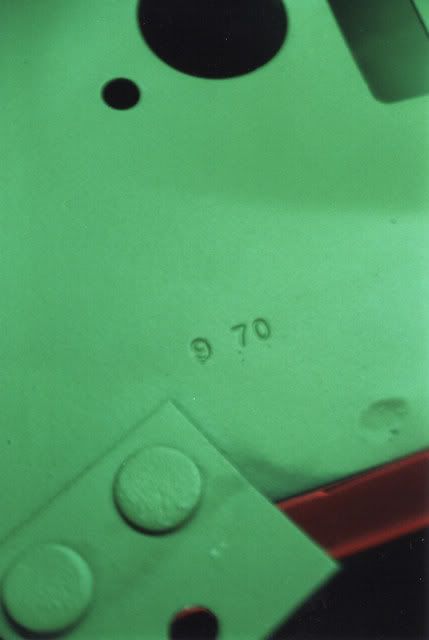
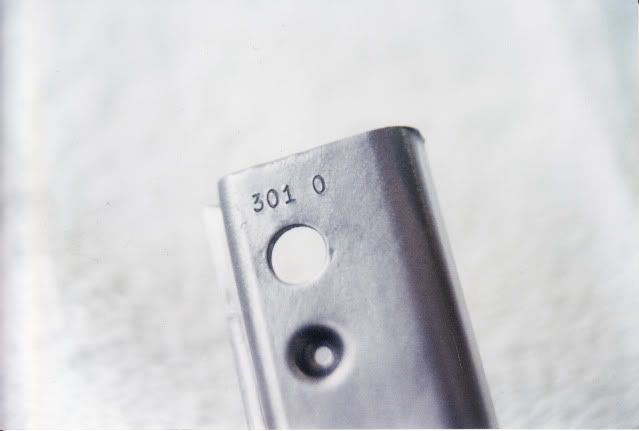
Parts inspector marks have been found on panels; handwritten dates have shown up.
Last edited by Easy Mike; Dec 5, 2012 at 04:29 PM.
Hi d,
As Mike said the numbers found on the body generally are the 'job number' which is loosely related to the vin.... sometimes.
I found the last 3 digits of the vin on the underside of one of the roof panels on my 71 as you did on your 72.
Regards,
Alan
Here's a rarely seen birdcage date.... driver's side hinge pillar, interior side. Mid January 71 built car
I have the 4th Edition of the "70-72 NCRS Judging Guide" as well as the '53 - '72 NCRS Corvette Specifications Guide, the '72 AIM and several other books and manuals, but have only found bits and pieces of information about these marks. I'm hoping that by opening this topic on this forum, people will share what they know so that others will be inclined to preserve the assembly, job number or inspection numbers as carefully as the date codes and part numbers found on other major components. It's very interesting to me to find these unique marks since they are a valuable part of my Corvette's history. Hopefully, others will feel the same and make an effort to document and preserve them. Once they're gone, they're gone for ever. The contributions that have been made so far are very interesting and useful. I hope to see more. Thanks much!
As has been said, the Job Number can usually be found written in crayon, on many panels of the car.
The car also had numerous other crayon and paint dabs, in various places. Crayon was used to mark the number of body mount shims used, on the frame near each of the body mounts. There were also paint dabs on the steering box, drive shaft and a number of other locations.
Quanta Products in Maryland, offers a very nice "Chassis Detailing Kit", that includes instructions, paint, crayons and a frame stencil correctly configured for your car. Below is a link to the kit for a 72 Corvette.
Hi d,
People also report finding production line worker signatures on the cars.
One place is on the underside of the rear deck and another is on the underside of the hood.
Regards,
Alan
I was able to read another mark today, which is very clearly "408" and is located in the engine compartment on the toe kick area of the firewall directly under the heater core, in the same location as the number "27" in the example that Mike provided. "408" is close to a couple of the RPO numbers offered in 1972, but none are 408, and the only factory options on my coupe are the AV3 seat belts, U69 radio and black leather interior (RPO 404). My coupe is Classic White (RPO 972) and retains the original M20 transmission. Since the build date of my coupe is 5/19/72, I suppose it's possible this could be a date code (April 08), but I think it's more likely to be a job number, as has been suggested. If I could load a picture of it, I would, but am currently restricted from posting attachments.
Hi D,
I believe the number you found on the toe board is generally considered to be the job number. It also appears on the build sheet and other locations on the body as has been mentioned.
Here's the # from my 71.
Regards,
Alan
Hi,
I think the job number was typically written on the underside of the rear deck on coupes (below the rear window).
I believe the 'R' may indicate 'radio'; perhaps indicating that the antenna hole needed to be cut?
Regards,
Alan
Dinther,
Might I suggest that you add the two reference texts below to your corvette library. Tom Russo devotes an entire chapter to Job Numbers and where to find them. The "Prince" book notes some inspection marks, colors, and locations, with photos examples. Both books are easily found on line.
Tooch
Last edited by Tooch1; May 17, 2017 at 12:28 PM.
Reason: Edited info!
Hi,
I think you need to be careful to differentiate between the various marks that were part of the ASSEMBLY process and thus were generally on every car, and INSPECTION marks, some of which might be on every car, but others may have been on just every 5th or 10th, or ?, car.
Regards,
Alan
For what it's worth, I've also found number 408R written under the rear deck just above the rear window tray on my '72 coupe. This same number, minus the R, is also written on the right side of the transmission tunnel (inside) as well as behind the shield on the lower right side of the firewall in the engine bay. My coupe came with the mono radio, which supports Alan's suggestion that it may indicate an antennae hole is needed.
The only conflict is that my tank sticker shows 374 in pencil, which is the result of subtracting 500 from my VIN of 521874. My transmission and engine match this VIN.
Hi D,
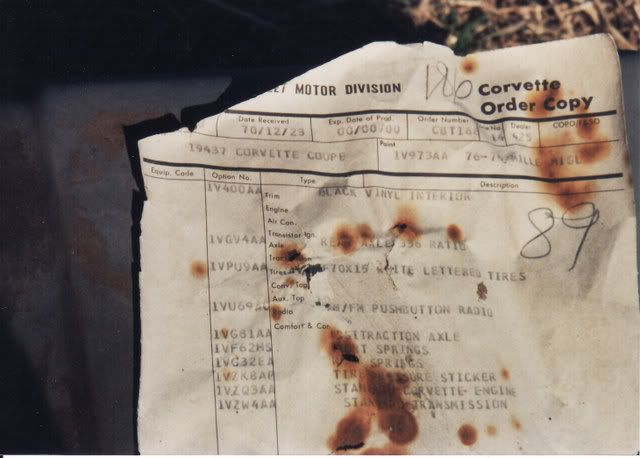
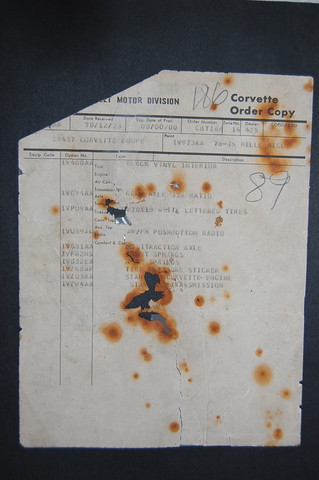
The Order Copy from my 71 shows both:
89… 500 less than last 3 digits of the build sequence number (589)
186….job number written various places on car's body.
Regards,
Alan
[QUOTE=Alan 71;1594756914]Hi D,
The Order Copy from my 71 shows both:
89… 500 less than last 3 digits of the build sequence number (589)
186….job number written various places on car's body.
Regards,
Alan
Yes Alan, Shortly after I posted I recalled being told by an NCRS inspector that, in my case, 408 is the position of my Corvette on the line during the day of production on which it was built. So, in my case, there is a job number of 374 written on the tank sticker and a production line number of 408 written on the car in various places.
I have four different markings under the rear deck on my 69 with an October 24th 1969 build date. In large white grease pencil is 306. Then in smaller print in yellow grease pencil and in different spots there is:
10-1, 1326, 10-22
No idea what the last three are other than the 10-22 is close to the build date.
Last edited by CanadaGrant; May 17, 2017 at 03:03 PM.
Hi CG,
I'm not sure how much lead there was from the time the rear clip was assembled until the car started on the production line.
10-1 seems like a lot because I believe storage was an issue at St.Louis so I won't think they'd have weeks worth of clips on hand.
The 10-22 seems just about right for body assembly on a car that passed the Trim Tag station on the 24th.
Regards,
Alan







 factory assembly, inspection marks