




Radiator question

Thread Starter
Racer

Joined: Jul 2010
Posts: 261
Likes: 0
From: Manahawkin NJ
 Radiator question
I have a cooling question that hope will spark a discussion radiators. I just installed the engine and trans on my '74 and I am up to the cooling and exhaust. At the same time I work on the crew of a road race car that is getting repowered for the upcoming season. The owner/driver said that he had heard that tilting the radiator will be beneficial to cooling. He also owns a few Corvettes so I thought that is where the idea came from. When I started measuring out everything he informed me that he was talking about the top being pushed out and the bottom moved closer to the motor, opposite from the Corvette set up.
Has anyone ever ran across any discussion on this? My thought is that the more you tilt the radiator the more restricted the flow would be since the tubes would change the air direction. On the other hand air would not have the pocket on top to be trapped between the hood and top of the rad support.
If forward on top and back on the bottom is better I would try to fit a lower longer aluminum radiator with more fins in the Corvette. Any thoughts would be great appreciated.
Tom
Has anyone ever ran across any discussion on this? My thought is that the more you tilt the radiator the more restricted the flow would be since the tubes would change the air direction. On the other hand air would not have the pocket on top to be trapped between the hood and top of the rad support.
If forward on top and back on the bottom is better I would try to fit a lower longer aluminum radiator with more fins in the Corvette. Any thoughts would be great appreciated.
Tom

Racer

Joined: Mar 2002
Posts: 406
Likes: 1
From: Maroochydore QLD
You didnt mention what you are trying to cool?
If it is a SBC very similar to what the car was shipped with then any aluminum stock size radiator will cool it IF you have the shroud and foam in place to force the air through the rad. I have not heard of tilting the rad up and dont know where you would gain the clearance to do so in a C3? One could also argue that the rad on a lean like ours are deflect more wind therefore exchanging more heat in the process, lets not forget what a radiator is, it is a heat sink, the more cool air it comes in contact with the more it will work, let the air pass through too quickly and it wont cool so well, same reason we have thermostats in our engines, if the water flows through too fast then it doesnt exchange the heat. I would just buy a good aluminum rad and make sure everything is in place to force air through it. Thats what I recently did and it cools perfectly on my stock L48.
If you have a fully worked rat motor then good luck, I hear from most that they just cant be cooled enough.
Cheers, Dennis.
If it is a SBC very similar to what the car was shipped with then any aluminum stock size radiator will cool it IF you have the shroud and foam in place to force the air through the rad. I have not heard of tilting the rad up and dont know where you would gain the clearance to do so in a C3? One could also argue that the rad on a lean like ours are deflect more wind therefore exchanging more heat in the process, lets not forget what a radiator is, it is a heat sink, the more cool air it comes in contact with the more it will work, let the air pass through too quickly and it wont cool so well, same reason we have thermostats in our engines, if the water flows through too fast then it doesnt exchange the heat. I would just buy a good aluminum rad and make sure everything is in place to force air through it. Thats what I recently did and it cools perfectly on my stock L48.
If you have a fully worked rat motor then good luck, I hear from most that they just cant be cooled enough.
Cheers, Dennis.

Le Mans Master

Joined: Jan 2000
Posts: 8,918
Likes: 27
From: New Hill NC
OH boy, this ought to get interesting.

Burning Brakes


Joined: Oct 2010
Posts: 1,160
Likes: 23
From: Prescott AZ
I think both opinions have good points. I have seen instances where not running a thermostat did cause insufficient cooling due to lack of contact time. But on the other side, the more air you can flow through the radiator probably the better. I am interested in what others have to say.

Race Director


Joined: Feb 2001
Posts: 11,295
Likes: 2,094
From: Grapevine Tx
2018 C3 of Year Finalist
2016 C3 of the Year Finalist
The radiator is tilted to fit under the hoodline of the C3. Also, on the C7, the radiator is tilted forward, not backward. A result of Corvette Racing experience.
Racer
Joined: Mar 2002
Posts: 406
Likes: 1
From: Maroochydore QLD
Just remember what I said, "the more air that comes in contact with it the more it cools", I was referring to the angle, if the air "hits" the core then it is cooling, if it passes between the cores it is doing very little, perhaps just clearing the radiant heat only and not the core heat. Just my logic being applied here, not proven science by the way so dont flame me. All I do know without doubt is that a stock aluminum radiator in my 79 works a treat, I drive at highway speeds for hours and not even close to over heating, just gets cooler in traffic.
Dennis.
Dennis.
Last edited by Aussie79; Jan 23, 2013 at 12:38 AM.

Race Director
Joined: Mar 2006
Posts: 14,112
Likes: 28
From: Florida
Rads have been tilted forward on Ford GT40s since the early 60s and on many other cars.
Advantages include lower front hood lines for down force, air extraction on top of the car instead of underneath, and a more direct air flow to the radiator since air intake is always low for aerodynamics.
The new Corvette C7 now has a rad heat vent in the hood.
Probably why the C3 could not was because of the headlite mechanisms.
Here is a GT40 rad installed

Here is a GT40 radiator hood vent

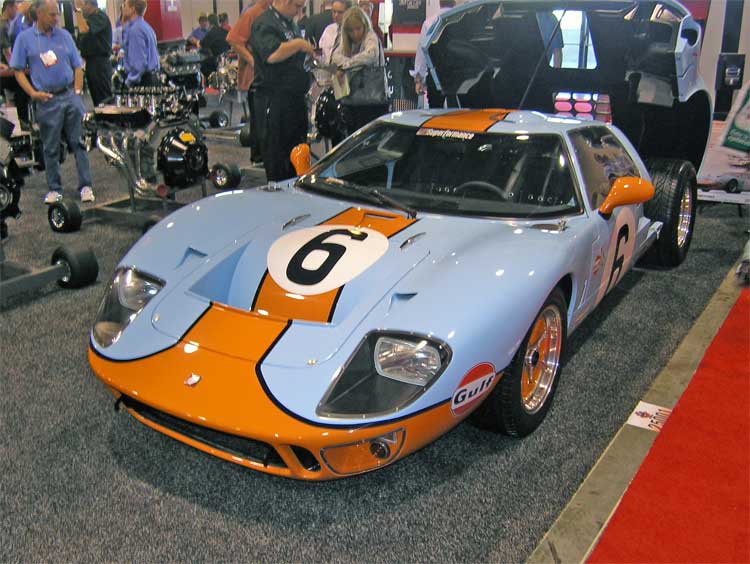
Here is a Greenwood style C3 racer setup

Higher coolant flow always increases cooling.
More airflow also increases cooling as does lower air temperature.
One purpose of the thermostat is to act as a restriction to build higher pressure in the engine to reduce coolant boiling in the critical areas.
Advantages include lower front hood lines for down force, air extraction on top of the car instead of underneath, and a more direct air flow to the radiator since air intake is always low for aerodynamics.
The new Corvette C7 now has a rad heat vent in the hood.
Probably why the C3 could not was because of the headlite mechanisms.
Here is a GT40 rad installed
Here is a GT40 radiator hood vent
Here is a Greenwood style C3 racer setup
I have seen instances where not running a thermostat did cause insufficient cooling due to lack of contact time. But on the other side, the more air you can flow through the radiator probably the better.
More airflow also increases cooling as does lower air temperature.
One purpose of the thermostat is to act as a restriction to build higher pressure in the engine to reduce coolant boiling in the critical areas.
Corvette Stories
The Best of Corvette for Corvette Enthusiasts

Top 10 Most Expensive Corvettes Ever Sold on Bring A Trailer
Brett Foote
10 Things Every Corvette Owner Needs (2026 Edition)
Michael S. Palmer
8 Most "Only Corvette Owners Understand" Quirks and Problems
Pouria Savadkouei
10 Reasons the C6 Z06 is Still A Performance Benchmark After 20 Years
Joe Kucinski
How Much Horsepower Every Corvette Engine "LOST" in 1972
Joe Kucinski
Top 10 DOs and DON'Ts for Protecting Your Convertible Top!
Michael S. Palmer
Top 10 Most Explosive Corvettes Ever Made: Power-to-Weight Ratio Ranked!
Joe Kucinski
150 hp to 1,250 hp: Every Corvette Generation Compared by the Specs That Matter
Joe Kucinski
8 Coolest Corvette Pace Cars (and Replicas) of All Time
Verdad Gallardo

Race Director

Joined: Jul 2001
Posts: 15,892
Likes: 42
As long as people hang their hat on this old myth, no reasonable discussion can take place.
Racer
Joined: Mar 2002
Posts: 406
Likes: 1
From: Maroochydore QLD
then no reasonable discussion can take place. Fire your garden hose at your BBQ hotplate, the water reflecting off will be virtually cold, now run water across your hotplate slowly and watch your hand get burned testing it's temperature, of course water flowing too fast does not exchange heat as well, fluid passing at an optimum speed designed by a thermal engineer will carry away the most heat, learn a little about thermal dynamics and entropy and I would be happy to have a reasonable discussion. Surely every mechanical design engineer since the early 1900's has been wrong
 I have run my car without the thermostat and it definately runs hotter at highway speeds, please take yours out if you wish.
Cheers, Dennis.
Le Mans Master
Joined: Jan 2000
Posts: 8,918
Likes: 27
From: New Hill NC
Just remember what I said, "the more air that comes in contact with it the more it cools", I was referring to the angle, if the air "hits" the core then it is cooling, if it passes between the cores it is doing very little, perhaps just clearing the radiant heat only and not the core heat. Just my logic being applied here, not proven science by the way so dont flame me. All I do know without doubt is that a stock aluminum radiator in my 79 works a treat, I drive at highway speeds for hours and not even close to over heating, just gets cooler in traffic.
Dennis.
Dennis.
No one will win that argument here. Someone will always come up with an personal experience to cite, proving one way or the other his beliefs.
Fact is, assuming laminar flows, more flow, of either water or air, through the heat exchanger, increases the transfer, (more cooling) period. The only way that isn't true is if there is cavitation or very high turbulence of the flows. Thats not likely in an automobile system, but maybe in some cases.
Last edited by wombvette; Jan 23, 2013 at 07:12 PM.
Race Director
Joined: Jul 2001
Posts: 15,892
Likes: 42
Hi Mike,
then no reasonable discussion can take place. Fire your garden hose at your BBQ hotplate, the water reflecting off will be virtually cold, now run water across your hotplate slowly and watch your hand get burned testing it's temperature, of course water flowing too fast does not exchange heat as well, fluid passing at an optimum speed designed by a thermal engineer will carry away the most heat, learn a little about thermal dynamics and entropy and I would be happy to have a reasonable discussion. Surely every mechanical design engineer since the early 1900's has been wrong I have run my car without the thermostat and it definately runs hotter at highway speeds, please take yours out if you wish.
Cheers, Dennis.
then no reasonable discussion can take place. Fire your garden hose at your BBQ hotplate, the water reflecting off will be virtually cold, now run water across your hotplate slowly and watch your hand get burned testing it's temperature, of course water flowing too fast does not exchange heat as well, fluid passing at an optimum speed designed by a thermal engineer will carry away the most heat, learn a little about thermal dynamics and entropy and I would be happy to have a reasonable discussion. Surely every mechanical design engineer since the early 1900's has been wrong
I have run my car without the thermostat and it definately runs hotter at highway speeds, please take yours out if you wish.Cheers, Dennis.
You'll find the amount of heat transferred from the heat plate to the water in each experiment will be virtually equal. This is secondary thermodynamics taught in secondary school as 'physics', not advanced stuff in Uni.
We're not dealing with transonic velocities in a car's cooling system or a threat of cavitation (assuming proper operating pressure) or the serious need to consider Reynolds numbers.
This is not rocket science unless people want to think it is.



Team Owner


Joined: Jun 2000
Posts: 38,923
Likes: 1,482
From: Southbound
Cruise-In II Veteran