






3x2 Experts-Please Help

Le Mans Master


Joined: Oct 2010
Posts: 6,937
Likes: 848
From: melbourne florida
2023 C3 of the Year Finalist - Modified

if i remember correctly, the mopar 6 pack carbs were very similar and they had plugs on the baseplate of the end carbs with mixture screws behind them. check with the holley tech line.

Thread Starter
Melting Slicks


Joined: Oct 2003
Posts: 2,189
Likes: 830
From: Chapel Hill NC
2025 c3 ('68-'73) of the Year Finalist - Unmodified
2025 C4 of the Year Finalist - Unmodified
2025 C8 Stingray of the Year Finalist - Unmodified
I had to move the car so I reinstalled the rear carb but put a blocking plate between the base of the carb and the manifold. There was a substantial improvement in idle and off idle performance leading me to believe there was too much air flow as I initially suspected. I don't think the shaft is leaking. There is too much space around the throttle/butterflies when held closed. I do not believe there is a mixture screw for the outer carbs. How do I specifically reduce the gap around the throttle/butterflies?
Burning Brakes


Joined: Feb 2012
Posts: 925
Likes: 7
I had to move the car so I reinstalled the rear carb but put a blocking plate between the base of the carb and the manifold. There was a substantial improvement in idle and off idle performance leading me to believe there was too much air flow as I initially suspected. I don't think the shaft is leaking. There is too much space around the throttle/butterflies when held closed. I do not believe there is a mixture screw for the outer carbs. How do I specifically reduce the gap around the throttle/butterflies?
Le Mans Master
Joined: Oct 2010
Posts: 6,937
Likes: 848
From: melbourne florida
2023 C3 of the Year Finalist - Modified
just to humor me , look at the baseplate of your end carbs on the front. just in from the bolts that hold it to the manifold, there should be a part of the casting that comes out maybe 1/4 inch diameter? on each side, there should be a hard cap on it nothing that looks like it removes easily.that is where the mixture screws should be. you may not need to do anything with them but that should be where they are.let me know i don't think I've lost it completely
Burning Brakes
Joined: Feb 2012
Posts: 925
Likes: 7
Mopars used different end carbs. My Bro-in-Law had a 70 440 6 pack Cuda and he thought the end carbs were 500 cfm, for a total of 1350. The Vette's tri-powers used a 466 cfm end carb with no adjustment features. Holley part number 3659. I'm looking at a Holley book right now and the end carbs have a fixed idle circuit in the form of a metering plate. There are no plugs in the base. I just looked at 2 sets of these carbs.

Le Mans Master

Joined: Apr 2007
Posts: 7,353
Likes: 72
From: Graceland in a Not Correctly Restored Stingray
Corvette Stories
The Best of Corvette for Corvette Enthusiasts

Top 10 Most Expensive Corvettes Ever Sold on Bring A Trailer
Brett Foote
10 Things Every Corvette Owner Needs (2026 Edition)
Michael S. Palmer
8 Most "Only Corvette Owners Understand" Quirks and Problems
Pouria Savadkouei
10 Reasons the C6 Z06 is Still A Performance Benchmark After 20 Years
Joe Kucinski
How Much Horsepower Every Corvette Engine "LOST" in 1972
Joe Kucinski
Top 10 DOs and DON'Ts for Protecting Your Convertible Top!
Michael S. Palmer
Top 10 Most Explosive Corvettes Ever Made: Power-to-Weight Ratio Ranked!
Joe Kucinski
150 hp to 1,250 hp: Every Corvette Generation Compared by the Specs That Matter
Joe Kucinski
8 Coolest Corvette Pace Cars (and Replicas) of All Time
Verdad Gallardo
Burning Brakes
Joined: Feb 2012
Posts: 925
Likes: 7
just to humor me , look at the baseplate of your end carbs on the front. just in from the bolts that hold it to the manifold, there should be a part of the casting that comes out maybe 1/4 inch diameter? on each side, there should be a hard cap on it nothing that looks like it removes easily.that is where the mixture screws should be. you may not need to do anything with them but that should be where they are.let me know i don't think I've lost it completely
Last edited by Super6; May 12, 2013 at 09:53 PM. Reason: Typo correction - 440, not 340.

Race Director


Joined: Jul 2004
Posts: 12,706
Likes: 329
From: Scottsdale Arizona
Interesting thread and problem. Although not tripower related, Lars has a paper somewhere describing how to properly center the butterflies in a q-jet. I wonder if that might help.
I have a tripower setup waiting for a big block. The throttle linkage always bound at the rear carb. I just checked and, just as you said, the clips are identical to the door lock rod clips. Thanks or pointing this out. I could have chased that problem for months
Last edited by CA-Legal-Vette; May 13, 2013 at 01:07 AM.
Burning Brakes
Joined: Feb 2012
Posts: 925
Likes: 7
Interesting thread and problem. Although not tripower related, Lars has a paper somewhere describing how to properly center the butterflies in a q-jet. I wonder if that might help.
I have a tripower setup waiting for a big block. The throttle linkage always bound at the rear carb. I just checked and, just as you said, the clips are identical to the door lock rod clips. Thanks or pointing this out. I could have chased that problem for months
I have a tripower setup waiting for a big block. The throttle linkage always bound at the rear carb. I just checked and, just as you said, the clips are identical to the door lock rod clips. Thanks or pointing this out. I could have chased that problem for months
Sometimes, even with the wrong clip, the rear linkage will clear the intake runner if the carb is pushed forward as far as it will go (until the slop between the carb base mounting hole and the mounting stud is zero). I know because I had a newly rebuilt L71 with only 8 miles on it, when the rear clip hung up on the runner and popped off, allowing the "brand new" motor to instantaneously rev to 7300 before I could get the ignition off. Ticked me off that that would happen when the engine wasn't even broken-in. If you have or have had the wrong clip on the rear linkage, you might see little scrape marks on the intake runner.
Last edited by Super6; May 13, 2013 at 03:18 AM.
Race Director


Joined: Jun 2000
Posts: 10,046
Likes: 675
From: FL
Mopar Direct Connection used to sell the mechanical carb setup over the counter. Part number 4782 for the center card and 4783 for the end carbs. All three carbs have metering blocks and acceleration pumps. To fit the extra length of the metering blocks on the rear carb, all three carbs are setup with side hung float bowls, which also helps clear the linkage.
I scored a set on eBay and installed them on my 496. Fun, fun, fun.
No vacuum pods:
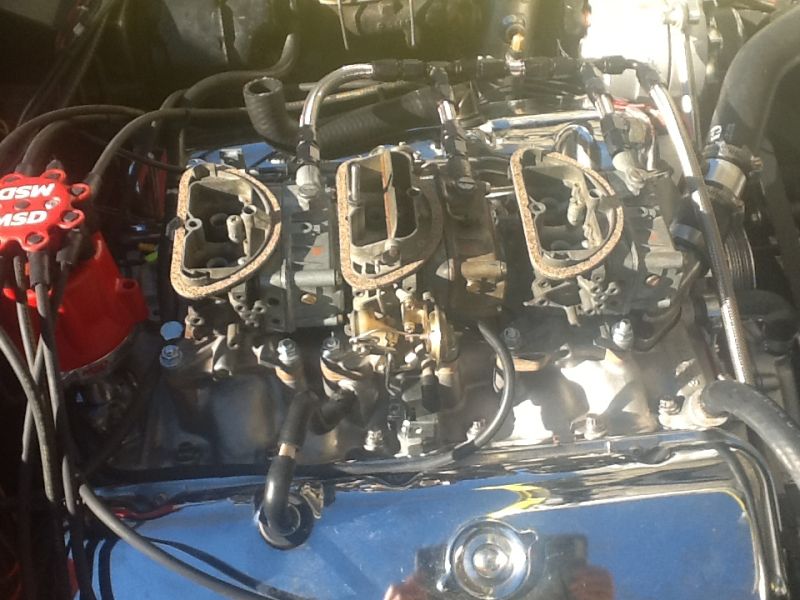
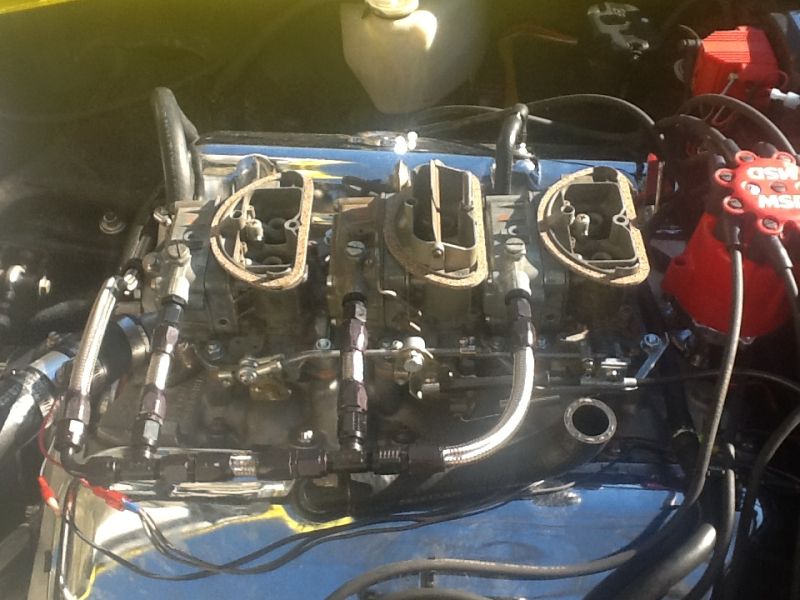
I scored a set on eBay and installed them on my 496. Fun, fun, fun.
No vacuum pods:

Burning Brakes
Joined: Apr 2008
Posts: 1,222
Likes: 93
From: shelbyville West Michigan
Did you read the link I posted earlier? Do you have the correct jets? Correct orifice in the metering plate? Float levels correct? All good things to check. Also, on Rochester tri-powers, the butterflys on the rear carbs can be coated with a sealer and lapped in to the throttle body to ensure a tight seal. Haven't heard of needing to do that on a Holley but may be something to look up.