




Timing and Vacuum

Thread Starter
Racer


Joined: May 2010
Posts: 448
Likes: 3
From: Olathe KS
 Timing and Vacuum
So last night, trying to diagnose my rough running (and dying at stops) 1973, I gained some more info.
First, I have a 350, auto, Edelbrock 600cfm, AcCell HEI distributor, Edelbrock Torquer II manifold. (If you need more info let me know).
My vacuum from the manifold has about 14 psi at idle in gear.
My timing is about 8* at idle and 45* at WOT.
Motor seems to run fine when driving, and when first firing up. Once she's nice and warmed up (190* if my water temp gauge is working - that's as hot as it has shown latetly, and stays there), she will die at stops.
My fuel line is definitely getting hot and I am working on a solution to correct it.
Last night I took off the carb, cleaned it all out, changed the gasket, and put it back on. I also noticed my PCV valve tubing was worn and had quite a bit of wiggle room - replaced it. Car ran better initially, but still dying when I slow down to 10-15 mph.
Are my vacuum and timing correct? Any suggestions where to look next?
First, I have a 350, auto, Edelbrock 600cfm, AcCell HEI distributor, Edelbrock Torquer II manifold. (If you need more info let me know).
My vacuum from the manifold has about 14 psi at idle in gear.
My timing is about 8* at idle and 45* at WOT.
Motor seems to run fine when driving, and when first firing up. Once she's nice and warmed up (190* if my water temp gauge is working - that's as hot as it has shown latetly, and stays there), she will die at stops.
My fuel line is definitely getting hot and I am working on a solution to correct it.
Last night I took off the carb, cleaned it all out, changed the gasket, and put it back on. I also noticed my PCV valve tubing was worn and had quite a bit of wiggle room - replaced it. Car ran better initially, but still dying when I slow down to 10-15 mph.
Are my vacuum and timing correct? Any suggestions where to look next?

Tech Contributor


Joined: Jun 2004
Posts: 20,855
Likes: 959
From: I tend to be leery of any guy who doesn't own a chainsaw or a handgun.
Your timing numbers are very odd. Can you give a few more specifics?
And, when it dies, is it an abrupt or soft type power down?
And, when it dies, is it an abrupt or soft type power down?
Thread Starter
Racer
Joined: May 2010
Posts: 448
Likes: 3
From: Olathe KS

Racer
Joined: Feb 2013
Posts: 386
Likes: 3
From: Clifton Virginia
I think it's a typo. Probably 35 total. If he had a manifold vacuum advance total could be on the low side but the initial is way to low be on a full manifold vacuum.

Team Owner


Joined: Jan 2006
Posts: 37,637
Likes: 3,116
From: Crossville TN
Your "initial" timing must be set with the vacuum line removed from the dist. advance can and the line plugged. A timing number at WOT means nothing; mechanical advance is a function of rpm, and you can achieve WOT at ANY rpm setting.
Review the processes for setting up your timing and the purpose of the vacuum advance can. Then, try it again.
Review the processes for setting up your timing and the purpose of the vacuum advance can. Then, try it again.
Thread Starter
Racer
Joined: May 2010
Posts: 448
Likes: 3
From: Olathe KS
No, it is 45 with vacuum hooked up and WOT. According to the timing gun.. Should I set the timing with no vacuum advance hooked up at idle? And set it at what?
Racer
Joined: Feb 2013
Posts: 386
Likes: 3
From: Clifton Virginia
Once this is done, you can connect the vacuum advance canister to the manifold source on the carb or the intake manifold (you will need to adjust idle speed) and see how much advance the canister is adding to your initial and total timing.
Thread Starter
Racer
Joined: May 2010
Posts: 448
Likes: 3
From: Olathe KS
Many will agree here that you need to set the initial and total timing without the aid of the vacuum canister.
Once this is done, you can connect the vacuum advance canister to the manifold source on the carb or the intake manifold (you will need to adjust idle speed) and see how much advance the canister is adding to your initial and total timing.
Once this is done, you can connect the vacuum advance canister to the manifold source on the carb or the intake manifold (you will need to adjust idle speed) and see how much advance the canister is adding to your initial and total timing.
Corvette Stories
The Best of Corvette for Corvette Enthusiasts

Top 10 Most Explosive Corvettes Ever Made: Power-to-Weight Ratio Ranked!
Joe Kucinski
150 hp to 1,250 hp: Every Corvette Generation Compared by the Specs That Matter
Joe Kucinski
8 Coolest Corvette Pace Cars (and Replicas) of All Time
Verdad Gallardo
Top 10 Corvette Engines RANKED by Peak Torque (70+ Years of Muscle!)
Joe Kucinski
Corvette ZR1X Will Be Pacing the Indy 500, And Could Probably Race, Too!
Verdad Gallardo
Top 10 Corvettes Coming to Mecum Indy 2026!
Brett Foote
Top 10 C9 Corvette MUST-HAVES to Fix These C8 Generation Flaws!
Michael S. Palmer
10 Revolutionary 'Corvette Firsts' Most People Don't Know
Joe Kucinski
5 Reasons to Upgrade to an LS6-Powered Corvette; 5 Reasons to Stay LT2
Michael S. Palmer
Instructor
Joined: Apr 2013
Posts: 146
Likes: 0
I got a paper from "Lars" (forum user) he had written on this issue, and it cleared the whole thing up .
I had a similar problem, although I'm using all original GM equipment.
In the end I had the distributor professionally spun up and set, and I did change over to manifold vac from ported vac.
I set static timing @16 deg without vac line hooked up, and I think total timing is all in at 3200rpm, with todays fuels we made it a bit later.
The car is a monster now, and I haven't even hooked the Vac advance up yet, I still have to play with the Vac canister, now that's its full manifold vac, its pulling it on at idle, which is making it idle rough .
So , I have to run through the vac Numbers with a wind back timing gun to see what's happening with the canister, then make the decision whether to back the static, or alter or change the Vac Canister.
Once you get your head around how and why it all works , it all makes sense.
Perhaps search for Lars's posts here on the forum.
Have fun ,, Marty.


Tech Contributor


Joined: Aug 1999
Posts: 14,373
Likes: 6,371
From: At my Bar drinking and wrenching in Lafayette Colorado
You unhook vacuum hose and set total timing to 36 - not 0. Then you verify that the initial is in the 12 - 18 range. Then you hook up vacuum and verify that your vacuum advance pulls in 12 - 14 additional degrees. Correct as required.
Lars
Thread Starter
Racer
Joined: May 2010
Posts: 448
Likes: 3
From: Olathe KS
Thanks Lars!! I will work on it! Hopefully she runs well after that.
Thread Starter
Racer
Joined: May 2010
Posts: 448
Likes: 3
From: Olathe KS
Drivers side vacuum is going to the distributor, with the passenger side plugged. I have an auto tranny, which is going to the rear manifold vacuum. Edelbrock says most people will use ported vacuum to distributor, but some will use manifold vacuum. Why?

Last edited by Killingsworth 73; Jul 31, 2013 at 12:00 PM.
Melting Slicks

Joined: Mar 2007
Posts: 2,520
Likes: 11
From: Hinckley OH
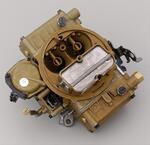
I have that carb on my '74. The port you have hooked up for vacuum advance has manifold vacuum. That causes the vacuum advance to be pulled in even at idle. The port on the passenger side is ported vacuum. If you attach the hose to the vacuum advance to that port you will not have vacuum advance at idle.
Le Mans Master

Joined: Mar 2008
Posts: 5,948
Likes: 72
From: Oxford MA-----You just lost the game!!!!
You seem to be having trouble wrapping your head around how ignition timing works. It's not all that complicated once you understand the basics. Read the first post in this thread:
http://forums.corvetteforum.com/c3-t...long-post.html
Understanding the concepts put forth in this post will help you to ask more pertinent questions, and better understand the answers that you are given. Good luck,
Scott
http://forums.corvetteforum.com/c3-t...long-post.html
Understanding the concepts put forth in this post will help you to ask more pertinent questions, and better understand the answers that you are given. Good luck,
Scott
Thread Starter
Racer
Joined: May 2010
Posts: 448
Likes: 3
From: Olathe KS
You seem to be having trouble wrapping your head around how ignition timing works. It's not all that complicated once you understand the basics. Read the first post in this thread:
http://forums.corvetteforum.com/c3-t...long-post.html
Understanding the concepts put forth in this post will help you to ask more pertinent questions, and better understand the answers that you are given. Good luck,
Scott
http://forums.corvetteforum.com/c3-t...long-post.html
Understanding the concepts put forth in this post will help you to ask more pertinent questions, and better understand the answers that you are given. Good luck,
Scott
Thread Starter
Racer
Joined: May 2010
Posts: 448
Likes: 3
From: Olathe KS
According to the thread you posted, it says my vacuum is hooked up correctly - full manifold vacuum. I had it hooked up as ported vacuum, and I can't keep the car idling. Again, my car is a 73, but has a 1988 or 1989 Engine.
••• note on vacuum source: older cars such as my ’65 used a full manifold vacuum source off the carb to run the vacuum advance. What this means is that at idle the carb supplied full motor vacuum to the vacuum can. Later cars switched to what is called “ported” or “timed” vacuum. The difference is where the vacuum is picked up on the carb. Full manifold vacuum is picked up BELOW the throttle blades on the carb so it always gets the full vacuum the motor produces. The ported vacuum is drawn off the carb higher up ABOVE the throttle blades. This makes a large difference since at idle full manifold vacuum gives full vacuum but a ported vacuum port will give NO vacuum at idle but than will work the same as a full manifold vacuum source after the throttle blades are cracked open when driving.
If your car is a later car and is set up to run off a ported vacuum source you are typically better off switching it to a full manifold vacuum source port on the carb. If you carb does not have a full manifold vacuum port it's possible to pick it up directly off the intake manifold. Many manifolds have a hole already drilled into them for various vacuum purposes that are simply pluged and you can get a proper fitting to feed vacuum from many of the Corvette parts suppliers such as Paragon, etc.
The ONLY reason they switched to a ported vacuum source was because of emissions requirements. One way they lowered hydrocarbon emissions was the A.I.R. system and to make that work properly they needed a very retarded spark at idle. Since a Ported vacuum gives no advance at idle this worked perfect. The problem is that while a ported vacuum helps reduce emissions it’s lousy for performance!
Switching from a ported vacuum to a full manifold vacuum source will typically give you better idle characteristics, better throttle response, cooler operating temps, and better fuel economy.
••• note on vacuum source: older cars such as my ’65 used a full manifold vacuum source off the carb to run the vacuum advance. What this means is that at idle the carb supplied full motor vacuum to the vacuum can. Later cars switched to what is called “ported” or “timed” vacuum. The difference is where the vacuum is picked up on the carb. Full manifold vacuum is picked up BELOW the throttle blades on the carb so it always gets the full vacuum the motor produces. The ported vacuum is drawn off the carb higher up ABOVE the throttle blades. This makes a large difference since at idle full manifold vacuum gives full vacuum but a ported vacuum port will give NO vacuum at idle but than will work the same as a full manifold vacuum source after the throttle blades are cracked open when driving.
If your car is a later car and is set up to run off a ported vacuum source you are typically better off switching it to a full manifold vacuum source port on the carb. If you carb does not have a full manifold vacuum port it's possible to pick it up directly off the intake manifold. Many manifolds have a hole already drilled into them for various vacuum purposes that are simply pluged and you can get a proper fitting to feed vacuum from many of the Corvette parts suppliers such as Paragon, etc.
The ONLY reason they switched to a ported vacuum source was because of emissions requirements. One way they lowered hydrocarbon emissions was the A.I.R. system and to make that work properly they needed a very retarded spark at idle. Since a Ported vacuum gives no advance at idle this worked perfect. The problem is that while a ported vacuum helps reduce emissions it’s lousy for performance!
Switching from a ported vacuum to a full manifold vacuum source will typically give you better idle characteristics, better throttle response, cooler operating temps, and better fuel economy.

Le Mans Master
Joined: Dec 2007
Posts: 6,422
Likes: 591
From: McHenry Illinois