







Supercharged 383 Engine Installation Progress

Thread Starter
Tech Contributor


Joined: Aug 1999
Posts: 14,379
Likes: 6,390
From: At my Bar drinking and wrenching in Lafayette Colorado

Actually, we've been talking about doing exactly that. Once we get the car on the road, we're going to take a look at the "phase 2" refinement upgrades, which will include a cold air inlet system pulling cool air from the inside fender area. 
Lars
Lars

Safety Car


Joined: Mar 2007
Posts: 3,518
Likes: 37

Burning Brakes


Joined: Sep 2010
Posts: 822
Likes: 82
From: Columbus OH
Thread Starter
Tech Contributor
Joined: Aug 1999
Posts: 14,379
Likes: 6,390
From: At my Bar drinking and wrenching in Lafayette Colorado
That's certainly a generous offer, but I wouldn't want anyone to be inconvenienced by my need for a test driver...
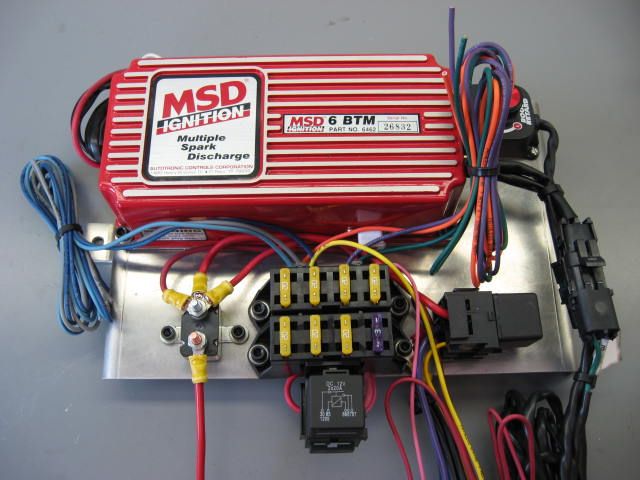
Here's the latest progress on electrical control system: Since there's no good space for mounting an MSD, fuel pump relay, accessory fuse box, and circuit breaker in the engine compartment of a C3, I have fabricated a simple electrical panel that bolts in place right on the passenger side inner fender well. This panel mounts the MSD, the boost retard switch, the fuel pump relay, the accessory fuse block, and the accessory circuit breaker for all this. This removable panel controls the fuel pump through the oil pressure switch, and the ignition system, all without any draw on the stock fuseblock other than an "IGN" trip wire through the new fuseblock relay. Nothing is spliced into the stock wire harness, and this panel takes care of all electrical requirements for the current and future accessories. It will all be hooked up with quick disconnects, so the entire panel can be removed and serviced with 3 screws:

Lars
Here's the latest progress on electrical control system: Since there's no good space for mounting an MSD, fuel pump relay, accessory fuse box, and circuit breaker in the engine compartment of a C3, I have fabricated a simple electrical panel that bolts in place right on the passenger side inner fender well. This panel mounts the MSD, the boost retard switch, the fuel pump relay, the accessory fuse block, and the accessory circuit breaker for all this. This removable panel controls the fuel pump through the oil pressure switch, and the ignition system, all without any draw on the stock fuseblock other than an "IGN" trip wire through the new fuseblock relay. Nothing is spliced into the stock wire harness, and this panel takes care of all electrical requirements for the current and future accessories. It will all be hooked up with quick disconnects, so the entire panel can be removed and serviced with 3 screws:

Lars
Corvette Stories
The Best of Corvette for Corvette Enthusiasts

Top 10 Most Expensive Corvettes Ever Sold on Bring A Trailer
Brett Foote
10 Things Every Corvette Owner Needs (2026 Edition)
Michael S. Palmer
8 Most "Only Corvette Owners Understand" Quirks and Problems
Pouria Savadkouei
10 Reasons the C6 Z06 is Still A Performance Benchmark After 20 Years
Joe Kucinski
How Much Horsepower Every Corvette Engine "LOST" in 1972
Joe Kucinski
Top 10 DOs and DON'Ts for Protecting Your Convertible Top!
Michael S. Palmer
Top 10 Most Explosive Corvettes Ever Made: Power-to-Weight Ratio Ranked!
Joe Kucinski
150 hp to 1,250 hp: Every Corvette Generation Compared by the Specs That Matter
Joe Kucinski
8 Coolest Corvette Pace Cars (and Replicas) of All Time
Verdad Gallardo
Thread Starter
Tech Contributor
Joined: Aug 1999
Posts: 14,379
Likes: 6,390
From: At my Bar drinking and wrenching in Lafayette Colorado
Oh, crap..!! I almost forgot that.!! That would not only allow major debris to enter the engine, but it would result in a MASSIVE boost leak, with associate HUGE drop in power. I'm so glad you caught that - you can, obviously, see in the above photos that the washer is missing...
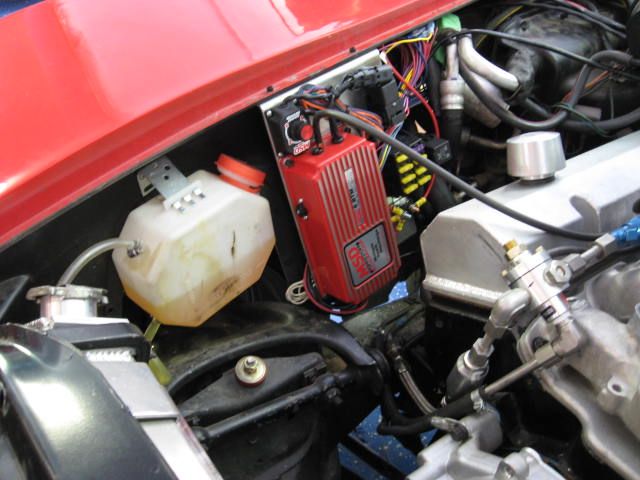
With that fixed, I now also have the electrical system panel mounted. It actually works, and the engine fired up on the first crank, thanks to the wingnut seal washer:
With that fixed, I now also have the electrical system panel mounted. It actually works, and the engine fired up on the first crank, thanks to the wingnut seal washer:

Thread Starter
Tech Contributor
Joined: Aug 1999
Posts: 14,379
Likes: 6,390
From: At my Bar drinking and wrenching in Lafayette Colorado
The additional electronics are the fuel pump (with its control systems) and the MSD ignition. The pump runs at 6 amps, and the MSD draws less than 1 amp per 1000 rpm. That puts the new panel draw at about 12 amps, so the stock alternator is likely to handle it. The primary purpose of the panel is to provide clean, circuit-protected ignition-triggered power and battery power without the need to hack into the stock wiring system, and to get all the control components mounted in a single accessible location.
Lars
Lars
Last edited by lars; Aug 16, 2013 at 11:13 PM.
Burning Brakes
Joined: Jan 2012
Posts: 943
Likes: 73
The additional electronics are the fuel pump (with its control systems) and the MSD ignition. The pump runs at 6 amps, and the MSD draws less than 1 amp per 1000 rpm. That puts the new panel draw at about 12 amps, so the stock alternator is likely to handle it. The primary purpose of the panel is to provide clean, circuit-protected ignition-triggered power and battery power without the need to hack into the stock wiring system, and to get all the control components mounted in a single accessible location.
Lars
Lars



Race Director


Joined: Jul 2004
Posts: 12,705
Likes: 329
From: Scottsdale Arizona
You could always mount a second alternator 
A serious question about the fuel pressure. I understand the need for having the input fuel pressure to be higher than the boost pressure but won't this cause the float valves to leak? Is there a margin on these or can you raise the sealing pressure by altering the float level?
A serious question about the fuel pressure. I understand the need for having the input fuel pressure to be higher than the boost pressure but won't this cause the float valves to leak? Is there a margin on these or can you raise the sealing pressure by altering the float level?
Le Mans Master

Joined: Oct 2002
Posts: 7,098
Likes: 378
From: Las Vegas - Just stop perpetuating myths please.
...
The distributor is an aftermarket HEI that I've put an aggressive mechanical curve in. It's also running vacuum advance to get the idle smoothed out and to assure cool running in city traffic. It's set up to produce 34 degrees total timing at 2500 rpm with 18 degrees initial. The vacuum advance pulls in an additional 14 degrees, making the engine idle at 32 degrees of timing. Under boost, the vacuum advance drops out, of course, and the ignition is controlled through a boost-controlled MSD system which retards the timing with each pound of boost (there is actually a vacuum hose hooked up to the MSD box, which senses manifold pressure). We did a lot of dyno pulls to optimize the boost retard, thinking that best power would be produced by not retarding the timing. Even though we did not get into any detonation by leaving the full 34-degree timing curve in it, we dialed in some retard to see what the numbers would do: Setting up the MSD for maximum boost retard surprised us by producing about 25 horsepower more with no other changes to boost or parameters.
...
Lars
The distributor is an aftermarket HEI that I've put an aggressive mechanical curve in. It's also running vacuum advance to get the idle smoothed out and to assure cool running in city traffic. It's set up to produce 34 degrees total timing at 2500 rpm with 18 degrees initial. The vacuum advance pulls in an additional 14 degrees, making the engine idle at 32 degrees of timing. Under boost, the vacuum advance drops out, of course, and the ignition is controlled through a boost-controlled MSD system which retards the timing with each pound of boost (there is actually a vacuum hose hooked up to the MSD box, which senses manifold pressure). We did a lot of dyno pulls to optimize the boost retard, thinking that best power would be produced by not retarding the timing. Even though we did not get into any detonation by leaving the full 34-degree timing curve in it, we dialed in some retard to see what the numbers would do: Setting up the MSD for maximum boost retard surprised us by producing about 25 horsepower more with no other changes to boost or parameters.
...
Lars
So i'm reading the MSD box is setup for max boost retard from 34* mechanical. Curious what retard/advance u have at full boost/rpm?
Also when do u see/have boost come on? 1000rpm? 1500rpm?
One more question, how's that 4-speed muncie? Any mods for that kind'a power?
cardo0

Thread Starter
Tech Contributor
Joined: Aug 1999
Posts: 14,379
Likes: 6,390
From: At my Bar drinking and wrenching in Lafayette Colorado
A serious question about the fuel pressure. I understand the need for having the input fuel pressure to be higher than the boost pressure but won't this cause the float valves to leak? Is there a margin on these or can you raise the sealing pressure by altering the float level?
The blower is actually producing boost at idle, and it's blowing off through the blowoff valve - the blowoff is about like a hairdryer on the "hi" setting with the engine just idling. This thing instantly pressurizes the manifold the moment you go to WOT and force the blowoff valve to close. It's just a couple of pounds at low rpm, and then it comes on very quickly.
Lars
Le Mans Master
Joined: Oct 2002
Posts: 7,098
Likes: 378
From: Las Vegas - Just stop perpetuating myths please.
.....
The blower is actually producing boost at idle, and it's blowing off through the blowoff valve - the blowoff is about like a hairdryer on the "hi" setting with the engine just idling. This thing instantly pressurizes the manifold the moment you go to WOT and force the blowoff valve to close. It's just a couple of pounds at low rpm, and then it comes on very quickly.
The 4-speed Muncie is fine. It's in the basement, and does just fine in the dark. I put a Tremec 5-speed in the car...
Lars
The blower is actually producing boost at idle, and it's blowing off through the blowoff valve - the blowoff is about like a hairdryer on the "hi" setting with the engine just idling. This thing instantly pressurizes the manifold the moment you go to WOT and force the blowoff valve to close. It's just a couple of pounds at low rpm, and then it comes on very quickly.
The 4-speed Muncie is fine. It's in the basement, and does just fine in the dark. I put a Tremec 5-speed in the car...
Lars
Okay a 5 speed Tremec sounds like a better match for the vortec type blowers. I read the vortec blowers like to stay in the hi rpm and not a good match for something like a 3 speed auto. But if running "normalized" shouldn't be much problem. Whatch'a think lars, could u run an auto behind a vortec blower? Can u normalize a blower?
cardo0

Burning Brakes
Joined: Apr 2013
Posts: 1,194
Likes: 109
From: Las Vegas NV
my '78 was infested with some mean lookin' solid black spiders when i bought it. nests and all!
i power washed every inch of the underside and used enough cy-kick that i probably should have called in hazmat
i power washed every inch of the underside and used enough cy-kick that i probably should have called in hazmat