





What is this connector?

Thread Starter
Burning Brakes


Joined: Mar 2011
Posts: 969
Likes: 1
From: NJ
 What is this connector?
The temp sending unit in on the drivers side, this one is on the passenger side.
What is this for?
And are these wires correct, both being split from the same source?


What is this for?
And are these wires correct, both being split from the same source?
Thread Starter
Burning Brakes
Joined: Mar 2011
Posts: 969
Likes: 1
From: NJ
1970 L46, all stock except for the headers I just installed. It has the stock mechanical fan. I can only trace these wires so far, they seem to be going somewhere behind the distributor and I think into the firewall.
Thread Starter
Burning Brakes
Joined: Mar 2011
Posts: 969
Likes: 1
From: NJ
http://forums.corvetteforum.com/c3-g...needed-of.html
post#4 (from Alan), 4th picture - also shows this with light blue wires.
This is what Im trying to identify.
post#4 (from Alan), 4th picture - also shows this with light blue wires.
This is what Im trying to identify.
Thread Starter
Burning Brakes
Joined: Mar 2011
Posts: 969
Likes: 1
From: NJ
Did some more searching, looks like its ANOTHER temperature sender switch
https://www.paragoncorvette.com/p-35...er-switch.aspx
But why are there 2?
https://www.paragoncorvette.com/p-35...er-switch.aspx
But why are there 2?
Thread Starter
Burning Brakes
Joined: Mar 2011
Posts: 969
Likes: 1
From: NJ

Team Owner


Joined: Jan 2006
Posts: 37,637
Likes: 3,118
From: Crossville TN
It is for the TCS system. The double-pin sensor in the head is a temp sensor; it is a LO and HI temp sensor. The wires you have there should have a 90* Packard spade connector on them. The two wires that are tied together go to one of the lugs; the other wire goes to the other lug. Then, that connector gets plugged onto the temp sensor mounted in the head.
How does it work? Well, when the engine temp is cold, one connector is grounded, so it does not trigger ported vacuum to be sent to the distributor advace can (manifold vacuum is directed to it). When the engine temp is too hot,the other connector is grounded, so it also will not trigger ported vacuum to be sent to the advance can.
If the engine temp is 'normal' (not warming up nor too hot), both sensor connectors DO neither connector has continuity to ground, so the carb solenoid DOES direct ported vacuum to the advance can...meaning there is no advance signal from the can when your engine is at idle. This causes the engine to run hotter and burn off more hydrocarbons. Plus, it runs more rough, eats more fuel, and reduces the life of the engine. If the engine idles for too long in this manner it gets overheated, the HOT connector on that double-lug temp sender breaks continuity which turns off the carb solenoid switch, and manifold vacuum is sent to the advance can allowing the engine to "take a breather" from that [unnecessary] abuse!!
Anyway, that's how it works. If you can't find the correct 90* [twin terminal] connector, you can just put spade connectors on the wires and hook them to those two sender terminals. It makes no difference which is which.
Personally, I hook that cr@p all up as it is supposed to look; then I re-plumb the advance can to get fed manifold vacuum directly so it runs and acts well. If I enter a show with knowledgeable judges, I do a quick re-plumb to set it up as it came from the factory. Best of both worlds!
How does it work? Well, when the engine temp is cold, one connector is grounded, so it does not trigger ported vacuum to be sent to the distributor advace can (manifold vacuum is directed to it). When the engine temp is too hot,the other connector is grounded, so it also will not trigger ported vacuum to be sent to the advance can.
If the engine temp is 'normal' (not warming up nor too hot), both sensor connectors DO neither connector has continuity to ground, so the carb solenoid DOES direct ported vacuum to the advance can...meaning there is no advance signal from the can when your engine is at idle. This causes the engine to run hotter and burn off more hydrocarbons. Plus, it runs more rough, eats more fuel, and reduces the life of the engine. If the engine idles for too long in this manner it gets overheated, the HOT connector on that double-lug temp sender breaks continuity which turns off the carb solenoid switch, and manifold vacuum is sent to the advance can allowing the engine to "take a breather" from that [unnecessary] abuse!!
Anyway, that's how it works. If you can't find the correct 90* [twin terminal] connector, you can just put spade connectors on the wires and hook them to those two sender terminals. It makes no difference which is which.
Personally, I hook that cr@p all up as it is supposed to look; then I re-plumb the advance can to get fed manifold vacuum directly so it runs and acts well. If I enter a show with knowledgeable judges, I do a quick re-plumb to set it up as it came from the factory. Best of both worlds!
Last edited by 7T1vette; Aug 3, 2013 at 11:54 PM.
Corvette Stories
The Best of Corvette for Corvette Enthusiasts

Top 10 Most Expensive Corvettes Ever Sold on Bring A Trailer
Brett Foote
10 Things Every Corvette Owner Needs (2026 Edition)
Michael S. Palmer
8 Most "Only Corvette Owners Understand" Quirks and Problems
Pouria Savadkouei
10 Reasons the C6 Z06 is Still A Performance Benchmark After 20 Years
Joe Kucinski
How Much Horsepower Every Corvette Engine "LOST" in 1972
Joe Kucinski
Top 10 DOs and DON'Ts for Protecting Your Convertible Top!
Michael S. Palmer
Top 10 Most Explosive Corvettes Ever Made: Power-to-Weight Ratio Ranked!
Joe Kucinski
150 hp to 1,250 hp: Every Corvette Generation Compared by the Specs That Matter
Joe Kucinski
8 Coolest Corvette Pace Cars (and Replicas) of All Time
Verdad Gallardo
Thread Starter
Burning Brakes
Joined: Mar 2011
Posts: 969
Likes: 1
From: NJ
It is for the TCS system. The double-pin sensor in the head is a temp sensor; it is a LO and HI temp sensor. The wires you have there should have a 90* Packard spade connector on them. The two wires that are tied together go to one of the lugs; the other wire goes to the other lug. Then, that connector gets plugged onto the temp sensor mounted in the head.
How does it work? Well, when the engine temp is cold, one connector is grounded, so it does not trigger ported vacuum to be sent to the distributor advace can (manifold vacuum is directed to it). When the engine temp is too hot,the other connector is grounded, so it also will not trigger ported vacuum to be sent to the advance can.
If the engine temp is 'normal' (not warming up nor too hot), both sensor connectors DO neither connector has continuity to ground, so the carb solenoid DOES direct ported vacuum to the advance can...meaning there is no advance signal from the can when your engine is at idle. This causes the engine to run hotter and burn off more hydrocarbons. Plus, it runs more rough, eats more fuel, and reduces the life of the engine. If the engine idles for too long in this manner it gets overheated, the HOT connector on that double-lug temp sender breaks continuity which turns off the carb solenoid switch, and manifold vacuum is sent to the advance can allowing the engine to "take a breather" from that [unnecessary] abuse!!
Anyway, that's how it works. If you can't find the correct 90* [twin terminal] connector, you can just put spade connectors on the wires and hook them to those two sender terminals. It makes no difference which is which.
Personally, I hook that cr@p all up as it is supposed to look; then I re-plumb the advance can to get fed manifold vacuum directly so it runs and acts well. If I enter a show with knowledgeable judges, I do a quick re-plumb to set it up as it came from the factory. Best of both worlds!
How does it work? Well, when the engine temp is cold, one connector is grounded, so it does not trigger ported vacuum to be sent to the distributor advace can (manifold vacuum is directed to it). When the engine temp is too hot,the other connector is grounded, so it also will not trigger ported vacuum to be sent to the advance can.
If the engine temp is 'normal' (not warming up nor too hot), both sensor connectors DO neither connector has continuity to ground, so the carb solenoid DOES direct ported vacuum to the advance can...meaning there is no advance signal from the can when your engine is at idle. This causes the engine to run hotter and burn off more hydrocarbons. Plus, it runs more rough, eats more fuel, and reduces the life of the engine. If the engine idles for too long in this manner it gets overheated, the HOT connector on that double-lug temp sender breaks continuity which turns off the carb solenoid switch, and manifold vacuum is sent to the advance can allowing the engine to "take a breather" from that [unnecessary] abuse!!
Anyway, that's how it works. If you can't find the correct 90* [twin terminal] connector, you can just put spade connectors on the wires and hook them to those two sender terminals. It makes no difference which is which.
Personally, I hook that cr@p all up as it is supposed to look; then I re-plumb the advance can to get fed manifold vacuum directly so it runs and acts well. If I enter a show with knowledgeable judges, I do a quick re-plumb to set it up as it came from the factory. Best of both worlds!
Thanks for all the great info. I might actually do the same, hook everything up but do some re-plumbing. Do you have any pictures of how to re-plumb the advance can? I have no experience with the vacuum system.... yet.
 He's amazing with his documentation.

Team Owner

Joined: Sep 2006
Posts: 31,278
Likes: 4,372
From: Westminster Maryland
Hi r,
7T1 explained it well.
In order to know what to hook up and what to by-pass it might be good to know if your L-46 still has the the TCS solenoid on it or not.
It looks like a very small 'soup can' with 2 vacuum nipples and 1 electrical connector. It's located on one of the intake manifold bolts on the right side of the engine about at the rear of the q-jet.
Do you have that?
Regards,
Alan
This is a 72, but the solenoid is similar to this one. The way the hoses run are different for your 350/350 though.

7T1 explained it well.
In order to know what to hook up and what to by-pass it might be good to know if your L-46 still has the the TCS solenoid on it or not.
It looks like a very small 'soup can' with 2 vacuum nipples and 1 electrical connector. It's located on one of the intake manifold bolts on the right side of the engine about at the rear of the q-jet.
Do you have that?
Regards,
Alan
This is a 72, but the solenoid is similar to this one. The way the hoses run are different for your 350/350 though.


Drifting


Joined: Sep 1999
Posts: 1,970
Likes: 91
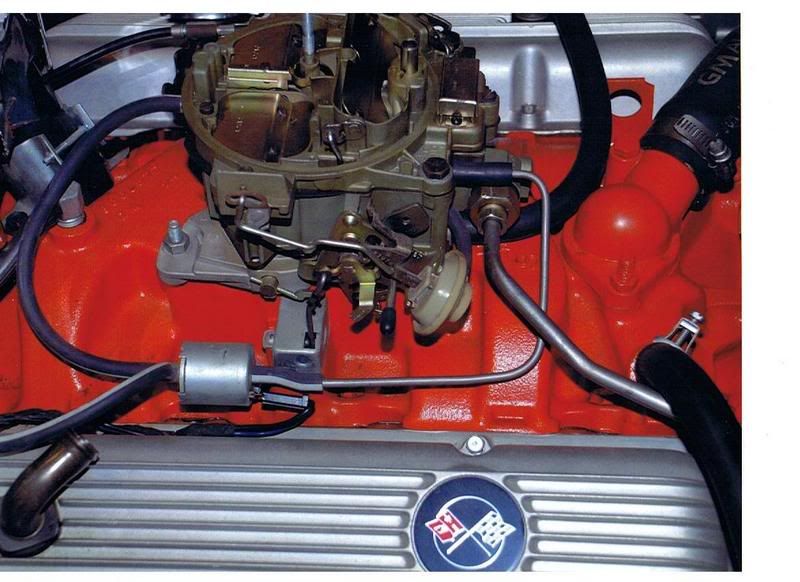
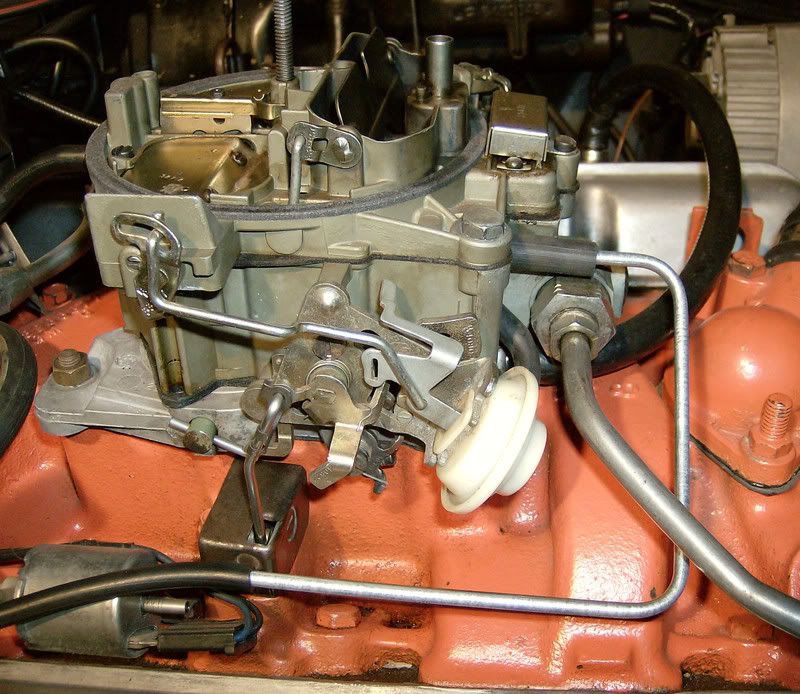
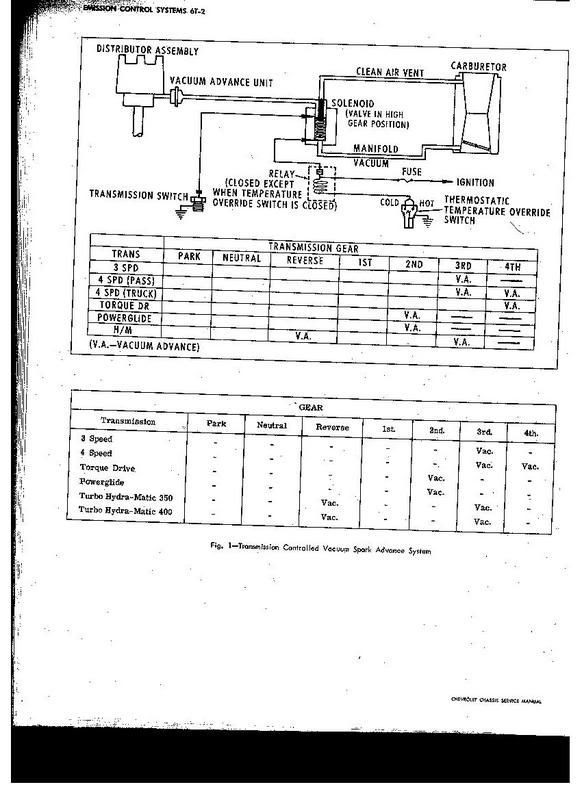
Diagram shows when vacuum advance functions. System works pretty much as described although I'm not aware of a overheat function in 1970. There is also a switch on the muncie that grounds and allows advance in 3rd and 4th gear (1970 version). Agree its a dumb system and most will run a vacuum line direct from the carb to the dist. vacuum canister, bypassing the solenoid. The 1st photo shows the vacuum routing connected as it should be. 2nd shows direct connect to distributor Both pics are 70 L-46
Team Owner
Joined: Jan 2006
Posts: 37,637
Likes: 3,118
From: Crossville TN
You can leave it "hooked-up" or "not" without having it impact anything. That temp sender circuit is just to provide the TCS solenoid with the 'decision' signal to send ported vacuum to the advance can or to send manifold vacuum to it. If you have no solenoid, just run a line from the right-side vacuum port on the carb (sticks out through the choke mechanism) directly to the advance can. That side port is manifold vacuum.